
Repeated factory outages require a battery-state and recharge assessment. A runtime result from a charged system cannot be repeated automatically after a short restoration.
Section 01
Define battery condition before each outage
For repeated factory outages, evaluate the battery state at the start of each event and the supported recharge behaviour between them. A runtime curve for a fully charged configuration does not establish the same duration after a short restoration. Define the required recording service, actual protected load and starting battery conditions before requesting a performance commitment.
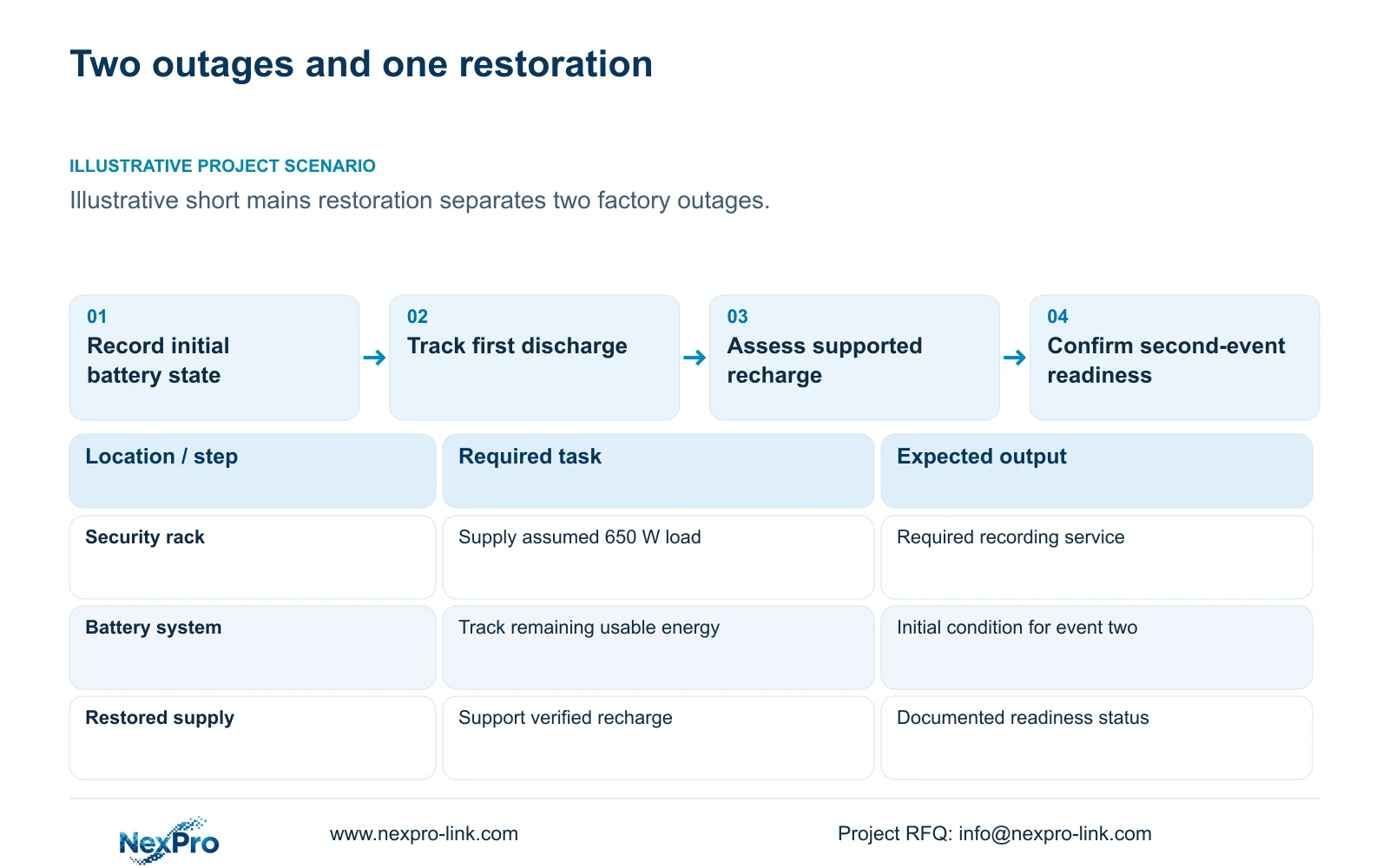
Illustrative project scenario: Short power restorations occur between two outages during one factory shift. Use a separate assumed 650 W security load to compare energy targets, while CASE01 provides the broader 32-camera CNC project context. The 650 W illustration is not the reference case's calculated 682.7407 W recording-first load.
Record battery identity, initial charge indication, service age, ambient conditions and recent discharge history. Ask the supplier which conditions apply to its runtime evidence and how readiness is reported. The owner should know whether the second-event target assumes full recharge, partial recharge or enough stored energy to cover both events without relying on restoration.
Section 02
Model the whole discharge and restoration sequence
Build a timeline showing the first outage, stable restoration interval and second outage. Include any generator contribution and the required security loads during each state. A brief return of mains may restore equipment operation while providing insufficient time to recover the energy used during the first event.
For planning, express the energy balance as available usable energy before event two equals remaining usable energy after event one plus verified usable energy restored during the interval. This is a bookkeeping method, not a battery-runtime model. No recharge rate is supplied here, so a numerical second-event duration cannot be calculated responsibly.
Compare two procurement targets: one longer continuous outage and two shorter outages separated by a defined restoration interval. They can require similar delivered energy while creating different charger and battery-readiness requirements. Ask for evidence under the requested sequence, including the operating load while charging, rather than substituting a generic recharge-to-full statement.
Section 03
Request recharge evidence for the exact configuration
Obtain the proposed UPS model, battery voltage and configuration, charger limits and supported recharge information. Require the supplier to state the starting discharge condition, target charge condition, ambient assumptions and whether the security load remains operating throughout recharge. Those fields make offers comparable without inventing a universal charging time.
The rack series lists SP1KR(S) at 1 kVA / 900 W, SP2KR(S) at 2 kVA / 1800 W and SP3KR(S) at 3 kVA / 2700 W. These are output capacity references. They do not establish battery energy, recharge rate or second-event runtime. Do not transfer a default 960 Wh field from one selected variant to another.
A larger compatible battery arrangement may increase energy provision but still require a recharge review. Temperature, ageing, discharge rate, BMS limits and UPS self-consumption also affect the performance boundary. Consistent with APC/Schneider's buying guidance, request runtime and configuration evidence separately from the kVA and W selection.
Section 04
Use energy arithmetic to define the request
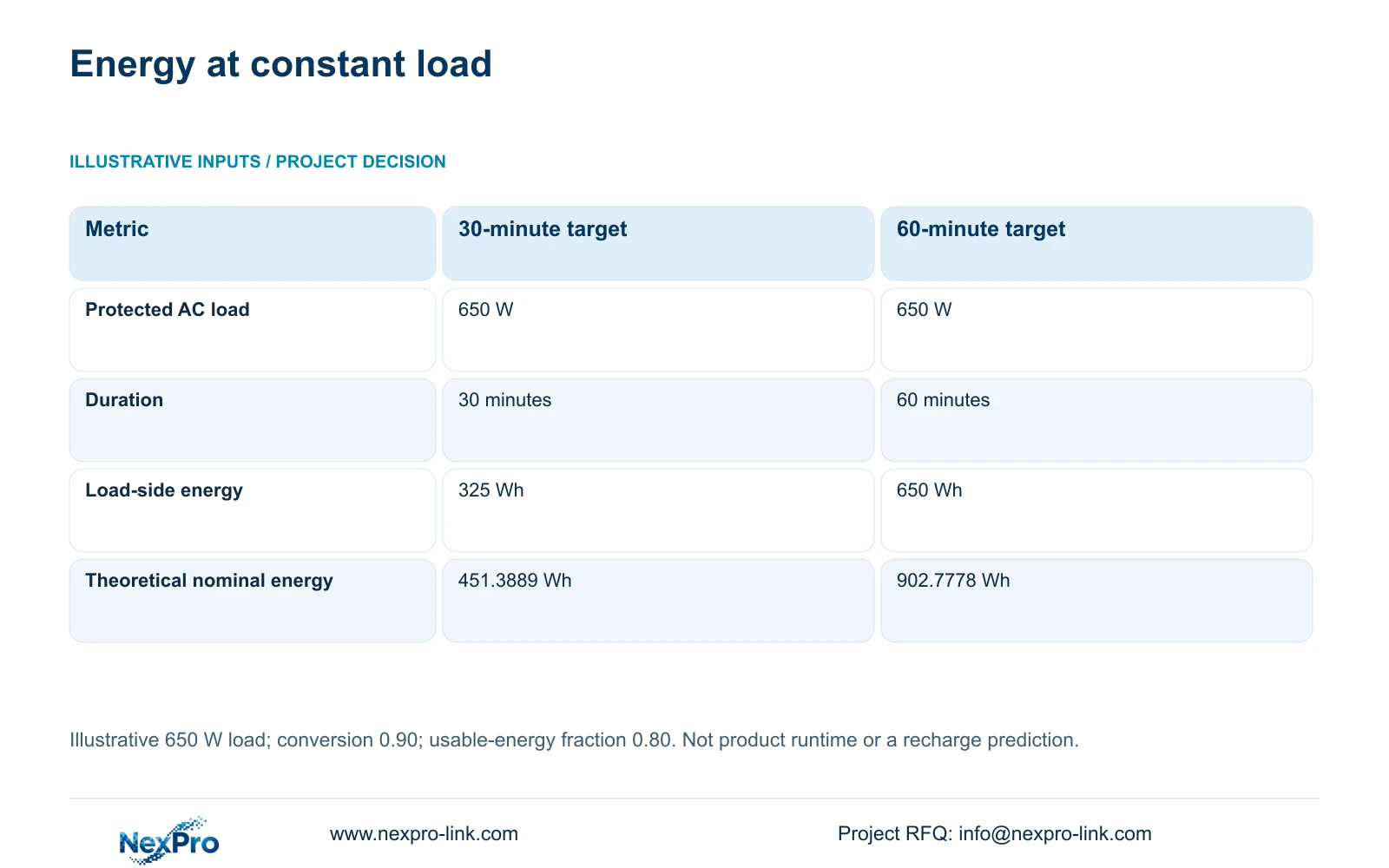
The supplied illustration assumes a constant protected AC load of 650 W and compares 30 minutes with 60 minutes. The formulas are load_Wh = P_W × minutes / 60 and nominal_battery_Wh = load_Wh / (0.90 × 0.80). The 0.90 battery-to-load conversion factor and 0.80 usable stored-energy fraction are teaching assumptions.
For 30 minutes, load energy is 650 × 30 / 60 = 325 Wh, giving theoretical nominal energy of 325 / 0.72 = 451.3889 Wh. For 60 minutes, load energy is 650 Wh, giving 650 / 0.72 = 902.7778 Wh. The decisive difference is doubled delivered-energy demand at the same assumed load.
Two 30-minute events also total 325 + 325 = 650 Wh at the loads. That equality does not prove the one-hour theoretical battery provision will meet the sequence under real conditions, or that a short restoration replenishes 325 Wh. Use the figures to describe the energy request, then obtain a supported battery configuration and actual runtime evidence.
| Metric | Option A | Option B |
|---|---|---|
| Protected AC load | 650 W | 650 W |
| Target duration | 30 minutes | 60 minutes |
| Delivered load energy | 325 Wh | 650 Wh |
| Theoretical nominal battery energy | 451.3889 Wh | 902.7778 Wh |
Section 05
Set a second-event policy that preserves essential recording
Recommend an operating policy tied to verified battery readiness. Define what the guard team does when mains returns but the full backup target has not been re-established. The policy may prioritise essential recording, defer optional display demand or escalate generator support, subject to the approved electrical and operational arrangements.
CASE01 illustrates why the load boundary matters: adding four assumed 120 W LCD panels and a 100 W decoder raises demand by 580 W while retaining the original screen. Whether displays remain essential during repeated outages is an owner decision. Any revised load must preserve the cameras, switching and storage required for the selected recording task.
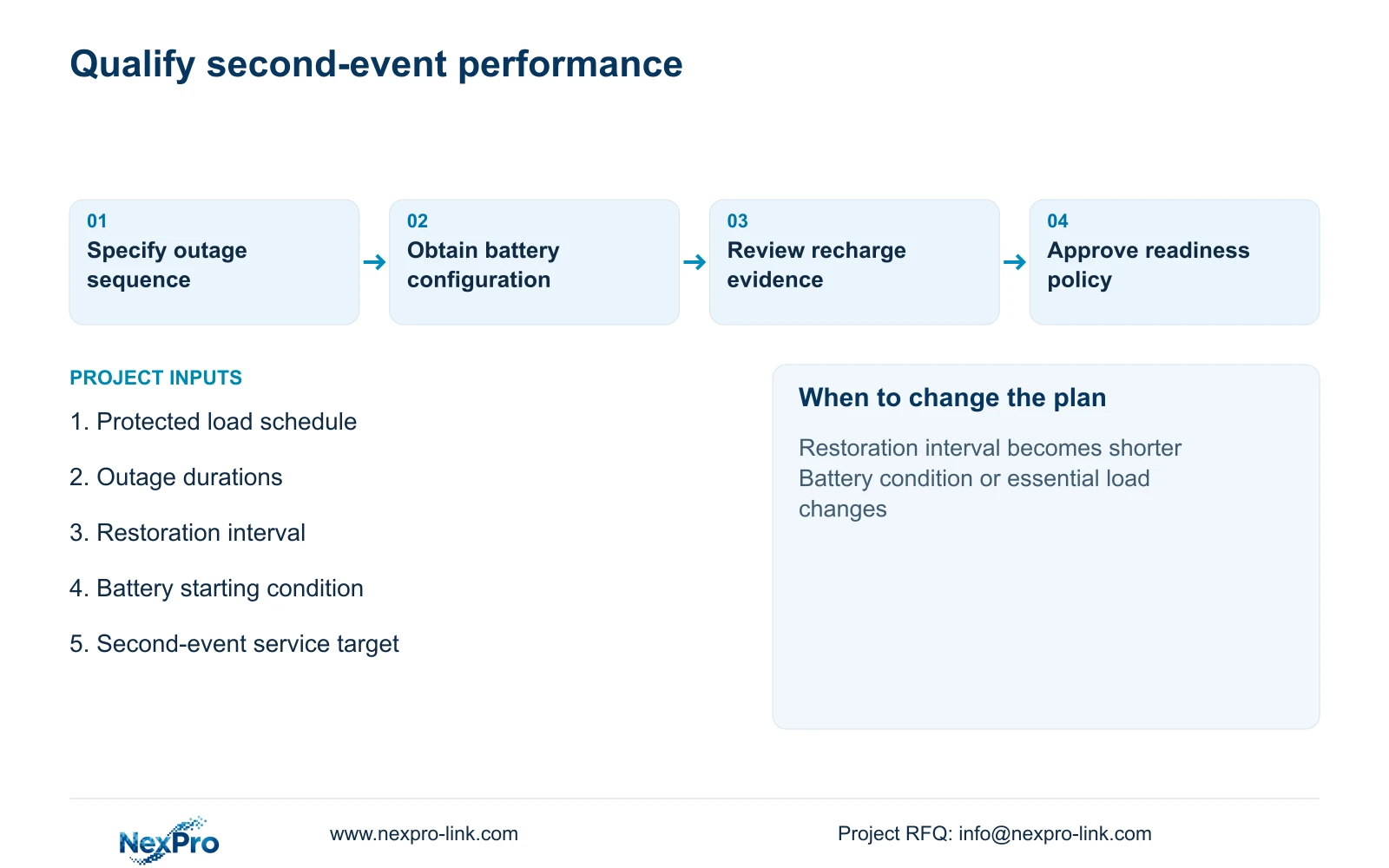
Change the equipment request if the actual load exceeds 650 W, restoration intervals shorten, battery conditions change or the owner requires a guaranteed second-event duration. Do not convert charge indication directly into proportional runtime without supported evidence. Record the reduced-protection state until the appointed service or operations team can confirm readiness.
Section 06
Qualify repeated-event performance and recovery responsibilities
The RFQ should describe the event sequence and request the configuration evidence needed to evaluate it. Separate output capacity, battery energy, recharge behaviour and any monitoring or alarm requirements. State which loads remain connected during restoration and who confirms the next backup target is available.
NexPro-Link can discuss rack UPS references and BOQ coordination for the protected security package. Request the actual battery and runtime documentation with the offer rather than accepting a model name as the performance basis. Site electrical distribution, generator transitions and any controlled qualification work remain with the appointed qualified team.
Prepare an authorised acceptance plan that evaluates the requested sequence under agreed conditions without using a generic discharge recipe. After any qualifying interruption, verify fresh recording and usable playback as well as battery status. The final record should show what service was preserved, what charge recovery was observed and which second-event conditions remain unproven.
Section 07
Buyer questions
Does a restored mains indicator mean full backup is available again? No. It establishes supply restoration, not replenished battery energy. Use the supported readiness information for the exact configuration and keep the remaining protection status visible.
Can two half-hour outages be specified as one hour of runtime? Their assumed load-side energy totals are equal at constant load, but the operating sequence differs. Specify both outages and the restoration interval so recharge and initial-condition requirements can be assessed.
Will selecting SP2KR(S) instead of SP1KR(S) solve the recharge problem? The higher output rating alone cannot establish that. Compare the actual compatible battery arrangement, charger behaviour and runtime evidence at the same load and outage sequence.
Section 08
Specify the second-outage requirement
Send your protected AC load schedule, expected outage and restoration sequence, battery configuration and condition, and second-event recording target to info@nexpro-link.com. NexPro-Link can discuss capacity references and the evidence needed for a supported battery proposal.
Engineering references
These sources support the general planning principles. Always use the selected product's current datasheet and applicable project standards for final design.