For a supported array, request the permitted recording workload and intervention steps while degraded. Assign the person who checks ongoing writes and retrieval during recovery.
Section 01
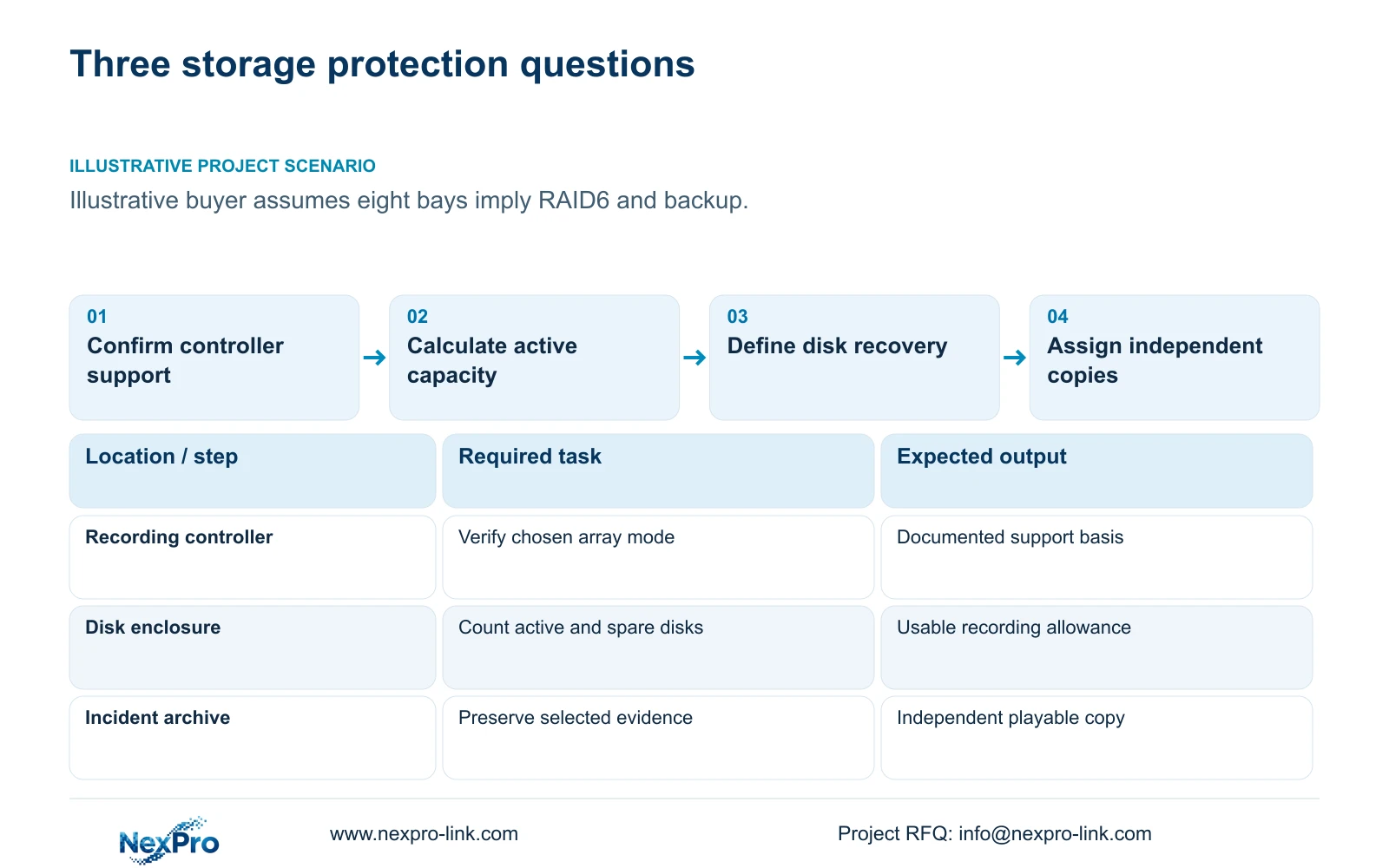
Verify RAID support before promising disk recovery
For a supported array, request the permitted recording workload and intervention steps while degraded. Assign the person who checks ongoing writes and retrieval during recovery. Retain unresolved workload limits in acceptance. A parity calculation establishes nominal capacity, not that the owner can continue every required task during a rebuild.
Use RAID in factory CCTV only when the exact recorder or storage controller explicitly supports the chosen mode and drive layout. Calculate its capacity cost before comparing retention, and retain an independent preservation process for selected incidents. Multiple bays alone establish neither RAID6 capability nor protection against deletion, corruption or loss of the recording site.
Illustrative project scenario: A buyer assumes any multi-bay NVR can provide RAID6 and that RAID removes the need for backup. The supplied CNC reference needs 32 ordinary security streams at an assumed 4 Mbps each for 30 days. Its four 16 TB disks are a capacity example without RAID. The buyer's redundancy request therefore introduces a new technical requirement rather than revealing a feature already established.
Request the exact model, firmware, supported RAID modes, minimum and maximum active-drive counts, compatible disks and recovery procedure. The NexPro-NVR4449-4K and NexPro-NVR8864-4K publish four and eight SATA bays respectively, but the supplied specifications establish no RAID mode. Treat a RAID proposal as conditional until the relevant controller evidence is available.
Section 02
Count active drives, parity and spares separately
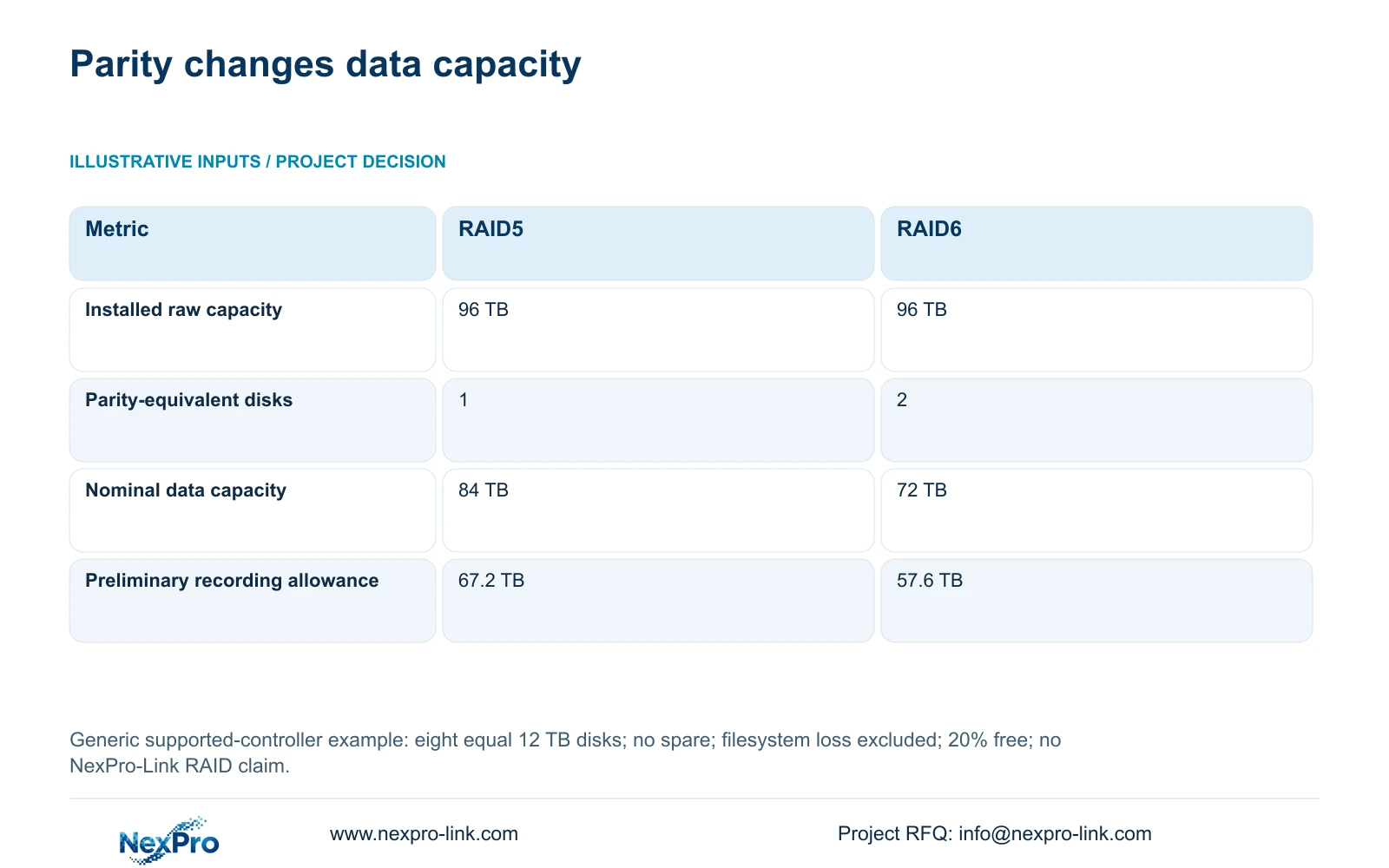
For the generic comparison, assume eight equal 12 TB disks on a controller that supports the selected arrangement. Installed raw capacity is 8 × 12 = 96 TB. With no dedicated hot spare, RAID5 nominal data capacity is (8 − 1) × 12 = 84 TB, while RAID6 is (8 − 2) × 12 = 72 TB.
These are nominal data capacities before filesystem overhead. The parity-equivalent capacity is distributed within the array; the arithmetic does not mean one specific disk contains only parity. Apply actual usable-capacity information before treating either result as an available recording volume.
A dedicated hot spare inside the same eight bays changes the active count to seven. The corresponding nominal capacities become (7 − 1) × 12 = 72 TB for RAID5 and (7 − 2) × 12 = 60 TB for RAID6. The spare contributes no current recording capacity. Confirm that the actual controller supports the proposed spare policy rather than assuming it follows from the arithmetic.
Section 03
Preserve incidents independently of the recording array
Disk redundancy and independent copies answer different failure questions. A supported array can provide a defined response to certain disk failures. It does not create a separate event copy when an operator deletes footage, the recorder becomes inaccessible or the site is lost. The owner should identify which risks require preservation outside that shared recording system.
For the factory's material-transfer task, nominate an authorised person to select the relevant cameras and time window before rolling footage is overwritten. Export enough context to show the event sequence, retain identifying information and check playback outside the recorder. Assign the archive destination and access rights separately from recorder administration.
Do not call a copy independent merely because it sits in another folder or disk within the same recorder. Assess the common equipment, location and access dependencies relevant to the owner's objective. The required archive may contain selected incidents rather than every recorded hour, but that choice needs an explicit selection and preservation responsibility.
Section 04
Compare recording allowance after parity
The supplied comparison intentionally ignores filesystem loss first, then retains 20% of nominal data capacity as free space. Recording_budget_TB = nominal_data_TB × 0.8 gives 67.2 TB for RAID5 and 57.6 TB for RAID6. These are preliminary allowances, not formatted measurements or claims about a NexPro-Link recorder.
The decisive capacity difference is 12 TB nominal data, reducing the preliminary video allowance by 9.6 TB. RAID6 consumes more parity-equivalent capacity within the same 96 TB installed raw total. Whether that trade-off meets the owner's recovery objective depends on supported behaviour and operating conditions, not merely on the larger or smaller allowance.
CASE01's 41.472 TB video demand can be used as a common workload for a later qualified design, but do not silently mix its 95% usable-capacity assumption into this table. Complete the actual formatted-capacity and spare calculation first, then compare the resulting recording allowance with the footage requirement.
| Metric | RAID5 example | RAID6 example |
|---|---|---|
| Installed raw capacity | 96 TB | 96 TB |
| Active disks | 8 | 8 |
| Parity-equivalent disks | 1 | 2 |
| Nominal data capacity | 84 TB | 72 TB |
| Preliminary recording allowance | 67.2 TB | 57.6 TB |
| Independent incident copy | Not created | Not created |
Section 05
Select a supported recovery plan for the required workload
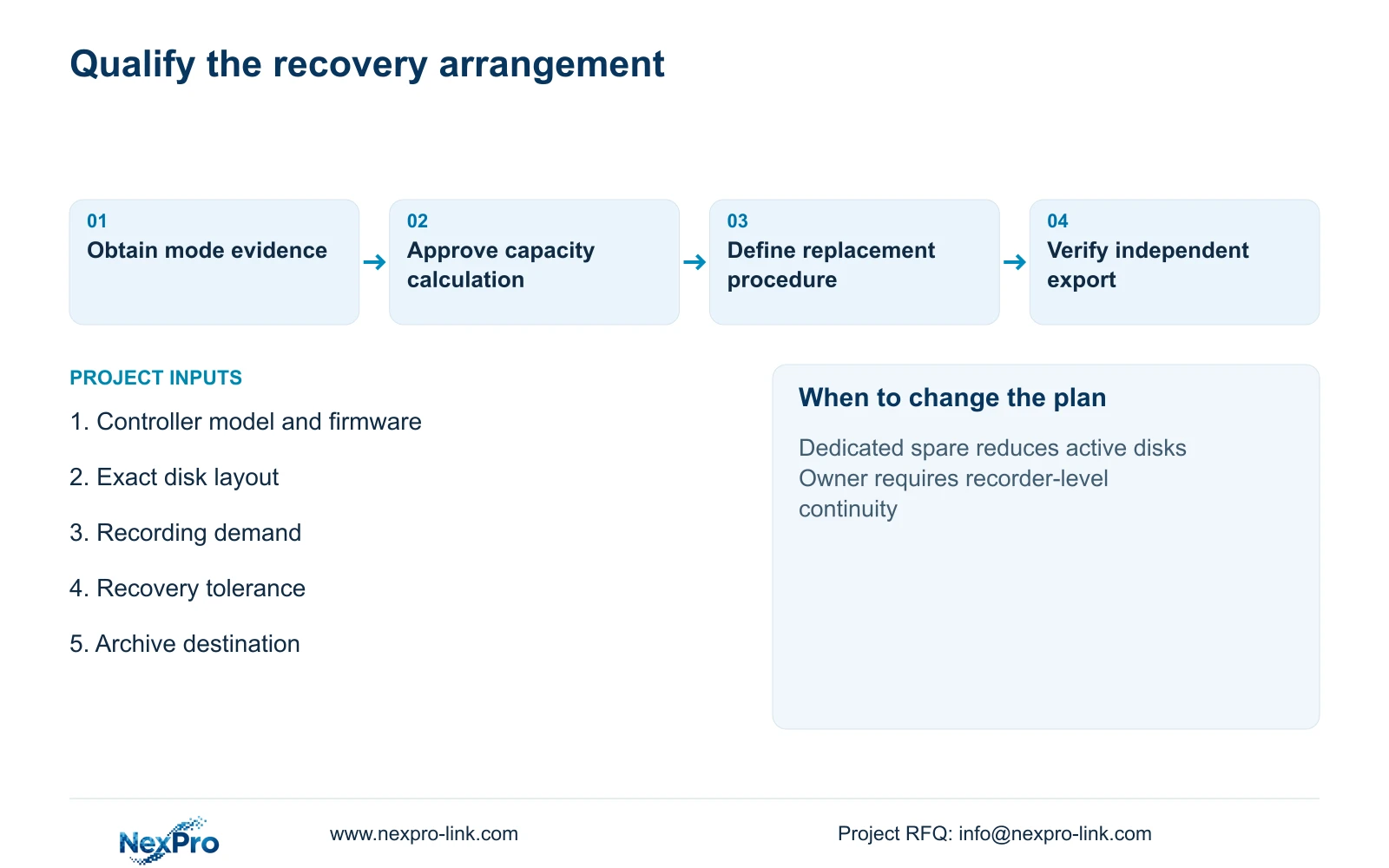
If disk redundancy is mandatory, select equipment with documented support and adequate capacity rather than attaching RAID6 wording to an unqualified NVR. Ask what recording, playback and export remain available during a degraded state and reconstruction. These behaviours require model-specific confirmation; the nominal capacity calculation cannot establish them.
Approve a recovery procedure that identifies alarms, responsible staff, replacement disk requirements and checks after reconstruction. Discuss the consequences of delayed replacement and the conditions under which the system returns to its accepted state. Do not promise a universal reconstruction time or uninterrupted performance without evidence for the offered configuration.
If the owner can accept a defined disk-failure consequence, an explicitly non-RAID recording layout may remain an option, supported by prompt independent incident preservation. Present that consequence clearly. Neither more disk bays nor independent exports automatically provide recorder failover, and a change in failure tolerance can require a different architecture rather than a larger disk alone.
Section 06
Procure capacity, recovery and archive as separate deliverables
The quotation should identify the supported controller arrangement, active disks, any dedicated spare, formatted-capacity basis and resulting video allowance. Put replacement stock, recovery configuration and archive provision in separate lines. This allows the cost team to compare equivalent scope without mistaking a disk quantity for a complete resilience service.
NexPro-Link's BOQ and Tender Support scope can help document the requirement and visible model deviations. The supplier should provide evidence for the offered configuration, while the engineer confirms that it meets the owner's workload and retention needs. The local integrator should demonstrate the approved alarm and recovery workflow under a planned, authorised test.
Handover should include an independent export and playback check alongside storage-state records. Preserve the tested configuration and the recovery responsibility. The owner then receives three understandable outcomes: a usable recording allowance, a defined response to disk failure and a separate way to preserve selected evidence beyond the recorder.
Section 07
Buyer questions
Can adding a UPS turn a non-RAID recorder into redundant storage? No. Backup power and disk redundancy address different conditions. A UPS does not establish an array mode, an independent copy or a supported reconstruction procedure.
Should a hot spare be included in the parity calculation? Exclude a dedicated spare from active-drive count first, then calculate the selected mode. Its role must be supported by the controller; an installed unused disk is not automatically a configured hot spare.
Does a successful export prove the recovery plan? It proves only the tested export workflow. Array recovery needs separate confirmation of alarms, replacement, reconstruction and post-recovery recording behaviour.
Section 08
Define the storage failure objective before ordering
Send your recorder/controller model and firmware, disk layout, required recording workload and acceptable recovery conditions to info@nexpro-link.com. NexPro-Link can discuss a capacity and supply schedule with RAID claims kept within documented support.
Engineering references
These sources support the general planning principles. Always use the selected product's current datasheet and applicable project standards for final design.