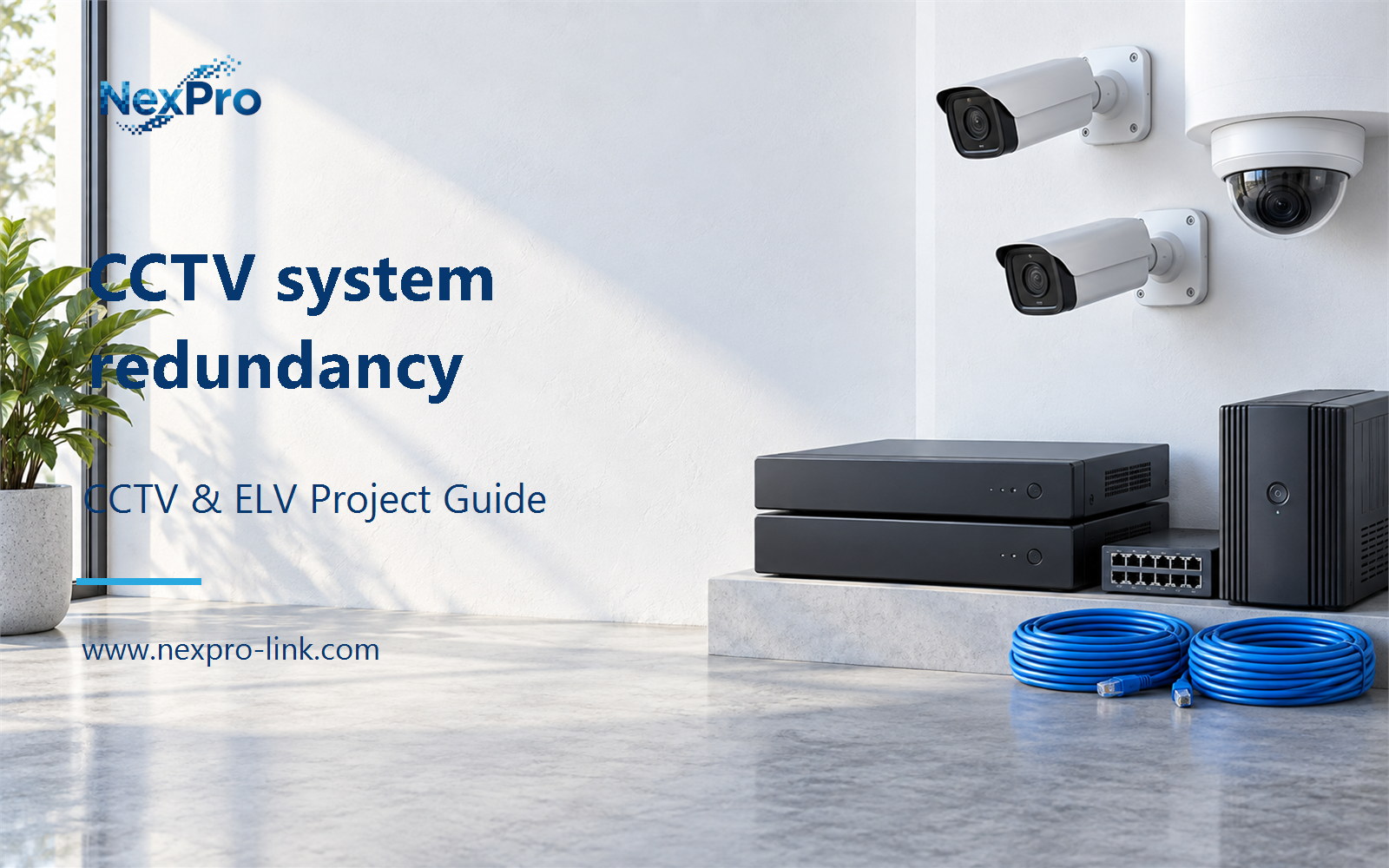
Plan CCTV system redundancy with practical guidance on define the service that must survive and network diversity beyond two cables. NexPro-Link project guide.
Section 01
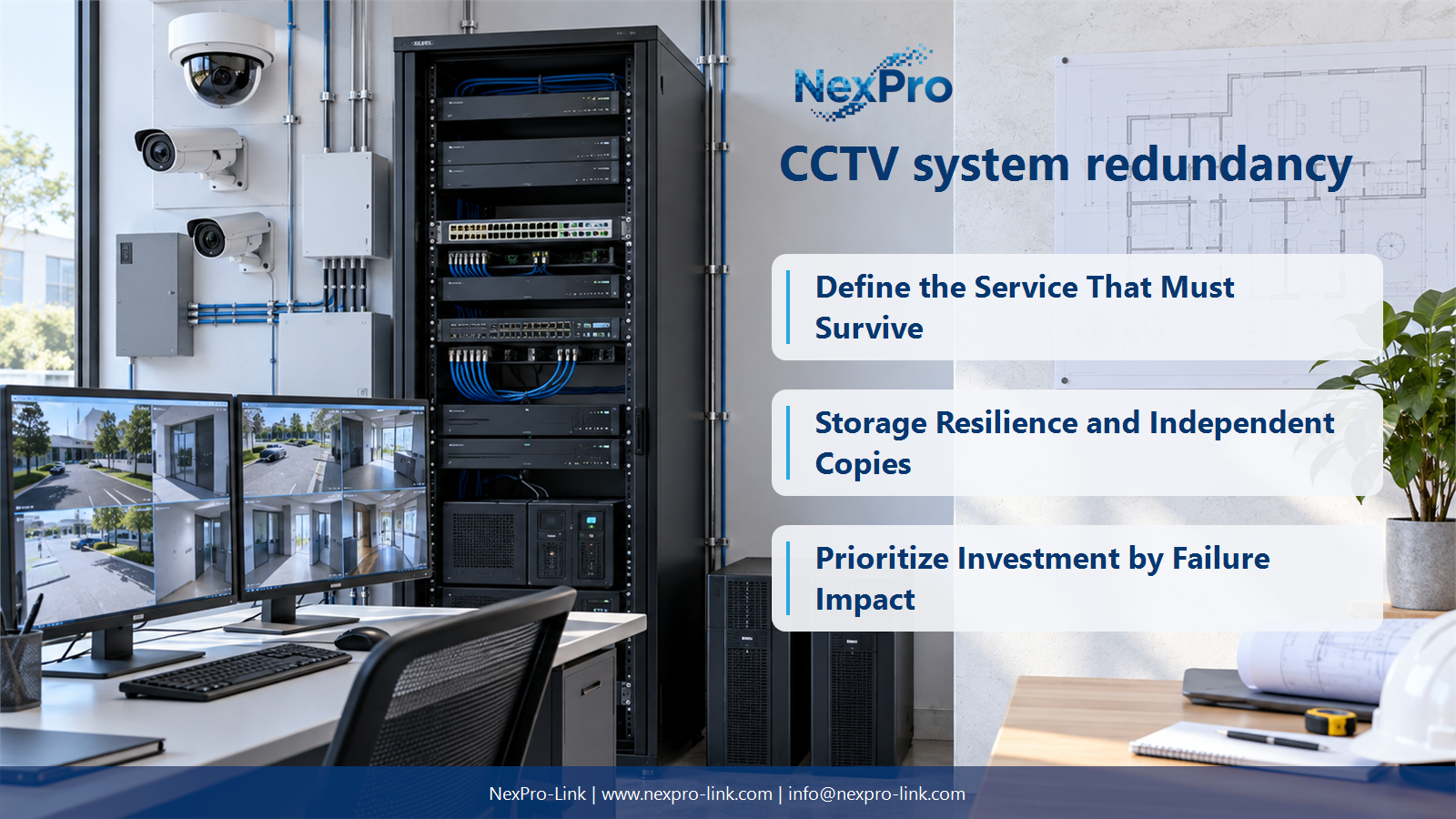
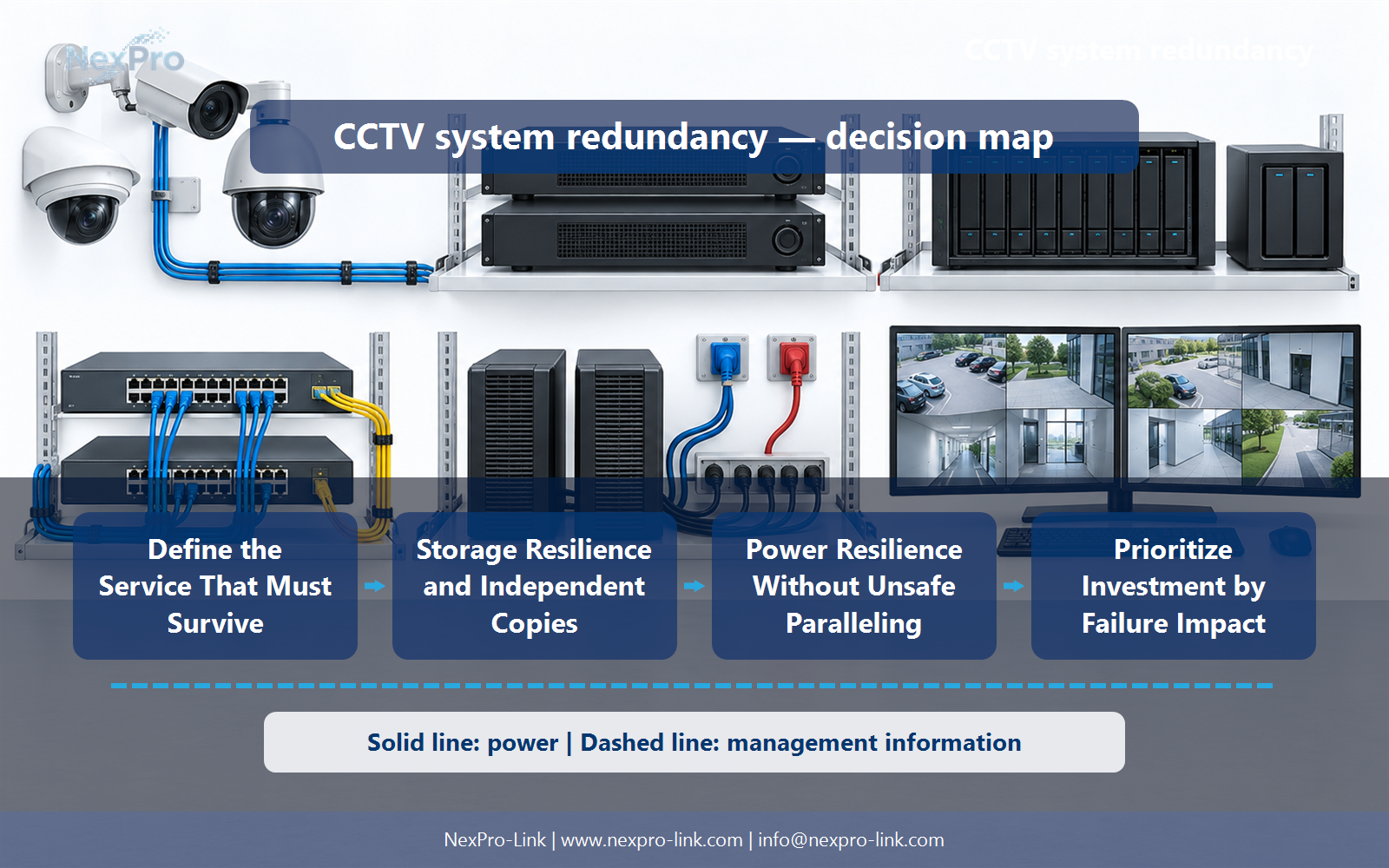
Define the Service That Must Survive
State the permitted recording gap, restoration time and affected views for each failure scenario. Continuous live viewing, uninterrupted recording and rapid equipment replacement are different objectives. A project can spend heavily on duplicate hardware while leaving its essential service dependent on one switch, storage controller or power path.
Turn the answer into a working record using Service, Failure, Allowed gap, Recovery target, Critical views.
| Decision area | Buyer question | Required output |
|---|---|---|
| Define the Service That Must Survive | How should CCTV redundancy requirements be specified? | State the permitted recording gap, restoration time and affected views for each failure scenario. |
| Recorder Failover and Edge Recording | Is a spare NVR the same as recorder failover? | No. |
| Storage Resilience and Independent Copies | Does RAID make CCTV recording redundant? | RAID can tolerate specified drive failures in a supported configuration, but it does not protect against every recorder, controller, deletion or site failure. |
Section 02
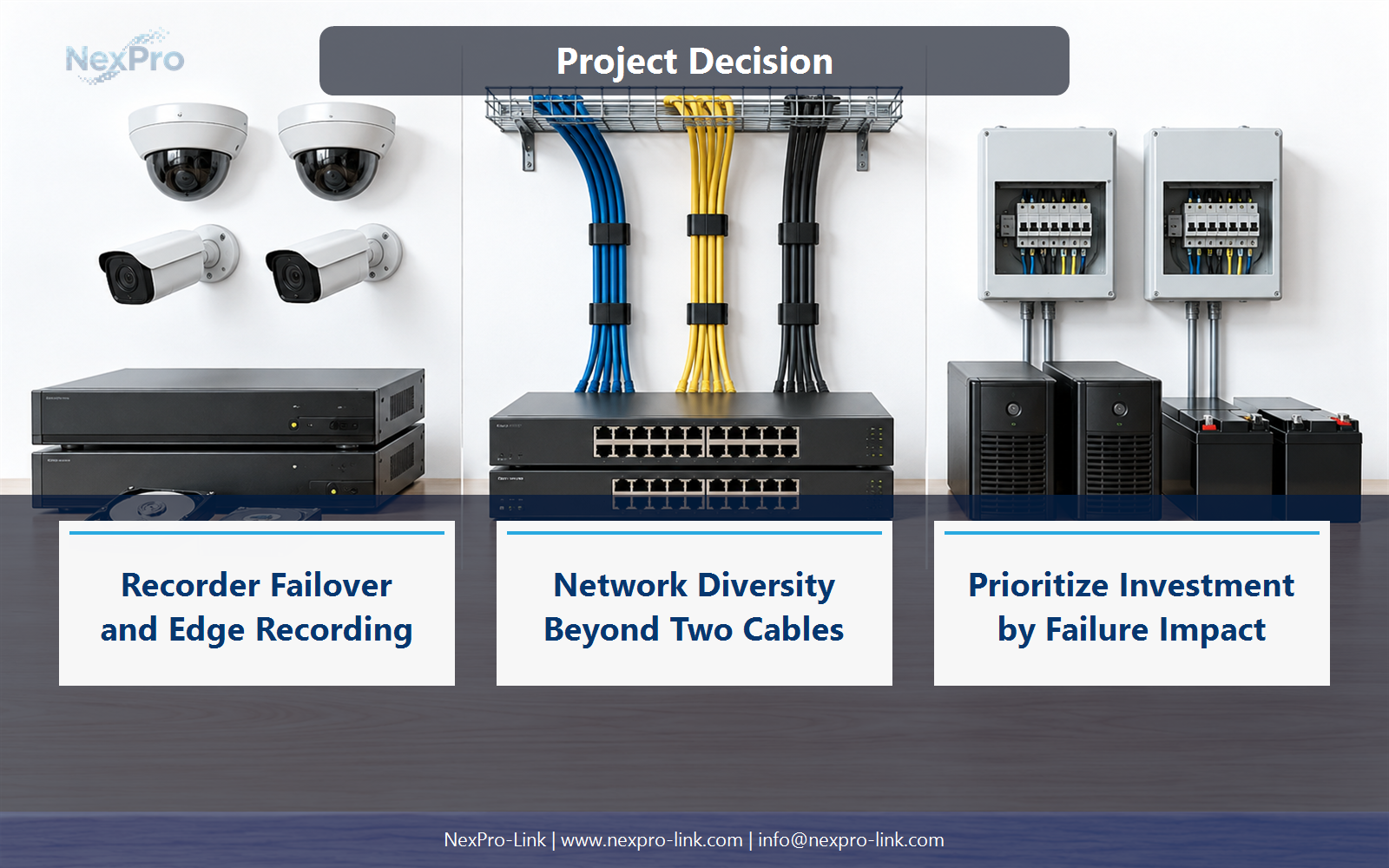
Recorder Failover and Edge Recording
No. Failover requires a supported mechanism to transfer recording responsibilities, capacity and configuration when the active service fails. A boxed spare mainly shortens replacement time. Edge recording can address some network interruptions, but synchronization and retrieval must be part of the platform design rather than an assumed property of every camera.
Use Failure mode, Active role, Standby role, Recovery behavior to compare options on the same basis. Keep product capability, project assumption and operating responsibility in separate columns.
Section 03
Storage Resilience and Independent Copies
RAID can tolerate specified drive failures in a supported configuration, but it does not protect against every recorder, controller, deletion or site failure. Define whether the objective is disk availability, preserved incident copies or a second recording location. These needs can require different mechanisms and should not be combined under one unqualified redundancy label.
The project output should make Risk, RAID contribution, Independent-copy need, Remaining gap traceable from input to acceptance.
- Confirm the answer to: Does RAID make CCTV recording redundant?
- Record the project fields: Risk / RAID contribution / Independent-copy need / Remaining gap.
- Keep product capability, project assumptions and site responsibility in separate records.
Section 04
Network Diversity Beyond Two Cables
The paths must be supported by the devices, configured for the intended function and separated from shared failure causes. Two ports may serve isolated networks rather than automatic failover. Compare physical routing, upstream switches and recovery behavior, then verify that the surviving path can carry the required recording and viewing workload.
Record Path, Normal role, Surviving load, Shared infrastructure before selecting a product family. That makes later substitutions possible without silently changing the operational requirement.
Section 05
Power Resilience Without Unsafe Paralleling
Not by simply joining their outputs. Use only a supported parallel or transfer architecture designed for the equipment and electrical installation. Also consider dual-input devices, common upstream circuits and the camera power path. Redundancy is lost when supposedly independent feeds converge on an unprotected point or unsuitable connection.
Review Power path, Supported arrangement, Common dependency, Load with the party that will operate or maintain the system.
Section 06
Prioritize Investment by Failure Impact
Address the failure that causes the most unacceptable service loss under the project's operating conditions. That may be a core switch, recorder storage, remote power cabinet or restoration process rather than the most expensive device. Compare the protected views, remaining risks and maintenance requirements for each investment, not just the number of duplicate boxes.
Use Upgrade, Protected service, Remaining risk, Operational effort as the handoff between design and procurement.
Engineering references
These sources support the general planning principles. Always use the selected product's current datasheet and applicable project standards for final design.