Rehearse two simultaneous yard requests. Record who receives PTZ control, what fixed footage remains available and how the second request is handled.
Section 01
Define the distant target before specifying zoom
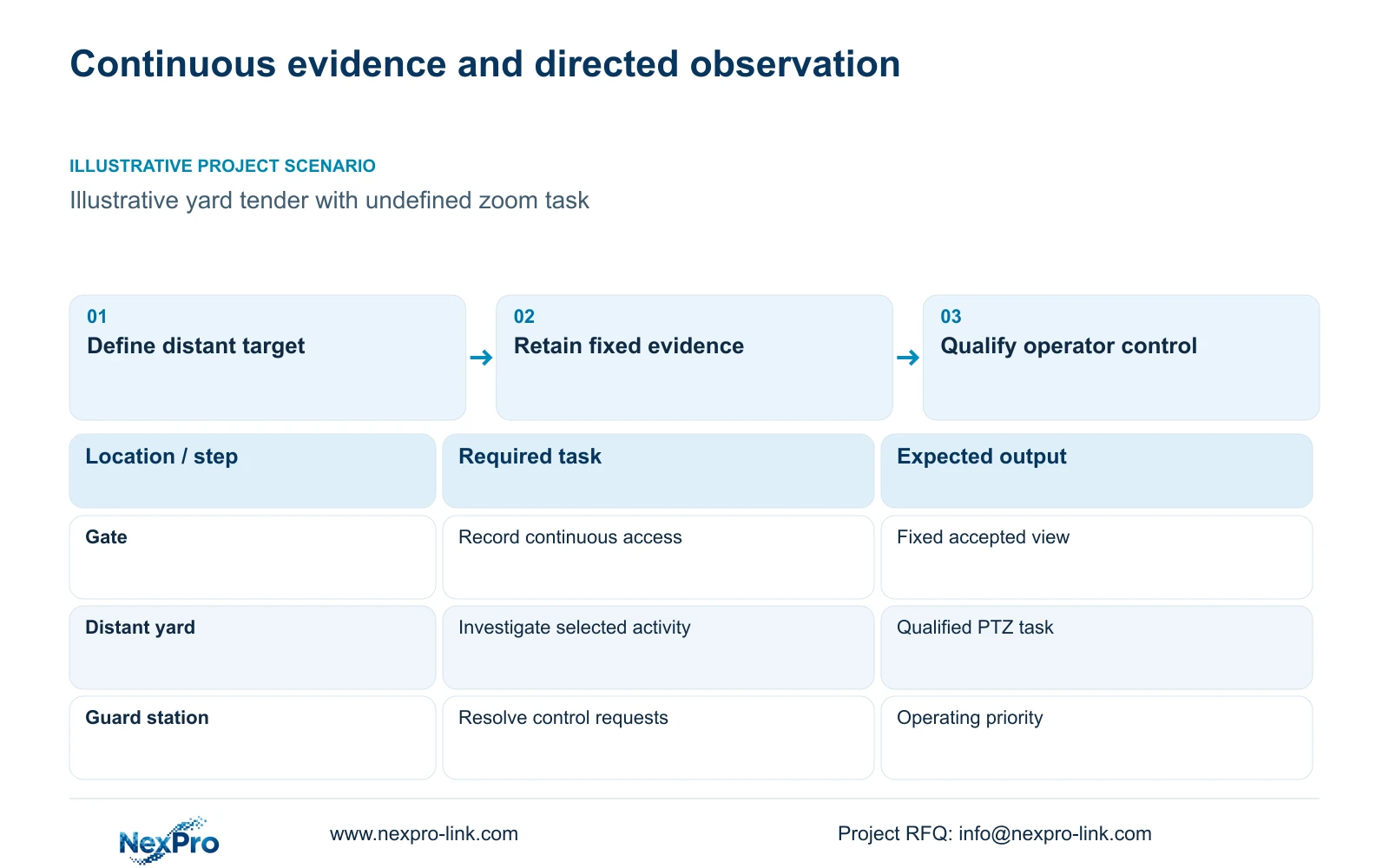
Rehearse two simultaneous yard requests. Record who receives PTZ control, what fixed footage remains available and how the second request is handled. If the procedure sacrifices a required continuous event, retain another fixed view or revise the operating scope. Zoom capability does not settle competing control authority.
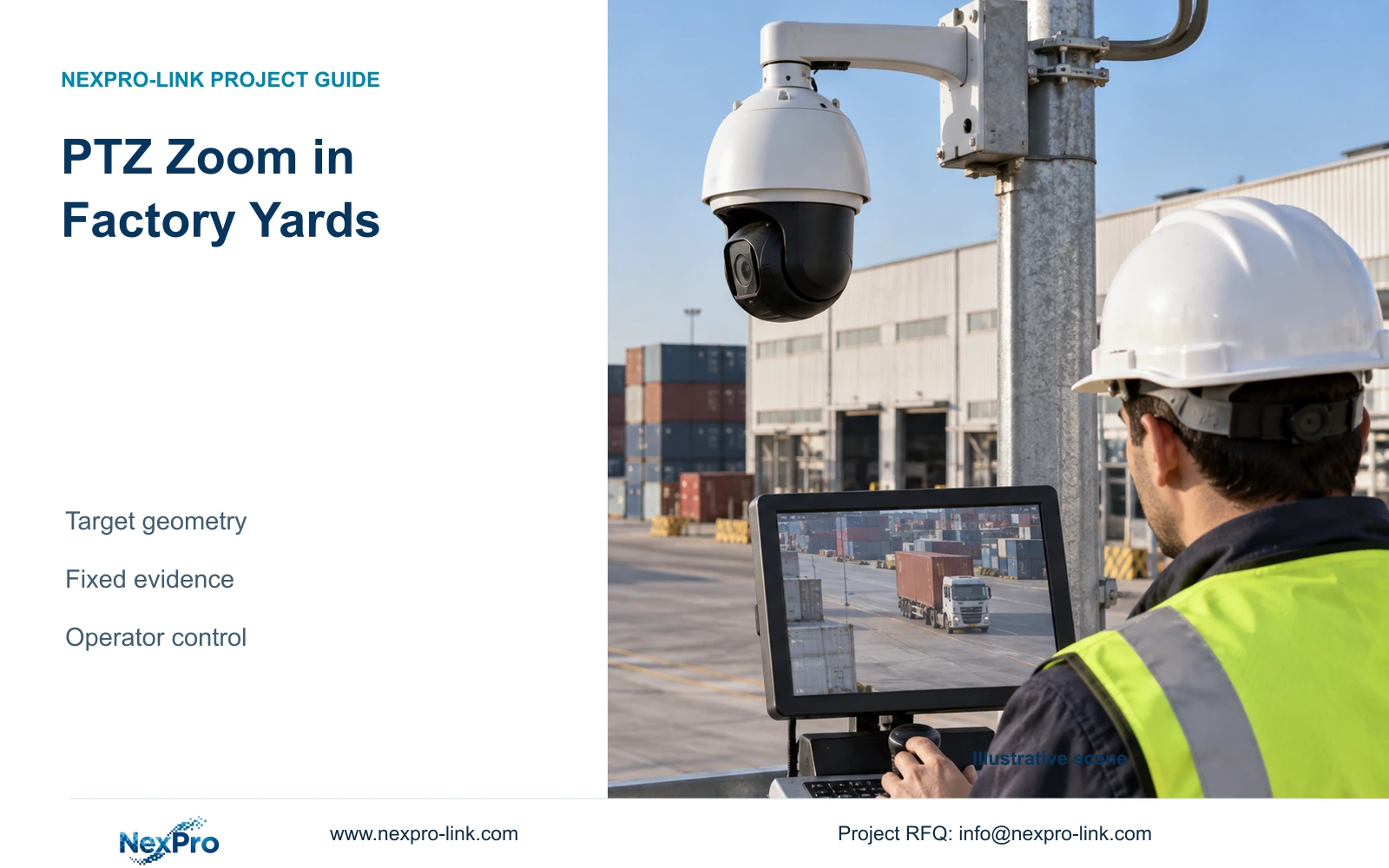
Specify PTZ zoom in factory yards from the required target, its distance and the selected model's optics and recorded output. A zoom ratio alone cannot establish identification distance. Define continuous evidence separately, because a camera directed at one yard activity may leave another required event outside its current view.
Illustrative project scenario: A factory specification asks for a high zoom ratio without defining the viewing target or patrol task. Assume the engineer must clarify whether the owner wants occasional inspection of distant activity or continuous gate and dispatch evidence within the supplied CNC reference. No exact PTZ model or achieved distance is provided.
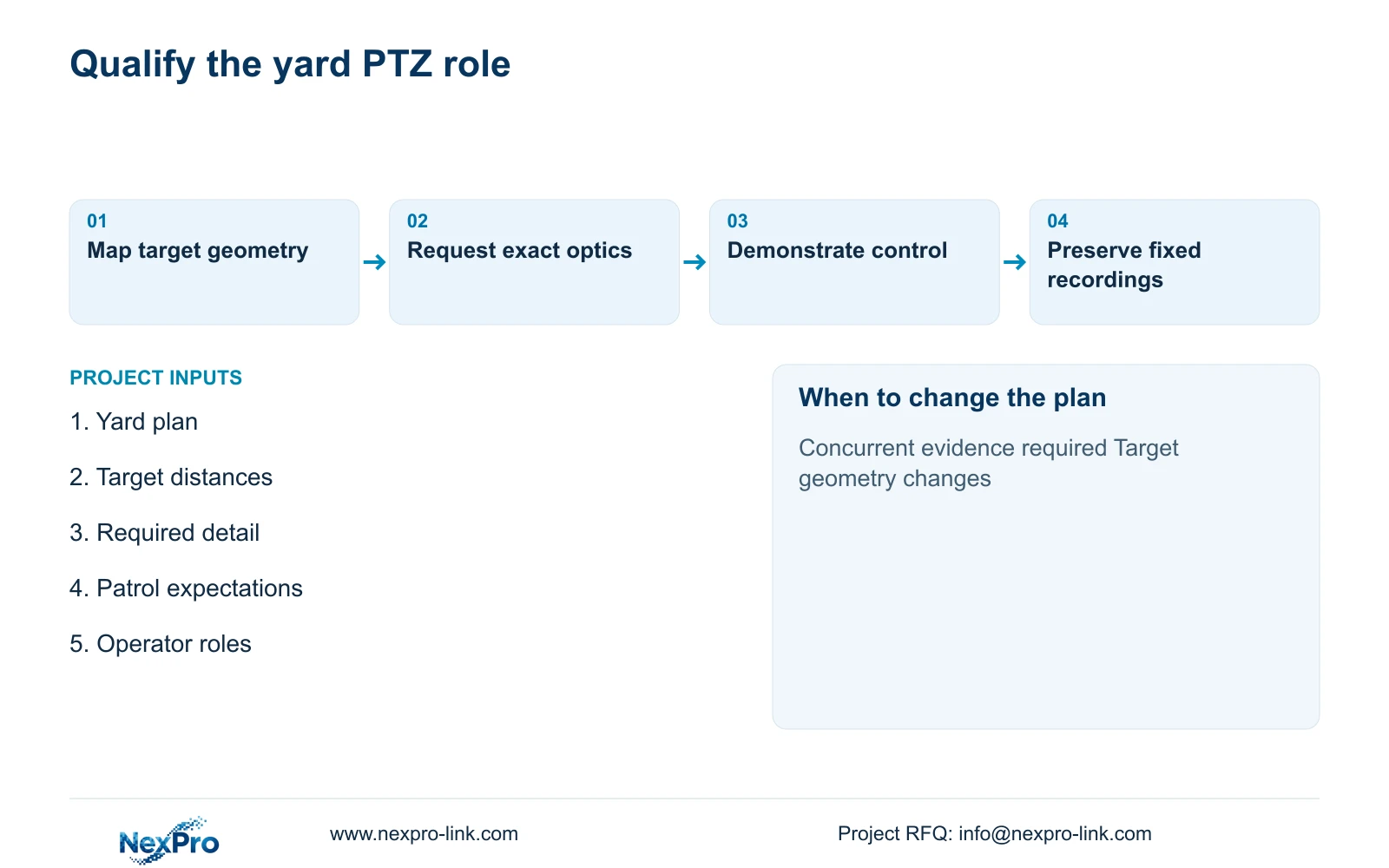
Ask the owner to identify the object detail, target width, viewing distance and relevant lighting. The engineer can then request focal range, selected output and representative recordings for an actual PTZ candidate. A numerical magnification requirement should remain provisional until those inputs show what the camera is expected to resolve.
Section 02
Keep critical fixed views outside the patrol decision
Retain fixed cameras where the owner requires uninterrupted evidence of a boundary or handover. In the supplied 32-camera CNC reference, four gate-overview views and six dispatch views have defined ordinary-security roles. Do not remove those tasks simply because a proposed PTZ can point toward the same locations.
Map PTZ coverage as a changing view, with named presets and the purpose of each. Identify which required evidence persists while the camera is elsewhere. If a gate event and a dispatch event can occur together, the engineer should show how both remain recorded rather than count the PTZ's possible directions as simultaneous coverage.
The supplied BL2812M bullet and DM2812M Dome references are fixed-position motorized-lens candidates. Their 2.8-12 mm lens ranges do not establish pan-and-tilt capability. Use them only for the documented fixed-view role; keep the PTZ equipment requirement open until an exact model is selected and qualified.
Section 03
Check who will control the camera during competing events
Define the operating workflow before comparing PTZ offers. State who may take control, which views have priority and what happens when two operators request different positions. A patrol function can be useful, but the buyer needs exact evidence for its behaviour and the supported recorder or client control path.
Run a demonstration with competing requests: one operator investigates distant activity while another needs a gate view. Record whether control ownership is clear and whether returning to the agreed position is practical. Do not assign staffing savings or automatic tracking performance without an authorised trial of the proposed configuration.
Carry these decisions into the camera schedule. Fixed gate views remain supplied or retained for continuous evidence; the PTZ is an optional supplementary role pending qualification; control configuration belongs to the appointed integrator. The owner approves operating priorities. This makes the quotation reflect the actual monitoring work rather than a zoom number.
| Item | Required task | Scope | Responsible party |
|---|---|---|---|
| Gate fixed views | Continuous access evidence | Retain design task | Engineer qualifies coverage |
| Yard PTZ | Directed distant observation | Optional exact model | Supplier provides evidence |
| Control workflow | Resolve competing requests | Local configuration | Owner and integrator |
Section 04
Use output density without inventing PTZ performance
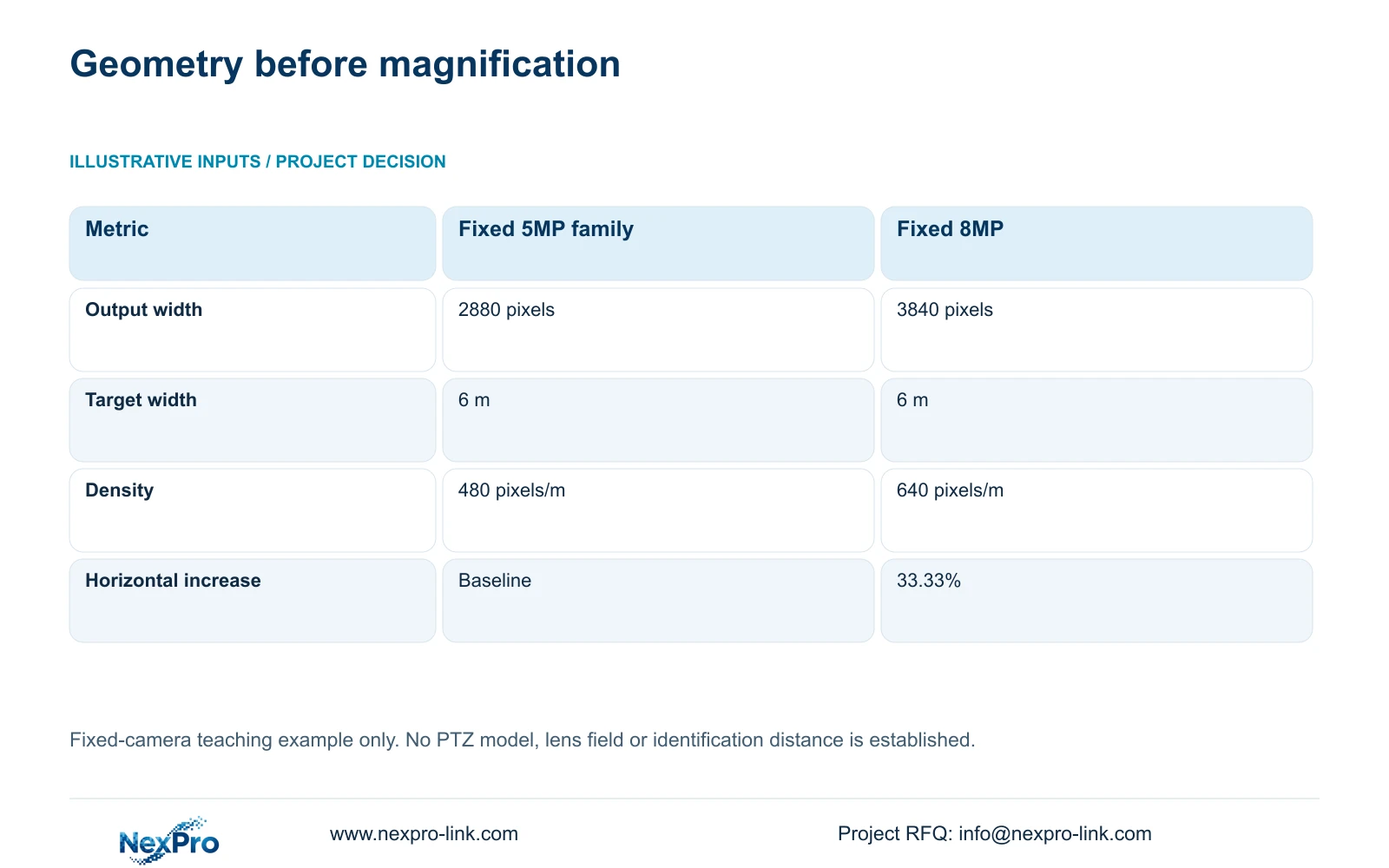
The supplied arithmetic compares documented fixed-camera output widths, not PTZ models. At an illustrative six-metre target plane, ppm = horizontal_pixels / 6 m. The 5MP-family field of 2880×1620 gives 2880 / 6 = 480 pixels/m; the 8MP field of 3840×2160 gives 3840 / 6 = 640 pixels/m.
Relative increase = (3840 / 2880 - 1) × 100 = 33.33%. This demonstrates why actual output and scene width matter alongside optical framing. It is not a 60% detail guarantee from family labels, and it establishes neither a PTZ identification distance nor comparative night performance.
Apply the same method to the selected PTZ only after its output and target-plane width are known. Obtain the view information for the actual mounting distance and lens setting. A candidate that fills the frame with the target still needs motion, lighting and recording qualification, while the fixed cameras retain the continuous context.
| Metric | 5MP-family reference | 8MP reference |
|---|---|---|
| Listed output | 2880×1620 | 3840×2160 |
| Horizontal pixels | 2880 | 3840 |
| Target width | 6 m | 6 m |
| Planning density | 480 pixels/m | 640 pixels/m |
Section 05
Add PTZ only where the directed task justifies it
Prefer a fixed-view baseline for the required continuous boundaries, with a PTZ added where directed observation has a clear operational purpose. If the owner cannot define a distant task or provide an operator workflow, defer the PTZ option and qualify the fixed cameras first. That produces a defensible base package.
Change the selection when the yard geometry, target detail or operating pattern changes. A dedicated fixed detail view may be more suitable for a recurring task at one boundary; a qualified PTZ may suit observation across changing locations. Neither choice should weaken the accepted gate or dispatch recording.
Review the supporting resources for the exact PTZ proposal. CASE01 assumes 4 Mbps and 12 W per ordinary camera as planning inputs. Do not transfer either assumption to an unspecified PTZ, particularly where movement or additional features alter demand. Confirm ports, device-side power, recording modes and client controls before adding the line item.
Section 06
Request an optical and operating demonstration
The PTZ submittal should connect each required target to distance, view width, selected lens setting and recorded output. Include representative day/night footage and the proposed control workflow. Keep model evidence separate from illustrative calculations so a planning density does not become an advertised recognition result.
NexPro-Link's factory project and BOQ support scopes can help coordinate the mixed camera schedule, technical documents and quotation. The supplied evidence supports ordinary fixed-camera references; the exact PTZ requires a separate model submission. Preserve required platform integration and local installation responsibilities when comparing suppliers.
At acceptance, demonstrate the distant observation task, competing control requests and return to the agreed view. Confirm that fixed critical footage remains available throughout. Retain the model and configuration record for replacements, so future procurement preserves the operational task instead of matching only the original zoom ratio.
Section 07
Buyer questions
Can digital zoom satisfy an optical detail requirement? Do not treat enlargement as evidence of additional captured detail. Define the required recorded task and test the proposed optical and digital workflow. If the specification explicitly requires optical capability, document that capability for the exact model.
Can an automatic patrol replace an operator? A patrol can cover an agreed sequence only if the selected configuration supports it. It does not establish response to every concurrent event. Demonstrate the workflow and retain fixed evidence before making any staffing decision.
Section 08
Turn the zoom requirement into a yard task
Send the yard plan with target distances, required object detail, critical continuous-view locations and operator/patrol expectations to info@nexpro-link.com for a mixed fixed-view and PTZ procurement scope.
Engineering references
These sources support the general planning principles. Always use the selected product's current datasheet and applicable project standards for final design.