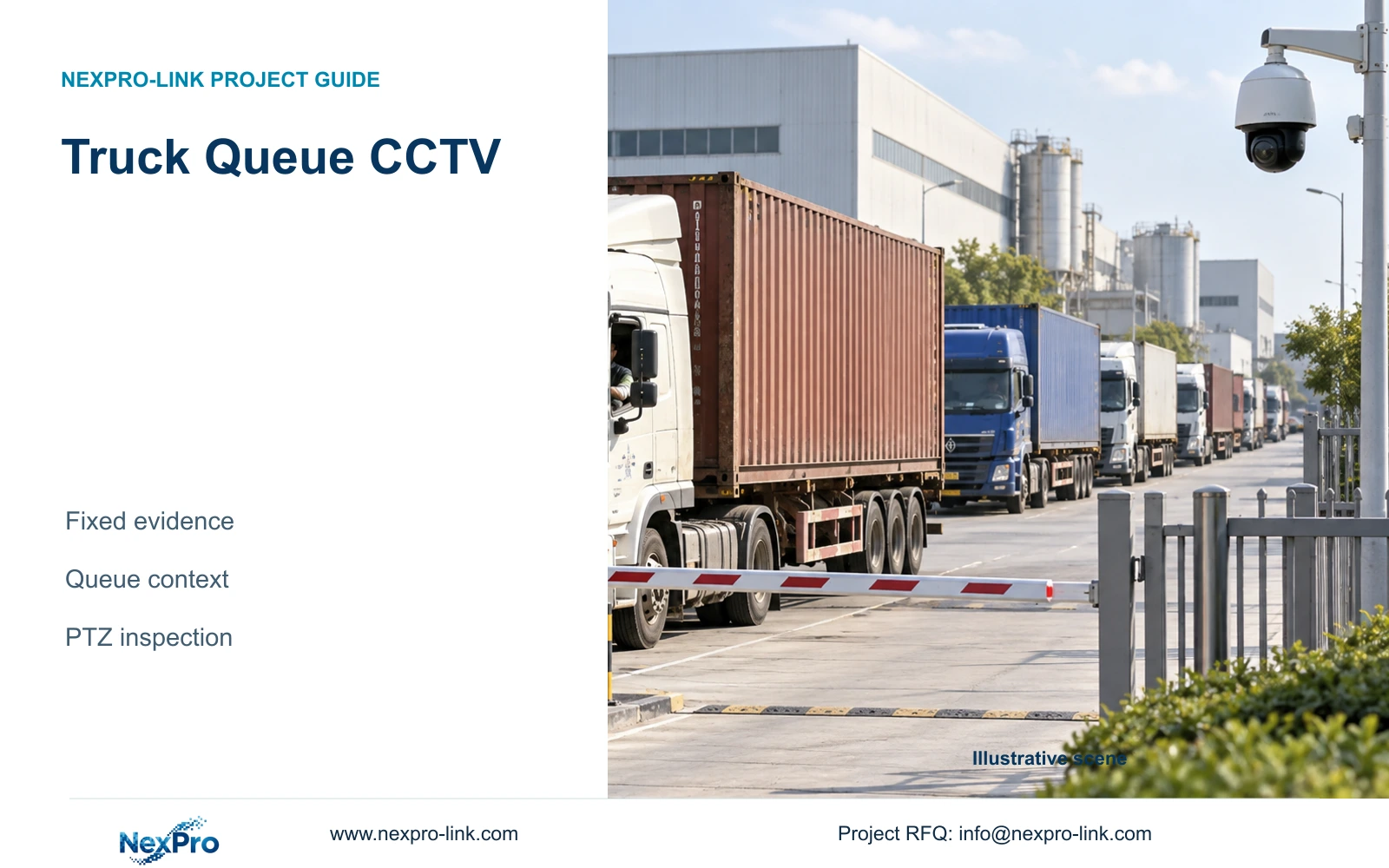
A PTZ can help a guard inspect a truck queue, but its movement leaves other transaction points outside the frame. Keep continuous evidence on fixed views and price patrol separately.
Section 01
Reserve fixed views for transactions that cannot be missed
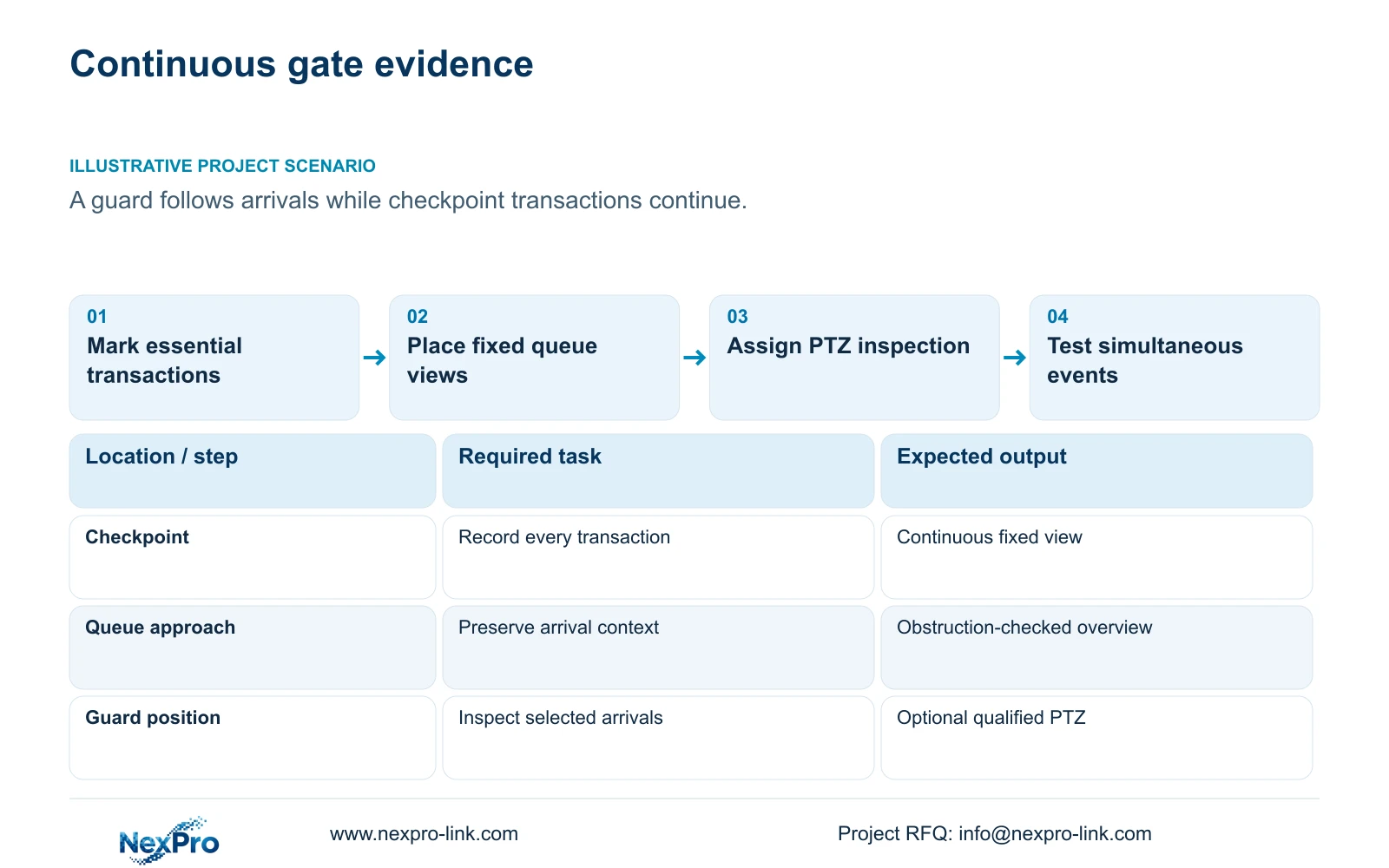
Use fixed views for continuous evidence of essential gate transactions, and add PTZ only for a defined patrol or operator-inspection task. A PTZ tour changes what is inside its frame; it cannot watch every transaction point simultaneously. First identify which arrivals, checks and passages must remain recorded even when the guard follows activity elsewhere.
Illustrative project scenario: The security team wants a PTZ to follow arrivals while still recording every gate transaction. Assume the gate has a checkpoint and a queue approach where trucks can obstruct one another. The project manager should mark those two roles independently and ask the owner which events require uninterrupted coverage. The proposed arrangement is hypothetical and has no measured operating result.
Write acceptance statements around events, such as retaining the checkpoint view while another vehicle arrives behind the queue. Continuous recording settings alone cannot satisfy that statement if the camera is pointing elsewhere. Keep plate recognition and safe barrier operation as separate equipment and responsibility lines, even when their activity appears in the fixed security footage.
Section 02
Place the queue overview where trucks cannot erase context
The queue overview should preserve approach order, lane use and movement toward the checkpoint. Survey likely truck positions and review the sightline with representative large vehicles. A roof-level picture may show the queue's extent while failing to show activity beside a cab. Decide whether that missing activity matters before approving the mounting point or adding another view.
Compare a baseline fixed checkpoint plus fixed queue overview with an adjusted arrangement where a bend or parked truck creates persistent occlusion. The adjustment may be another fixed angle, a relocated mount or an altered operational route. A PTZ can investigate a visible incident, but it does not recover footage of an event that occurred behind an obstruction.
Night review should include headlights, the gate's actual lighting and truck motion. Ordinary-area references such as the NexPro-BL2812M55-5MP-DIC-AI provide a listed 2880×1620 output and 2.8–12mm motorized lens. Motorized lens adjustment helps frame a fixed view; it does not provide pan-and-tilt patrol or establish readable plates throughout the queue.
Section 03
Assign PTZ work to an operator who can perform it
Ask the guard to describe the intended PTZ task: inspect a stopped vehicle, follow a pedestrian in the yard or look toward an unusual queue movement. Then establish who controls the camera while gate paperwork and access checks continue. If nobody can reliably operate it, a patrol tour may offer occasional observation, but its gaps must remain explicit in the evidence scope.
Define control priority when more than one user can operate the PTZ, and demonstrate how the operator returns to an agreed view after manual inspection. Any preset, tour or control function must be verified on the selected PTZ and client; no exact PTZ capability is supplied here. Keep the fixed camera recordings running independently while the operator exercises those controls.
A gate/perimeter task map should therefore assign fixed checkpoint recording to the CCTV package, queue context to the accepted overview arrangement and PTZ inspection to an optional qualified device and client. The owner approves the operational task, the engineer verifies interfaces, and the local installer confirms mounts and cable routes.
Section 04
Compare detail width without losing the queue overview
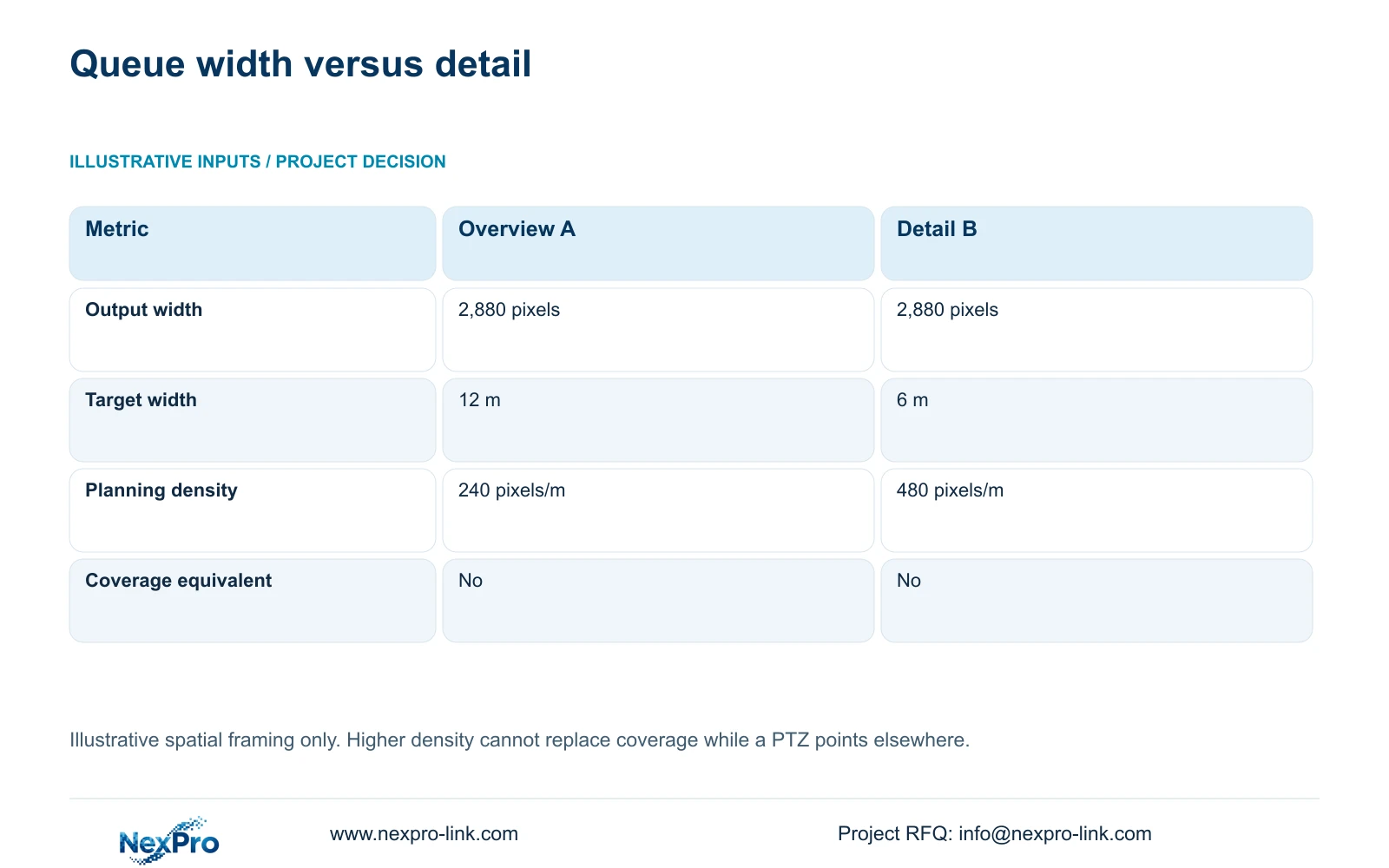
The supplied illustrative calculation uses 2,880 horizontal pixels across either 12 m or 6 m at the target plane. Planning_pixels_per_metre = horizontal_output_pixels / target_width_m gives 240 pixels/m for the 12 m overview and 480 pixels/m for the 6 m detail view. These widths are assumed geometry, not guaranteed lens coverage or a PTZ performance comparison.
Narrowing the view doubles horizontal planning density and removes half the horizontal scene width. At the checkpoint, that may support a more useful detail frame. Across the queue, it may remove the vehicle or pedestrian whose movement explains the event. Keep a separate overview if that wider context belongs to the accepted task.
The table's coverage distinction is spatial; the PTZ decision also has a time dimension. A PTZ looking at a 6 m detail area still leaves other areas unobserved while it stays there. Higher density cannot fill that absence. Lighting, exposure, compression, motion and vehicle obstruction must also be checked in recorded footage, without assigning an unsupported universal recognition threshold.
| Metric | Option A: wider view | Option B: detail view |
|---|---|---|
| Horizontal output | 2,880 pixels | 2,880 pixels |
| Target-plane width | 12 m | 6 m |
| Planning density | 240 pixels/m | 480 pixels/m |
| Coverage equivalent | No | No |
Section 05
Fund continuous evidence before supplementary patrol
Prefer the fixed evidence baseline when the owner requires every gate transaction to remain recorded. Add PTZ where the guard has an actionable inspection need and the chosen system supports it. If the budget is constrained, explain which optional inspection task is deferred rather than replacing continuous checkpoint evidence with a tour. Retain mandatory integrations or environmental requirements in any alternative offer.
CASE08 illustrates how gate additions should be assigned to a recording node. Each reference node has 32 ordinary cameras at an assumed 4 Mbps average, producing 128 Mbps input. A PTZ addition may use a different output mode, bitrate and power demand. Obtain those exact inputs before checking the recorder and local switch; the case's ordinary-camera assumptions are not PTZ specifications.
Protect the full camera and recording path if evidence is required during an outage. Include the PTZ's actual supply only if patrol remains essential during that period. A normal guard monitor may satisfy operation; an LCD wall is an optional display branch, not a prerequisite for recording. Any wall or decoder requires its own concurrency and power assessment.
Section 06
Test simultaneous events before releasing the gate package
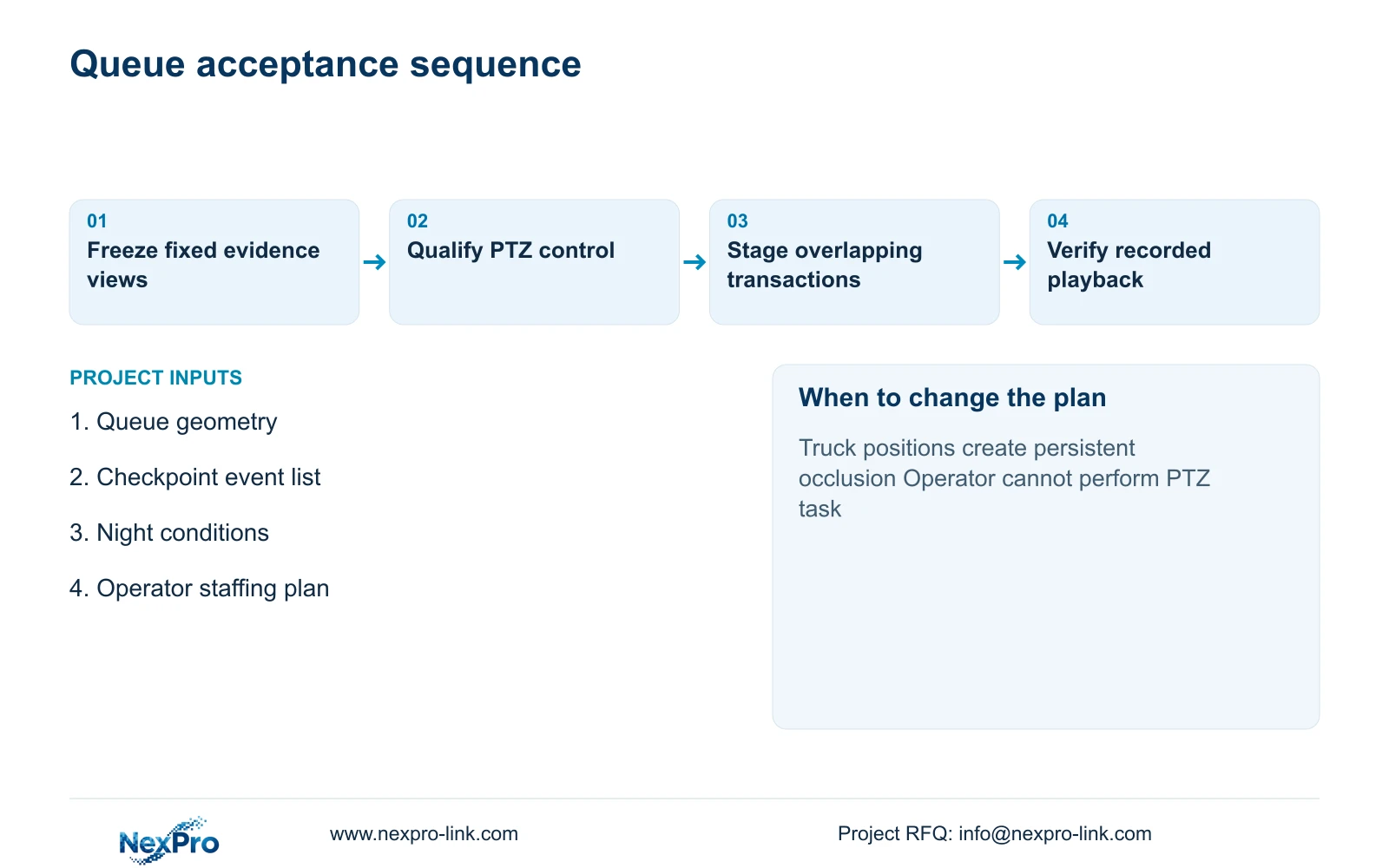
Build the acceptance demonstration around overlapping work. While the operator uses the PTZ to inspect an arrival, stage another permitted checkpoint transaction and confirm its fixed-view recording. Review both events through the intended client. This reveals whether the package preserves essential evidence while supplementary inspection is taking place, without relying on a persuasive live PTZ demonstration.
The supply schedule should distinguish fixed cameras, optional PTZ, controller or client requirements, recorder inputs, local power and outdoor installation work. Identify retained equipment and the supplier responsible for proving compatibility. Record camera names that match the gate drawing so operators can retrieve footage without guessing which generic channel shows the checkpoint.
NexPro-Link can support ordinary fixed-view model matching, technical submittals and coordinated project equipment supply. A proposed PTZ remains subject to its exact specification and operational demonstration. Project-labelled packing should follow the accepted checkpoint and queue roles, while local installation, alignment and final acceptance remain explicitly assigned.
Section 07
Buyer questions
Can a PTZ be the only camera if the gate is usually quiet? Only if the owner accepts the periods when required areas are outside its frame. Infrequent traffic does not remove that coverage gap; document the accepted evidence boundary before purchasing.
Does a motorized varifocal camera count as PTZ? No. A motorized lens can adjust focal length and framing, but it does not establish pan-and-tilt movement. The supplied BL2812M reference should remain a fixed-view role.
What changes should trigger a queue-view review? Changes to truck parking positions, lane direction, checkpoint location, lighting or operator staffing. Recheck both obstruction and the ability to operate supplementary PTZ controls.
Section 08
Specify continuous gate evidence
Send the queue and checkpoint layout, events requiring uninterrupted views, night conditions and intended PTZ operator tasks to info@nexpro-link.com for a fixed-view baseline with clearly priced patrol options.
Engineering references
These sources support the general planning principles. Always use the selected product's current datasheet and applicable project standards for final design.