Provide the installer a mapping from private-label order name to actual recorder model and accepted firmware. Keep that mapping available for authorized support without exposing credentials.
Section 01
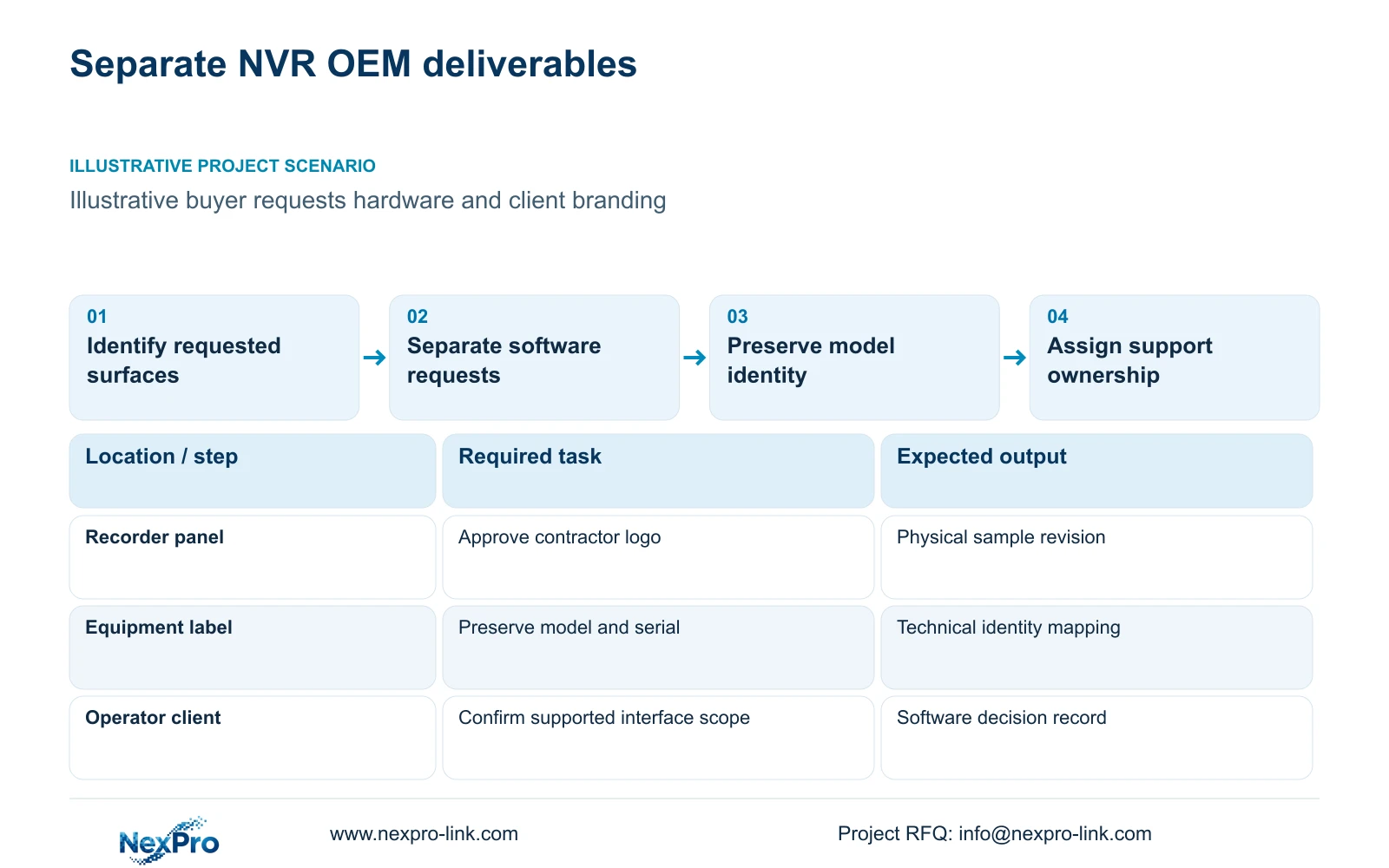
Separate the front-panel request from software work
Provide the installer a mapping from private-label order name to actual recorder model and accepted firmware. Keep that mapping available for authorized support without exposing credentials. When a label changes, preserve the technical identity and separate any software request. A branded manual must not obscure which supported instructions apply to the delivered recorder.
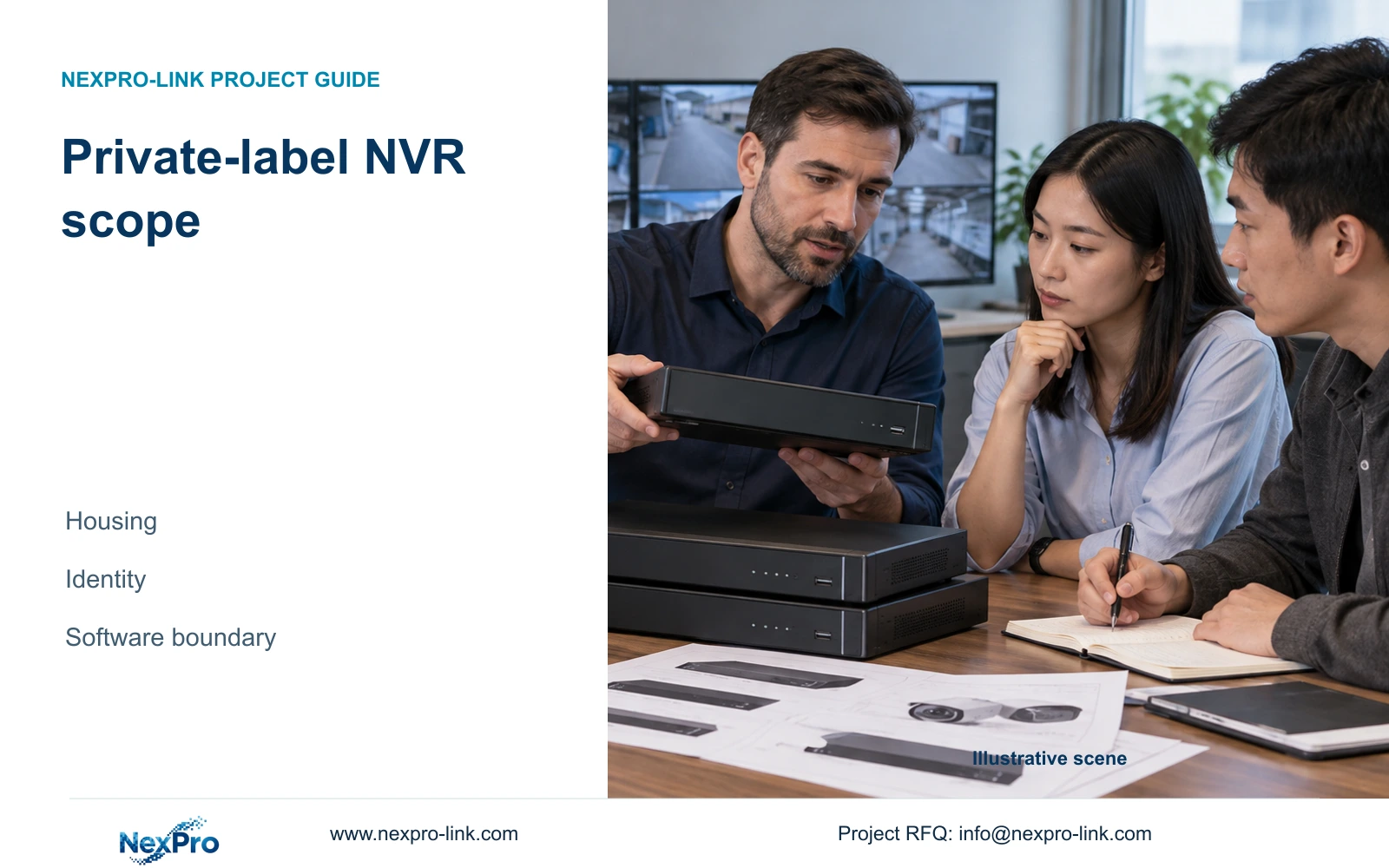
Private-label NVRs for industrial projects should be specified as individual deliverables: housing branding, identity labels, packaging, documentation and any requested interface change. Obtain confirmation for each deliverable. A logo on the front panel does not automatically include customised firmware, a renamed mobile application or permission to change a third-party client's identity.
Illustrative project scenario: The buyer requests branded cameras, NVR front panels and client software under one request. Use the hypothetical CASE01 CNC factory as the background: 32 ordinary-area cameras record to one local recorder. Assume the contractor wants its name on the equipment and an operator-facing support card. Software renaming remains an unconfirmed request rather than part of the accepted hardware scope.
Ask the buyer to show where each requested name should appear. A drawing can resolve a panel mark; a label proof can resolve a product name; a screenshot can identify a requested menu change. These different inputs let the supplier state what is supported and prevent a broad 'full OEM' line from being interpreted differently by procurement and operations.
Section 02
Preserve the recorder identity and support route
Keep an explicit mapping between the contractor's commercial name and the actual recorder model. For CASE01, NexPro-NVR4449-4K is the candidate reference. Its published fields include 49 channels, 320 Mbps input and four SATA bays supporting up to 18 TB per bay. The summary distinguishes 49x5MP from 9x4K; a private-label name must not turn those fields into an unrestricted all-4K claim.
The case assumes 32 supported 5MP-class streams at an average 4 Mbps, giving 128 Mbps of recording payload. Those are design inputs, separate from the recorder's catalogue rating. Preserve the selected stream mode, disk configuration and firmware identity in the technical schedule. Neither the model name nor the front-panel artwork establishes RAID or simultaneous decoding performance.
Assign the first support contact and the escalation route in writing. The contractor may receive owner enquiries while the supplier assists with hardware or configuration questions. Identify who collects logs, who arranges local diagnosis and who handles an approved return. The name on the front panel should lead to a usable support path without suggesting that onsite service is automatically included.
Section 03
Approve appearance and operation as separate records
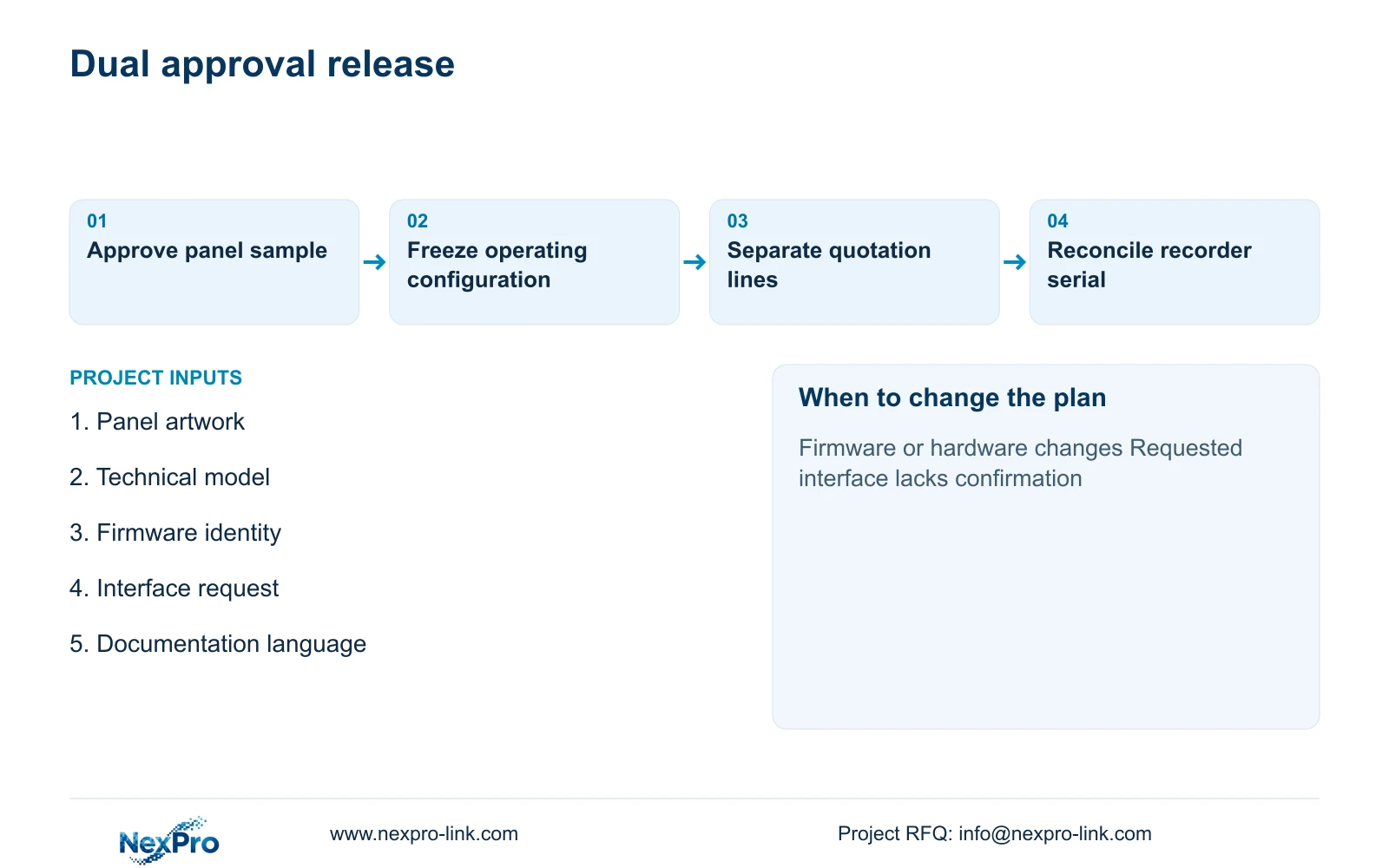
Use the actual selected recorder for panel and label approval. The appearance record should show logo position, retained model and serial labels, and the relationship between the unit and its box. The operating record should identify firmware, language settings and the demonstrated recording, playback and export workflow. Passing one record does not approve the other.
Give each approved element its own revision. A contractor can approve a support-card translation without authorising a firmware change. Conversely, an engineer may accept a firmware revision while requiring the existing artwork to remain. The purchase order should reference these decisions separately so a supplier does not repeat sample work that has not changed.
At batch release, compare the prepared recorder with both records. For the illustrative single-recorder project, this includes verifying its serial against the packing list and checking that the operator documentation names the actual client software. If the buyer later adds a recorder, repeat the identity and operating checks rather than assuming matching front panels prove matching hardware.
Section 04
Keep marking allocation separate from software pricing
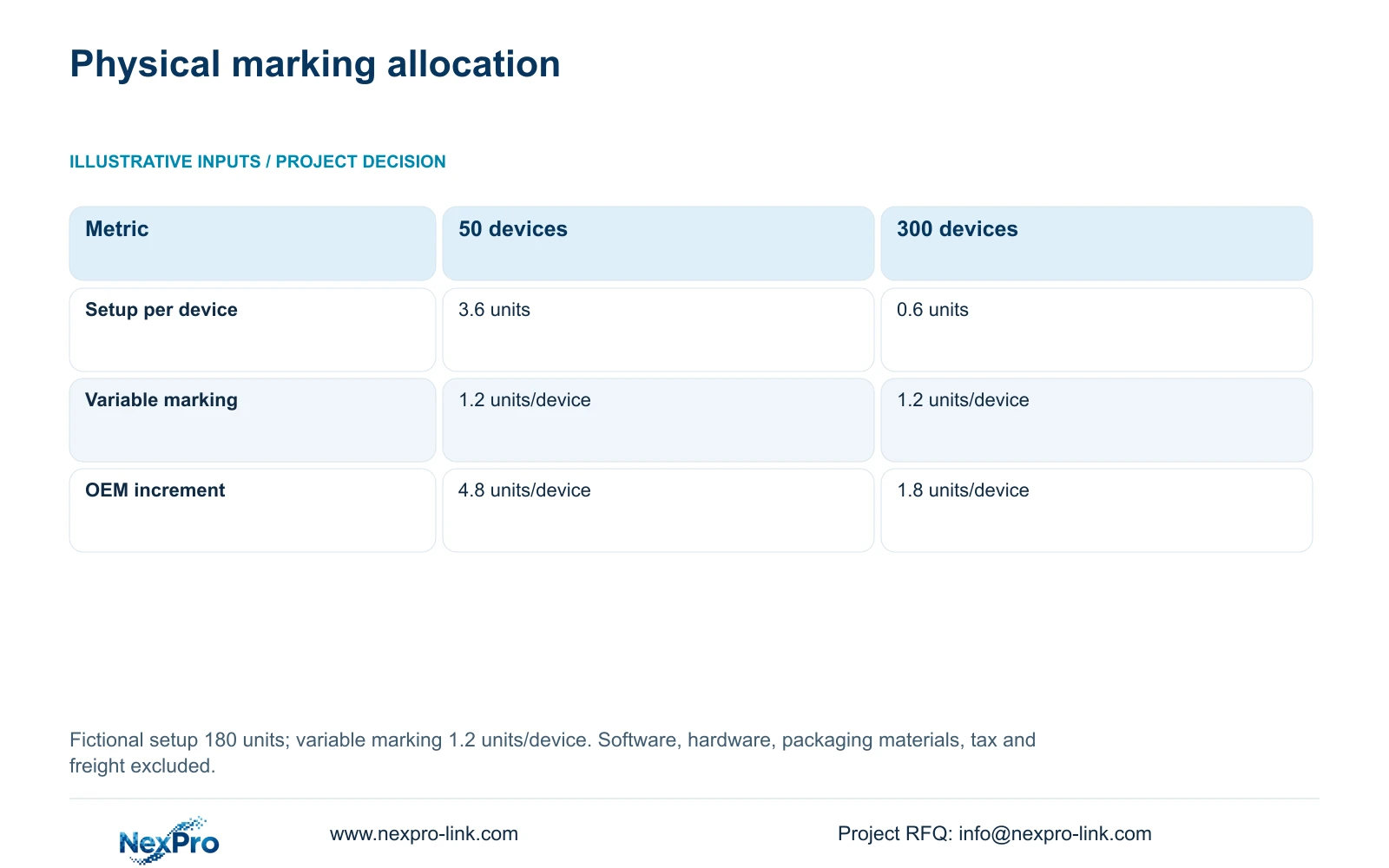
The supplied OEM calculation illustrates marking allocation only. Assume fictional artwork/setup of 180 cost units and variable marking of 1.2 units per device. Apply OEM_unit_cost = setup_units / batch_qty + variable_units. A batch of 50 gives 180 / 50 + 1.2 = 4.8 units per device; 300 gives 180 / 300 + 1.2 = 1.8 units per device.
The lower allocation comes from spreading the same setup across a larger batch. It says nothing about software development, interface testing or ongoing firmware maintenance. Hardware, packaging materials, tax and freight are also outside the calculation. The figures are not NexPro-Link prices, an order threshold or evidence that cameras and NVR panels can share the same preparation.
CASE01 contains one recorder, so neither demonstration batch represents that project's NVR quantity. Request actual setup and variable charges for the selected device lines. If a proposed software change is supported, obtain its separate scope, validation task and support basis. An unquoted software request should remain unresolved rather than being assigned the fictional 1.2-unit marking charge.
| Metric | 50-device batch | 300-device batch |
|---|---|---|
| Setup cost | 180 fictional units | 180 fictional units |
| Setup per device | 3.6 units | 0.6 units |
| Variable marking per device | 1.2 units | 1.2 units |
| OEM increment per device | 4.8 units | 1.8 units |
Section 05
Use supported hardware branding as the procurement baseline
For this factory, the preferred baseline is approved front-panel branding, accurate technical labels and contractor-facing documentation, with the actual software identity retained. This can meet the buyer's equipment-presentation objective while preserving a clear operating and support reference. NexPro-Link's OEM/ODM options provide a basis for discussing those physical and document deliverables.
Add interface work only when the supplier confirms the exact change and the owner has a reason for it. A language or support-information request should describe the required screen and acceptance method. A renamed third-party application needs a separate authorised basis; it cannot be inferred from the housing order or from a supplier's ability to mark hardware.
Retain neutral equipment when brand ownership is unsettled or sample approval threatens the required installation sequence. When comparing another proposal, hold the recording, export and support tasks constant. An alternative with a necessary enterprise workflow may justify a different package, but the cost comparison should identify that workflow instead of attributing the difference to the logo.
Section 06
Turn the OEM request into priced order lines
Write separate order lines for recorder hardware, disks, physical marking, labels, documentation and packaging. State whether requested software work is included, optional, excluded or awaiting confirmation. NexPro-Link's BOQ and tender support can help align model references and technical submissions; the buyer still approves the final commercial and operational scope.
Include packaging languages, carton allocation and destination in the release record. A recorder assigned to the common equipment room should remain identifiable even when cameras are packed by installation zone. Hardware logos and box artwork can use a common brand revision while the firmware record remains independently controlled.
The handover file should let a future technician identify the recorder without relying on the branded front panel. Retain actual model, serial, firmware, disk schedule, software name and accepted support route. Any subsequent change should state which record it supersedes and which checks need repeating. This gives repeat procurement a stable reference without promising that every future variant supports identical customisation.
Section 07
Buyer questions
Can a branded NVR use the standard client application? Yes, that can be the proposed procurement arrangement, subject to the selected model and workflow. The application should retain its accurate identity in instructions and support records; a branded housing does not require application renaming.
Should the purchase order say 'same as approved sample'? Use that phrase only with identifiable sample records. Reference the physical sample revision and the separately approved model, firmware and operating configuration, so appearance approval cannot conceal a hardware or software substitution.
What if software customisation is still unresolved when hardware is ready? Decide whether the confirmed standard software meets opening needs. If it does, release the supported hardware scope and keep the proposed software change separate. If it does not, hold the affected operational package until its workflow is confirmed.
Section 08
Specify your private-label recorder request
Email the recorder model and quantity schedule, panel artwork, requested interface screenshots, and documentation languages with destination to info@nexpro-link.com for a separated hardware, software and support scope.
Engineering references
These sources support the general planning principles. Always use the selected product's current datasheet and applicable project standards for final design.