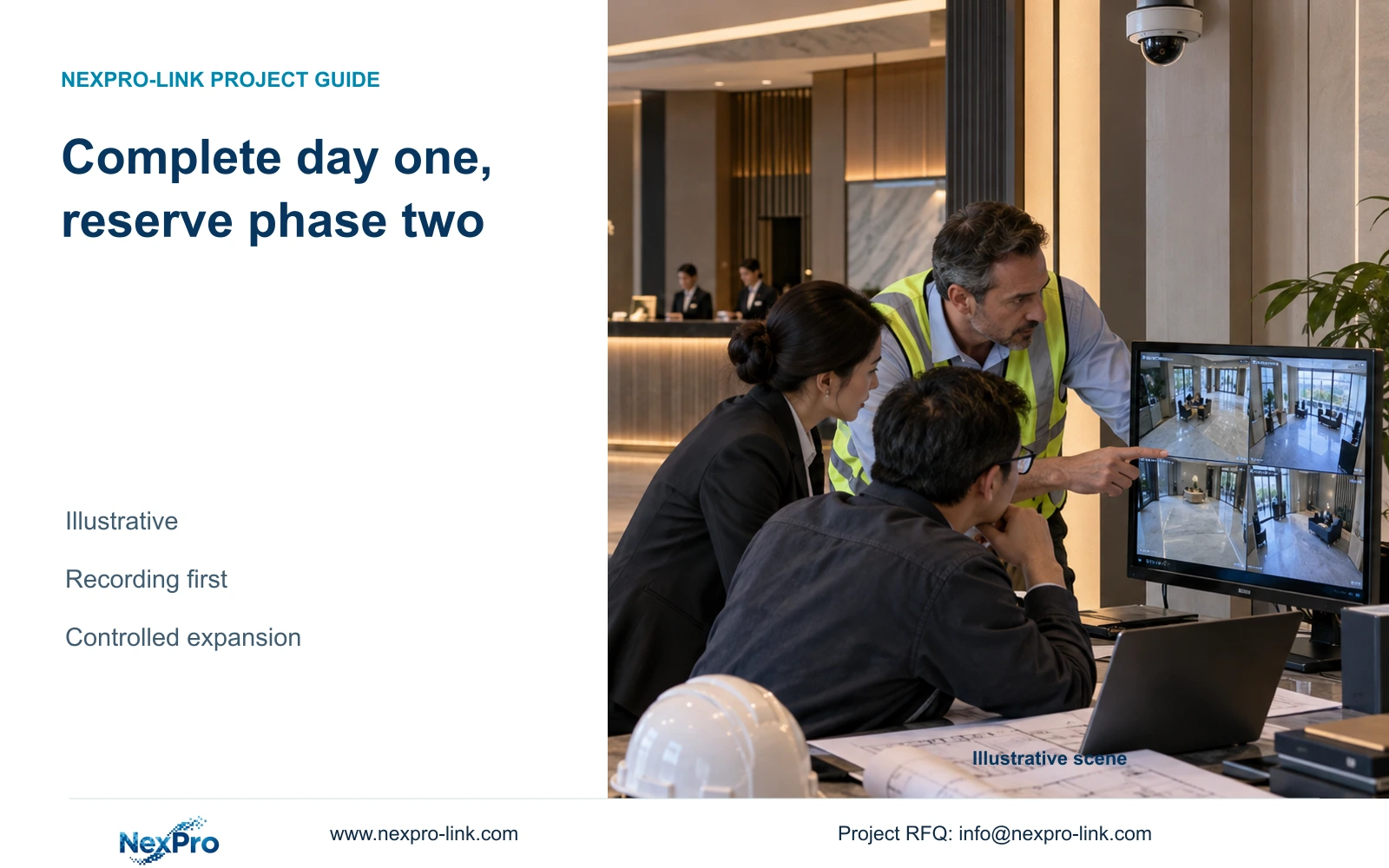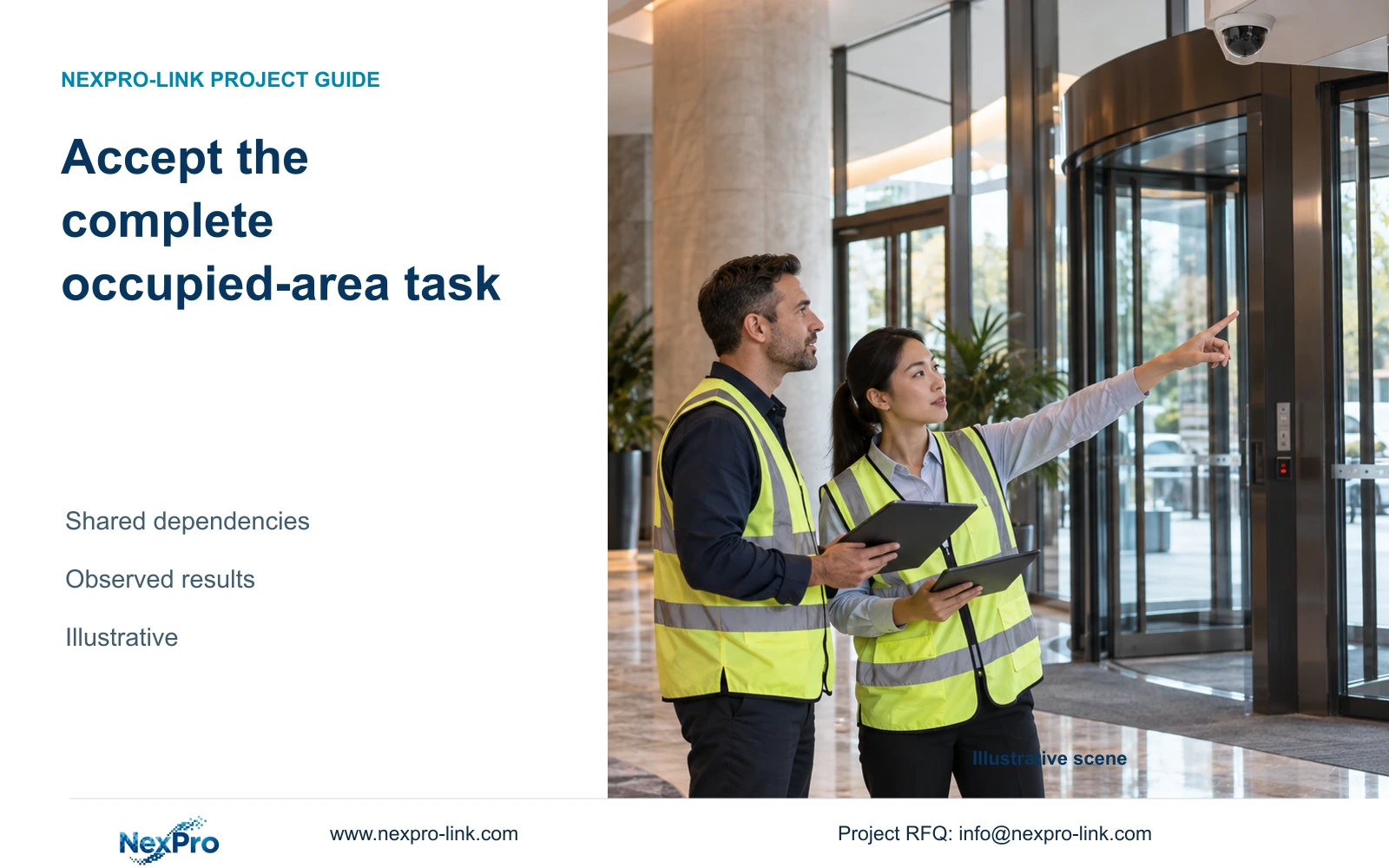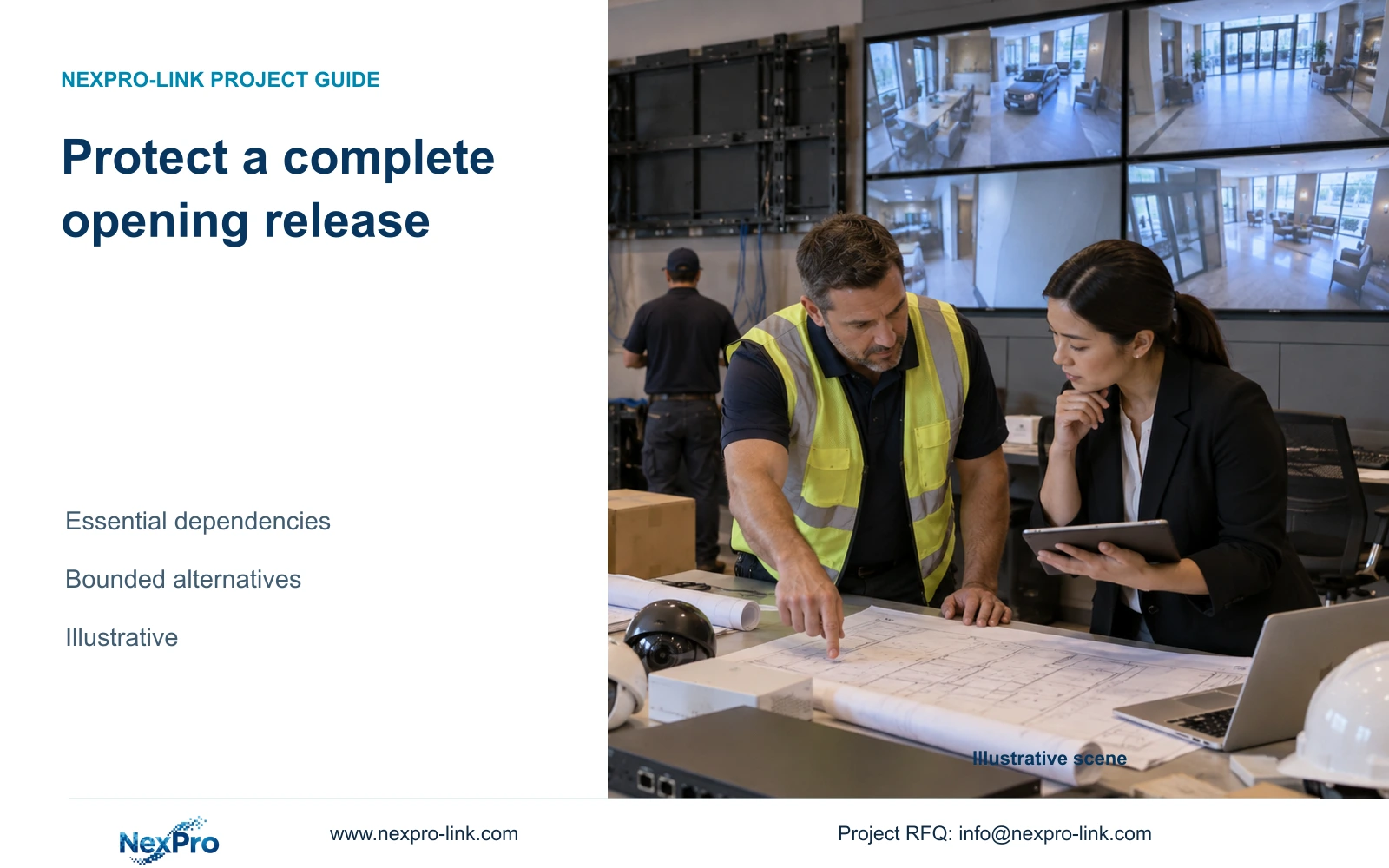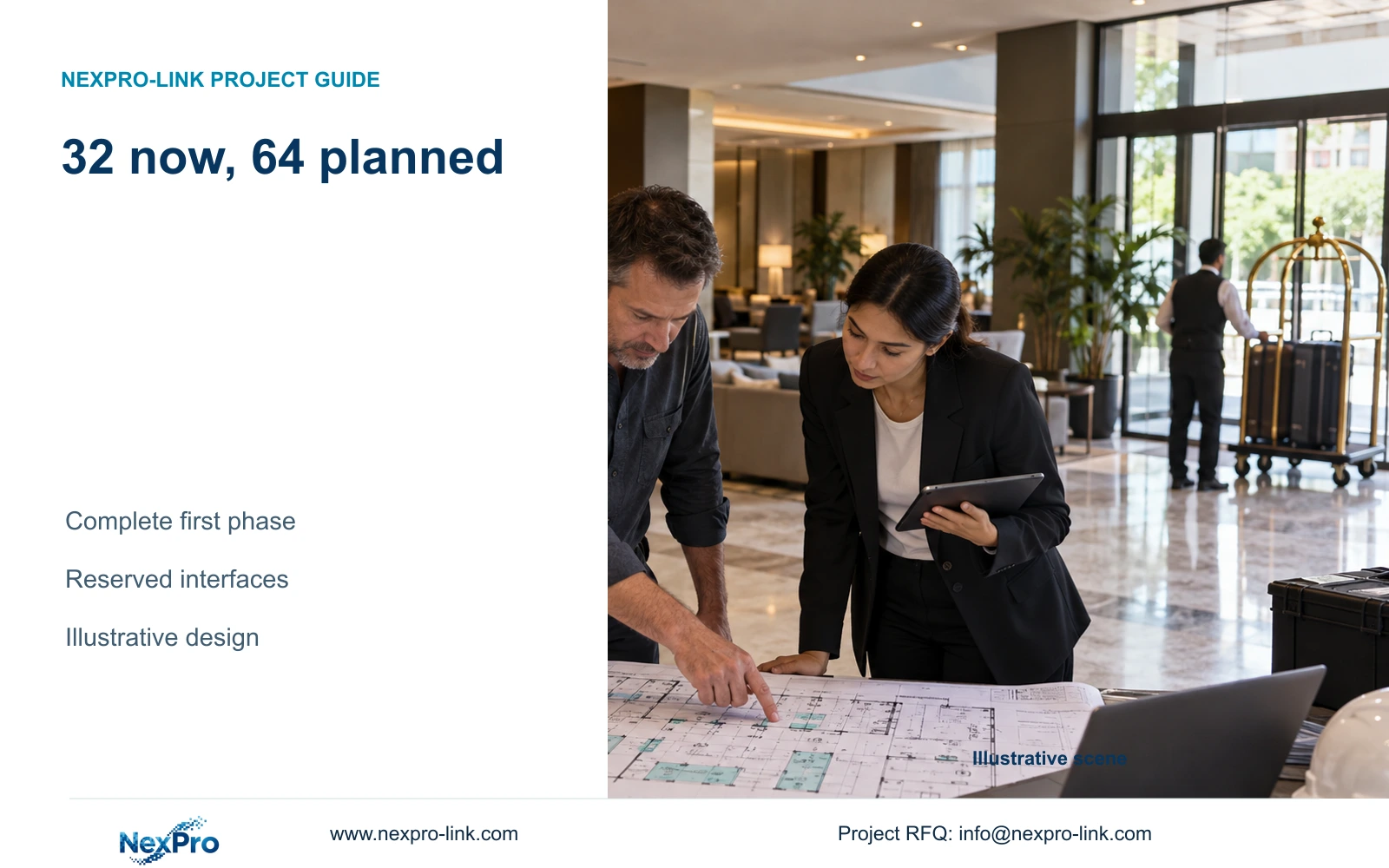
Buy the equipment needed for a complete first operating phase, while reserving the interfaces that let the final 64-camera system expand without replacing a usable core.
Section 01
Fix the day-one operating boundary
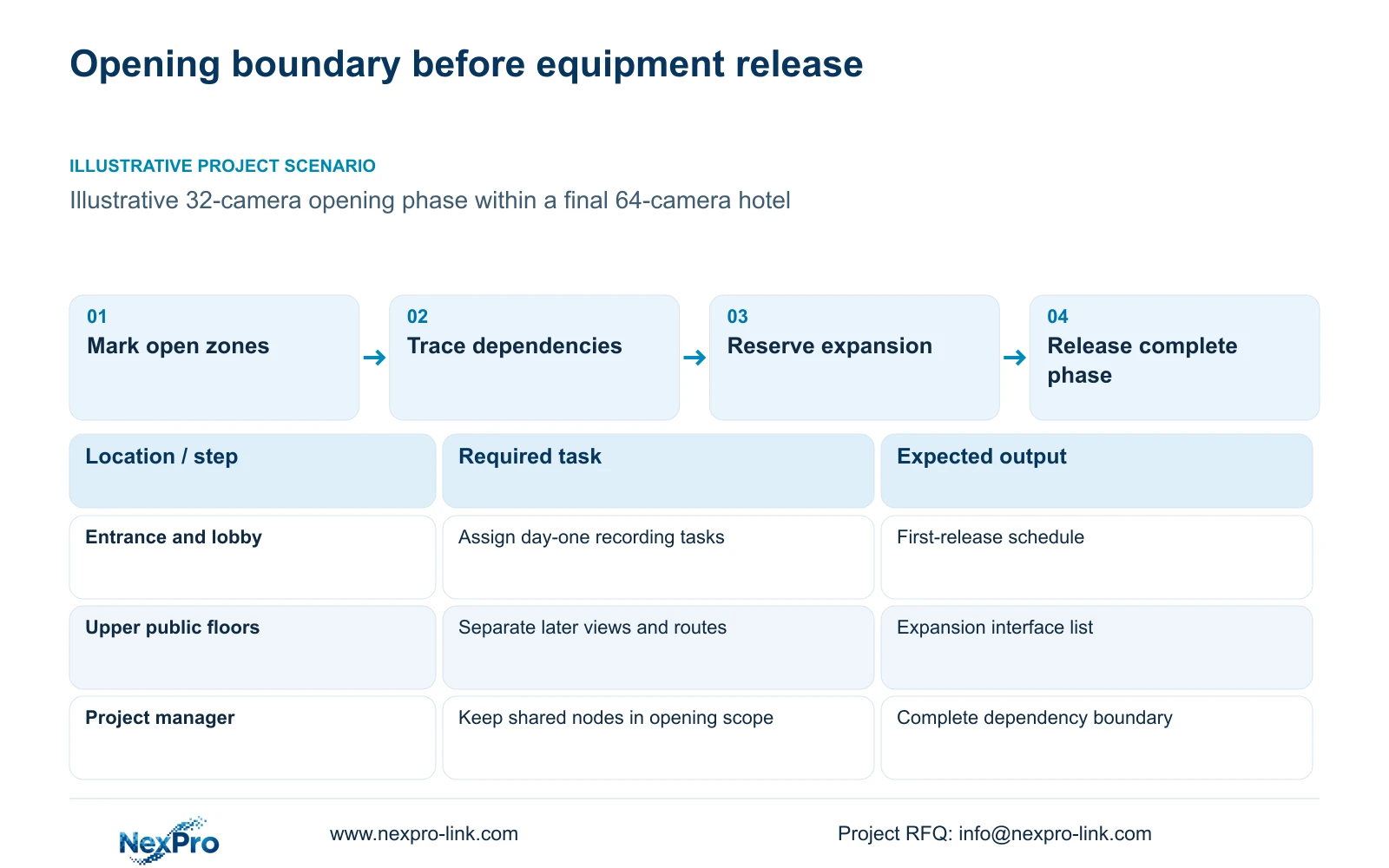
Buy a complete first operating package and reserve defined expansion interfaces when the first opening covers only part of the hotel. Purchase the final core immediately only where its capacity, location and required operating functions are already settled. An uncertain second-phase layout is a reason to defer its cameras and local equipment, while preserving the first phase's recording and backup-power path.
The illustrative CASE06 assigns 32 views to the first public entrance, lobby and open-floor scope, then another 32 to upper floors and a conference extension. Its 200-room background does not determine camera quantity. Each position needs an observation task, an approved view boundary and a phase identity. Public circulation coverage must avoid unnecessary views into private spaces.
Describe opening readiness through observable functions: required scenes are recorded, authorized staff can retrieve an incident, and the selected recording path continues through the agreed outage. A camera delivered for an unopened floor contributes nothing to those first-phase outcomes. Conversely, a shared network node needed by the opening area belongs in the first release even if it also supports later expansion.
| Required task | Given information | Decision still needed |
|---|---|---|
| Opening-area recording | 32 first-phase public-zone views | Approved positions and outage target |
| Final extension | 32 later public-zone views | Routes, interfaces and release date |
Section 03
Calculate each stage without borrowing capacity
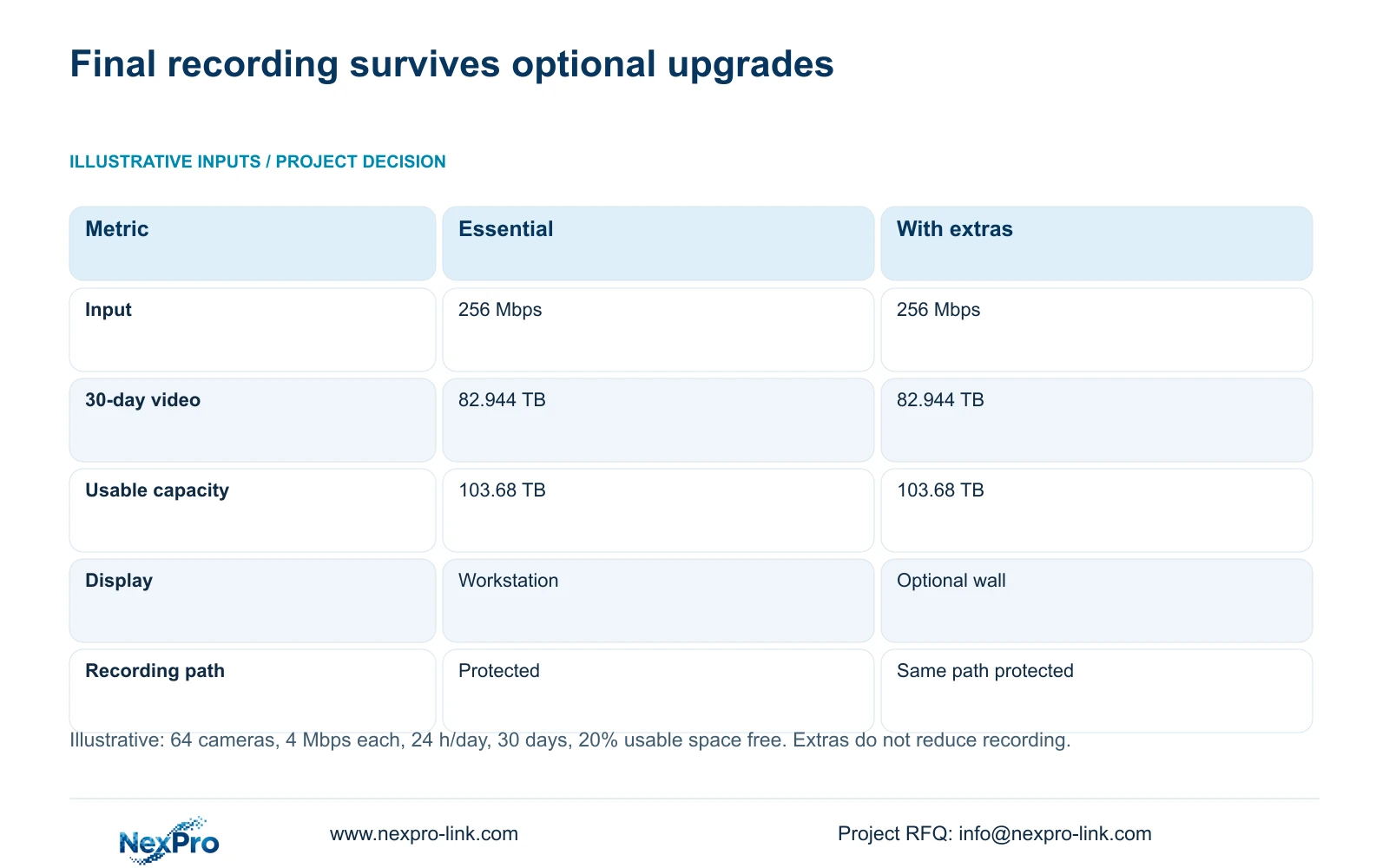
Assume an average 4 Mbps per camera, continuous recording and 30-day retention. These are teaching inputs, not values derived from resolution or a legal retention requirement. Input bandwidth equals camera count multiplied by Mbps. Decimal video TB equals 0.0108 × cameras × Mbps × days. Divide video data by 0.80 to leave 20% of usable capacity free.
The first 32 cameras therefore require 128 Mbps input, 41.472 TB of video and 51.84 TB usable capacity. The final 64-camera scope doubles those requirements. The comparison below holds the final recording task constant while adding optional display or recovery scope. Such additions cannot justify reducing the storage baseline.
CASE06 separately assumes two recorders with four 16 TB drives each: 128 TB raw, 121.6 TB after an assumed 95% formatting allowance, and 97.28 TB available for video after retaining 20% free. That supports the stated 82.944 TB video target without RAID loss. Per 16-camera access group, its assumed 12 W PD peaks require 266.67 W PSE budget with the stated efficiencies and reserve. NexPro SW-POE1618G has no clear total power value and conflicting port-speed fields, so it remains an RFQ candidate, not a confirmed fit.
| Metric | Essential recording-first | Same core with extras |
|---|---|---|
| Recording input | 256 Mbps | 256 Mbps |
| 30-day video data | 82.944 TB | 82.944 TB |
| Required usable capacity | 103.68 TB | 103.68 TB |
| Protected path | Cameras, network and recording | Same plus selected extras |
| Operator display | Task-sized monitor/workstation | Optional wall; recording independent |
| Cost basis | Complete scope quotation | Documented incremental scope |
Section 04
Give temporary equipment a destination
A temporary item should have a stated reuse, spare or removal role. A small monitor may remain useful for maintenance after a control-room upgrade. A temporary recorder requires more scrutiny because its footage, disk compatibility and operator search path may need migration. Include that work in the comparison with a permanent first-phase recorder.
Price the temporary arrangement with installation, later removal, configuration and any replacement accessories. Compare local spares and replenishment separately. Similar housings do not prove interchangeable firmware, lenses or power requirements. Equipment containing recordings or credentials needs an authorized handling process before return or reassignment.
Early receipt also affects service timing. The supplied policy record gives applicable main equipment a 24-month limited hardware baseline from receipt, subject to controlling written order terms. Deferred opening does not automatically reset that start event. Batteries, disks, cable and OEM conditions require their own scope; remote technical support does not establish included site labour.
Section 05
Release a working package at each milestone
Prepare each release around its operating area. Include the approved camera schedule, recorder and disk arrangement, port allocation, protected-power boundary and configuration identities. Separate supplier preparation from site readiness so equipment arrival is not confused with an operational handover.
Acceptance should demonstrate recorded movement at representative public-zone positions, retrieval and export of an authorized time window, and the agreed outage state. Factory-reproducible checks support equipment preparation; they cannot establish hotel lighting, installed cabling or local power performance.
During phase-two connection, repeat the first-phase tasks that share changed resources. Record unresolved functions, their responsible parties and repeat-test conditions. A larger display is worthwhile where multiple operators need persistent shared views, but its acceptance and extra electrical load must remain separate from the recording release.
Section 06
Buy settled interfaces now and uncertain scope later
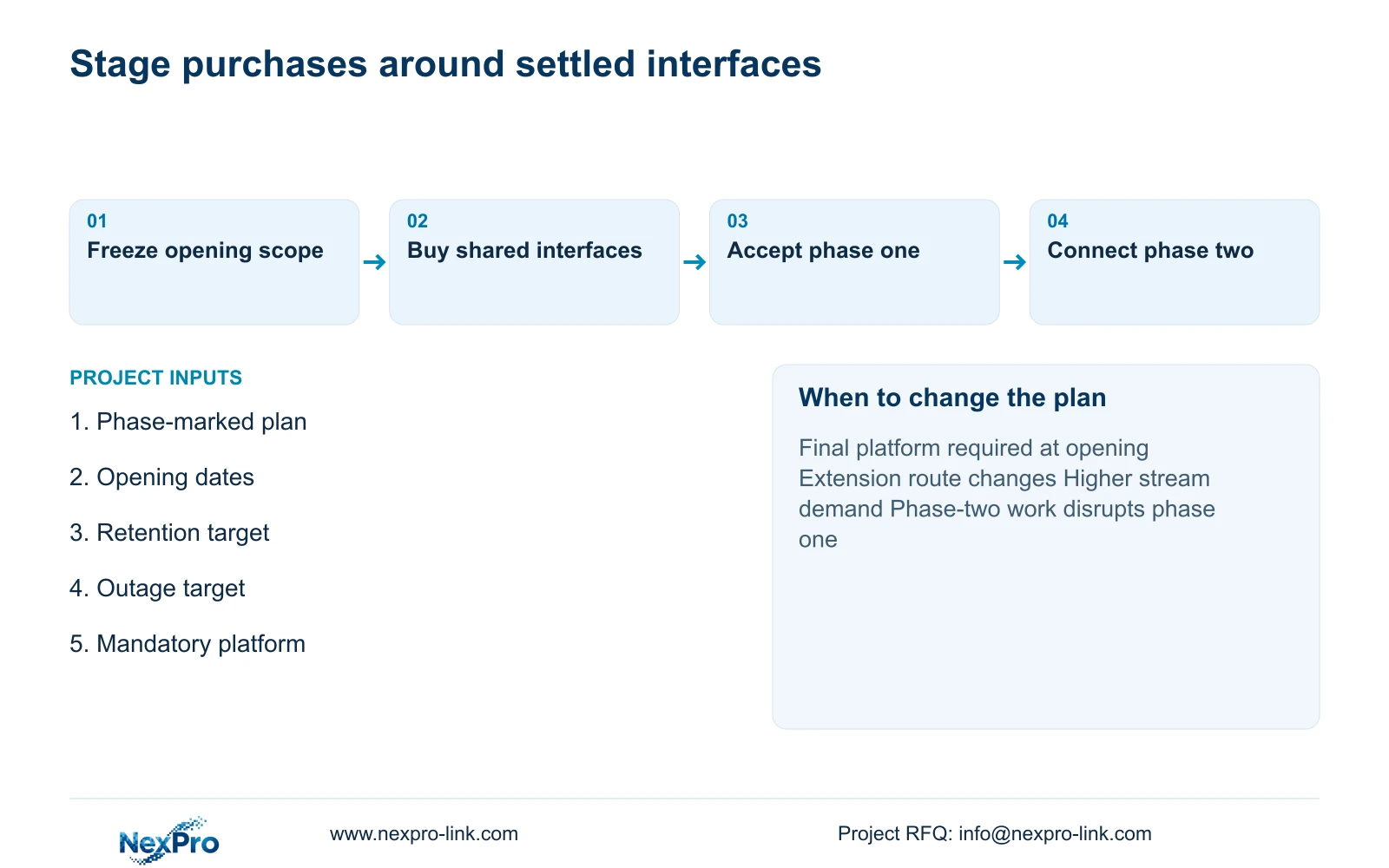
Start with the complete 32-camera operating release, permanent shared interfaces where approved, and documented expansion allowances. Release the second recorder, later access nodes and unopened-area cameras against the confirmed second-phase schedule. Change this recommendation if the operator requires centralized final-platform functions at opening or if later connection would disrupt an essential first-phase service.
The full CASE06 power budget is independently assumed at 1,187.54 W for its base arrangement. It must be divided among actual protection zones. SP2KR(S), rated 2 kVA/1800 W, is a capacity candidate for that aggregate comparison, not a guarantee that one centrally installed unit powers dispersed nodes or achieves a particular runtime.
Send the phase-marked public-area plan, opening dates, retention and outage targets, and mandatory platform requirements to info@nexpro-link.com. NexPro-Link's hotel project and BOQ support can address model matching and coordinated equipment supply. Its CCTV manufacturing scope and supporting-category coordination should be stated separately from local installation responsibilities.
Section 07
Buyer questions
Must both recorders be purchased before the first opening? Only if both are needed for opening functions or a settled procurement constraint. Ask for separate first-release and expansion BOMs, with the later recorder's interface and configuration requirements recorded.
What should a phase-two quotation identify? It should identify added equipment, resources reused from phase one, connection work and required repeat tests. Any changed bitrate, retention or outage target needs a revised capacity calculation.
Can the first release use neutral packing? Yes, packing can follow the agreed project scope. Preserve model and serial identities plus phase and location labels. Hardware branding does not grant permission to rename third-party software.
Engineering references
These sources support the general planning principles. Always use the selected product's current datasheet and applicable project standards for final design.