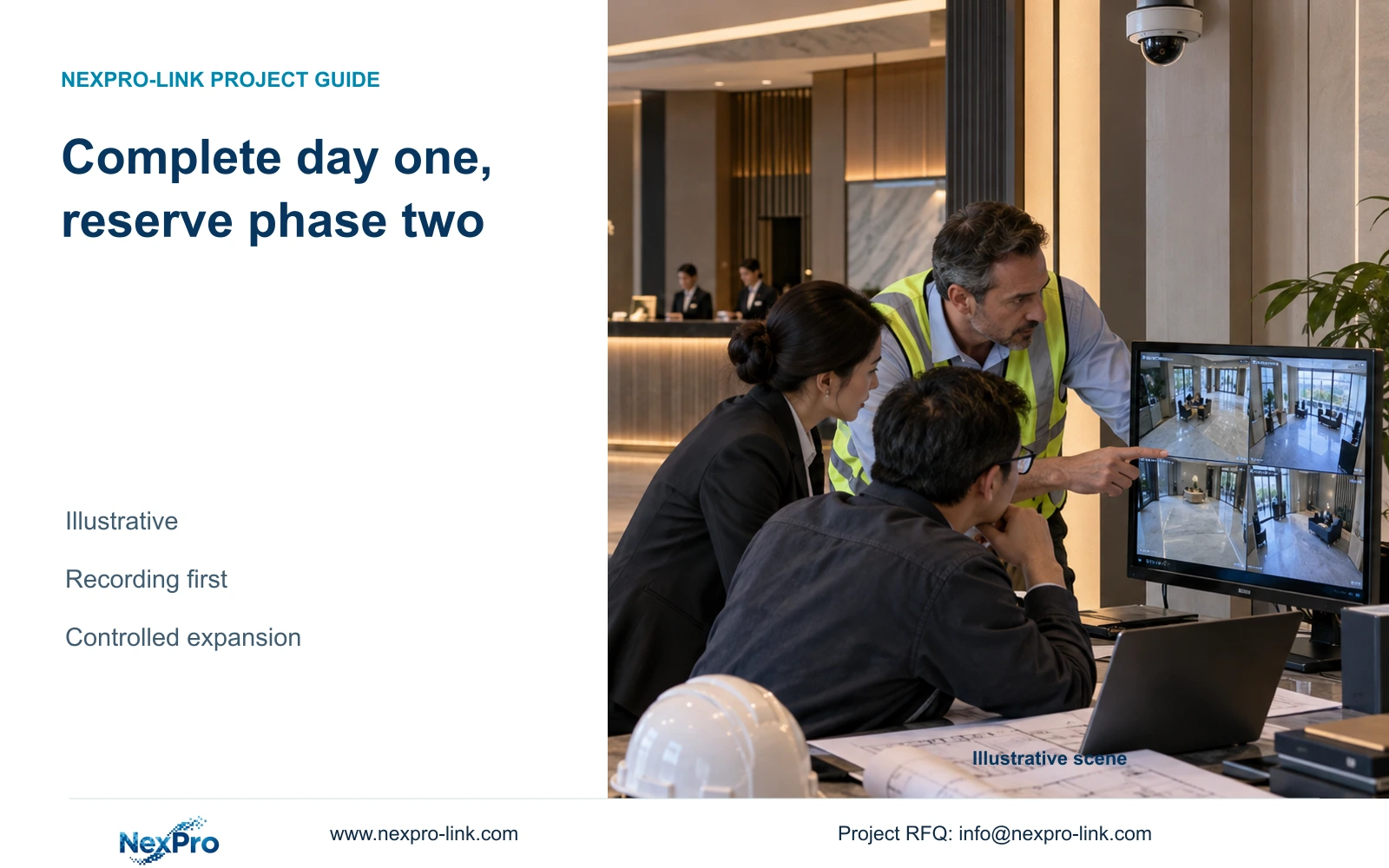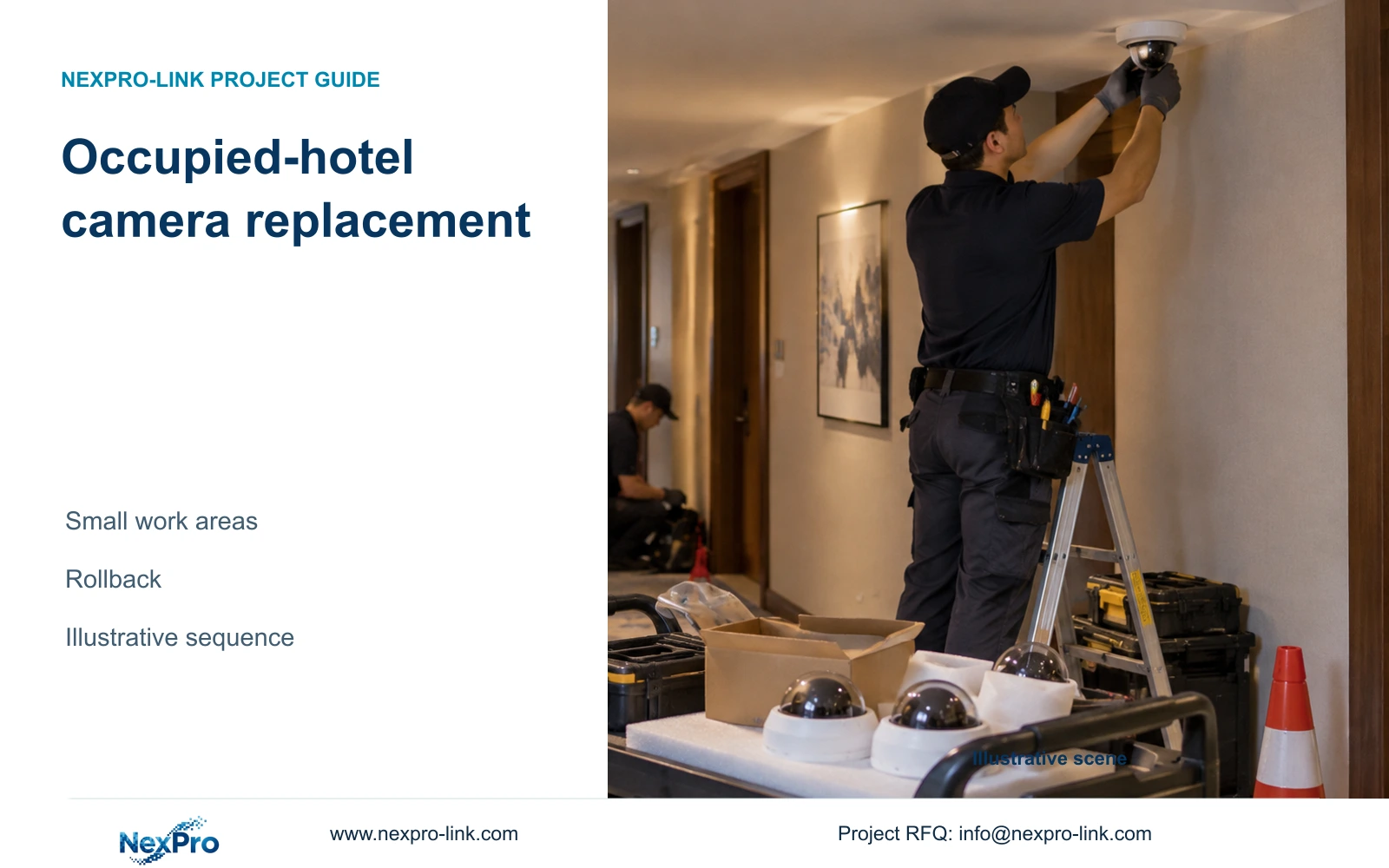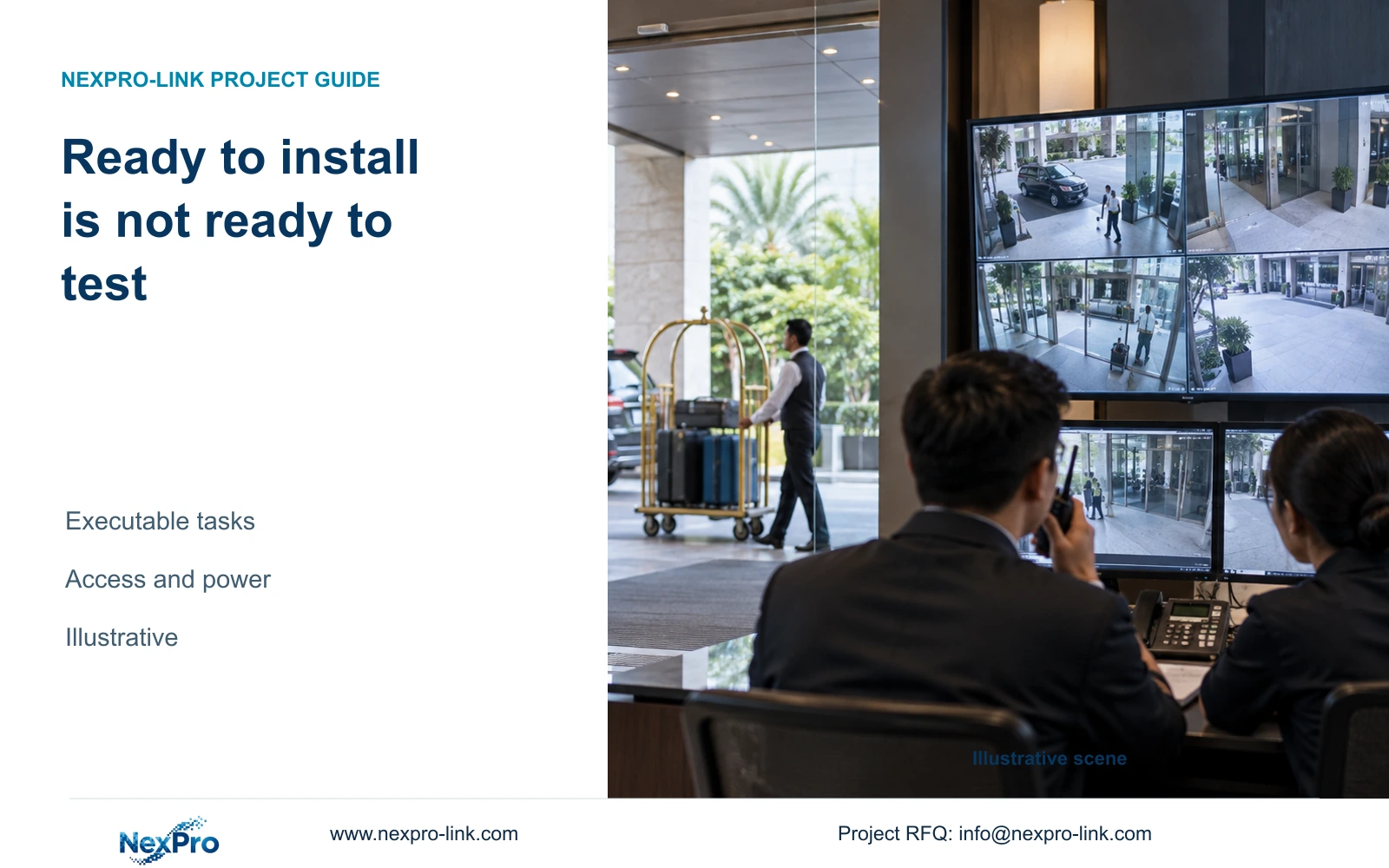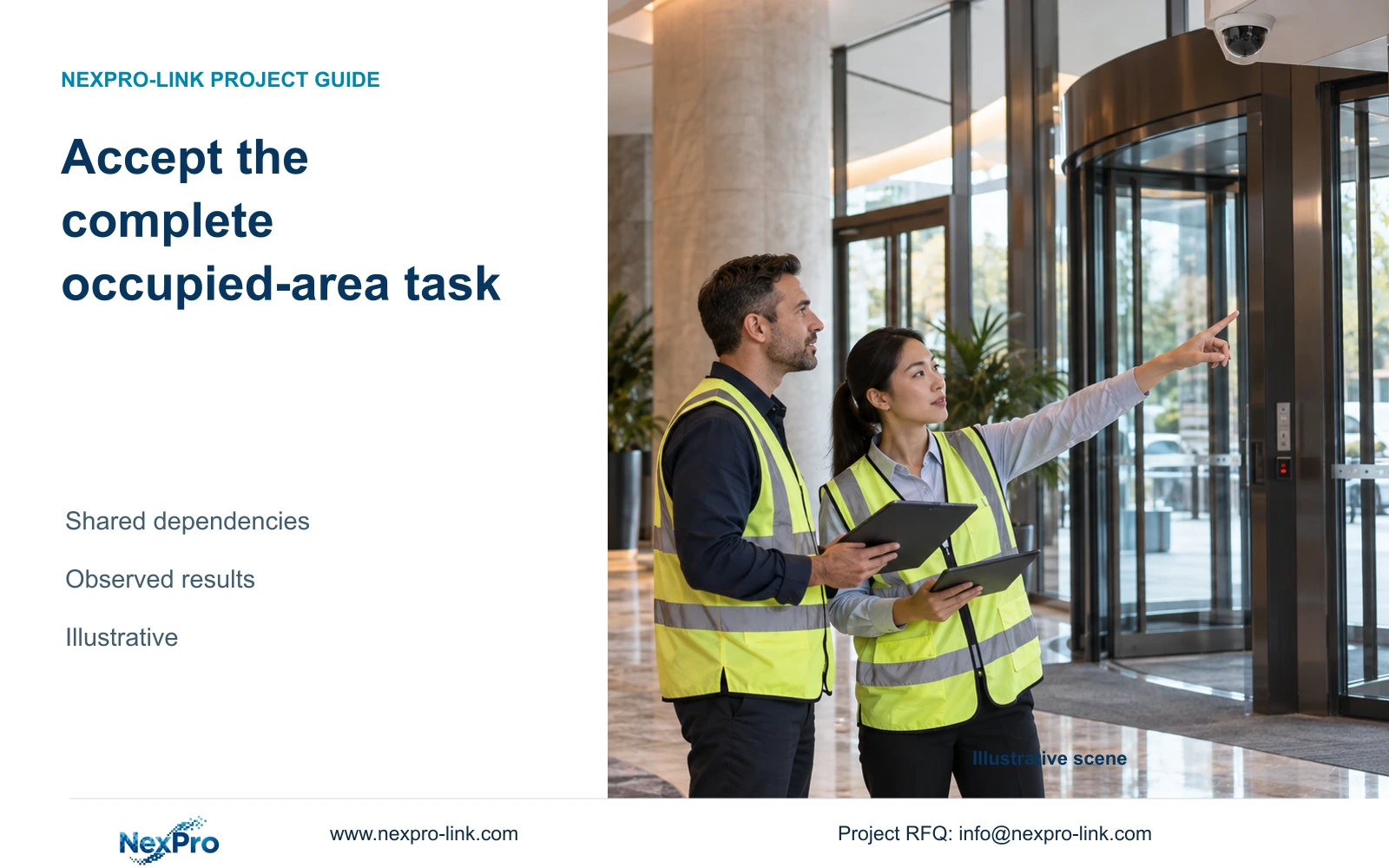
A partial equipment pass supports soft opening only when the occupied area's complete recording and operating tasks have been demonstrated, including shared network and protected-power dependencies.
Section 01
Define the area eligible for acceptance
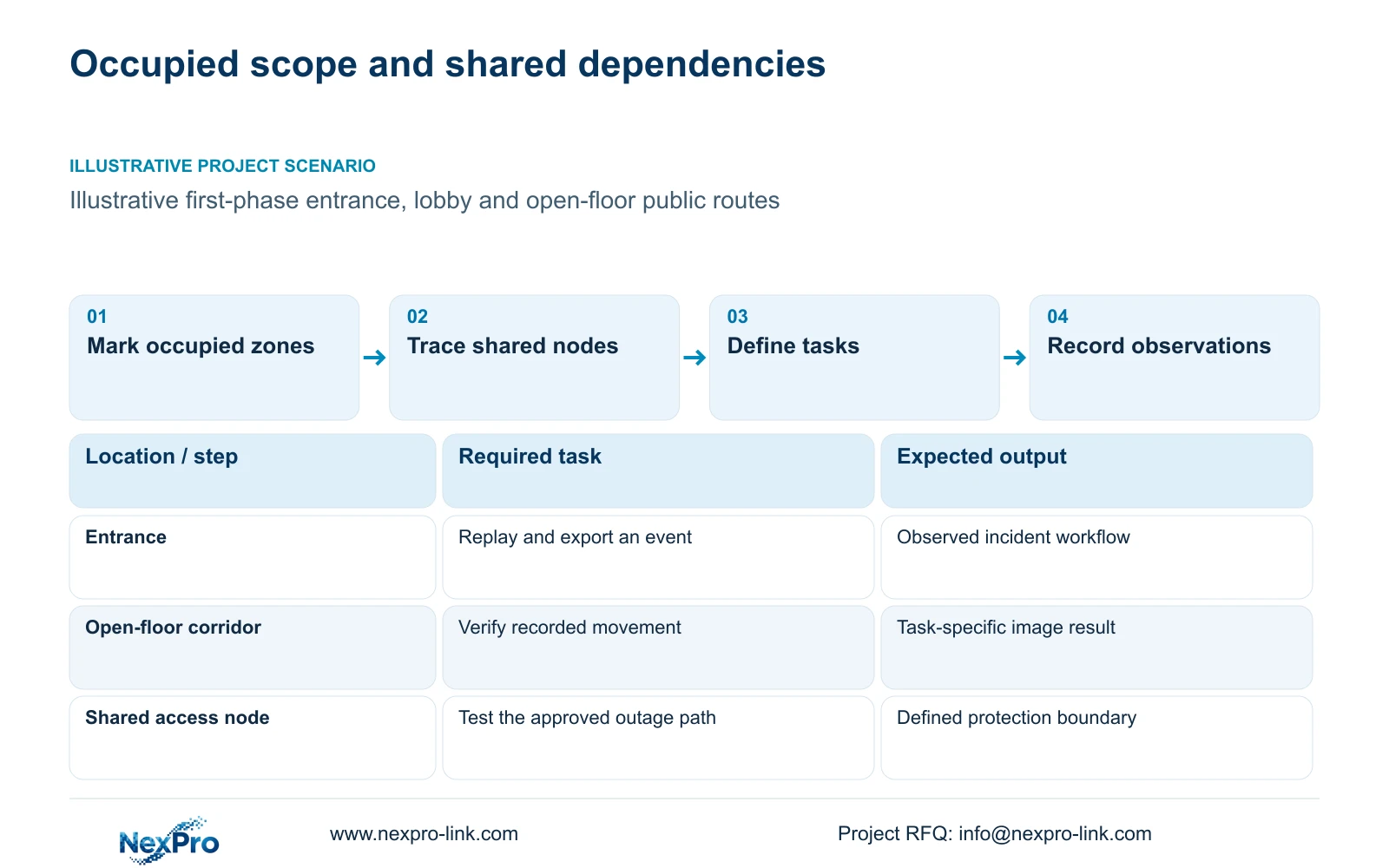
Accept a soft-opening security scope only when the occupied area's required recording, retrieval, permissions and operator tasks have been demonstrated through their complete dependencies. If a shared network or power resource remains untested, keep the affected operating task open even when individual cameras show clear live images.
Mark the entrance, reception, open-floor public routes and service areas included in the release. Show unopened areas separately and identify any resources within them that support the occupied zone. A switch in a closed construction area may still be essential to the lobby's recording path. Physical occupancy boundaries and technical dependencies therefore need separate records.
Define observable outcomes for each accepted task and record the model, firmware and relevant conditions. Night movement, incident retrieval and operation during the selected outage state require different observations. Keep private interiors outside routine coverage and limit test material to the authorized task. Expected outcomes belong in the criteria column until someone records the actual result.
| Required task | Given information | Decision still needed |
|---|---|---|
| Retrieve an entrance incident | Entrance camera assigned to first phase | Which recorder and authorized user complete retrieval? |
| Record open-floor public routes during outage | Cameras installed in occupied area | Which access nodes and power zones must remain operational? |
Section 03
Demonstrate normal and outage workflows
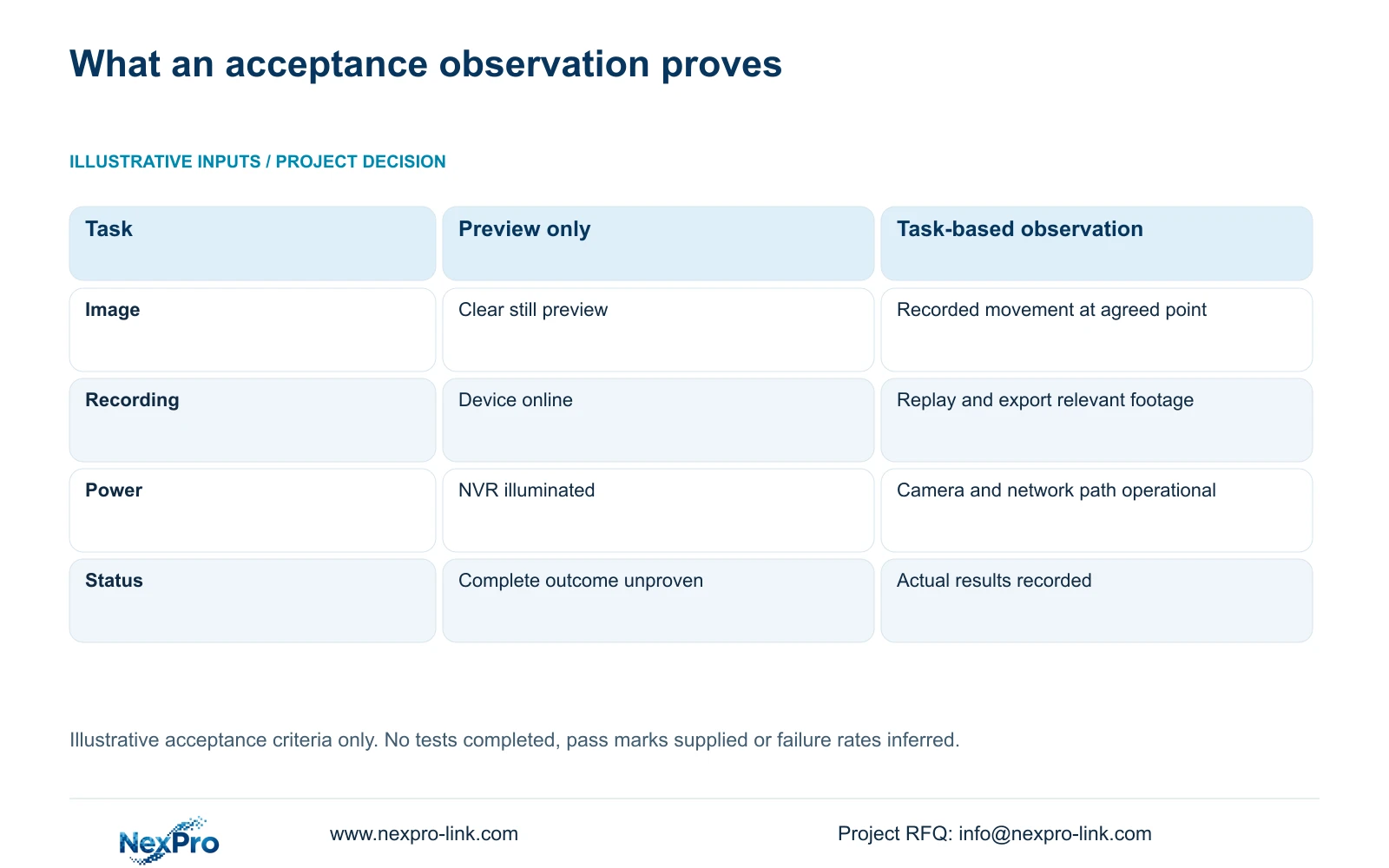
Use the observation log to tie each actual result to the opening scope and configuration. The retained illustration compares preview-only and task-based criteria; it is not evidence that this hotel has passed. Record the responsible observer and disposition when tests occur. A planned criterion is not an accepted result, and unobserved conditions must remain open.
For normal operation, review recorded movement at the agreed location and relevant lighting condition. Have an authorized operator locate the requested time window, replay it and export a usable clip. A still preview can support aiming checks, but it cannot establish that movement was recorded clearly or that the incident workflow works.
For an outage observation, the responsible professionals should test the approved protected path under the agreed conditions. Record whether cameras, access nodes and recording continue as required. A lit NVR front panel supplies little information about a camera whose remote switch has lost power. Capacity nameplates also do not establish battery runtime.
Factory checks cover conditions reproducible before shipment. Site checks cover the hotel's actual lighting, installed links, network permissions and operating arrangements. A factory pass can be retained as evidence for its scope, while site-specific tasks remain open until observed. A limited sample cannot establish zero defects across every device or operating condition.
| Task | Scope/configuration to record | Evidence and disposition |
|---|---|---|
| Recorded public-route detail | Opening point tags, lighting and stream profile | Named movement observation; unobserved conditions stay open |
| Incident retrieval/export | Authorized role, recorder/client versions and time window | Actual replay/export result and unresolved permission |
| Protected recording | Required local and shared nodes; approved outage state | Observed chain behavior, not an illuminated-NVR pass |
| Deferred shared dependency | Resource still serving occupied areas | Owner, interim limit and agreed corrective/retest window |
| Release decision | Accepted opening functions and excluded/deferred tasks | Authorized disposition; no invented acceptance date or signature |
Section 04
Separate accepted tasks from unresolved work
Write the acceptance record around tasks, with the observed result, conditions and configuration reference. List unresolved work separately, naming its owner and the observation required after correction. A missing export permission and a failed cable link may block the same incident task while requiring different people to resolve them.
Record the boundary of every accepted result. A successful daytime entrance test says nothing about an unobserved night condition. An outage test of a central rack does not cover a remote node omitted from that test. This precision allows useful partial acceptance without extending it beyond the evidence.
Close an item by repeating its original task under the relevant conditions after the correction. Preserve the earlier observation and the changed configuration so the record shows why the new result applies. Administrative closure alone does not demonstrate restored service, and changing the test to avoid the failure leaves the original requirement unresolved.
Section 05
Compare conditions for a usable first release
A staged release can proceed when its essential tasks are complete and later work is technically bounded. An optional wall display can remain outstanding if the accepted operator arrangement provides the agreed viewing, retrieval and export functions. A missing switch or unresolved recording allocation cannot be treated the same way.
Price any temporary arrangement with its later work visible. Include configuration changes, removal or reuse, operator instruction and repeat testing. Do not present a temporary monitor as equivalent to a mandatory multi-operator wall unless the hotel explicitly accepts the changed operating arrangement.
The cost manager should distinguish unfinished scope from an approved omission and from a temporary substitute. The project manager can then tie payment or release discussions to the actual accepted boundary under the contract. This article supplies an engineering method, not a replacement for the project's contractual acceptance provisions.
| Retained outcome | Extra scope | Worth buying when | Condition against it |
|---|---|---|---|
| Required incident handling | Temporary operator display | Final display can arrive later without losing tasks | Operator requires the final wall at opening |
| Complete first-phase recording | Separate release and retesting | Later work is isolated and access is controlled | Shared dependencies remain incomplete |
Section 06
Define what requires another acceptance check
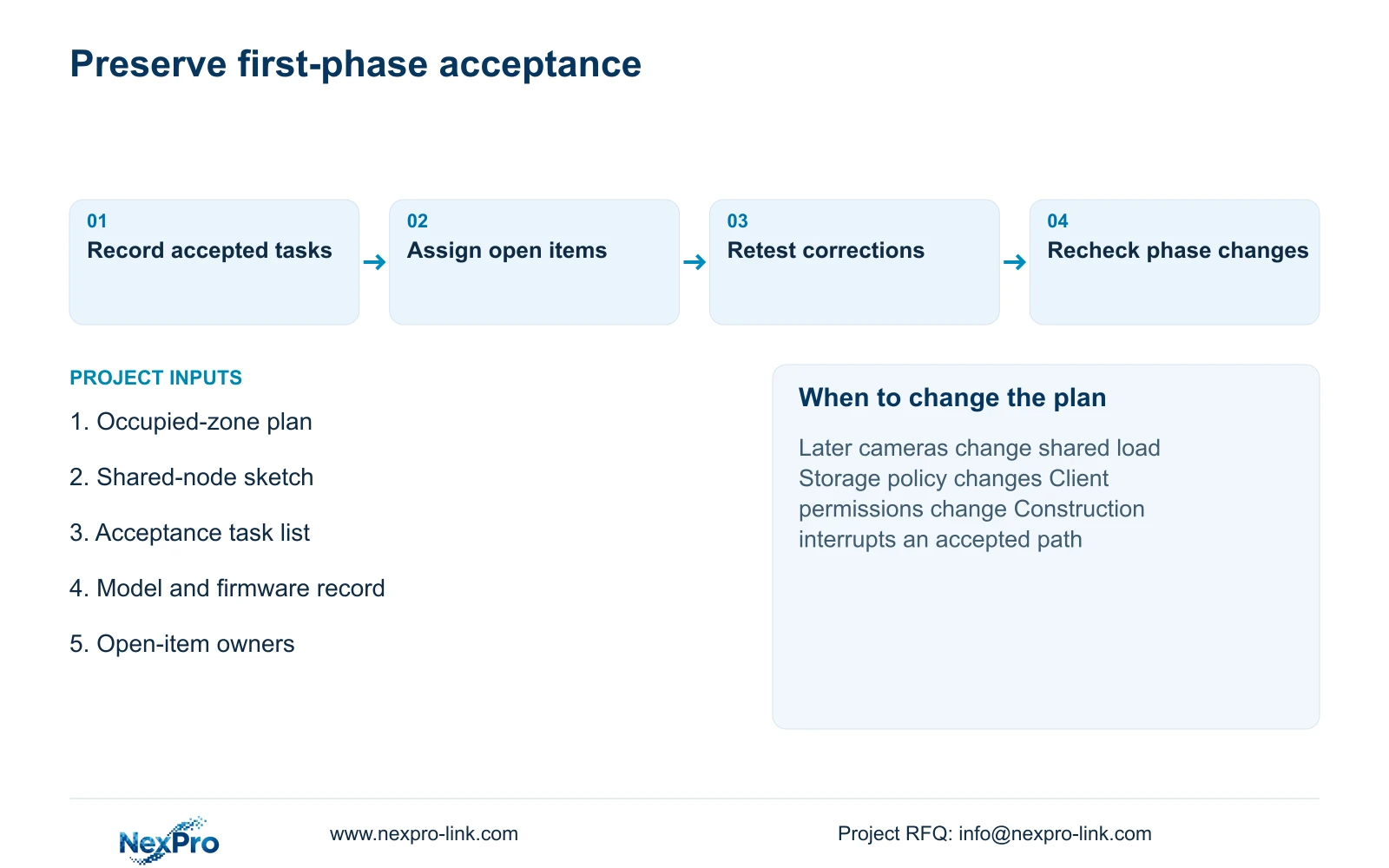
Recheck the affected first-phase tasks when later cameras are connected, a shared switch is changed, storage policy is revised or the client version and permissions change. Include operator-role changes in the handover record. The trigger should identify the task to repeat, not merely require another general demonstration.
Recommend task-based staged acceptance when the complete occupied-area path is demonstrated and outstanding work has a defined boundary. Hold affected acceptance if later construction interrupts that path or if mandatory operator conditions cannot be met. The supplied public policy gives applicable main equipment a 24-month limited hardware baseline from receipt; soft opening does not automatically reset it, and accessories follow their scoped terms.
Send the occupied-zone plan, dependency sketch, selected acceptance tasks and current open-item list to info@nexpro-link.com. Add the opening milestone and available test windows. NexPro-Link can discuss equipment and technical-document support, while the project's authorized parties retain site acceptance and local installation responsibilities.
Section 07
Buyer questions
Does a factory acceptance pass remove the need for site testing? No. Retain the factory result for its documented model and conditions. Actual hotel lighting, installed cabling, permissions and outage paths still require relevant site observations. Avoid paying for duplicate demonstrations while leaving those site-specific tasks untested.
Must every final-phase camera be installed before soft opening? The first release can be assessed independently when its agreed operating tasks and shared dependencies are complete. Unopened-area cameras may remain outside that boundary, but a resource serving both phases cannot be excluded simply because it sits in an unopened area.
Can NexPro-Link provide the entire acceptance service? Equipment records and scoped technical support can be discussed. Attendance, local installation, electrical testing and formal acceptance authority must be named in the agreed project scope. Coordinated supply does not automatically include those responsibilities.
Engineering references
These sources support the general planning principles. Always use the selected product's current datasheet and applicable project standards for final design.