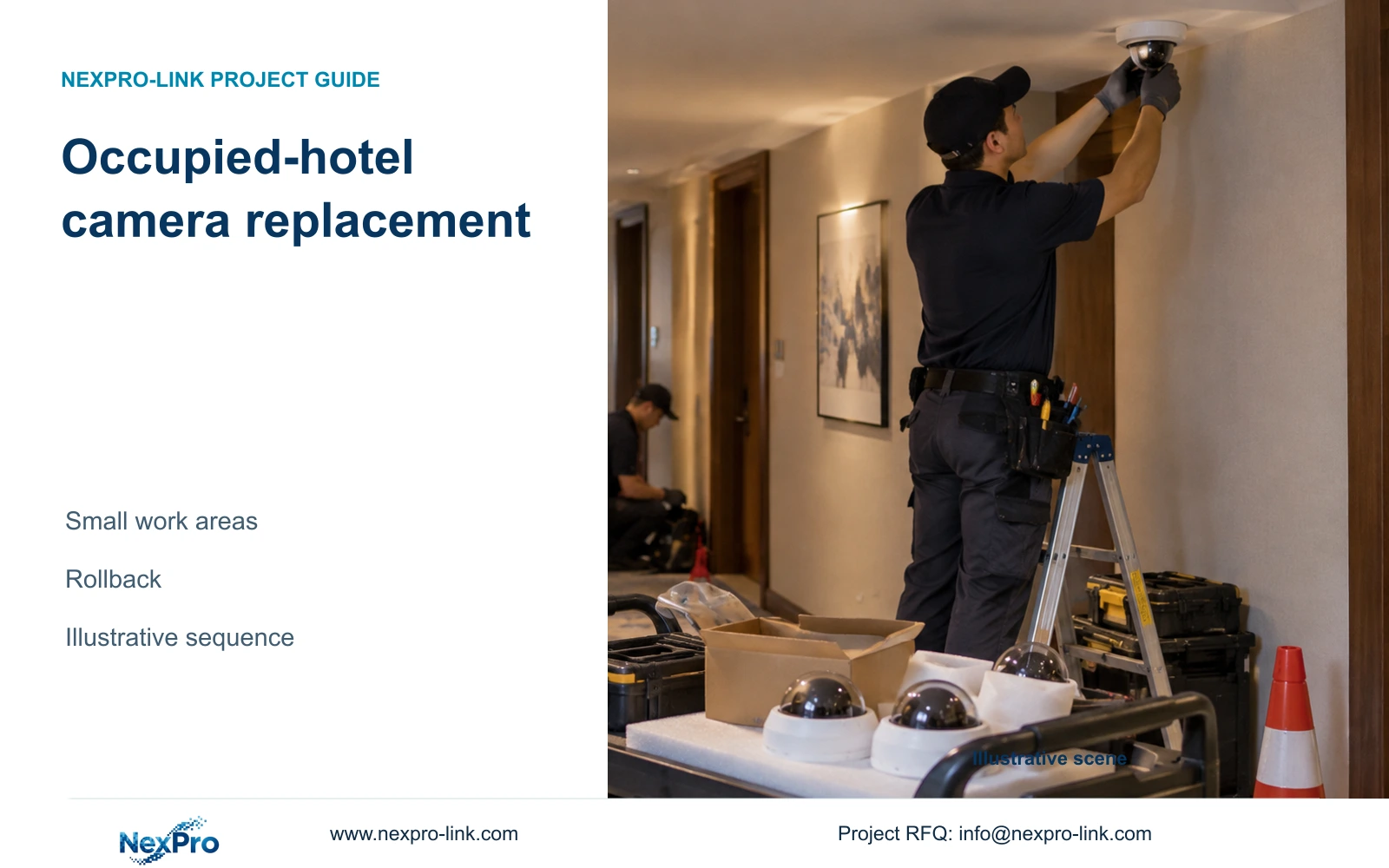
Replace cameras in small approved work areas, with configurations prepared and rollback available. Release each area only after its required recording and retrieval tasks are checked.
Section 01
Confirm the permitted work windows
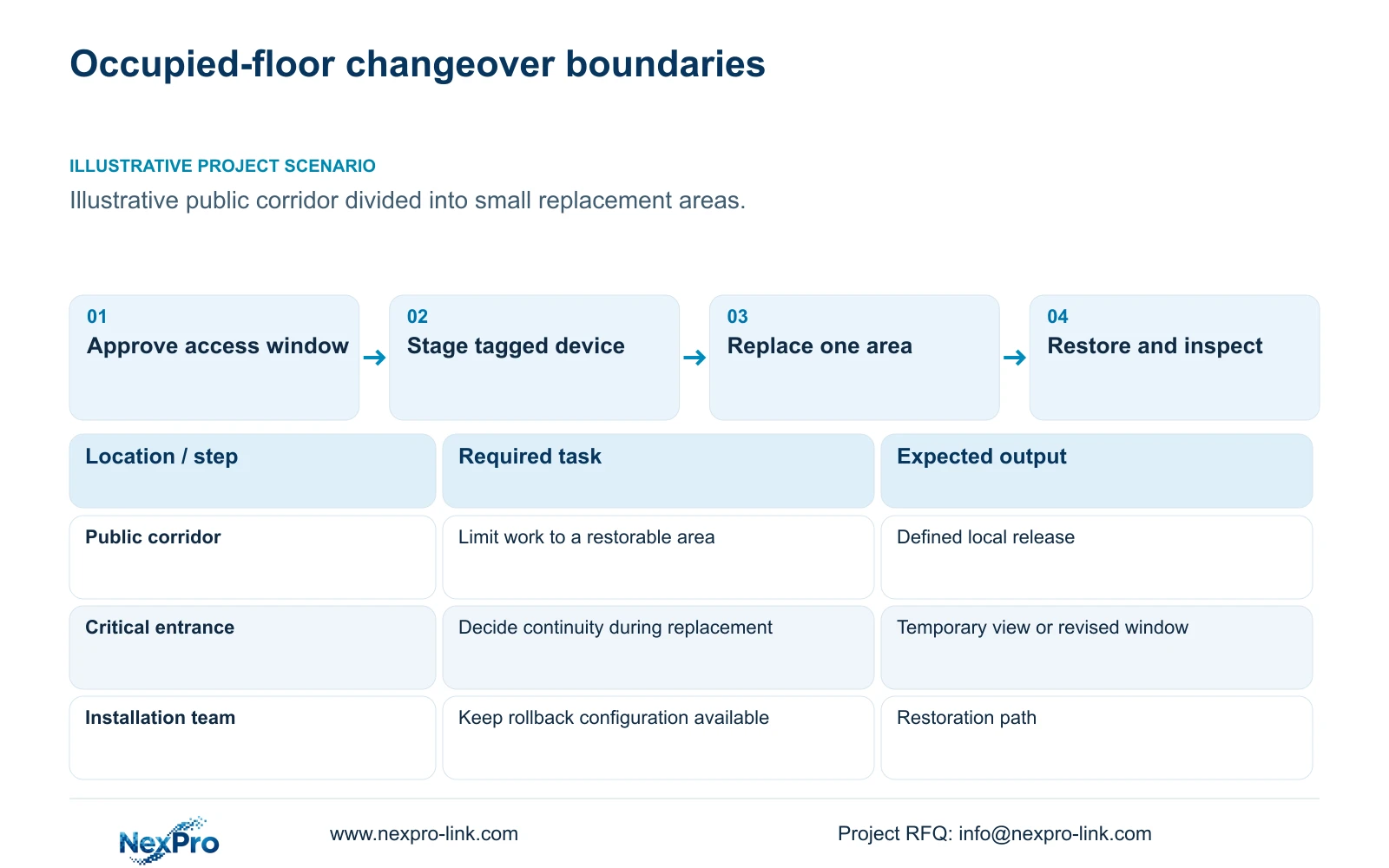
Use small, approved replacement areas when an occupied hotel has limited access and noise windows. Prepare each camera configuration and a usable rollback arrangement before disconnecting the existing unit. Change to a different sequence when floor access or a critical coverage requirement makes that approach impractical. Do not promise absolute zero recording interruption.
Work backwards from the time each public-area task must be restored. Separate delivery readiness from permission to enter the floor, perform noisy work and interrupt recording. Hotel operations should identify the usable access periods, while the technical team defines the checks needed before the area can be released.
Record the scope of each window against camera tags and corridor areas. Allow time within the approved activity plan for mounting, connection, image adjustment and recording checks. If the window cannot accommodate restoration or rollback, reduce the work area or reschedule the change. A shipment date alone does not establish that the replacement can proceed.
| Required task | Given information | Decision still needed |
|---|---|---|
| Replace a corridor camera | Restricted floor access and noise periods | Work area that can be restored within the window |
| Retain a critical entrance task | Recording interruption is possible | Approved temporary coverage or alternative timing |
Section 02
Prepare the replacement configurations
Map every new device to its existing camera tag and required task. Prepare the supported stream settings, network arrangement and recorder connection before the site window. Keep credentials within the hotel's approved process rather than putting them on cartons or public documents. Configuration readiness should be checked on the exact device and software combination.
Confirm mounting, power and lens requirements as well as resolution. Similar housings do not establish interchangeable brackets or camera behaviour. The supplied DM2812M PDF can inform a candidate selection, but its Dome designation does not prove an IK rating, and motorized zoom does not imply PTZ operation.
Group genuinely interchangeable devices for packing and contingency stock. Floor-based labels can reduce sorting at the work area when they preserve real model and serial identities. NexPro-Link's OEM and project-packing scope can support agreed labels and packaging; hardware branding does not establish a right to rename third-party software. Define the old configuration and the conditions for restoring it if the new task fails.
Section 03
Compare floor-by-floor and mixed sequencing
Floor-by-floor work keeps installation and inspection concentrated in one area when access is predictable. Mixed sequencing can suit separately available windows, but requires clear device allocation and status tracking across open areas. Prefer the sequence that allows each changed task to be restored and checked before another dependent task is interrupted.
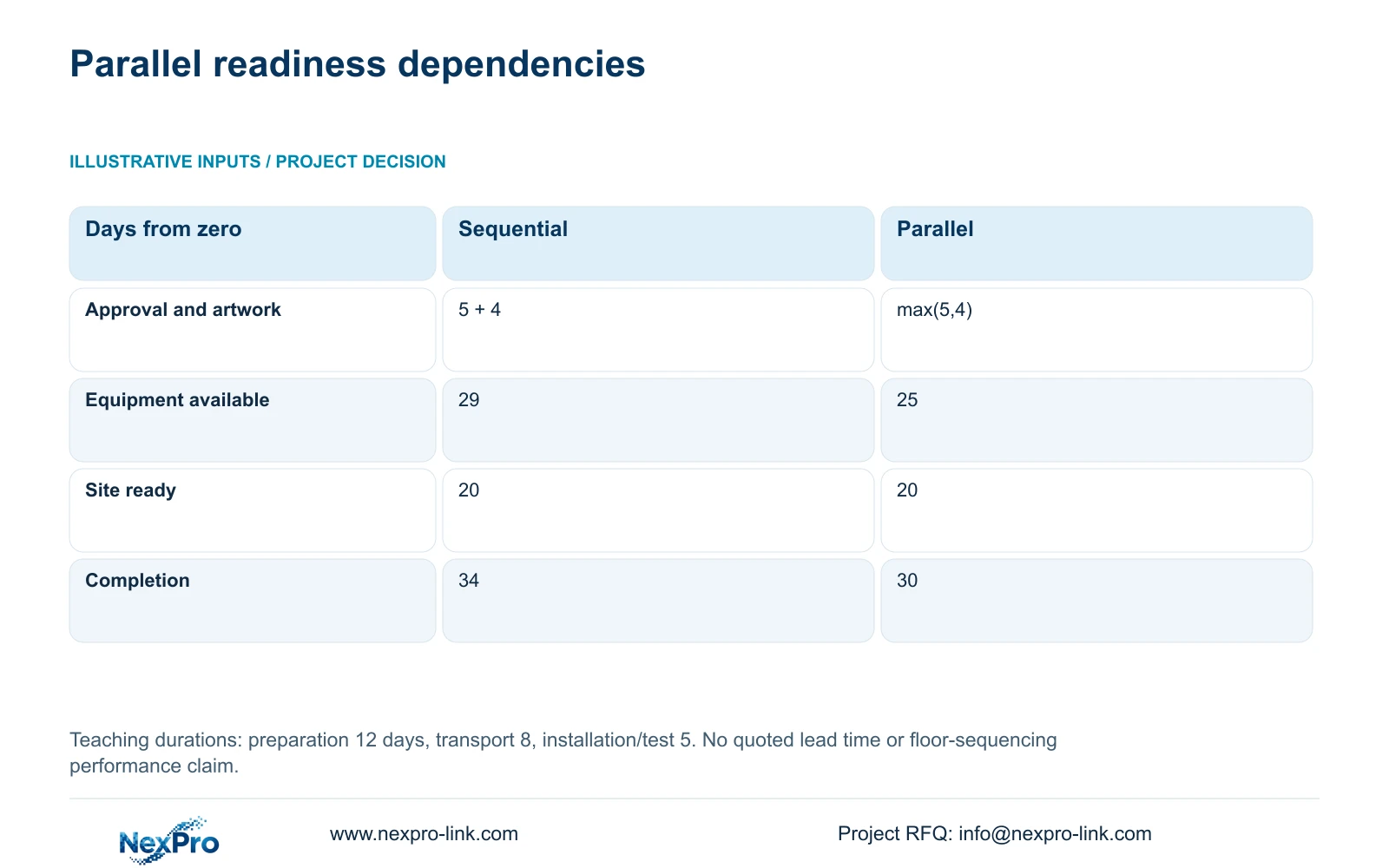
The independent schedule example below assumes technical approval takes 5 days and artwork takes 4 days in parallel, followed by preparation of 12 days and transport of 8 days. Site readiness occurs on day 20 from the same starting point; installation and testing take 5 days. These are teaching durations, not quoted supplier lead times.
Ready-to-install day equals the later of equipment availability and site readiness. Correct parallel treatment gives max(5,4)+12+8 = day 25, then completion on day 30. Treating the first branches as serial gives day 29 and completion on day 34. This comparison teaches dependency accounting; it does not measure the benefit of one floor sequence over another.
| Metric / condition | All branches sequential | Actual parallel branches |
|---|---|---|
| Approval + artwork treatment | 5 + 4 | max(5,4) |
| Equipment available day | 29 | 25 |
| Site ready day | 20 | 20 |
| Illustrative completion day | 34 | 30 |
| Actual commitment | Depends on real sequence and agreed dates | Requires actual project inputs |
Section 04
Plan temporary coverage where required
Identify the task that disappears during each changeover. If the hotel requires that task to remain observable, assess an authorized temporary view or another work window before disconnecting the original camera. Temporary coverage must have an appropriate recording destination and power path; a visible live image alone does not preserve the required recording function.
Check privacy boundaries and circulation around temporary equipment. A temporary view should not expand into guest-room interiors or other excluded areas. Its bracket and cable route need local coordination, and removal should be included in the work scope. Existing overlap is useful only when it actually retains the agreed task.
Separate a critical recording release from optional additions. A delayed display component need not hold a camera changeover if the authorized operator can complete the required checks through a supported path. Conversely, missing network or recorder support can block the task even when cameras have arrived. Reflect these dependencies in the local sequence instead of copying the example's day-30 completion into an actual programme.
Section 05
Test before closing each work area
Review recorded movement at the approved public-area task point after installation. Confirm framing through relevant door states, then perform playback and the required export. A device-online indicator or sharp still preview does not establish a complete recording outcome. Record the camera identity, configuration and conditions associated with the observation.
Separate preparation checks from site checks. Bench work can establish aspects of configuration, while corridor lighting, obstructions and the installed cable path require site inspection. ONVIF support should lead to checks of the needed functions on the actual recorder and client; it does not establish full event or audio compatibility.
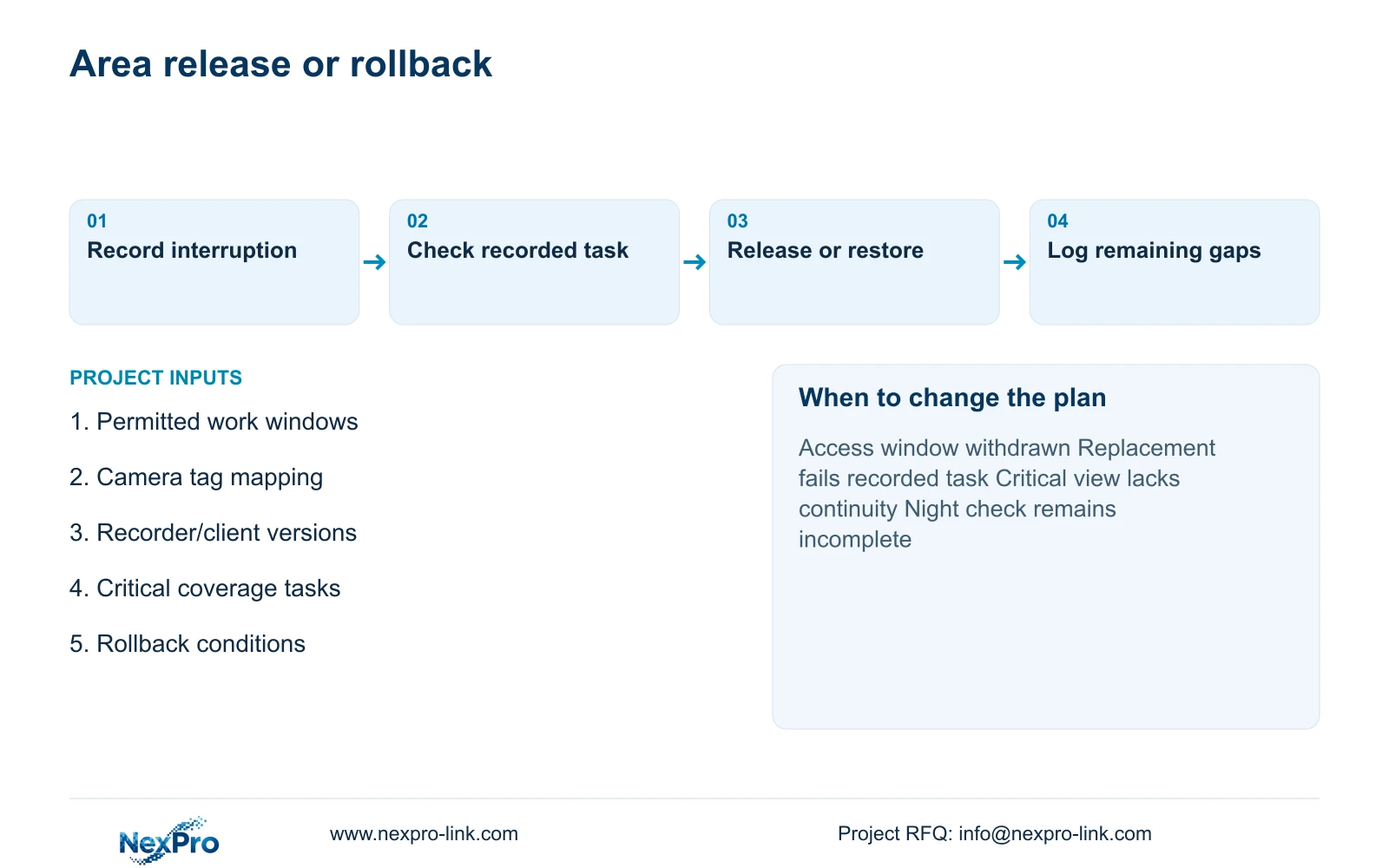
Close the work area only when the agreed release tasks are satisfied or the hotel has accepted a clearly described exception. If a task fails, apply the defined correction or rollback and repeat the same check. A successful sample supports its observed scope, not a claim of zero defects across the batch. Additional night inspection is justified when the task depends on reduced-light operation.
| Retained outcome | Extra scope | When needed |
|---|---|---|
| Usable recording and retrieval | Recorded walk, replay and export check | Before releasing every changed task |
| Required reduced-light detail | Separate night-condition inspection | When daytime conditions do not represent operation |
| Restored task after failure | Rollback and repeat check | When replacement fails the agreed release condition |
Section 06
Record remaining gaps and the next release
Maintain a short changeover record showing replaced tags, actual interruptions and unresolved tasks. For each gap, identify the responsible party and the condition required for another inspection. Distinguish an installed device awaiting a night check from a task that is still unavailable. An administratively closed report does not restore the missing function.
Recommend preconfigured, small-area changeovers with floor-based packing when the hotel can provide suitable access and each task has a defined restoration path. Change to mixed sequencing, temporary coverage or a deferred window when occupancy restrictions or dependencies prevent safe completion of that area.
Send the existing camera and recorder schedule, permitted work windows, critical public-area tasks and delivery destination to info@nexpro-link.com for a scoped equipment discussion. Local labour and site restoration responsibilities should be explicit. The supplied warranty record states a 24-month limited hardware baseline from receipt for applicable main equipment, subject to controlling order terms. It does not imply free local installation, travel or every accessory's coverage.
Section 07
Buyer questions
Can camera replacement guarantee uninterrupted recording? No absolute guarantee is supported here. Identify the expected interruption for each task and arrange approved temporary coverage or alternative timing where continuity is required.
What must be ready before a camera reaches the floor? Prepare its tag mapping, supported configuration, mounting and power match, recorder workflow and rollback conditions. Keep account credentials in the approved hotel process, separate from packing labels.
Does equipment warranty cover the site changeover? Hardware warranty and installation services have different scopes. The supplied main-equipment baseline is 24 months from receipt; labour, travel, accessories and project-specific arrangements require their own written terms.
Engineering references
These sources support the general planning principles. Always use the selected product's current datasheet and applicable project standards for final design.