Schedule CCTV commissioning against tasks that can actually be completed. Equipment arrival does not establish that power, network permissions, work-front access or the required operators are ready.
Section 01
Decide which commissioning tasks can proceed
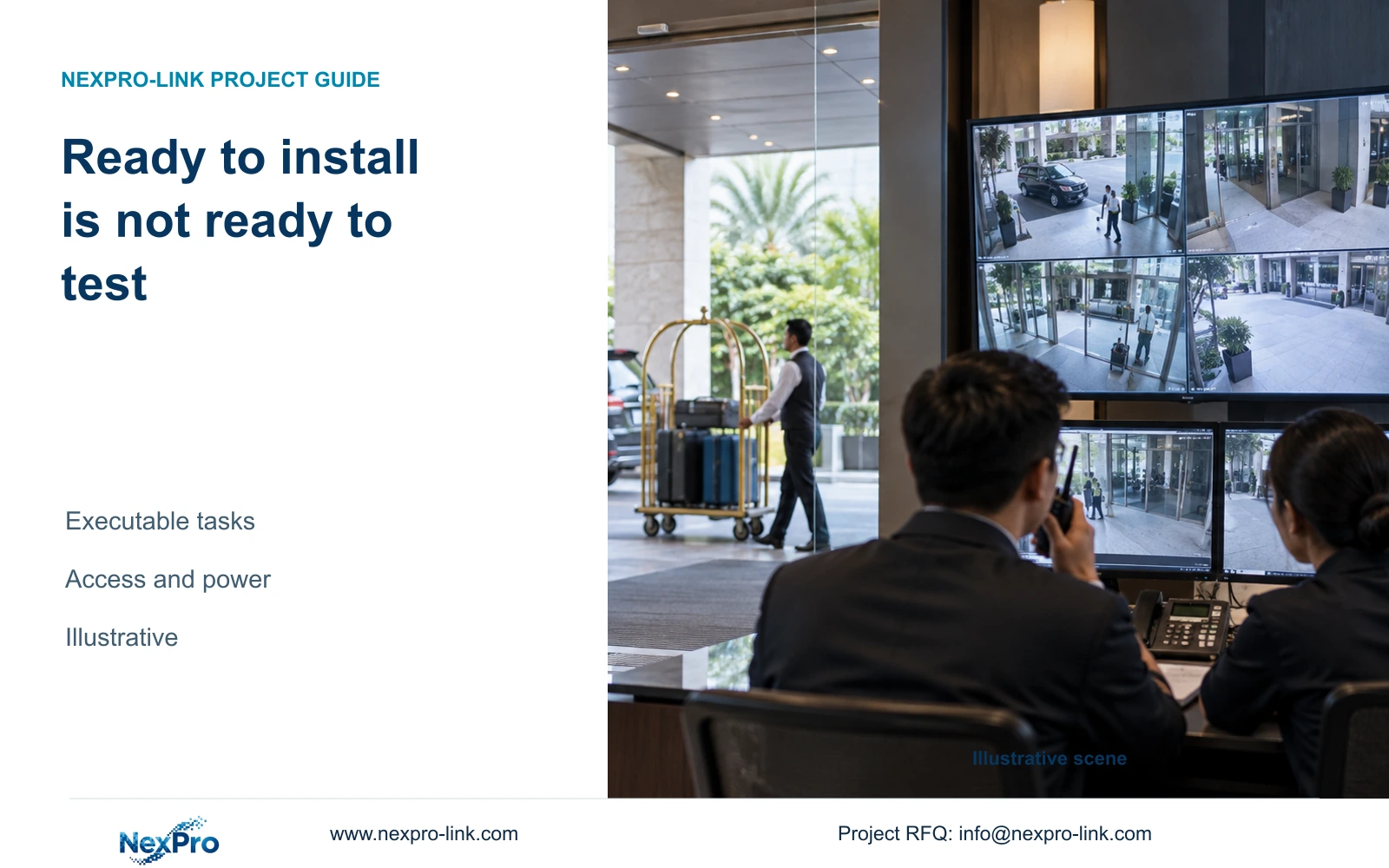
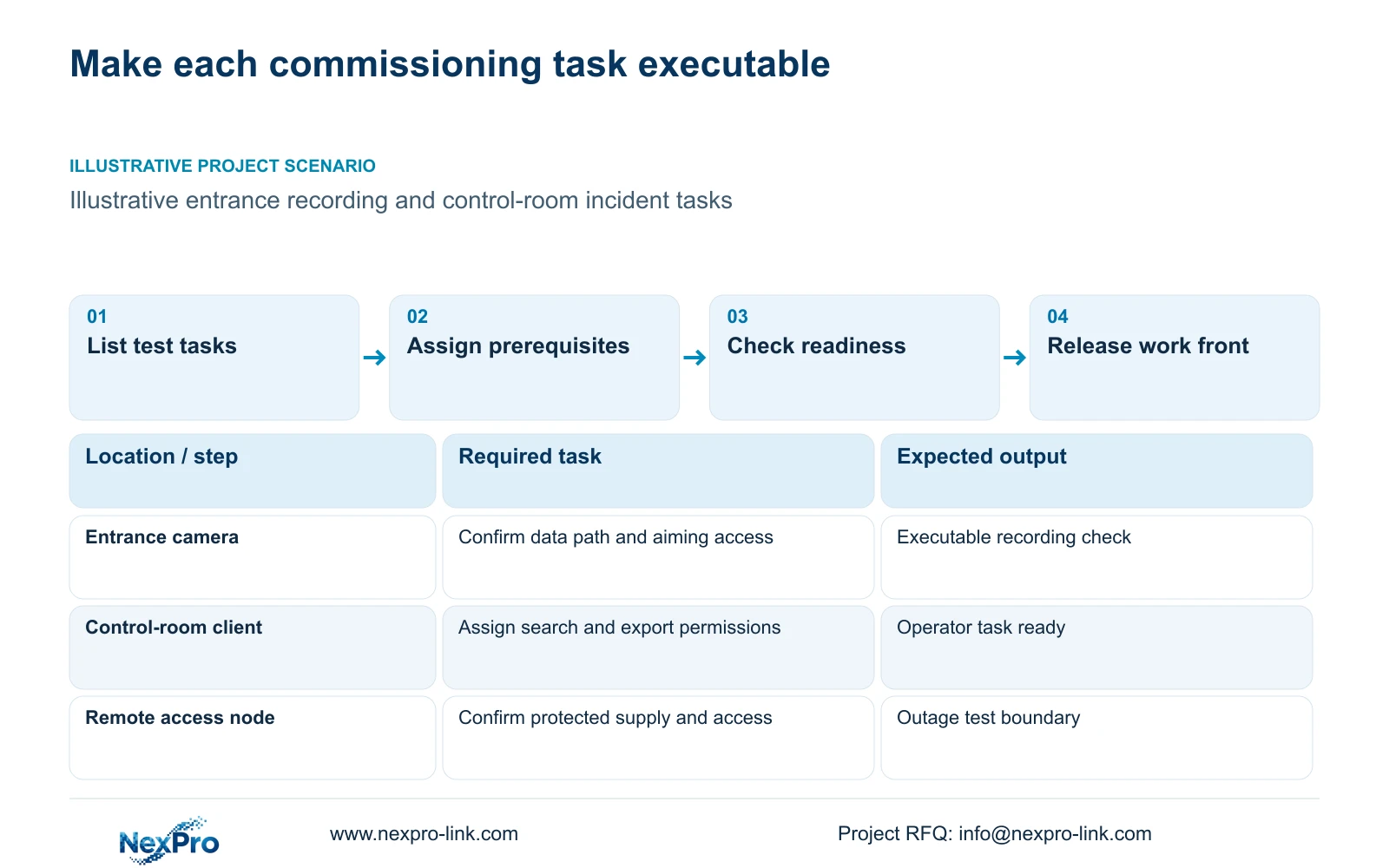
Book commissioning attendance when the planned tasks have usable power, verified connections, authorized accounts and an agreed access window. If only some work fronts meet those conditions, release a defined partial task package and record the blocked tasks separately. An installed camera with no reachable recorder cannot complete a recording test.
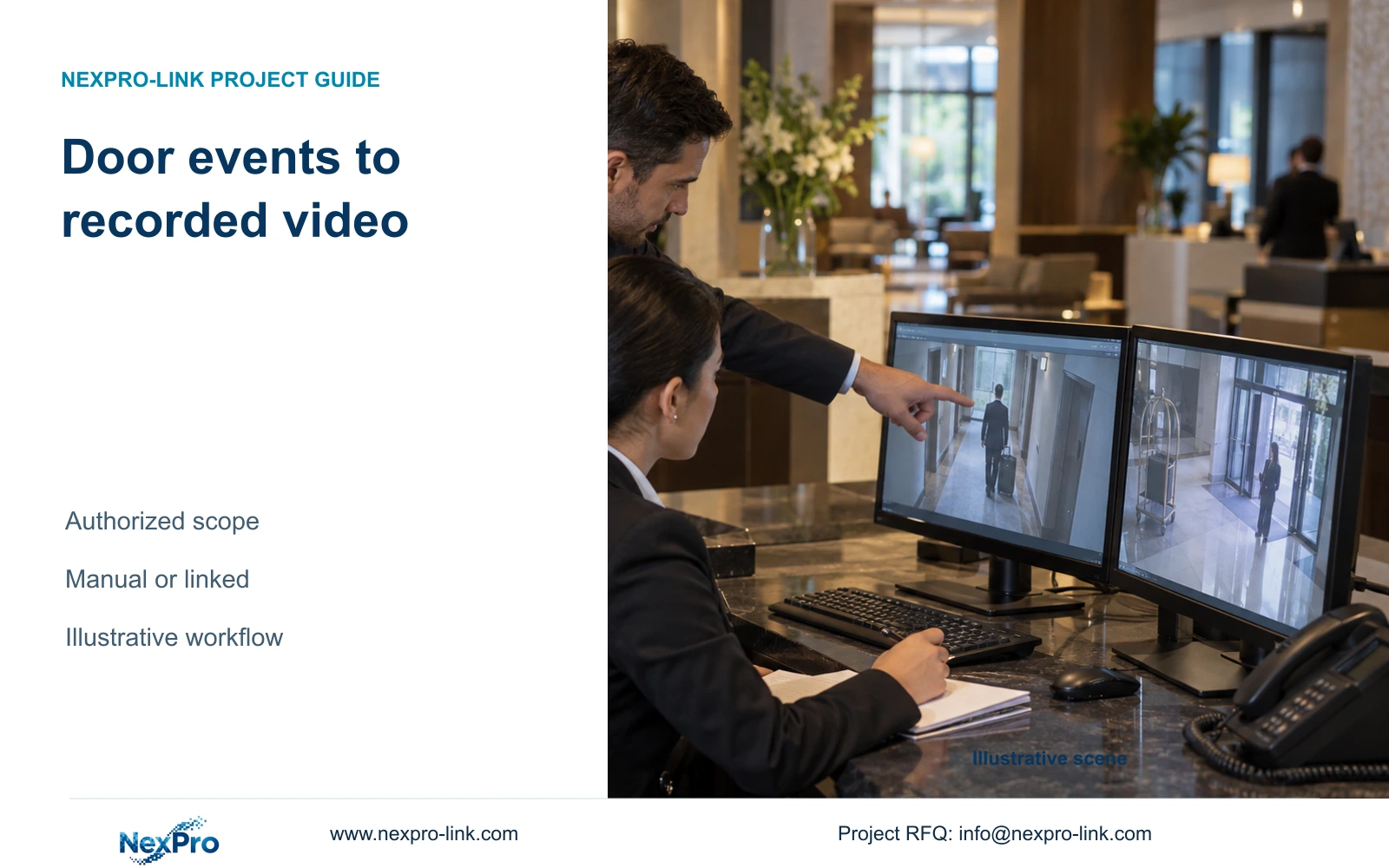
Work backward from the first operating release. List camera aiming, stream configuration, recording verification, incident search and export, then the agreed outage observation. Each task needs an endpoint and an expected result. Shipment, arrival and physical installation are milestones leading to those tasks; none establishes that the hotel can operate the system.
Identify the public zones and shared resources covered by the visit. In the illustrative CASE06 context, a complete first 32-camera release precedes the final 64-camera arrangement. That concept supports staging, but the real commissioning package must name its actual switches, recorders and operator interfaces. Unopened areas may contain resources that still serve the first phase.
| Task | Prerequisite and responsible role | Evidence or hold condition |
|---|---|---|
| Aim a public-zone camera | Installer access, usable local power and safe work window | Physical view can be set; recording may remain untested |
| Verify recording | Configured camera-to-recorder path and authorized engineer access | Hold if the relevant link, storage or configuration remains unresolved |
| Search/export an incident | Recorded time window, supported permissions and available operator | View-only access is not export readiness |
| Observe protected operation | Approved safe window and all necessary protected nodes | Electrical/site team authorizes the observation; no improvised outage |
| Release partial attendance | Named durable tasks and blocked dependencies | Record retained results and later retest; otherwise defer the visit |
Section 02
Assign services and supported permissions
Separate account ownership, user roles, device binding and network reachability. An operator may be able to view a camera while lacking export permission. A commissioning engineer may have device access but no approved route across the hotel network. Assign each required action to a role and confirm that the selected software and firmware support the intended control.
Hotel IT should define the approved network settings and support path for the project. Record who can implement the required access and when that person is available. Remote support should use a hotel-authorized route with limited scope and a defined end to the authorization. Do not place passwords or personal credentials in a shared readiness checklist.
ONVIF profile information can support device and client function checks, but it does not prove that every event, audio function, search workflow or cloud binding is compatible. If commissioning includes an integration, name the actual function and participating versions. Buying several categories through one supplier does not establish native software integration.
| Item | Unready condition | Ready condition | Effect on the task |
|---|---|---|---|
| Network path | Physical link only | Approved logical reachability | Allows configuration and recording checks |
| Operator account | Shared unrestricted access | Supported task permissions assigned | Allows meaningful handover |
| Remote support | Unapproved permanent access | Authorized bounded support path | Defines permitted commissioning assistance |
Section 03
Verify readiness against the controlling path
Confirm physical prerequisites at the relevant work front: usable electrical supply, installed links, accessible equipment and an environment suitable for the selected devices. Confirm logical prerequisites separately, including the approved settings, account permissions and required client access. A room described as ready may still lack one of these conditions.
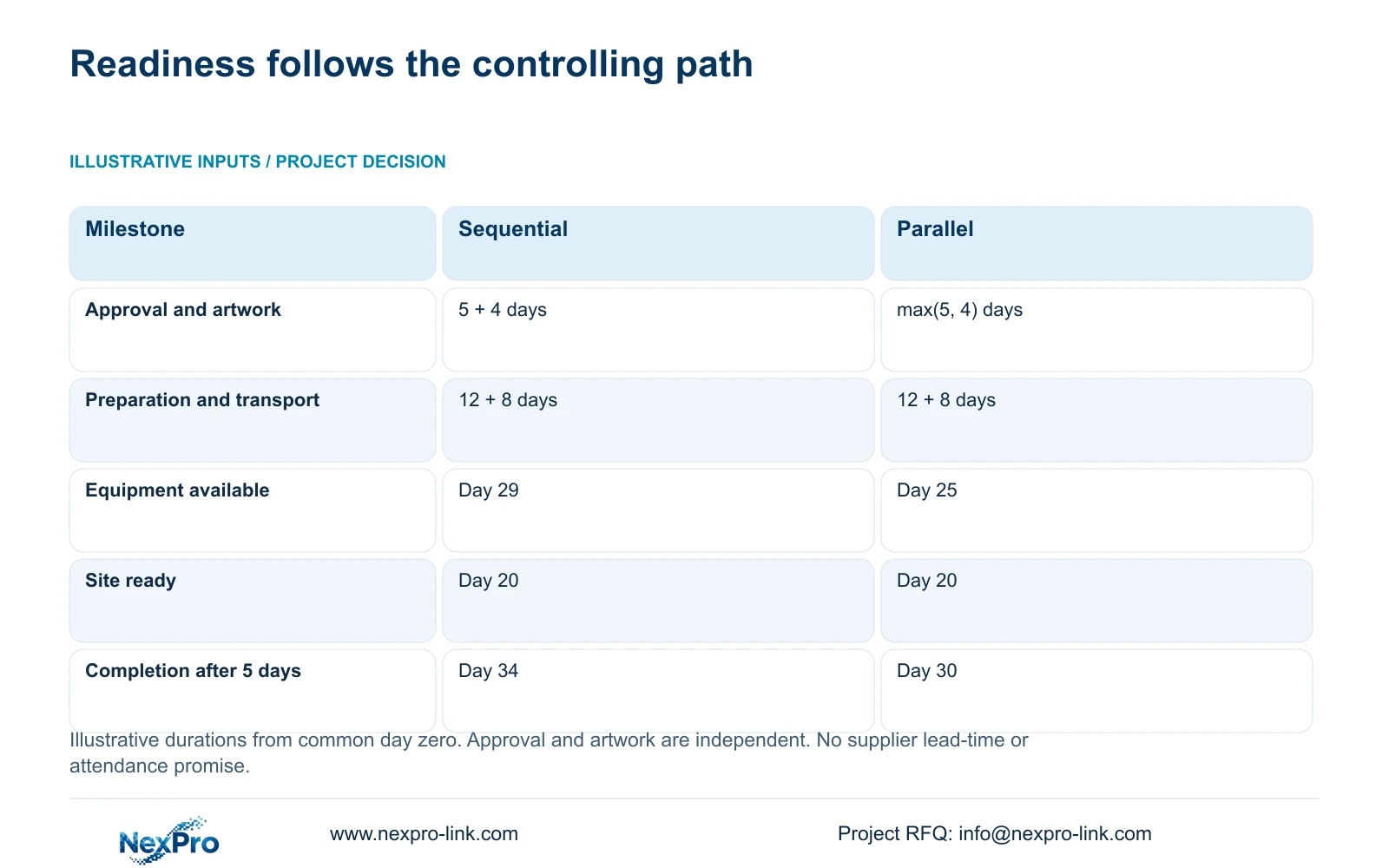
The independent schedule illustration assumes technical approval takes five days and artwork four days, starting in parallel. Preparation then takes 12 days and transport eight. Site readiness is day 20 from the same starting point, followed by five days for installation and testing. These are teaching durations, not supplier lead times or a site commitment.
Equipment availability is max(5, 4) + 12 + 8 = day 25. Ready-to-install day is max(25, 20) = day 25, and completion is day 30. Treating approval and artwork as sequential instead gives equipment on day 29 and completion on day 34. Parallel treatment is valid only when the branches can genuinely proceed independently.
For commissioning, use the same dependency method with actual permission and access dates. If site readiness moves beyond equipment availability, the site branch controls attendance. Faster shipment then leaves the team waiting for the unresolved task prerequisite. Record that constraint accurately so equipment performance is not blamed for a blocked test.
| Metric / condition | All branches sequential | Actual parallel branches |
|---|---|---|
| Approval + artwork treatment | 5 + 4 days | max(5, 4) days |
| Equipment available | Day 29 | Day 25 |
| Site ready | Day 20 | Day 20 |
| Installation/test completion | Day 34 | Day 30 |
| Actual commitment | Needs real sequence and agreed dates | Needs actual project inputs |
Section 04
Separate ready work fronts from blocked tasks
Classify readiness by task and location. An entrance camera can be aimed while its recording test remains blocked by an unavailable backbone. A central recorder can be configured while a public-floor access node awaits protected power. Record useful completed work without marking the entire chain commissioned.
Distinguish CCTV work from access-control and door-system responsibilities. A video system can provide incident context without being the authorized controller that releases a door. PMS or credential interfaces need their actual systems and versions identified. Emergency release and egress arrangements belong to the responsible local specialist's design.
A partial visit is worthwhile when ready tasks have durable results and do not require avoidable repetition after the blocked work is completed. Hold the visit when the same missing resource prevents most of the intended observations. State the remaining interface, owner and available access window so the next attendance decision has a concrete basis.
Section 05
Sequence observations to avoid repeated visits
Check the installed identity and connection records before configuring dependent tasks. Confirm the camera reaches its assigned recorder before testing retrieval. Once recorded material exists, have the authorized operator perform the intended search and export. Schedule lighting-dependent observations for the relevant conditions instead of substituting a daytime preview.
Plan the outage observation with the appropriate electrical professionals and the hotel's operating team. A UPS rating does not demonstrate configured runtime, and testing a central rack does not cover an omitted remote switch. Define the approved state and record the actual result across the required path.
When a task fails, record its conditions and responsible party. After correction, repeat that task using the relevant configuration. Keep factory observations separate from hotel-specific site evidence. This avoids inventing pass rates or treating an administrative issue closure as proof that service has been restored.
| Retained outcome | Extra scope | Worth buying when | Condition against it |
|---|---|---|---|
| Durable configuration work | Partial visit and later dependent tests | Ready equipment can be configured without rework | Unresolved interfaces will change the configuration |
| Complete operating demonstration | Combined attendance | Required resources and personnel share a window | Most tasks remain blocked |
Section 06
Assign remaining actions before the visit
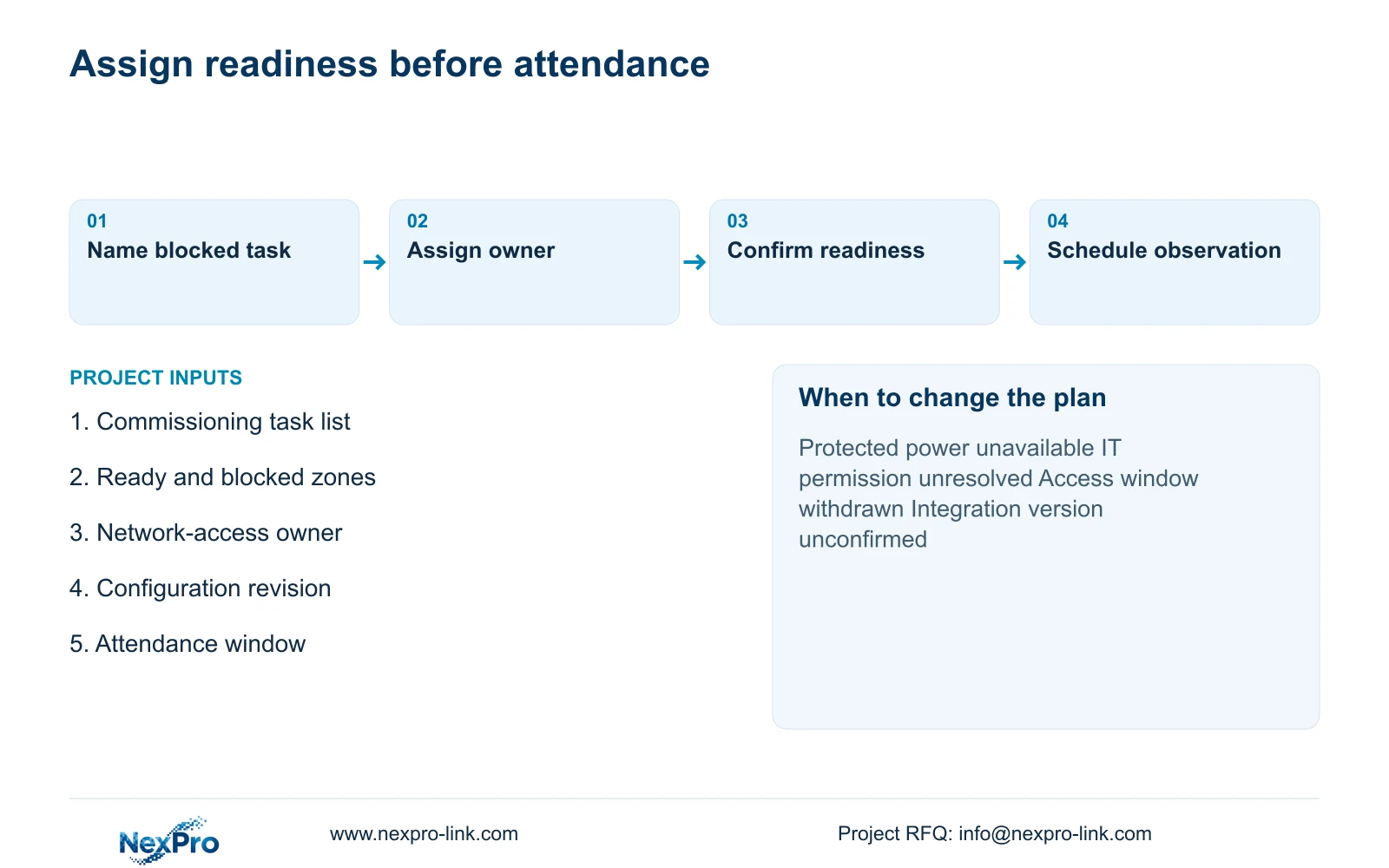
Name the owner of each remaining prerequisite, the evidence of readiness and its required date. The local installer handles the agreed installation work; hotel IT provides the authorized network and account arrangements; the operator supplies the relevant users and operating window. Supplier support and attendance should be stated explicitly in the agreed scope.
Recommend attendance for a complete task package when its prerequisites are confirmed. Use a partial package only when its results remain valid after the outstanding work. Reassess if the access window changes, a shared node is unavailable or a mandatory integration is unresolved. Neither this readiness method nor coordinated supply guarantees local commissioning attendance.
Send the intended test tasks, ready and blocked zones, network-access owner and proposed attendance window to info@nexpro-link.com. Include the equipment revision and opening milestone. NexPro-Link can discuss configuration documentation and equipment support boundaries; the site team must confirm local power, safety and access readiness before the agreed work proceeds.
Section 07
Buyer questions
Can CCTV commissioning proceed without WAN access? Assess the specific task. Local recording and a remote-access demonstration use different paths. Confirm the selected configuration's local workflow and label any untested remote function separately. Do not report remote commissioning complete when its approved connection is unavailable.
Should the installer receive the hotel's permanent administrator account? Use the supported permissions needed for the agreed commissioning tasks and keep ownership with the authorized hotel party. Define how temporary access ends. Available role controls depend on the actual device and client; a desired role is not automatically a supplied feature.
What information is needed before requesting commissioning support? Provide the task list, model and configuration revision, outstanding prerequisites and proposed access window. Identify the hotel IT contact role and local installation responsibilities. State whether support is remote or requires separately agreed site attendance.
Engineering references
These sources support the general planning principles. Always use the selected product's current datasheet and applicable project standards for final design.