Build the procurement programme around an accepted operating system at opening. Separate approval, supply and site dependencies before choosing shipment dates.
Section 01
Define the operating milestone required at opening
Schedule procurement backwards from the date when the hotel needs an accepted, usable security system. Use parallel preparation only where each branch has independent inputs, and release equipment in phases only when the first package can operate completely. Equipment lead time plus installation time leaves out approvals, transport dependencies and site readiness.
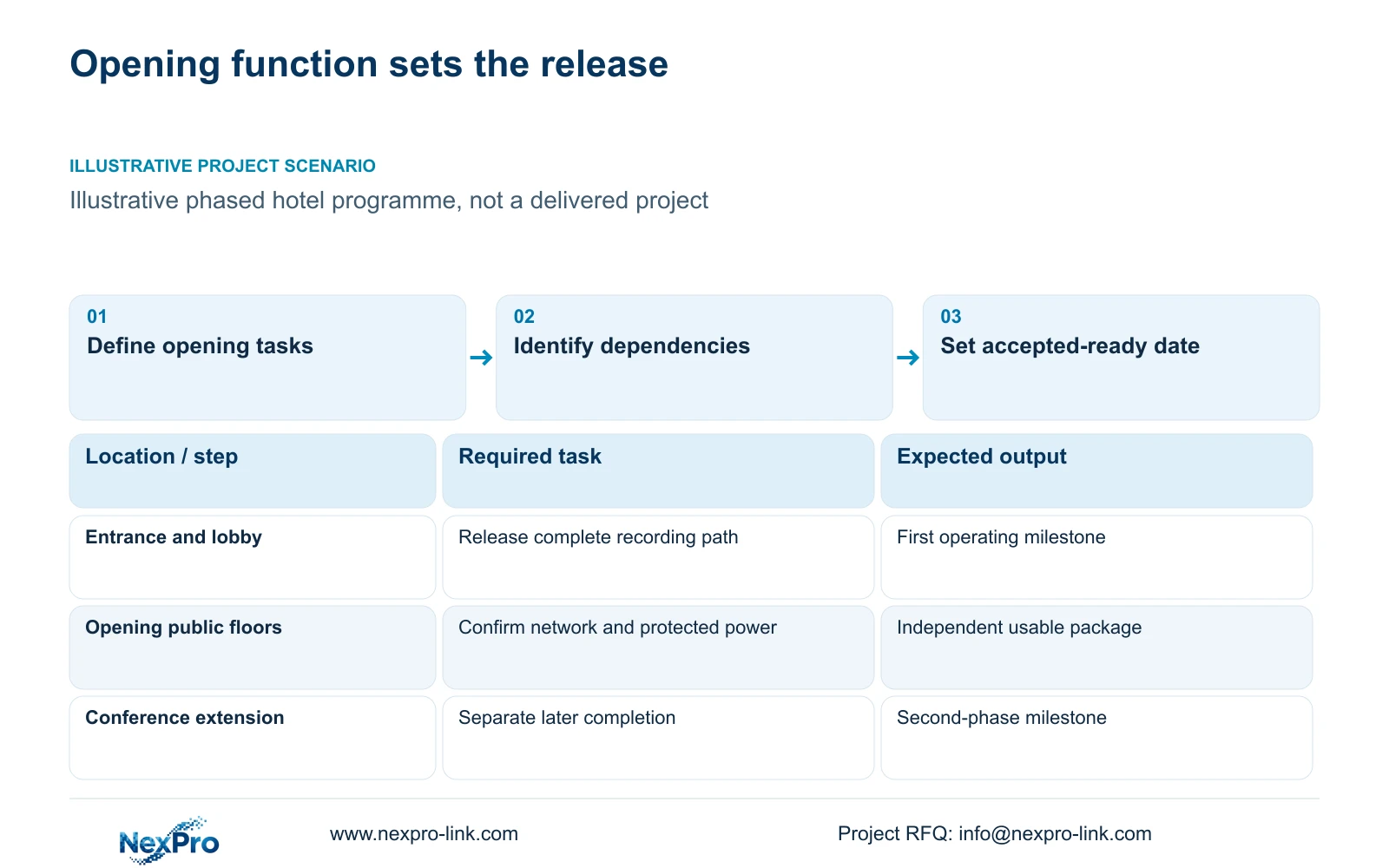
Define the opening requirement by public area and operating task. Entrance recording, reception incident retrieval and coverage of occupied public routes may be needed before later conference areas open. State which views must record, who must retrieve footage and what must remain operational during a power interruption. A shipment date cannot demonstrate those outcomes.
In the illustrative CASE06, the first operating release has 32 cameras within a final 64-camera design. Those quantities come from assigned public-zone tasks, not the hotel's 200-room background. This supports a phased scope discussion, but supplies no delivery durations. The schedule calculation below is a separate teaching example.
| Required task | Given information | Decision still needed |
|---|---|---|
| Entrance and lobby recording | First operating areas identified | Accepted recording and retrieval date |
| Public routes on opening floors | Phased occupation proposed | Released views and protected network scope |
| Later conference extension | Outside first operating release | Independent completion milestone |
Section 02
List approvals and release conditions
Separate supplier registration, brand acceptance, model approval and purchase authorization in the programme. Each has a different decision owner and output. A company accepted into a vendor system may still need a model submission; an approved model may still lack an authorized order. Record the document that permits each next activity to start.
A technical release should identify the camera schedule revision, recording requirements and equipment interfaces. Where alternatives are allowed, show the proposed difference and obtain the relevant decision before treating that alternative as the supply baseline. NexPro-Link's BOQ and tender support can assist model matching and technical submissions, without guaranteeing consultant approval or an order.
OEM work needs its own release conditions. Authorized artwork, label fields and carton grouping can affect preparation even after technical approval. Distinguish the CCTV manufacturing scope from coordinated supply of supporting categories. A combined equipment proposal does not establish that every item is manufactured by the same company or that local installation is included.
| Item | Incomplete release | Usable release | Effect |
|---|---|---|---|
| Model selection | Catalogue submitted | Reviewed model and revision identified | Preparation has a defined baseline |
| Project packing | Logo requested | Authorized artwork and carton fields accepted | Packing branch can proceed |
| Order authority | Forecast quantity circulated | Written purchase release issued | Supplier execution is authorized |
Section 03
Separate parallel supply branches
Map technical approval and artwork as separate branches when neither depends on the other's unfinished decision. In the teaching example, technical approval takes 5 days and artwork takes 4 days, both starting at day zero. Preparation takes 12 days after both are complete, transport takes 8 days, site readiness occurs on day 20 and installation with testing takes 5 days.
These are assumed durations in days, not quoted NexPro-Link lead times. The dependency rule is: ready-to-install day equals the later of equipment availability and site readiness. Equipment availability equals the later of approval and artwork completion, plus preparation and transport. Add installation and testing only after both equipment and the site are ready.
Place battery transport requirements on the relevant supply branch, and network permissions on the site or commissioning branch. A display addition can have a separate release if recording remains independent. Conversely, an unavailable access switch or protected remote power source can prevent the cameras from operating even when the recorder has arrived. Assign the dependency to the affected function.
Section 04
Calculate the controlling path
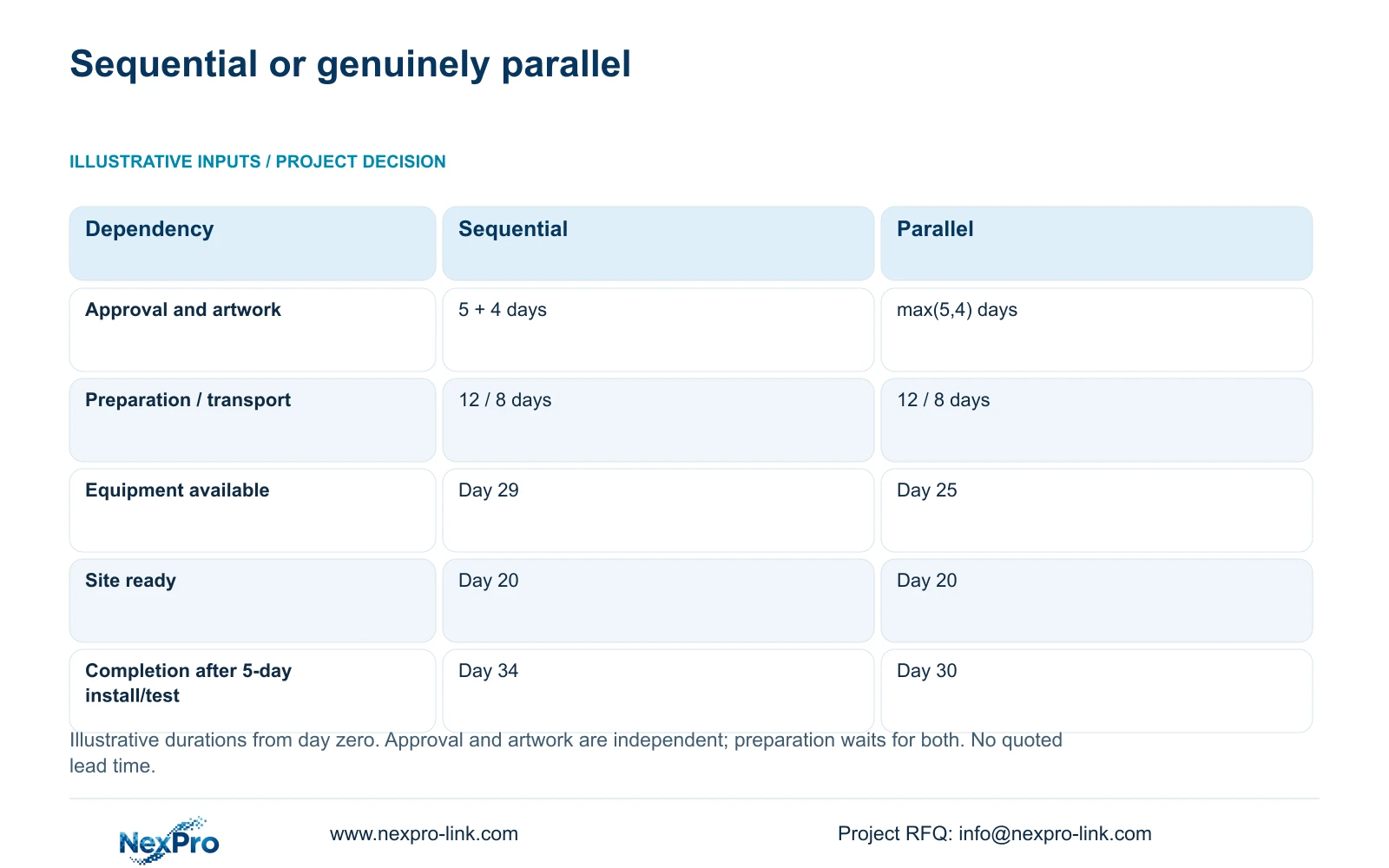
Treating approval and artwork as sequential gives 5 + 4 + 12 + 8 = 29 days until equipment availability. With actual parallel branches, availability is max(5,4) + 12 + 8 = 25 days. Site readiness at day 20 is earlier in both cases, so the supply branch controls installation start.
Adding the assumed 5-day installation and test period produces completion on day 34 or day 30. The four-day difference follows entirely from the stated dependency arrangement. It does not establish a general acceleration opportunity, a supplier performance result or a commitment to complete a real hotel in 30 days.
Work backwards using the parallel arrangement only after confirming that independence. The required equipment-ready date sits before installation and testing; preparation must then finish before transport begins, with both approvals completed before preparation. If actual site readiness moves beyond equipment arrival, the controlling branch changes and earlier shipping alone will not recover completion.
| Metric / condition | All branches sequential | Actual parallel branches |
|---|---|---|
| Approval + artwork treatment | 5 + 4 | max(5,4) |
| Equipment available day | 29 | 25 |
| Site ready day | 20 | 20 |
| Illustrative completion day | 34 | 30 |
| Actual commitment | Depends on real sequence and agreed dates | Requires actual project inputs |
Section 05
Compare phased and single shipments
Compare a complete first release with waiting for the whole order. In CASE06, the first 32-camera package must include its required recording, storage, access network and protected power path. Sending cameras ahead without those dependencies creates stock on site without delivering the opening function.
A single shipment can simplify receipt and quantity reconciliation when all areas will be ready together. Phased shipments can suit separately opening areas, but require clear packing lists, retained shared resources and later installation access. Evaluate transport, handling and storage scope using actual quotations. The reference case contains no price evidence from which to claim savings.
Keep optional display equipment separate from the essential recording release when the operating brief permits it. A mandatory operator platform or shared component may prevent that separation. Change the proposal to a combined release when the first phase cannot be accepted independently, or when repeated handling and transport outweigh the useful reduction in stored equipment.
| Retained outcome | Extra scope | Worth choosing when | Counter-condition |
|---|---|---|---|
| Complete first-phase recording | Separate packing and receipt records | Opening areas have independent readiness | Shared dependency remains unavailable |
| Whole-system installation | Storage for equipment arriving early | All work fronts become ready together | Later areas would delay opening functions |
Section 06
Assign dated decisions to each owner
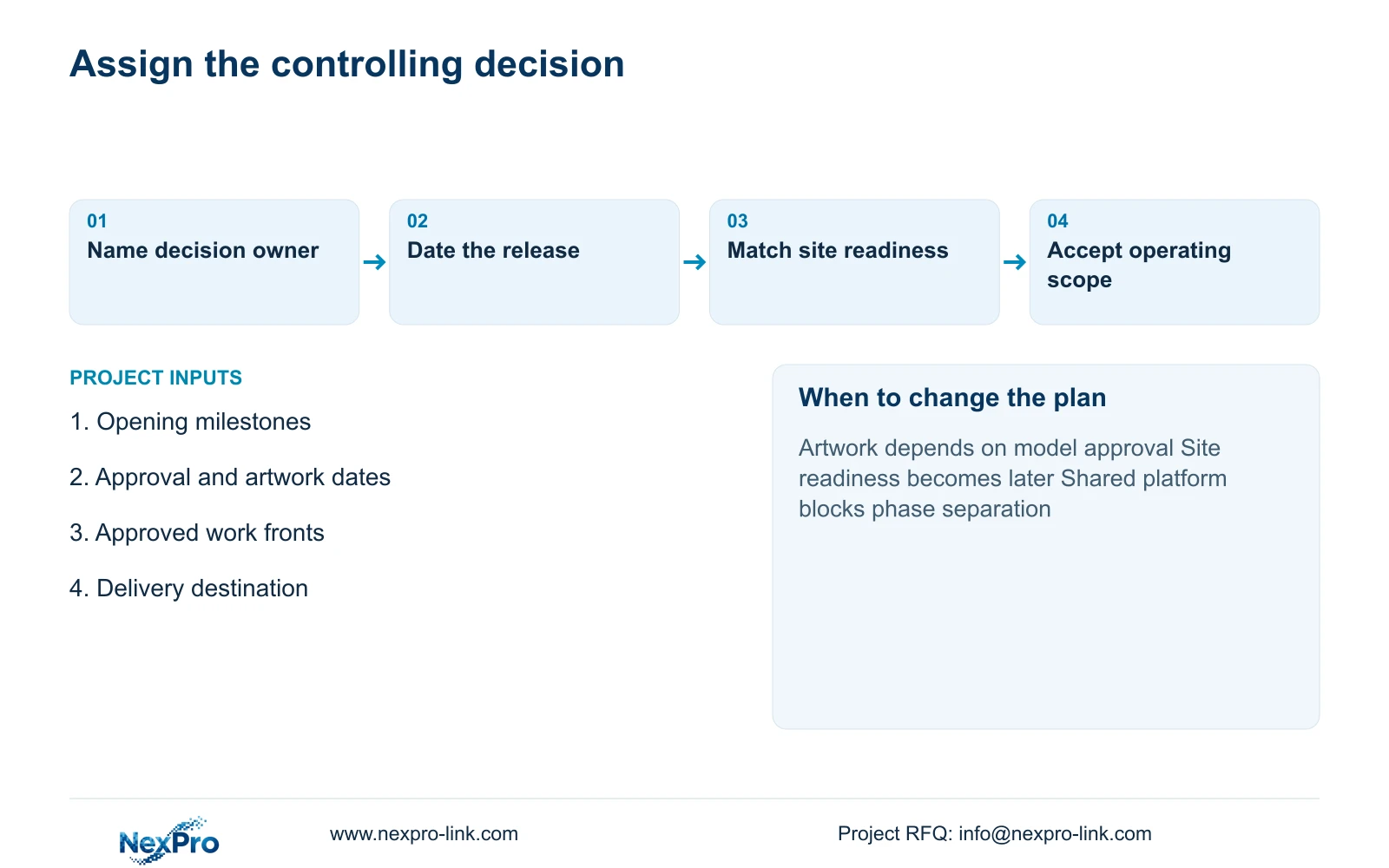
Give every controlling decision an owner, required date and deliverable. The hotel defines the opening function; the designer resolves equipment and interface requirements; procurement issues the authorized release. The supplier identifies preparation and supply conditions, while the site team confirms access, power and installation readiness.
Maintain the programme against a named revision. When a decision slips, identify the function and downstream activity affected before requesting expedited shipment. Record whether the response changes scope, packing or installation sequence. An indicative forecast remains separate from an instruction to purchase, prepare or substitute equipment.
Choose a dependency-based programme with a complete first operating release where the areas can be accepted independently. Recalculate when artwork becomes dependent on technical approval, site readiness changes or a mandatory shared system prevents separation. Send opening milestones, approved work fronts, current release dates and the delivery destination to info@nexpro-link.com. The hotel project equipment support and BOQ support routes provide relevant starting points for a scoped response.
Section 07
Buyer questions
Can packing approval proceed before model approval? Stable branding fields can be reviewed separately if they do not depend on the unresolved model. Keep model-specific dimensions, identifiers and accessory contents pending until their technical baseline is accepted. Only the independent work belongs on a parallel branch.
Does an approved programme authorize equipment preparation? A programme records intended timing. Preparation requires the applicable written release and agreed scope. Identify who has purchasing authority so a forecast or coordination meeting record does not become an unintended order.
What is enough for a first schedule discussion? Provide the opening function by phase, unresolved approval dates, site-ready dates and delivery destination. Mark any mandatory brand or platform requirement and whether alternatives are permitted. Detailed guest information and credentials are unnecessary.
Engineering references
These sources support the general planning principles. Always use the selected product's current datasheet and applicable project standards for final design.