You can request a useful first hotel security quotation before construction drawings are complete. State the decision needed now and distinguish known requirements from assumptions that still affect equipment or delivery.
Section 01
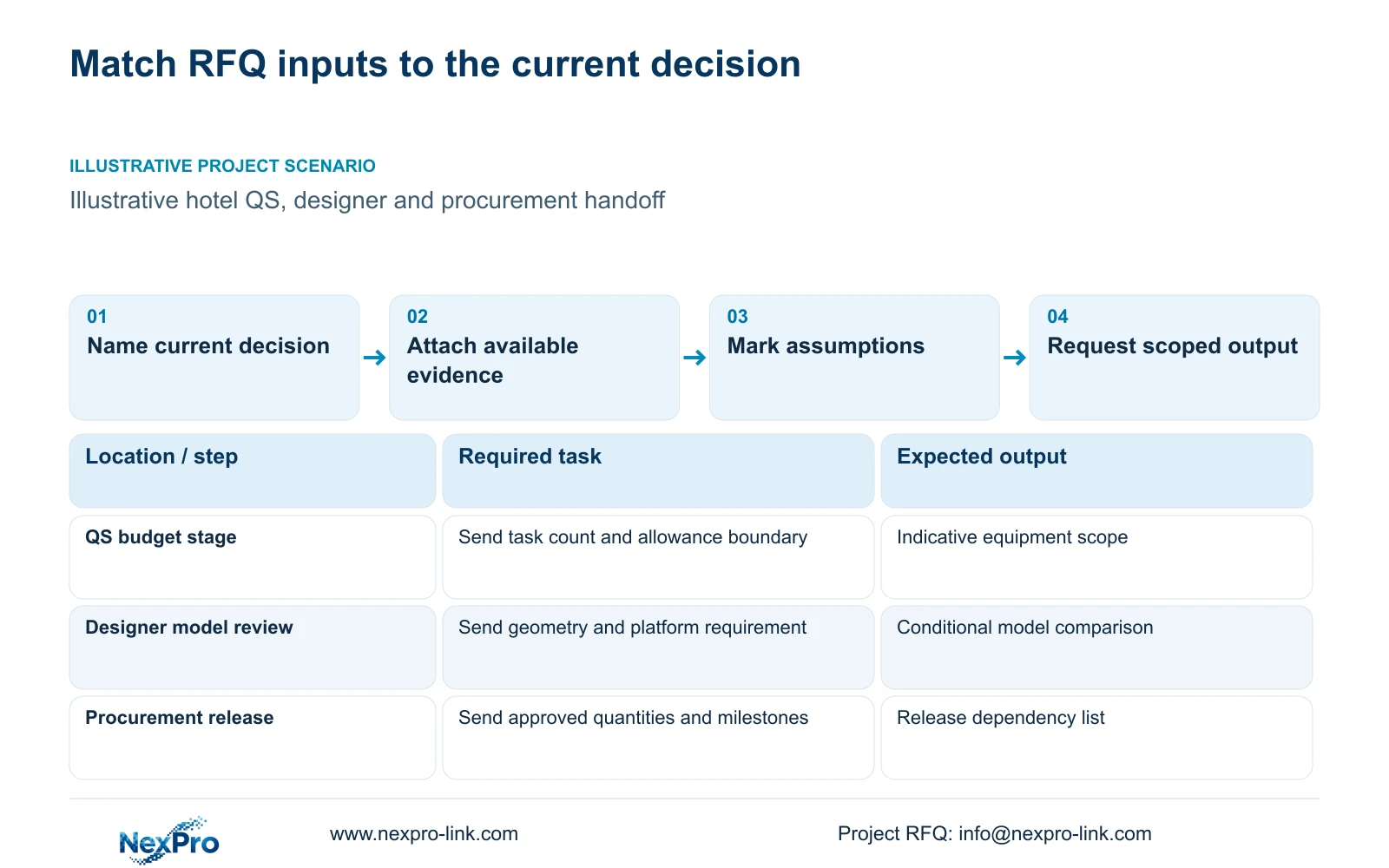
Identify the quotation decision needed now
Send an RFQ before final construction drawings are complete when you can describe the current decision, required public-area tasks and available scope. Request a stage-appropriate proposal with explicit assumptions. Wait for the missing input only where it controls a commitment, such as a mandatory interface, final installed quantity or approved equipment release.
Identify whether the present need is a budget allowance, model comparison or a defined supply quotation. Each requires a different degree of detail. A budget response can expose likely scope layers; a model response needs the disputed performance fields; an order-ready package needs controlled quantities and interfaces. Calling every request a final quote makes provisional inputs difficult to recognize.
Work backwards from the hotel function required at opening. Shipment, arrival and installation are separate milestones, followed by the task demonstration needed for operation. Tell the supplier which decision is blocking progress now. That allows the response to focus on an actionable equipment or scope question without waiting for unrelated design work.
| Required task | Given information | Decision still needed |
|---|---|---|
| Set an equipment allowance | Preliminary public-area plan | Task and quantity assumptions |
| Compare candidate models | Camera schedule and platform requirement | Exact disputed functions |
| Plan a first release | Opening milestone and destination | Approved scope and site readiness |
Section 02
Collect the design information already available
Provide the current public-area drawing or camera schedule with its revision and status. Mark required views at entrances, reception, public routes and service areas. Include target detail and any known lighting or mounting restriction where those affect model selection. Hotel room count supplies context but cannot establish camera quantity.
Add the existing recorder or platform requirement where equipment must connect to an installed system. For a new system, state the intended live-view, retrieval and export tasks. Keep guest-lock or staff-access questions tied to a separate door schedule and actual interfaces. A combined RFQ does not imply that these subsystems share power or integrate automatically.
List dependencies beside the input they affect. Authorized OEM artwork may need a separate decision; battery transport belongs on the relevant delivery path; hotel IT permissions affect configuration and commissioning. These items can run in parallel only when their required inputs are independent. Send drawings and schedule extracts relevant to the decision without guest footage, passwords or personal credentials.
| Input | Available now | Effect of unresolved detail |
|---|---|---|
| Camera plan | Preliminary public-zone positions | Quantity or lens remains provisional |
| System interface | Platform name and required workflow | Compatibility review remains conditional |
| Delivery scope | Destination and required milestone | Schedule needs release and transport inputs |
Section 03
Separate confirmed quantities from provisional ones
Mark each quantity as confirmed, provisional or optional. Confirmed should mean supported by the current agreed design basis, not merely repeated from an old estimate. Explain the basis for provisional camera counts and cable routes. Keep shared items once, including disks, patch leads or commissioning already included in a package.
Request a response that retains those statuses. A supplier can propose models for confirmed tasks and an assumption-based range for unresolved positions. If a revised view changes camera quantity, show that quantity effect separately from a specification change. This helps the cost manager update the estimate without losing the reason for the change.
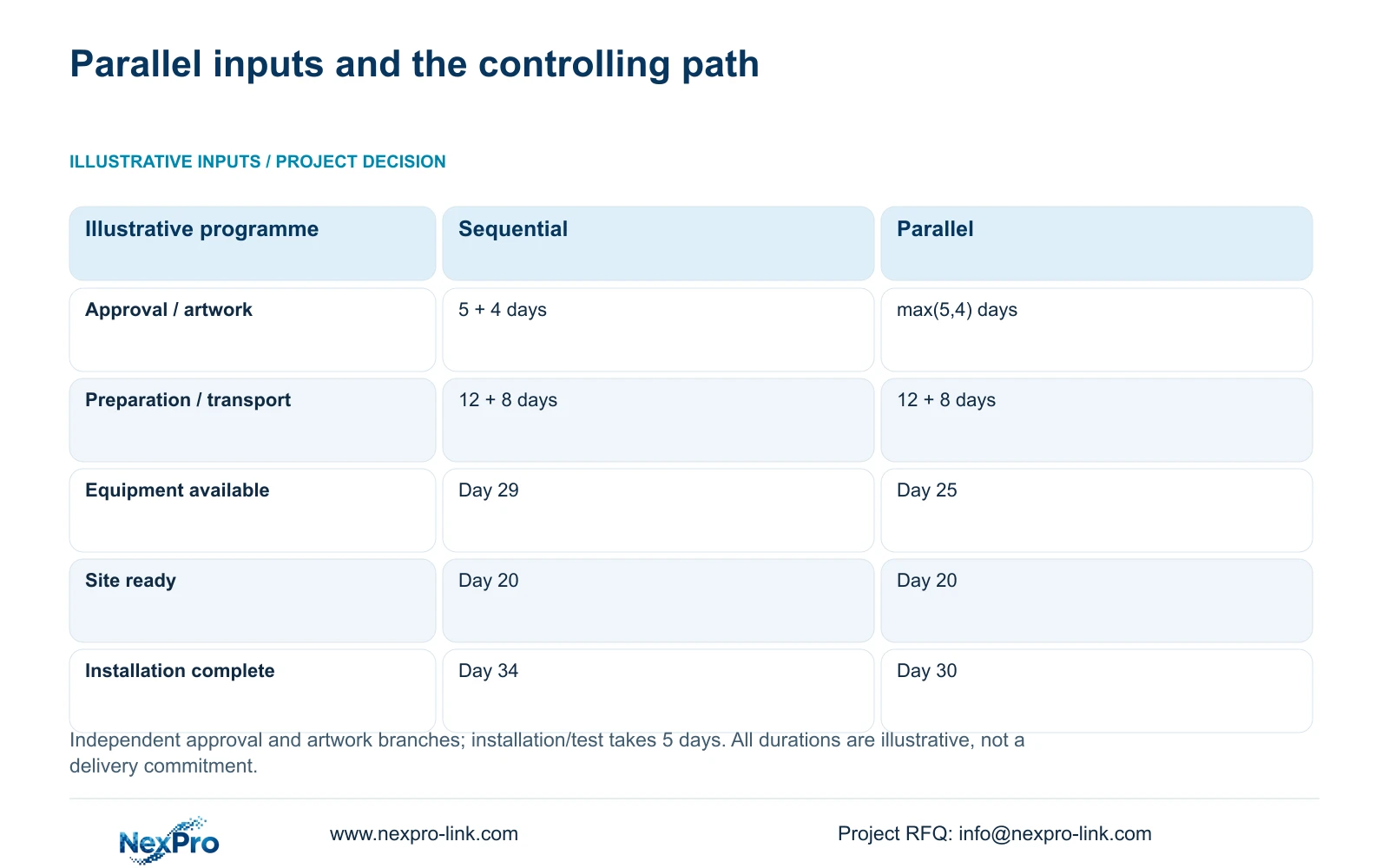
Quantity status also controls release timing. The illustrative programme assumes technical approval takes 5 days and artwork 4 days, with those branches independent. Preparation then takes 12 days and transport 8. Site readiness occurs on day 20 from the same starting point, followed by 5 days for installation and testing. These are teaching durations, not supplier lead times.
Section 04
State performance targets and delivery dependencies
Specify retention and recording hours, required image tasks and the outage state to be maintained. Identify whether backup includes remote network nodes and ordinary operator viewing. The supplier needs the target duration and protected boundary to discuss capacity and battery configuration; a general request for a UPS leaves the operating requirement unresolved.
For the illustrative programme, ready-to-install day equals the later of equipment availability and site readiness. Equipment availability is max(5,4)+12+8 = day 25 when approval and artwork can proceed in parallel. Completion is max(25,20)+5 = day 30. Treating both independent branches as sequential gives day 34.
The comparison changes the RFQ recommendation: collect branch-specific inputs early and ask which decisions release preparation. It proves no four-day saving for a real hotel. If artwork depends on a final technical choice, the parallel assumption fails. If site access is later than equipment availability, site readiness controls completion. Required IT access and battery transport conditions also belong on their actual paths.
| Metric / condition | All branches sequential | Actual parallel branches |
|---|---|---|
| Approval + artwork treatment | 5 + 4 | max(5,4) |
| Equipment available day | 29 | 25 |
| Site ready day | 20 | 20 |
| Illustrative completion day | 34 | 30 |
| Actual commitment | Depends on real sequence and agreed dates | Requires actual project inputs |
Section 05
Compare supplier responses on the same scope
Ask each response to identify the drawing revision, quantities and assumptions it priced. Compare recording, storage, networking and protected power on the same required outcome. A proposal with less retention or an unprotected remote node has changed the service boundary, even if its camera count matches.
Separate equipment delivery from installation and commissioning. Identify destination, packing and any OEM scope. Where the opening programme is tight, compare a functional first release with waiting for the whole package. The first release must include every dependency needed for its assigned operation; an optional display may follow only when that sequence preserves the approved tasks.
NexPro-Link can discuss model matching, technical documents and coordinated equipment supply. Its CCTV manufacturing core and supporting-category coordination should remain distinct in the proposal. The written response should define local work and third-party interface responsibilities. An indicative schedule or forecast quantity is not purchase-order authorization, and an RFQ does not approve production release.
| Retained outcome | Additional scope | Release condition |
|---|---|---|
| Essential recording | All required network and storage dependencies | Release as one functional scope |
| Expanded observation | Optional display package | Later release only if operator tasks still work |
| Project branding | Authorized artwork and packing | Parallel preparation only with independent inputs |
Section 06
Define the next clarification and its output
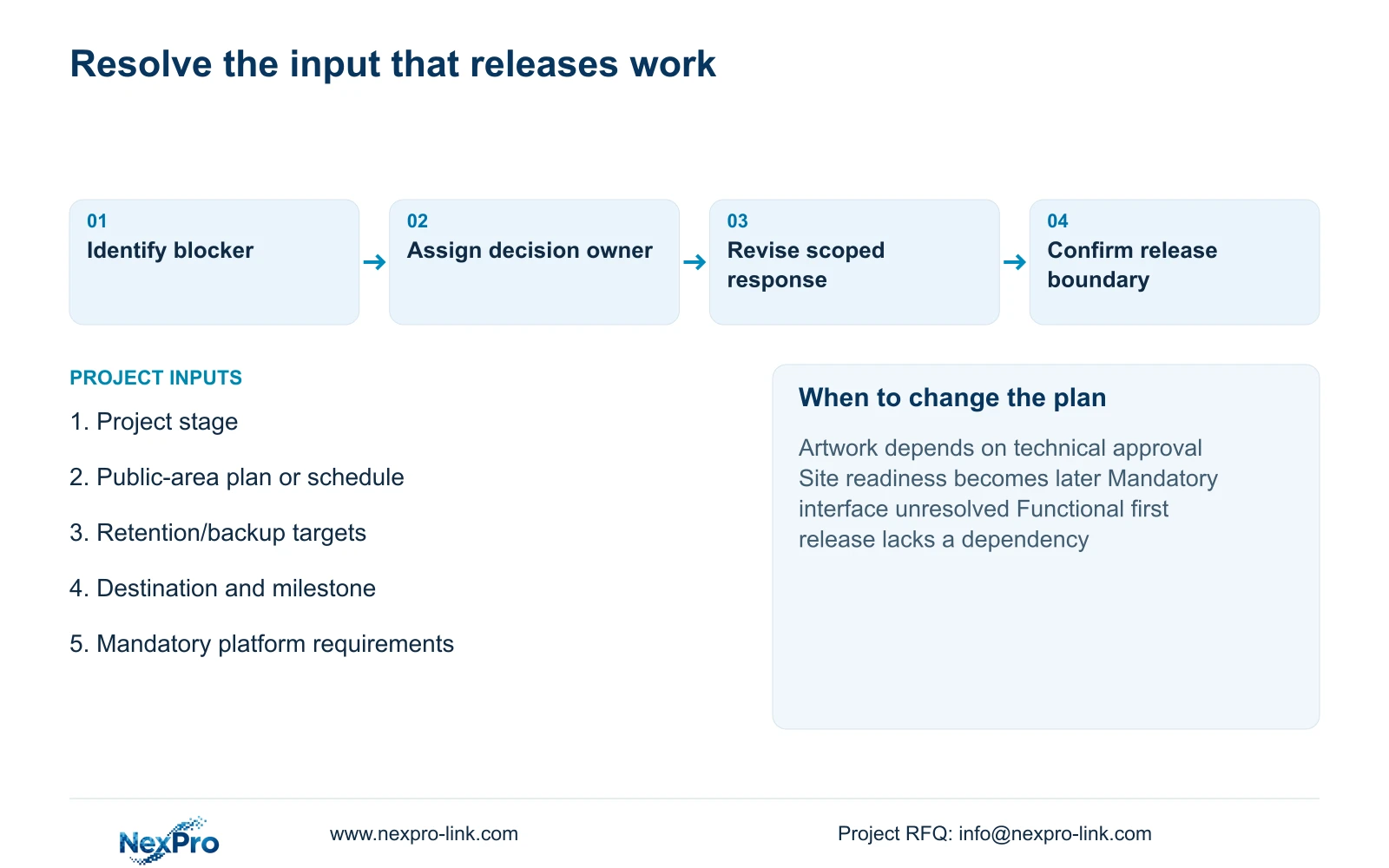
End the first quotation review with a specific missing decision and the result it enables. A clarified retention policy enables a revised storage proposal. A confirmed access-node location enables a power-zone review. An authorized artwork version enables packing preparation within the agreed process. Name the responsible project role and the scope that remains conditional.
Recommend a staged RFQ using available evidence when uncertainty can be bounded. Change to a final-scope request once quantities and mandatory interfaces are controlled. Hold the affected release if unresolved requirements could make the equipment unsuitable, while continuing independent work where it is safe to do so. This keeps the next step proportional to the actual procurement risk.
Send info@nexpro-link.com the project stage and current decision, public-area plan or schedule, retention and backup targets, and delivery destination with the relevant milestone. Identify mandatory brand or operator requirements. Hotel project support and BOQ and tender support can use those inputs for a scoped response that states what is priced, what is assumed and which clarification changes the proposal.
Section 07
Buyer questions
Can we start with a camera list instead of complete drawings? Yes. Include each position's public-area task and mark missing geometry or route information. The response can support model and equipment discussion while installation quantities and final framing remain provisional.
Must branding artwork delay the equipment quotation? No, if technical scope can be priced independently. Treat artwork as a separate input and state whether it affects preparation or packing. Actual release timing depends on the agreed dependencies.
What should the first supplier response contain? A proposed equipment scope, quantity status, technical assumptions, exclusions and delivery dependencies. It should identify the next input needed to revise or confirm the proposal, rather than present an unexplained total or unconditional arrival date.
Engineering references
These sources support the general planning principles. Always use the selected product's current datasheet and applicable project standards for final design.