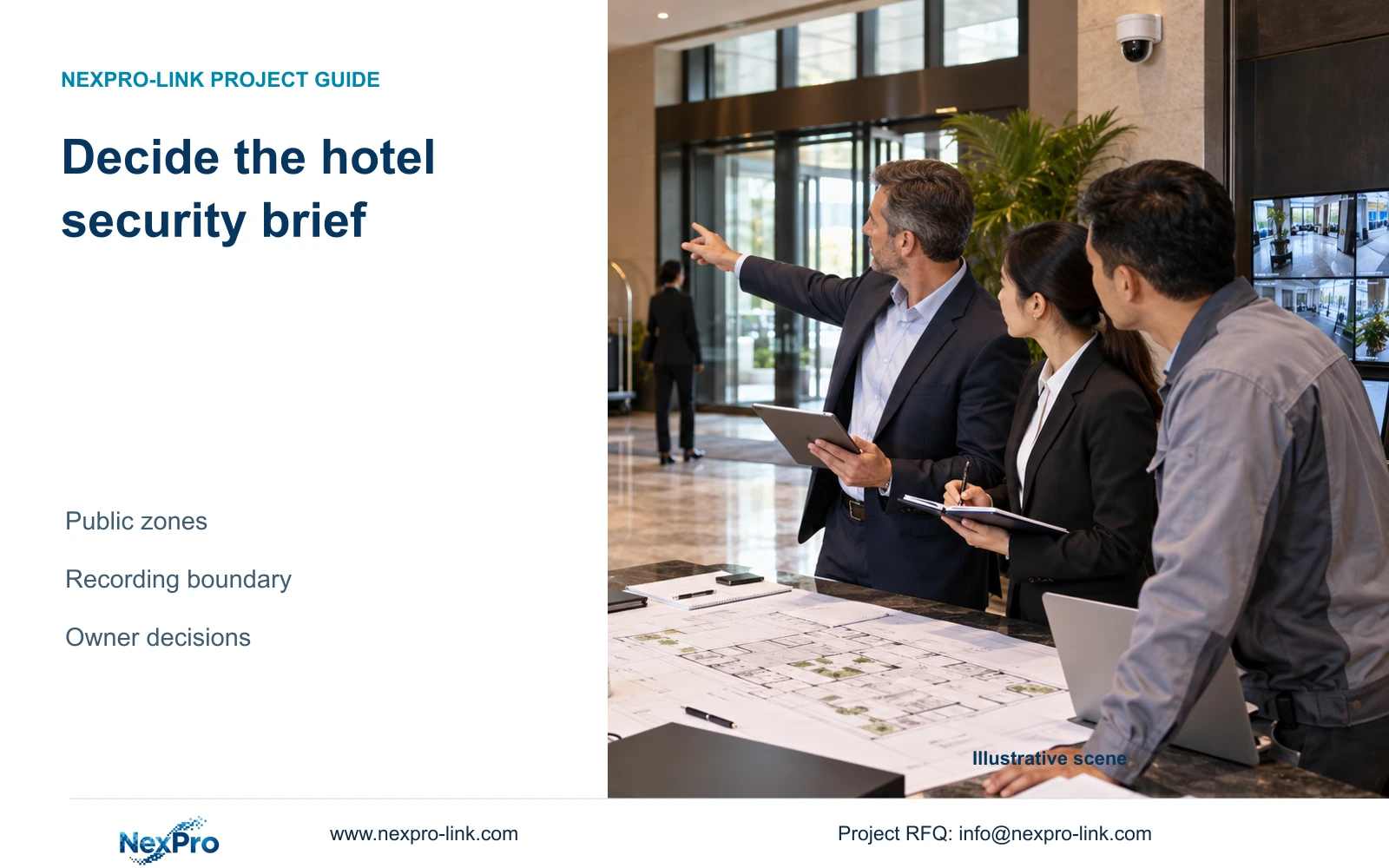
Freeze the required public-area tasks before selecting equipment. Compare packages against the same recording, retrieval and protected-power boundary, with optional displays priced separately.
Section 01
Define the operating objective
Decide what the hotel must observe, record and retrieve before choosing equipment. For a project at concept or pre-tender stage, freeze the required public-zone tasks and the agreed outage state first. Begin with an essential recording package; add display or recovery scope when an identified operating requirement justifies it. Guest-room count alone cannot establish the camera quantity.
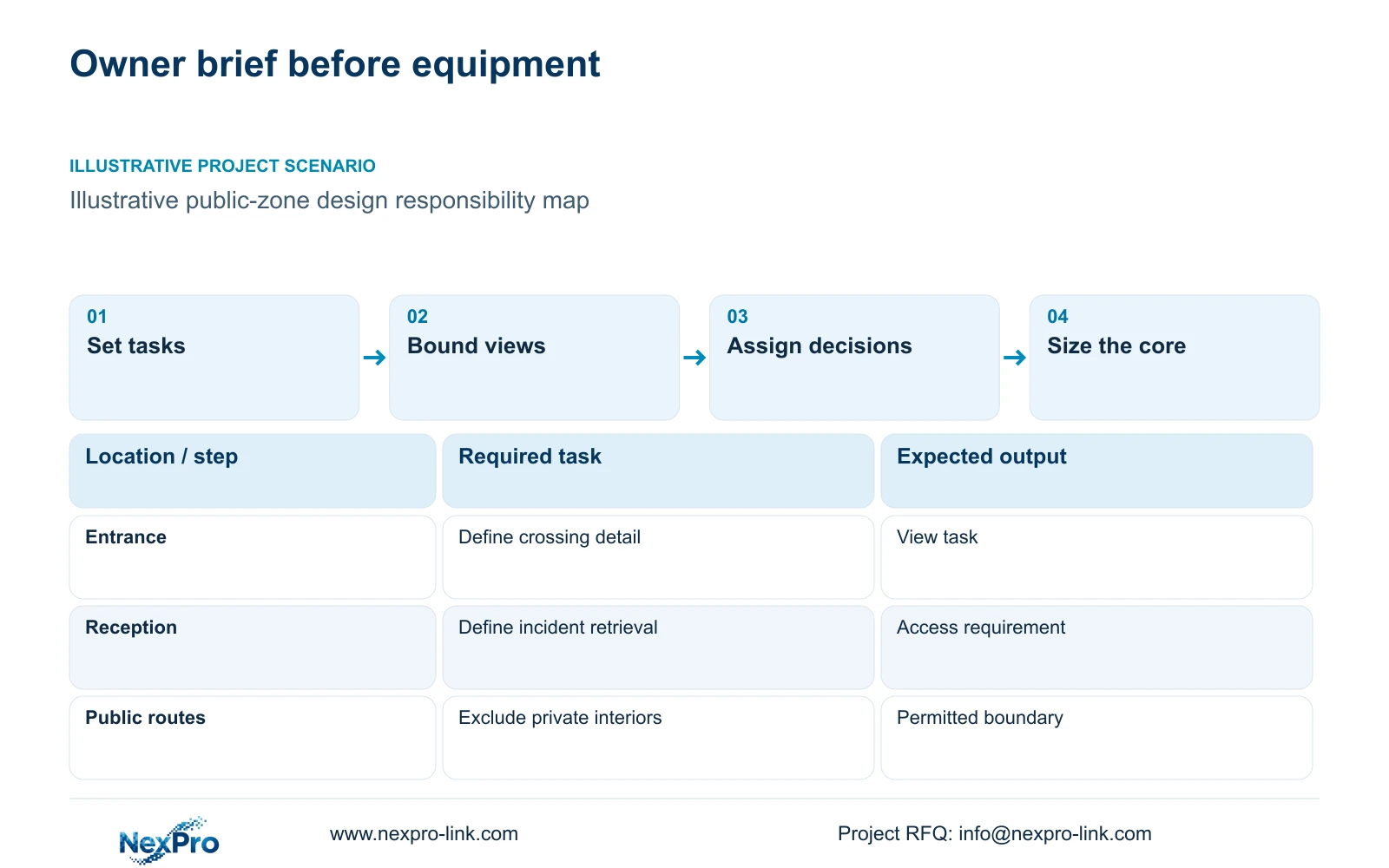
Write the brief in actions that an operator can demonstrate. At reception, the task might be to retrieve the relevant recording of an authorized incident. At an entrance, it might be to retain a usable view of movement through a defined crossing point. State the location and the required detail, then identify who needs access to the recording. A general instruction to provide hotel security leaves suppliers to make different assumptions.
Include the operating state during a power interruption. The brief should identify whether recording must continue, which network nodes support it, and whether live viewing also remains necessary. These decisions affect equipment and installation costs before any brand comparison begins.
| Required task | Given information | Decision still needed |
|---|---|---|
| Entrance recording | Public entrance identified | Required detail and permitted view |
| Incident retrieval | Authorized security team | Retention and export workflow |
| Recording during outage | Continuity requested | Protected nodes and target duration |
Section 02
Separate guest rooms from public zones
Mark the permitted observation areas on the available plans. Entrances, reception, public circulation routes, parking and authorized back-of-house handover points can have different tasks. Guest-room interiors, toilets and changing spaces are excluded from this planning scope. A public corridor view also needs a boundary that avoids unnecessary capture inside a room when its door opens.
Connect each proposed view to a camera tag and a task. The schedule can then carry image requirements into recorder, network and cabling decisions. Where one position cannot provide both an overview and the required detail, compare a changed position or lens with an additional view. The owner should understand the task gained or lost by either choice.
Keep audio separate from the image decision. A camera with two-way audio does not establish a need for continuous recording of conversations. The hotel must define its authorized use and applicable local requirements. Likewise, a 30-day storage example is a planning input, not a universal hotel retention rule.
| Item | Broad capture | Purpose-limited view | Effect |
|---|---|---|---|
| Public corridor | Includes unnecessary room interiors | Frames the public route | Retains the route task with less unrelated capture |
| Reception | One wide view assumed sufficient | Overview and detail assessed separately | Exposes any unresolved detail requirement |
Section 03
Assign owners to unresolved decisions
Give each unresolved input a responsible project role. The owner or operator defines the required service and retention purpose. The design engineer translates the accepted tasks into views and infrastructure. Hotel IT identifies network and access constraints. The cost manager compares the same scope across proposals, while the local installation team confirms routes and site responsibilities.
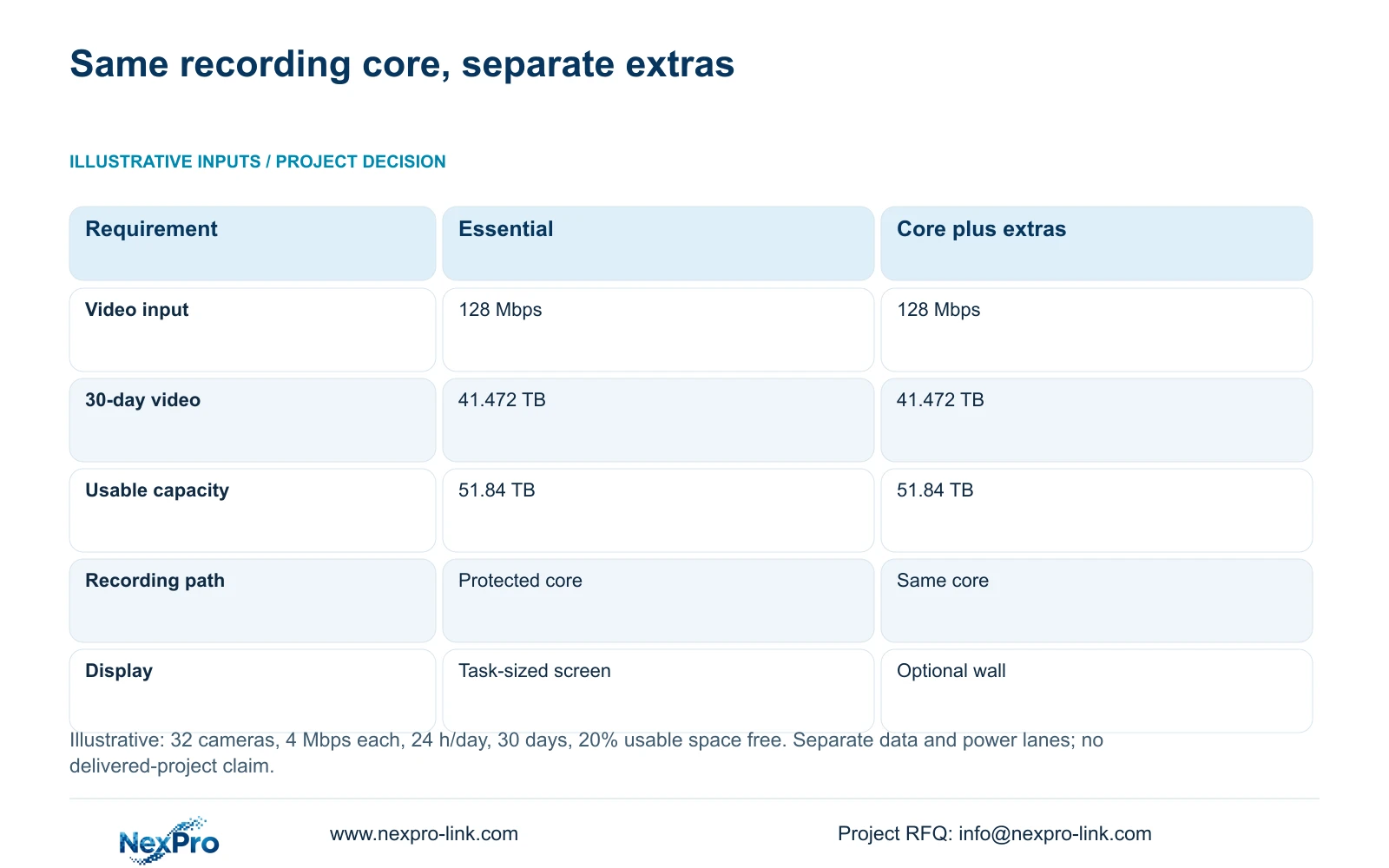
Use an explicit teaching baseline while these decisions develop: 32 cameras averaging 4 Mbps each, recording 24 hours per day for 30 days, with 20% of usable storage left free. These values are assumptions for the comparison. They are not camera specifications, measured hotel traffic or instructions to purchase 32 units.
The aggregate video input is 32 × 4 = 128 Mbps. Decimal video capacity is 0.0108 × 32 × 4 × 30 = 41.472 TB. Dividing by 0.80 gives 51.84 TB of required usable capacity. The 0.0108 factor converts one Mbps of continuous daily recording to decimal TB; the division preserves the stated free-space proportion.
Section 04
Compare two complete system boundaries
Compare an essential recording-first package with the same core plus selected display or recovery additions. Both must retain the accepted views and recording policy. A lower quotation that omits disks, a remote access switch or its protected supply changes the service being purchased.
Show data and power paths separately. The video path connects cameras through the required network to recording, with a viewing branch to an authorized client or decoder. The protected-power path must reach every active node needed during the agreed outage. An optical backbone carries data but does not automatically supply a remote switch or camera.
The table holds recording demand constant so the owner can evaluate the additions independently. It does not establish disk compatibility, concurrent playback or battery runtime. Those checks belong to the selected configuration. Optional viewing equipment should be removable from the comparison without interrupting the essential recording path.
| Metric / condition | Essential package | Same core plus extras |
|---|---|---|
| Recording input | 128 Mbps | 128 Mbps |
| 30-day video data | 41.472 TB | 41.472 TB |
| Required usable capacity | 51.84 TB | 51.84 TB |
| Protected path | Cameras + network + recording | Same plus explicitly selected extras |
| Operator display | Task-sized monitor/workstation | Optional wall; independent recording |
| Cost comparison | Complete scope quotation required | Documented incremental scope added |
Section 05
Translate priorities into capacity inputs
Use the accepted camera schedule to calculate recording input and storage, then calculate PoE demand by actual access group. Build the UPS load from the relevant AC equipment boundary. When a switch's AC input already includes its PoE loads, adding those cameras again would double-count their contribution.
NexPro-NVR4449-4K is a recording candidate with published fields of 49 channels, 320 Mbps input and four SATA positions supporting a stated 18 TB per disk. Its summary lists 49 × 5MP and 9 × 4K, so channel count does not prove arbitrary 49-camera 8MP operation. RAID levels are not established by the supplied record. NexPro SW-POE1618G remains an inquiry candidate because its access-port speed fields conflict and its total PoE wattage is unstated.
For protected power, SP2KR(S) has a published 2 kVA / 1800 W rating. That rating permits a capacity check, not a runtime promise. Select its battery configuration against the actual load and duration; do not transfer another model's battery energy to it.
| Retained outcome | Extra scope | Purchase trigger | Counter-condition |
|---|---|---|---|
| Required recording | Larger monitoring display | Simultaneous observation needs a larger layout | Event retrieval works on the simpler display |
| Agreed outage operation | Additional protected load | The added function must remain active | It can stop without losing required recording |
Section 06
Release a useful first RFQ
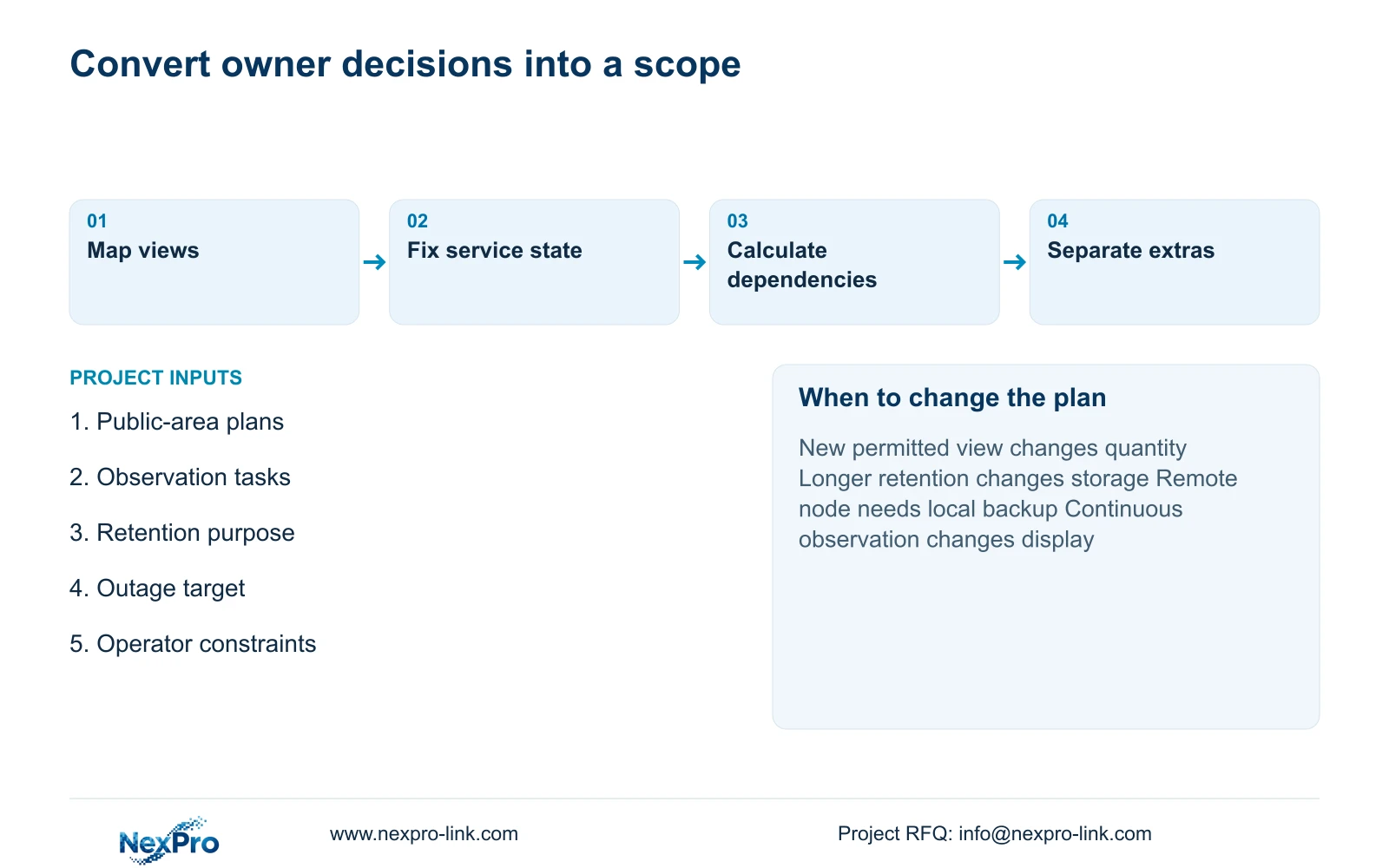
Request the essential package first when public-zone tasks are defined and ordinary viewing supports the operating workflow. Request a separate enhanced option when continuous multi-view observation or an explicit recovery requirement adds value. If a mandatory platform, environmental condition or revised retention policy changes the baseline, retain that requirement and recalculate the package.
Send the available public-area plans, a short task list and owner priorities to info@nexpro-link.com. Include the project stage and delivery destination, and identify the unresolved decision that is blocking progress. NexPro-Link's hotel project equipment support and BOQ support can address model matching, technical information and coordinated supply. CCTV manufacturing and coordination of supporting categories have separate responsibilities; a combined order does not establish automatic integration or included local installation.
Keep service terms visible in the quotation. The policy record supplied as checked on October 7, 2026 states a 24-month limited hardware baseline for applicable main equipment from receipt. Batteries, disks, cable, OEM scope and site costs follow their applicable written terms.
Section 07
Buyer questions
Can we request an equipment proposal before construction drawings are complete? Yes. Identify which views and quantities are provisional, and request a proposal against the available public-zone tasks. Ask the supplier to separate assumed quantities from confirmed requirements so later layout changes can be priced clearly.
What should remain identical when comparing two suppliers? Keep the required views, recording policy, outage state and delivery boundary identical. Require each supplier to identify exclusions and optional additions. A brand comparison is inconclusive when one package omits a required dependency.
What belongs in the first inquiry? Provide relevant public-area plans, owner priorities, the blocking design decision, project stage and destination. State mandatory operator or brand conditions and whether alternatives are allowed. Exclude guest images, passwords and access credentials.
Engineering references
These sources support the general planning principles. Always use the selected product's current datasheet and applicable project standards for final design.