Release a complete opening package when delayed displays or custom packaging can be separated without losing required security tasks. Keep essential recording, network and power dependencies together.
Section 01
Identify the delayed item and its release boundary
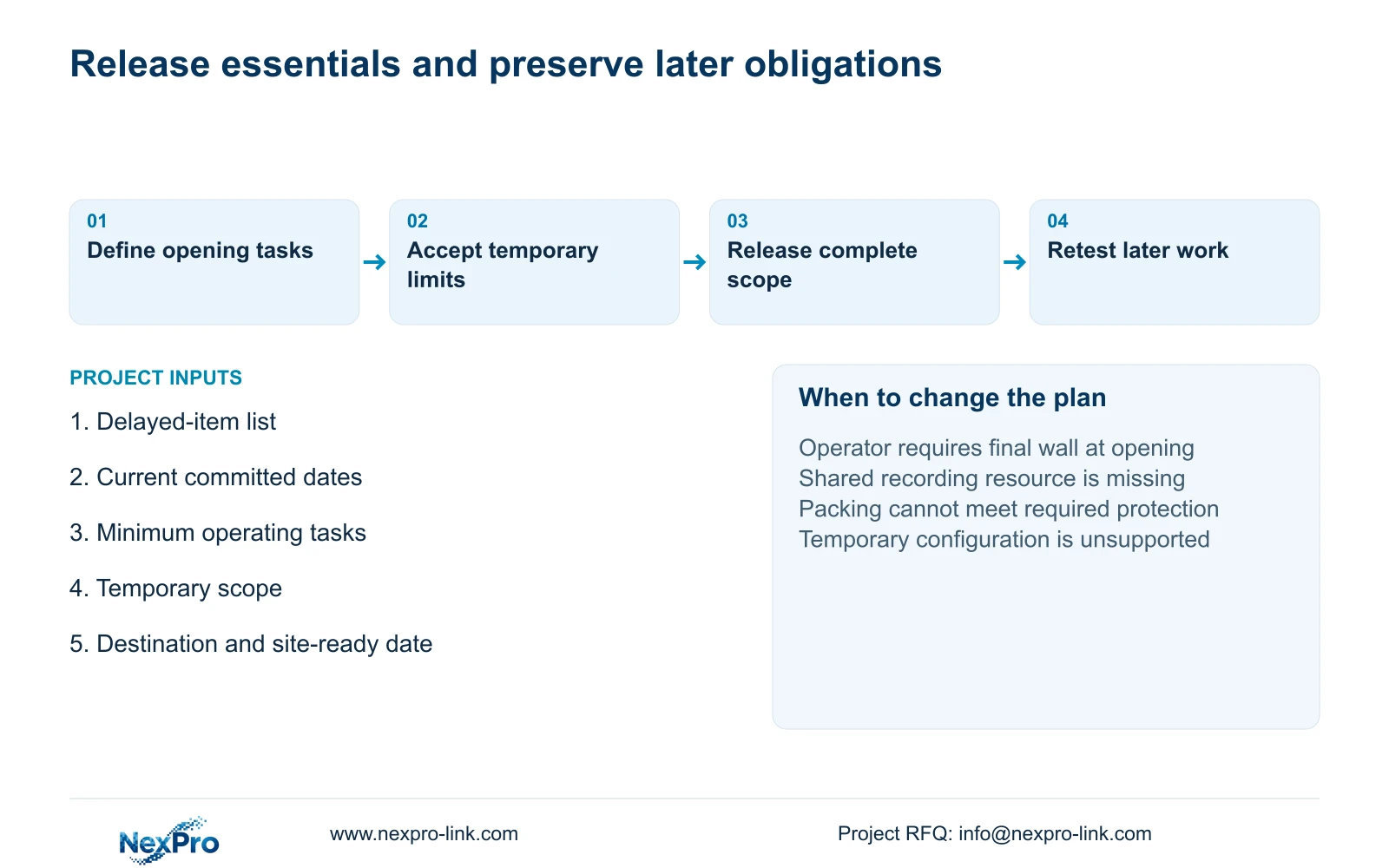
Release the essential hotel security package before a delayed optional display or custom packing item only when the approved opening tasks remain complete and the change is accepted in writing. Keep cameras, recording, necessary network resources and the agreed protected-power path together. If the delayed item is mandatory for operation, revise the release instead of silently omitting it.
Identify the exact delayed model, quantity or preparation step and its current status. Distinguish an item awaiting artwork from equipment awaiting technical approval, transport or site access. Each has a different recovery action. A general statement that the security package is late gives the project team too little information to choose a useful response.
Connect that item to the affected opening work front. Record whether it blocks physical installation, an operator task or formal acceptance under the project requirements. Confirm the current release date and the decision that could change it. Forecast dates support planning; they do not authorize changed quantities, packing or shipment arrangements.
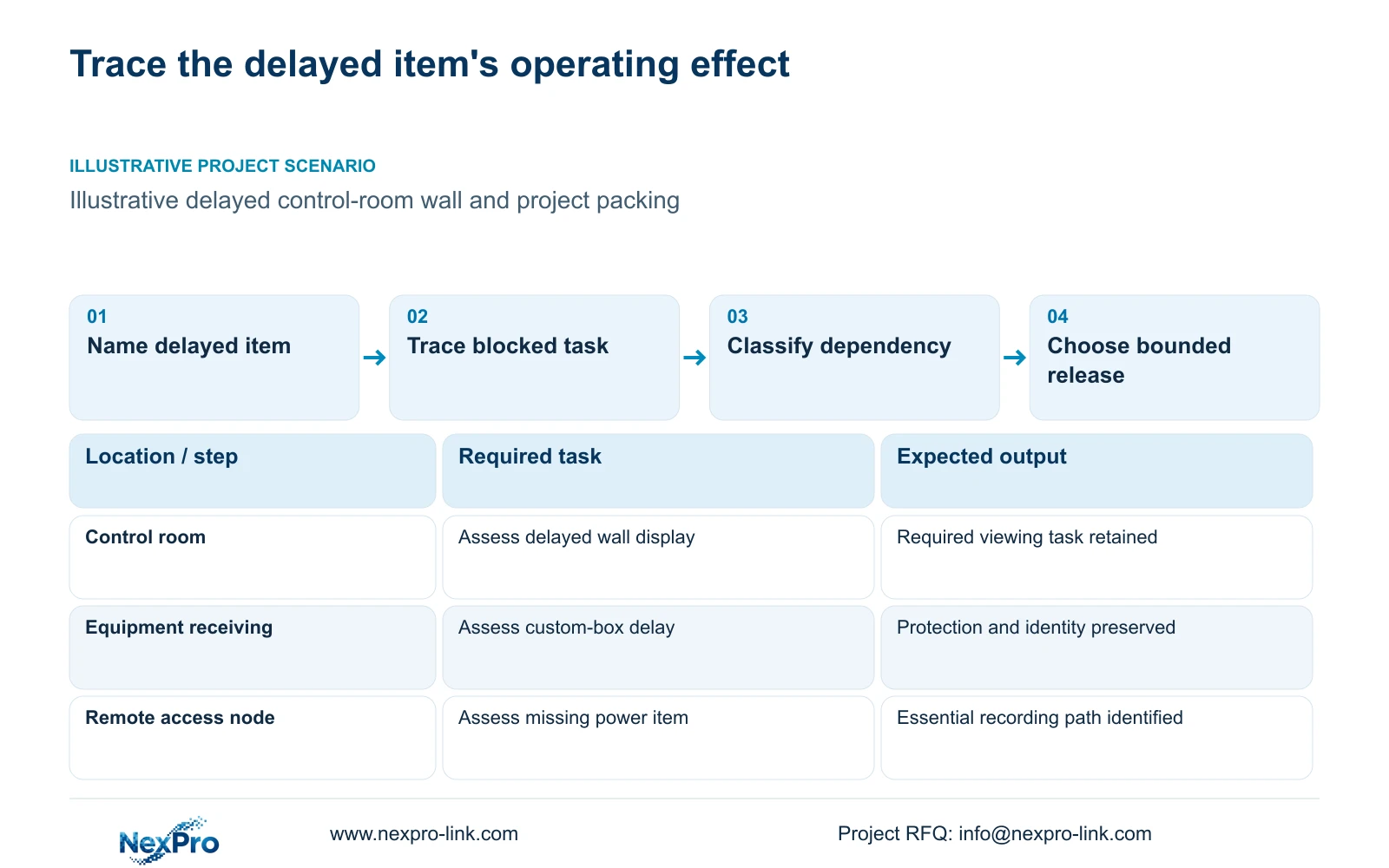
| Required task | Given information | Decision still needed |
|---|---|---|
| Operate incident viewing and retrieval | Final wall display delayed | Can an accepted temporary display support the tasks? |
| Identify and install first-phase devices | Custom color boxes delayed | Can approved packing retain protection and traceability? |
| Maintain recording during outage | Required power component delayed | Can a supported complete protected path be provided? |
Section 02
Trace the function the item actually blocks
Draw the camera-to-recorder path and the operator viewing path separately. A wall display receives video through a suitable client or decoder arrangement; it is not inherently a node through which recording must pass. Its delay may affect continuous observation or multi-operator use while leaving the recording path technically complete.
The product source identifies NX-VP-5535 as a 55-inch Full HD LCD panel, not direct-view LED. NX-VD-4K16 is a decoder candidate whose name does not establish 16 simultaneous 4K streams. A temporary display proposal must specify the actual supported viewing workload. A powered screen alone does not prove that the required operator layout is available.
Apply the same dependency discipline to other coordinated categories. Battery-operated room locks and centrally powered staff-access systems have different supply and control arrangements. A CCTV release cannot substitute for unresolved door safety or PMS interfaces. Keep the responsible local specialist's requirements intact when assessing what the hotel can open.
| Item | Wait for final item | Bounded alternative | Effect on the hotel task |
|---|---|---|---|
| Wall display | Final observation layout arrives later | Accepted monitor/client arrangement | Retain agreed viewing and incident work |
| Custom packing | Branded boxes control shipment | Approved alternative packing | Retain protection, labels and receiving identity |
| Required access-node power | Recording path remains incomplete | Supported protected supply | Outage task requires explicit validation |
Section 03
Separate essential dependencies from deferrable scope
Use the opening task list to classify each dependency. Recording requires its assigned cameras, network path, recorder and storage arrangement. The selected outage task also requires power at every necessary active node. An optional display enhancement may be deferred, while an ordinary operator display can still be essential for the accepted workflow.
CASE06 provides an illustrative design with a complete first 32-camera package within a final 64-camera hotel. It distinguishes ordinary operator viewing from an optional LCD wall and keeps display loads visible. This supports phased planning, but its system totals do not establish the loads, dates or acceptance status of the delayed project.
Preserve separate checks for stream input, retention capacity, PoE groups and protected W/VA. Removing a display load may change a power budget, but it does not justify reducing required storage or excluding a remote switch. Do not infer runtime from a UPS nameplate or move a default battery field across models to support an urgent release.
Section 04
Compare temporary and revised release packages
Compare three practical choices where available: wait for the complete order, release an independently usable first package, or provide a supported temporary arrangement followed by the final scope. Identify the operating task retained by each choice. If a mandatory operator standard requires the final wall, a single monitor cannot be presented as equivalent without an approved change.
Price temporary work transparently. Include configuration, extra delivery, removal or reuse and repeat testing as applicable. Keep cancelled items separate from deferred items. Confirm whether prepared material can actually be reused before crediting it. No general assumption makes a late change free or guarantees that a substitute arrives sooner.
Packing changes need their own boundary. Preserve model, serial and necessary equipment labels, accessory identity and receiving allocation. Authorized branding can be discussed through the OEM scope, but changing a box does not grant rights to rename third-party software. Protective and destination-specific requirements remain part of the agreed shipment.
| Retained outcome | Extra scope | Worth buying when | Condition against it |
|---|---|---|---|
| Required operator workflow | Temporary display and later replacement | Actual layout and permissions remain usable | Mandatory observation task is lost |
| Complete first-phase equipment | Split packing and transport | Release is technically independent | Shared equipment is still missing |
| Safe identifiable delivery | Alternative approved packing | Protection and receiving records remain intact | Required packing conditions cannot be met |
Section 05
Calculate the programme from real dependencies
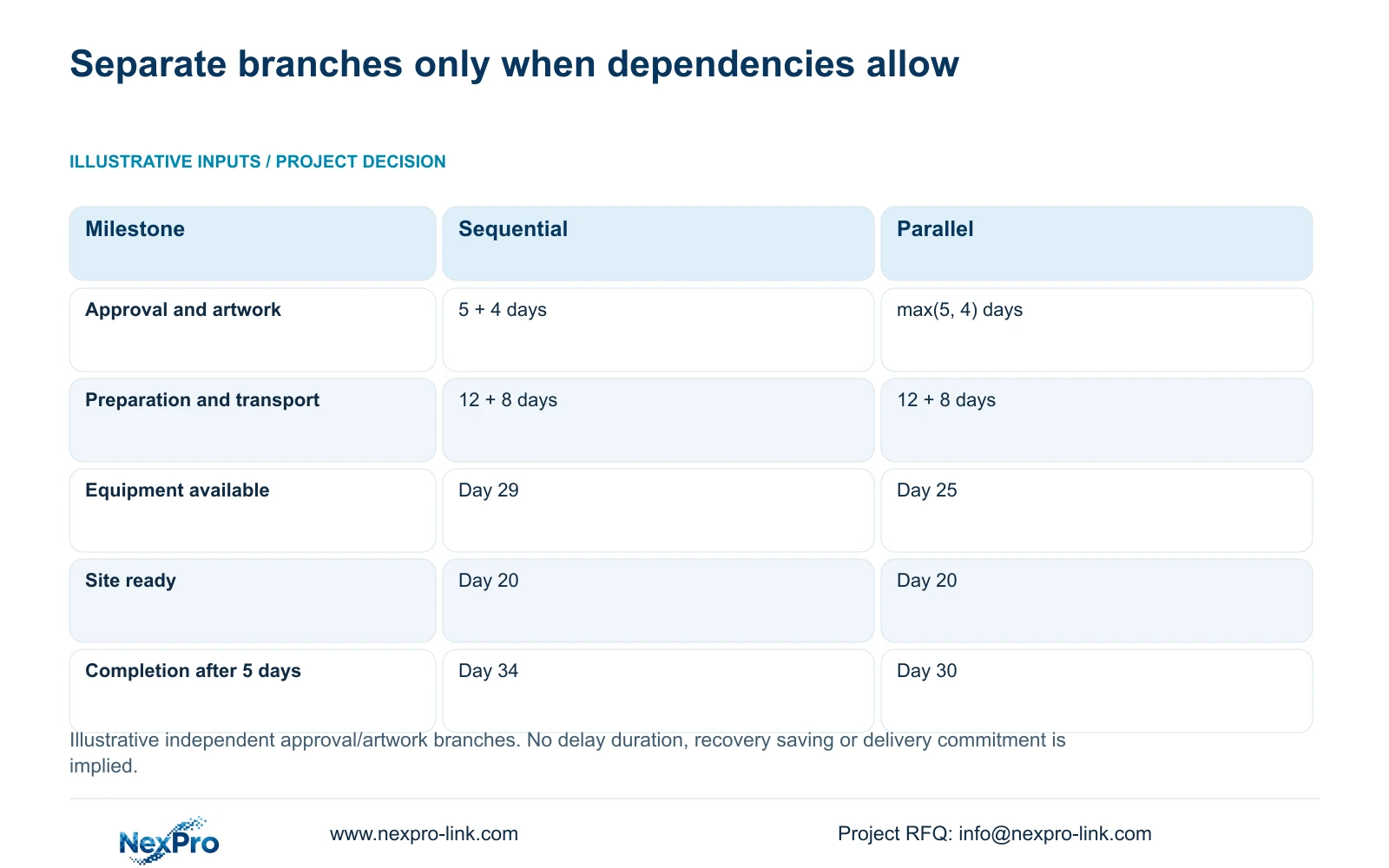
The independent teaching example assumes five days for technical approval and four for artwork, running in parallel. Preparation takes 12 days and transport eight. Site readiness is day 20 from the common starting point, followed by five days for installation and testing. None of these durations is a NexPro-Link delivery commitment.
Equipment availability is max(5, 4) + 12 + 8 = day 25. The usable installation start is max(25, 20), and completion is day 30. Adding approval and artwork as sequential steps gives equipment on day 29 and completion on day 34. The four-day difference reflects the stated dependency structure, not a measured recovery saving.
For a delayed display or packing item, establish whether it genuinely controls preparation or shipment of the essential package. If the branches can be separated under an approved release, calculate each branch using its actual dates. If the item remains a mandatory common prerequisite, retain that dependency. Separate site readiness and operator availability so faster delivery is not mistaken for earlier operation.
Use the controlling path to choose the recovery action. Extra freight cannot resolve missing network authorization, and early cameras cannot complete a package that lacks required recording equipment. Do not promise a recovered opening date until the relevant preparation, transport and site commitments have been established.
| Metric / condition | All branches sequential | Actual parallel branches |
|---|---|---|
| Approval + artwork treatment | 5 + 4 days | max(5, 4) days |
| Equipment available | Day 29 | Day 25 |
| Site ready | Day 20 | Day 20 |
| Illustrative completion | Day 34 | Day 30 |
| Actual commitment | Depends on real sequence and agreed dates | Requires actual project inputs |
Section 06
Record the approved recovery scope and later work
Document the selected package, retained tasks, temporary limits and deferred items. Name the responsible party for later installation, configuration and retesting, with an access window and receiving plan. Keep model approval, brand approval and order authorization separate so a proposed substitute is not treated as permission to ship it.
Recommend an independent essential release when recording, protected operation and the accepted operator workflow remain complete. Wait or revise the design when a delayed item blocks a required task, a supported substitute is unavailable or the operator rejects the temporary arrangement. The supplied policy records a 24-month limited hardware baseline from receipt for applicable main equipment; later opening does not automatically restart that term, and batteries, disks, cable and OEM terms remain scoped.
Send the delayed-item list, current committed dates, minimum opening tasks and proposed temporary scope to info@nexpro-link.com. Include the destination and site-ready date. NexPro-Link can discuss coordinated equipment and packing options, with CCTV manufacturing, supporting supply and local installation responsibilities identified in the written proposal.
Section 07
Buyer questions
Can neutral packing be used while custom boxes are delayed? It can be evaluated as a written alternative when equipment protection, required markings and receiving identity remain intact. Confirm the actual packing and destination requirements first. Custom branding can be deferred only within the accepted commercial scope.
Does a temporary display allow the hotel to accept the whole system? Only the agreed tasks demonstrated with that arrangement support acceptance. Record the temporary viewing limits and final work still due. A later wall installation may require new configuration and operator-task checks without changing the already demonstrated recording scope.
Will split delivery always improve the opening date? No. It helps only when the released package is complete and equipment availability controls the relevant work. Site access, power, permissions or a missing shared resource may still control completion. Compare those dependencies before accepting extra transport and handling costs.
Engineering references
These sources support the general planning principles. Always use the selected product's current datasheet and applicable project standards for final design.