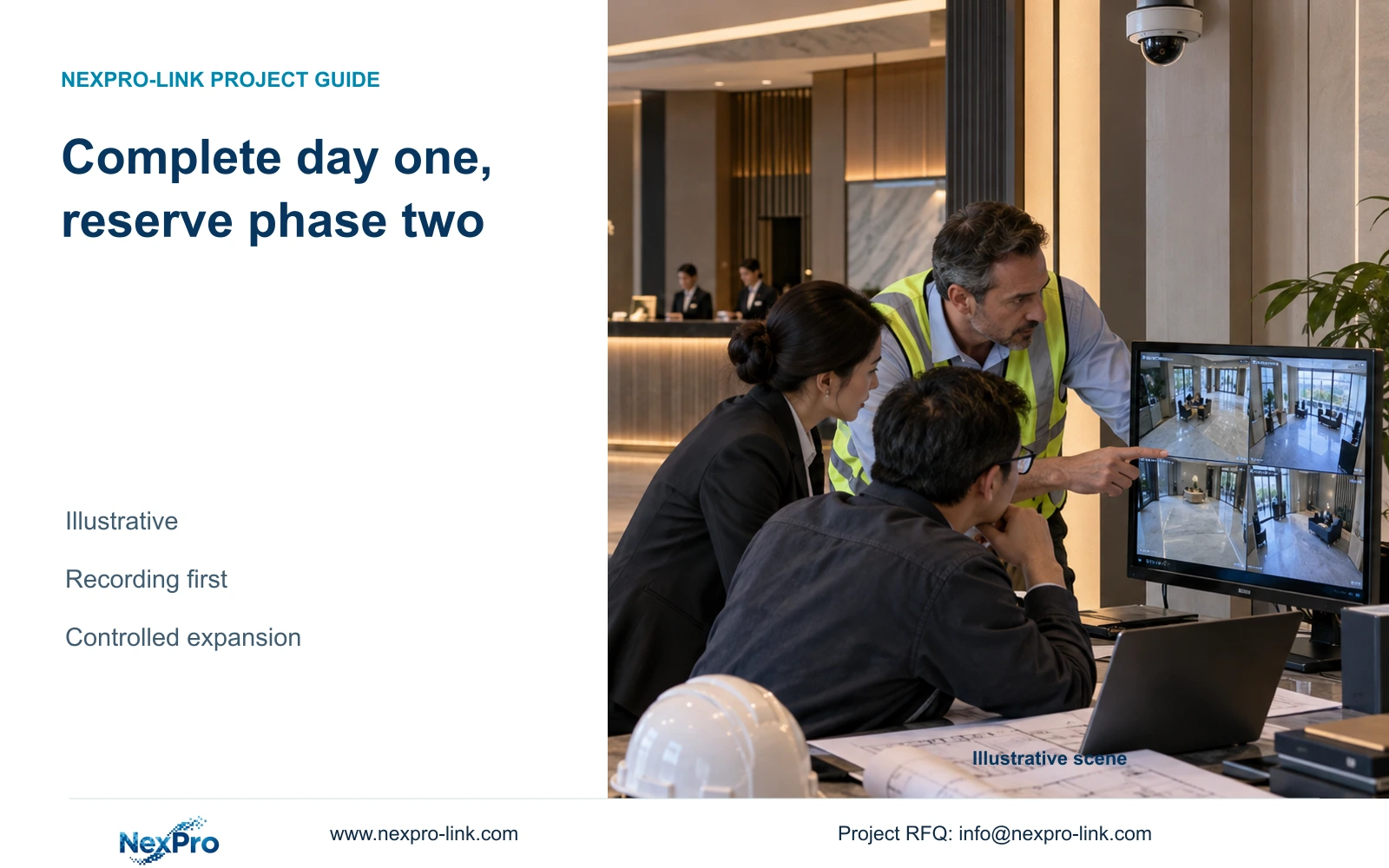
The first opening phase needs usable recording, authorized retrieval and protected power for every required node. Reserve later interfaces without buying every optional device.
Section 01
Define the public zones that must operate on day one
Install a complete recording, access-permission and backup-power arrangement for the first occupied phase. Defer later-floor equipment only when it is independent of that operating path. Reserve expansion interfaces early, and purchase optional displays or additional recovery equipment when an agreed task requires them.
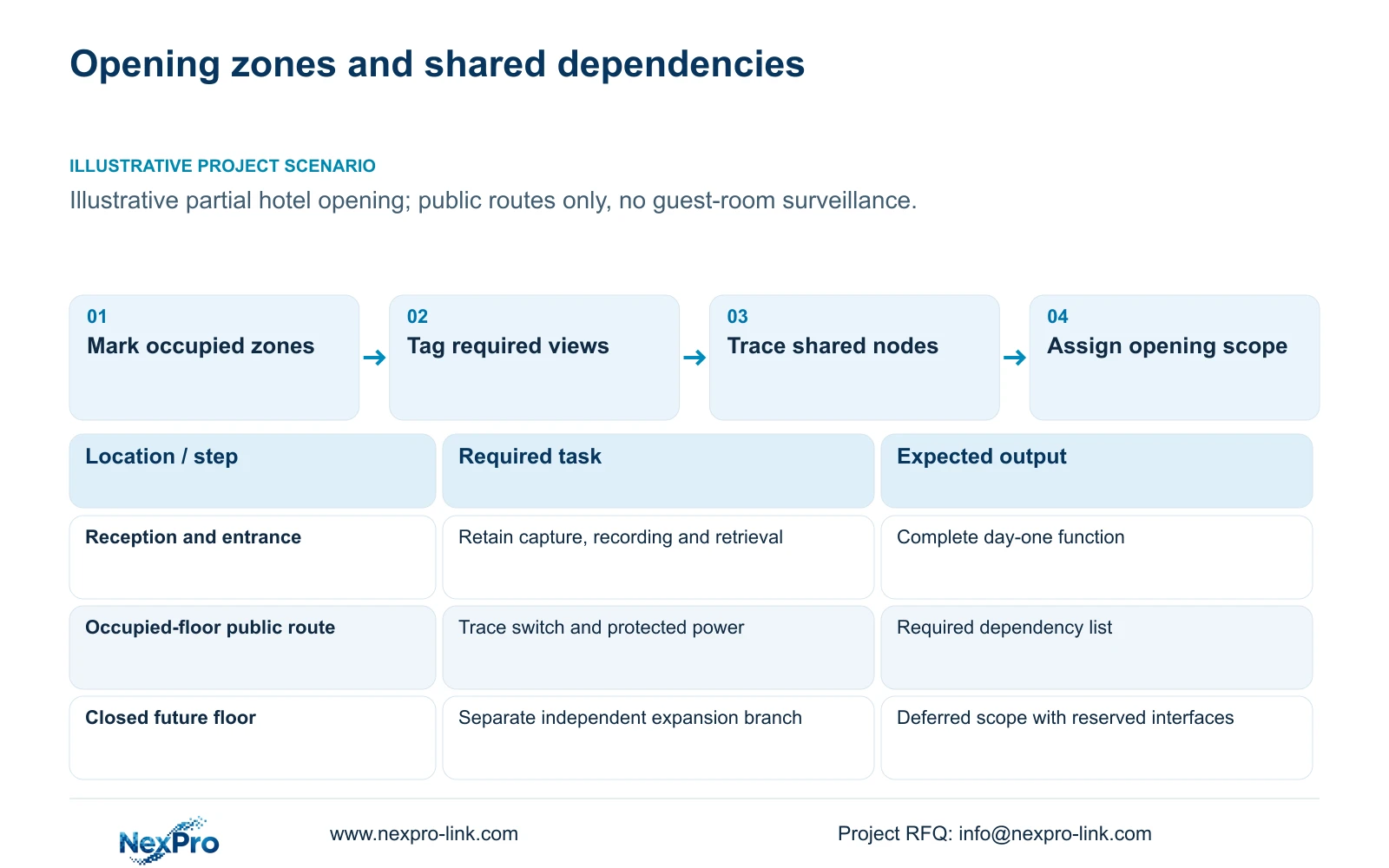
Mark the opening boundary on the public-area plan. Include the entrance, reception and public routes serving occupied floors, plus relevant back-of-house and parking tasks. Closed guest floors do not automatically remove shared entrance or service-route requirements. Separate construction access from guest circulation so each view has a stated purpose.
For every day-one camera tag, identify the required capture, recording and retrieval task and the intended outage state. Exclude guest-room interiors and other sensitive private spaces. The first-stage schedule should name what is operating and what remains deferred. That prevents a partial floor opening from becoming an assumption that every central component can also be postponed.
| Required task | Given information | Decision still needed |
|---|---|---|
| Reception incident retrieval | Reception opens in phase one | Complete recording and authorized export path |
| Occupied-floor circulation | Only selected floors open | Required shared-route views and active nodes |
Section 03
Size day-one recording and power
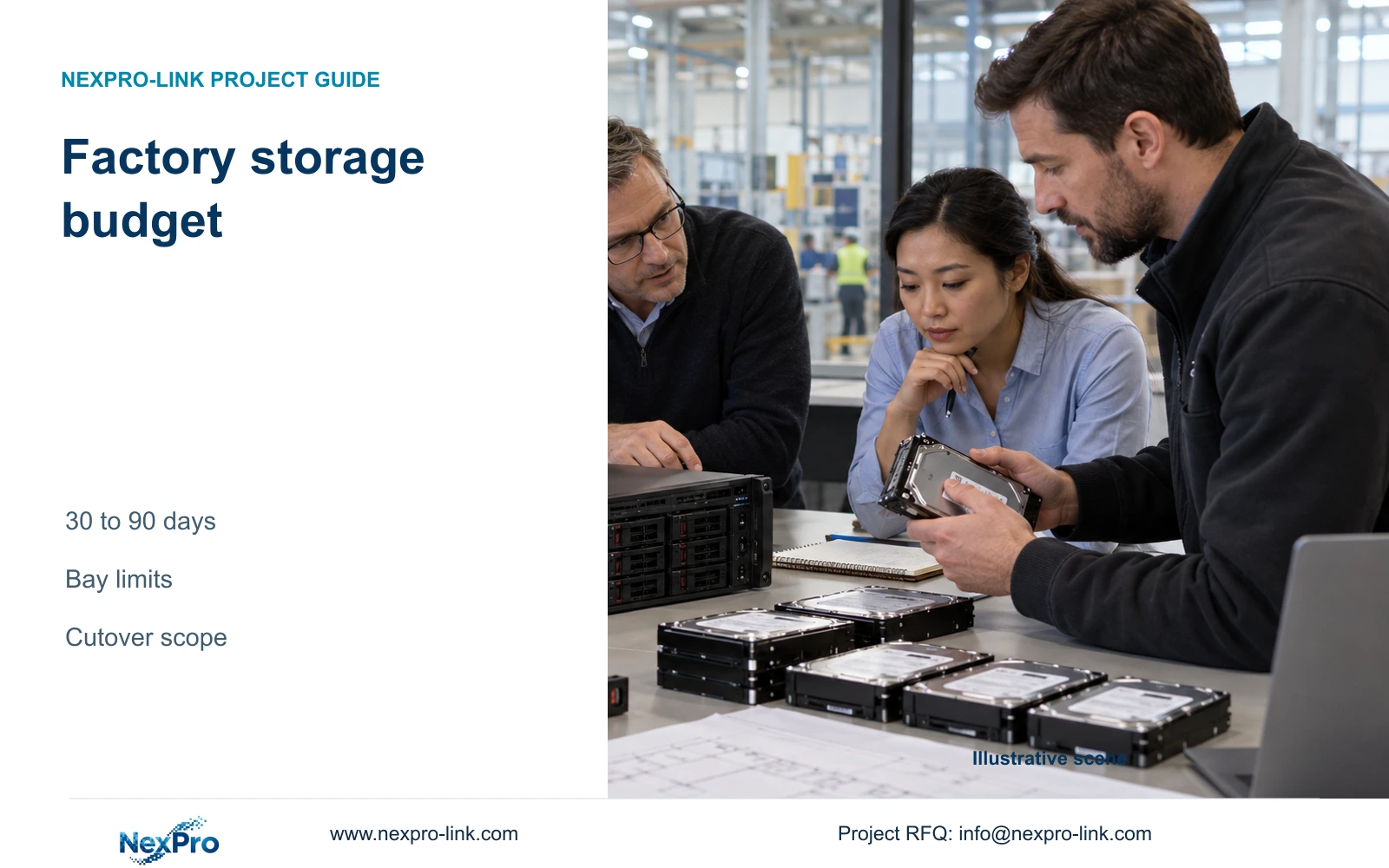
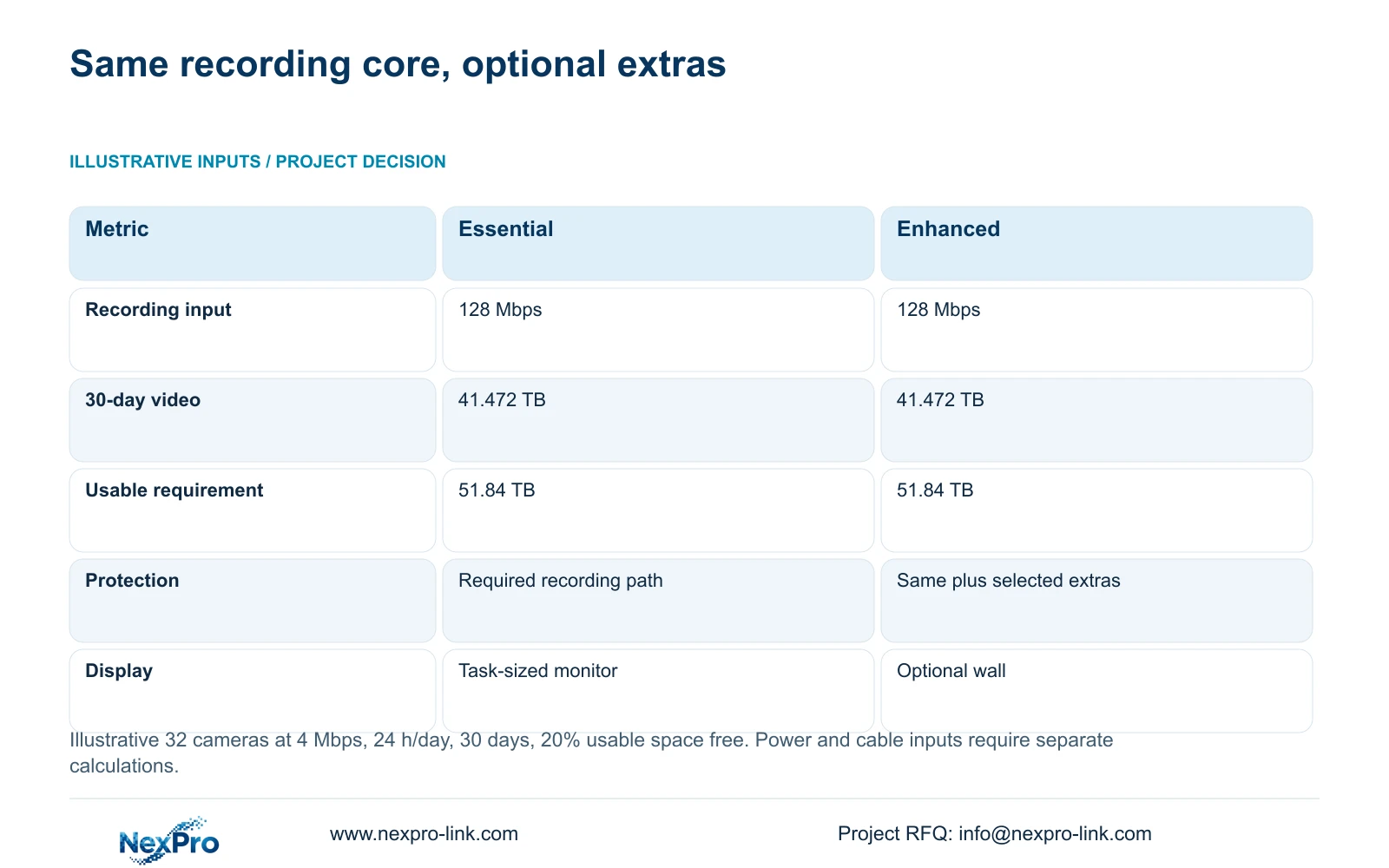
The illustrative comparison assumes 32 cameras averaging 4 Mbps each, recording continuously for 30 days, with 20% of usable space kept free. It compares an essential package with the same core plus optional display or recovery scope. It does not define the number of cameras needed for every soft opening.
Input is 32×4 = 128 Mbps. Using decimal TB, video data equals 0.0108×32×4×30 = 41.472 TB; 0.0108 converts one Mbps recorded for one day into decimal TB. Required usable capacity is 41.472/0.80 = 51.84 TB. Dividing by 0.80 preserves the stated free-space target.
Calculate PoE and UPS loads separately from these recording figures. CASE01's independent power assumptions cannot become measured product values. NexPro SW-POE1618G remains an inquiry candidate because its published access-port speeds conflict and its total PoE budget is absent. The camera PDF also lacks maximum watts. Obtain supported power inputs before approving a day-one backup configuration.
| Metric / condition | Essential package | Same core with selected extras |
|---|---|---|
| Recording input | 128 Mbps | 128 Mbps |
| 30-day video data | 41.472 TB | 41.472 TB |
| Required usable capacity | 51.84 TB | 51.84 TB |
| Protected path | Cameras, required network and recording | Same path plus selected extras |
| Operator display | Task-sized monitor/workstation | Optional wall; recording independent |
| Cost comparison | Complete scoped quotation | Documented incremental scope |
Section 04
Compare temporary and permanent equipment
Use permanent core equipment in phase one where the approved final design supports it and later expansion can occur without replacing essential functions. A temporary arrangement may be justified by a short-lived location or unresolved final room, but its later removal, configuration and recording-continuity work must be included.
NexPro-NVR4449-4K lists 49 channels, 320 Mbps input and four SATA positions with an 18 TB per-disk field. Its summary lists 49×5MP/9×4K; channel count does not establish 49 simultaneous 8MP recording capability. CASE01's independent-disk planning example uses four 16 TB drives and an assumed 95% formatted proportion, not a RAID capability claim.
Keep the 51.84 TB usable requirement unchanged when evaluating this illustration's temporary or enhanced arrangements. Do not substitute a smaller recorder merely because fewer floors are occupied if the same 32 required streams remain. Plan an authorized export and playback check before removing a temporary recorder; old disks are not automatically readable in a replacement.
Section 05
Plan the expansion interface
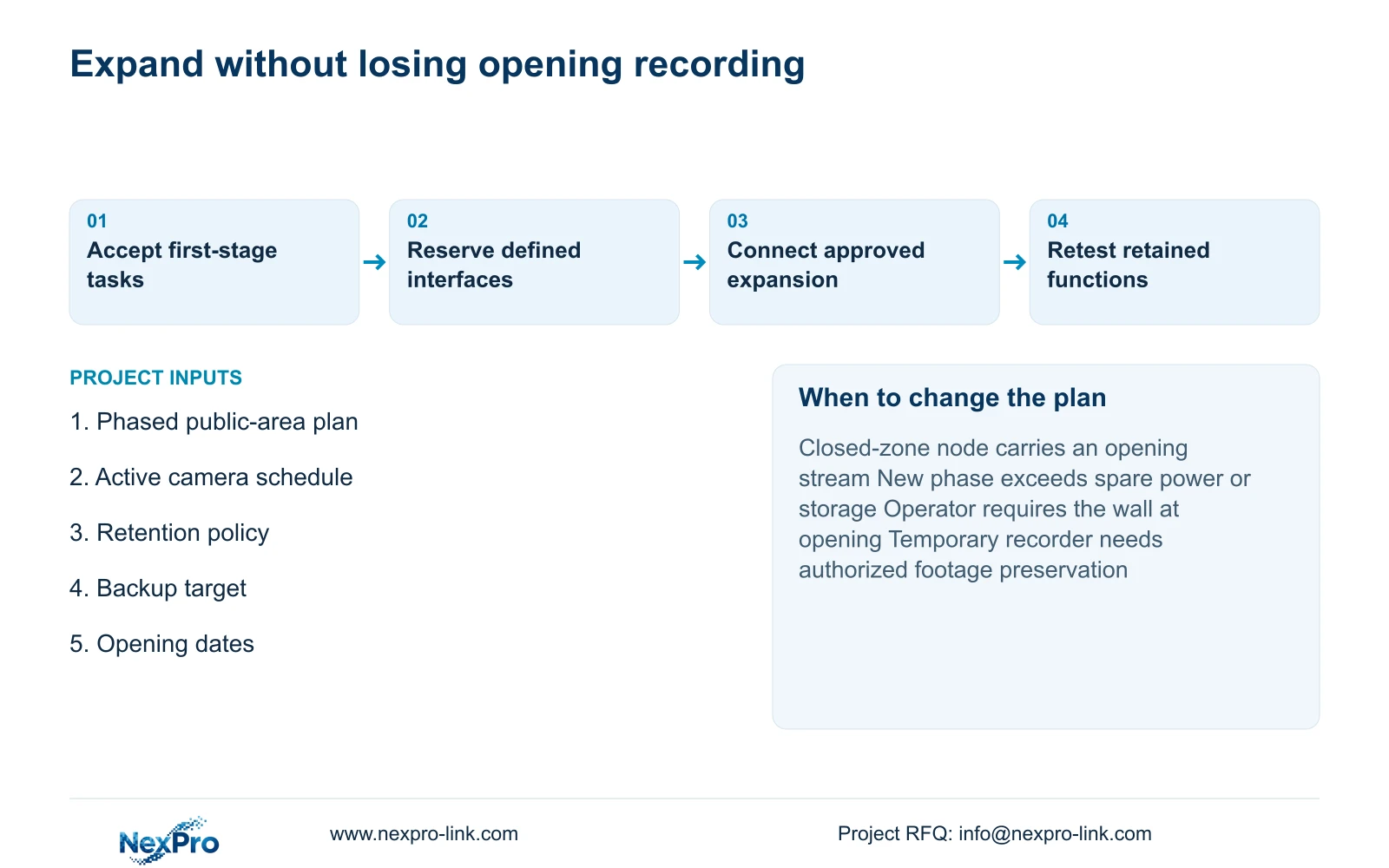
Reserve documented ports, routes and equipment space against the anticipated future task schedule. Keep those allowances separate from installed equipment. An available port does not establish spare PoE power, recorder bandwidth, storage or supported decoding, so review each resource when the next phase becomes defined.
Compare expansion work with the opening service that must remain available. A new branch can require changes to shared network configuration or protected power. Record the installation window and responsibility for preserving existing recording. Buy additional core capacity early only where the approved expansion demand or an inaccessible future interface makes that purchase justified.
If a later wall is selected, NX-VP-5535 is a 55-inch Full HD LCD candidate, not direct-view LED. Its actual mounting and electrical requirements need the selected configuration. The NX-VD-4K16 name does not establish sixteen concurrent 4K decodes. Deferred display scope should preserve a clear operational requirement without turning an unselected system into a fixed procurement promise.
| Retained outcome | Extra scope | Buy when | Counter-condition |
|---|---|---|---|
| Day-one recording | Future core capacity | Approved expansion cannot fit or later access is constrained | Future demand remains undefined and interfaces stay accessible |
| Authorized observation | Wall and decoder | Later operator tasks require that layout | Existing display remains sufficient |
Section 06
Agree on stage-specific acceptance
Define observable first-stage checks: recorded movement at the agreed public point, retrieval of a stated time window and continued recording through the selected outage state. Record model and firmware identities with the conditions and actual observations. A live preview or an illuminated NVR does not demonstrate the complete operating path.
Repeat the relevant checks after expansion, including the retained first-stage views and permissions. Factory checks cover reproducible factory conditions; hotel sightlines, installed routes and local power require site checks. An unresolved task should identify its responsible party and be retested under the same conditions after correction.
Choose the essential recording-first package unless an operator requirement or defined recovery task makes the additional scope necessary at opening. Send the phased public-area plan, active camera schedule, retention policy and backup target to info@nexpro-link.com, with the destination and opening dates. NexPro-Link can discuss model matching and coordinated supply; local installation and acceptance responsibilities remain explicit project scope.
Section 07
Buyer questions
Can equipment on a closed floor be deferred? Only if no required opening view or service depends on it. Check actual network and power paths first. A shared switch or backbone node may be essential even inside an unoccupied zone.
Should all future cameras be purchased for soft opening? Purchase against approved tasks and release needs. Reserve accessible routes and supported interfaces for later views. Early purchase is justified when final demand is defined or later installation access creates a specific constraint.
What must be retained before replacing a temporary recorder? Identify authorized footage to preserve, verify its export and playback, and document the replacement's stream and storage configuration. Do not rely on transferring the old disks without confirmed compatibility.
Engineering references
These sources support the general planning principles. Always use the selected product's current datasheet and applicable project standards for final design.