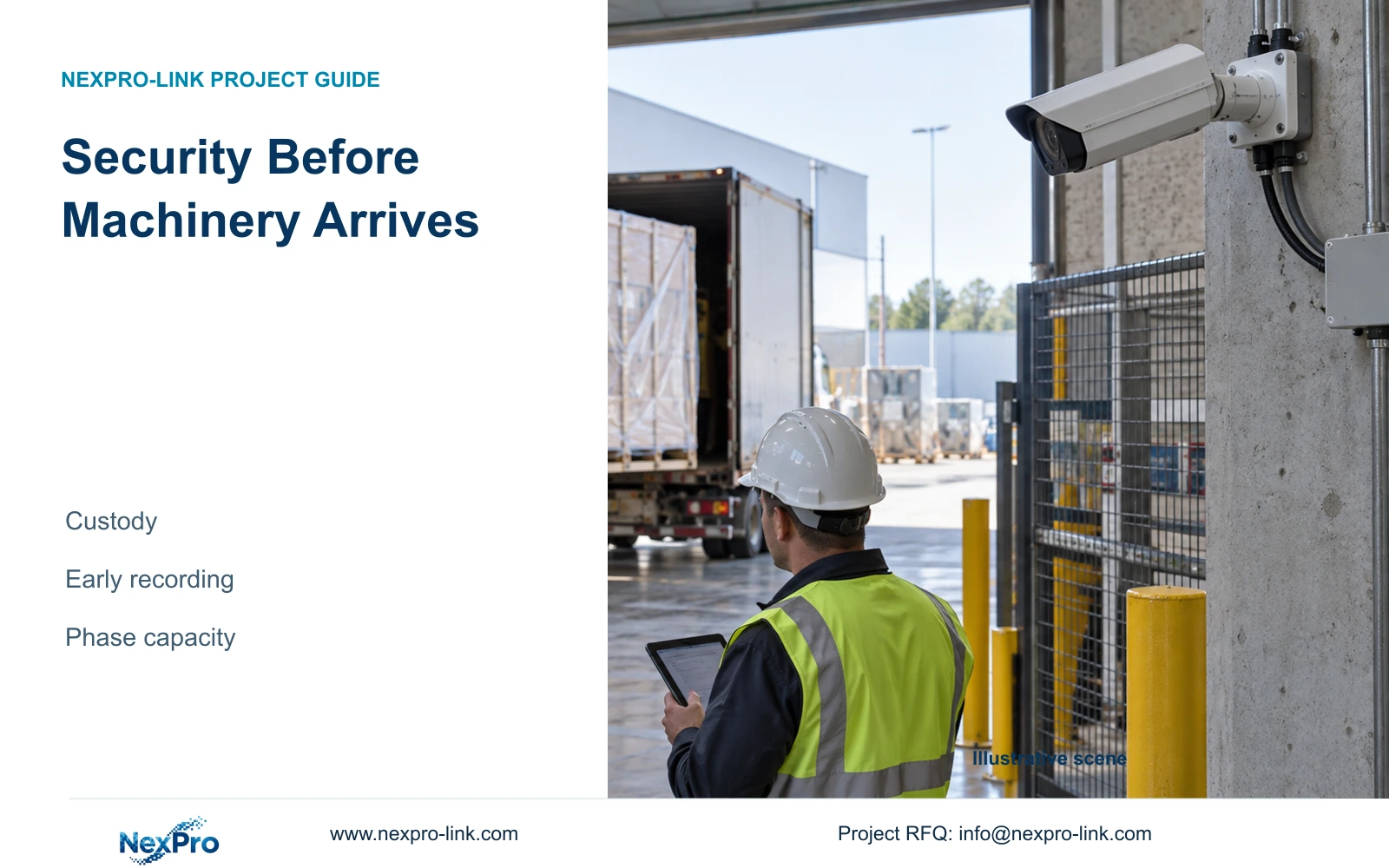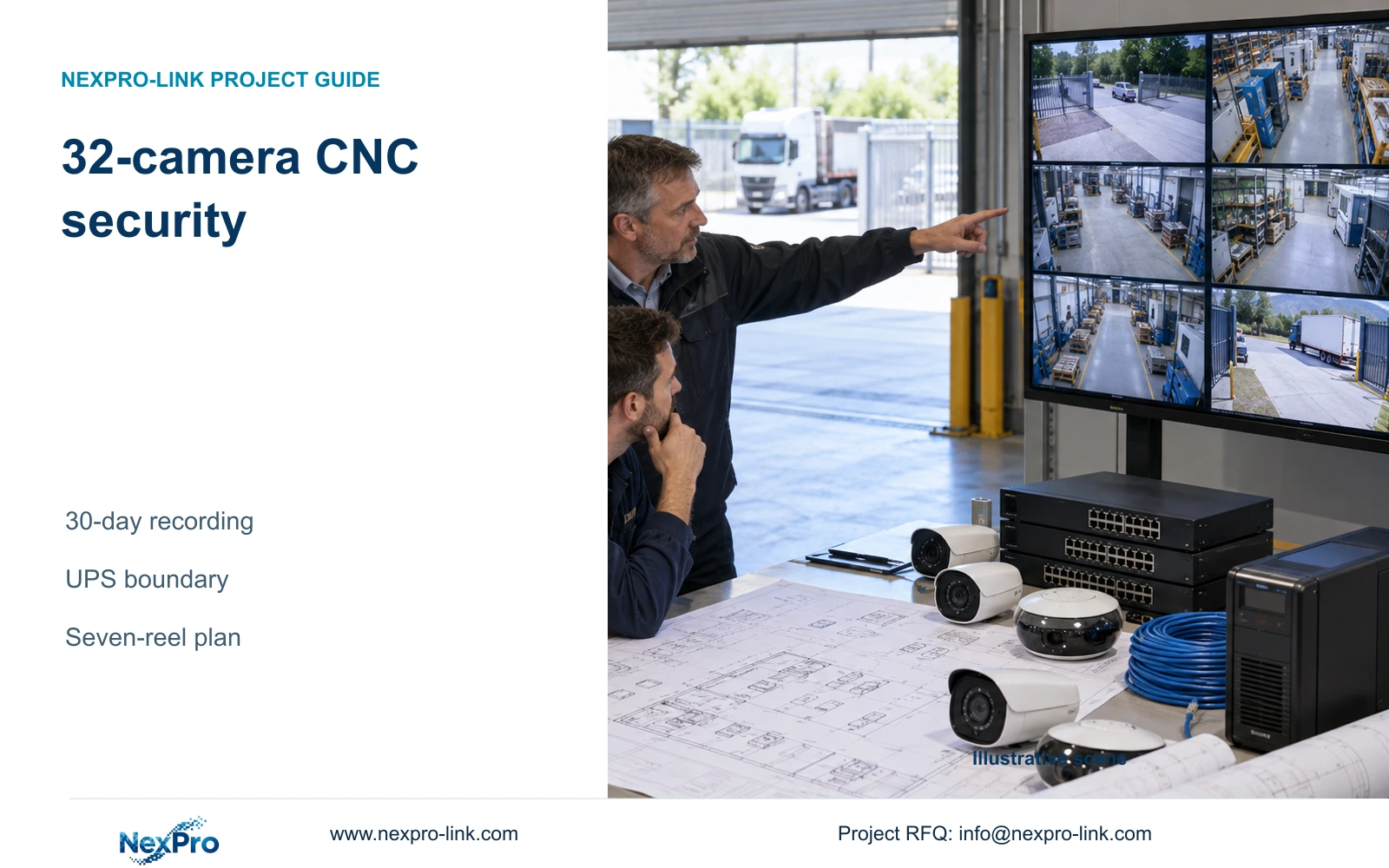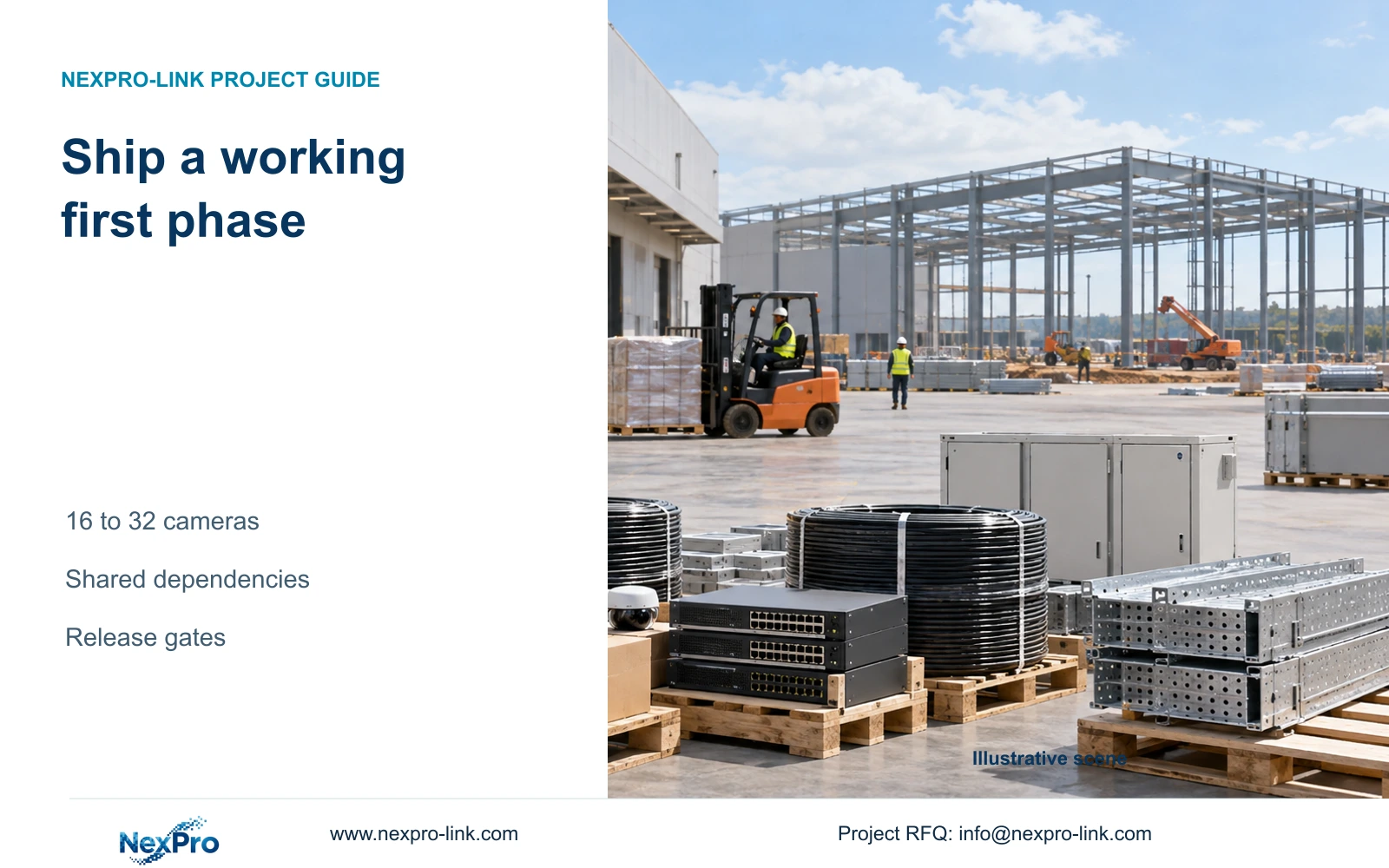
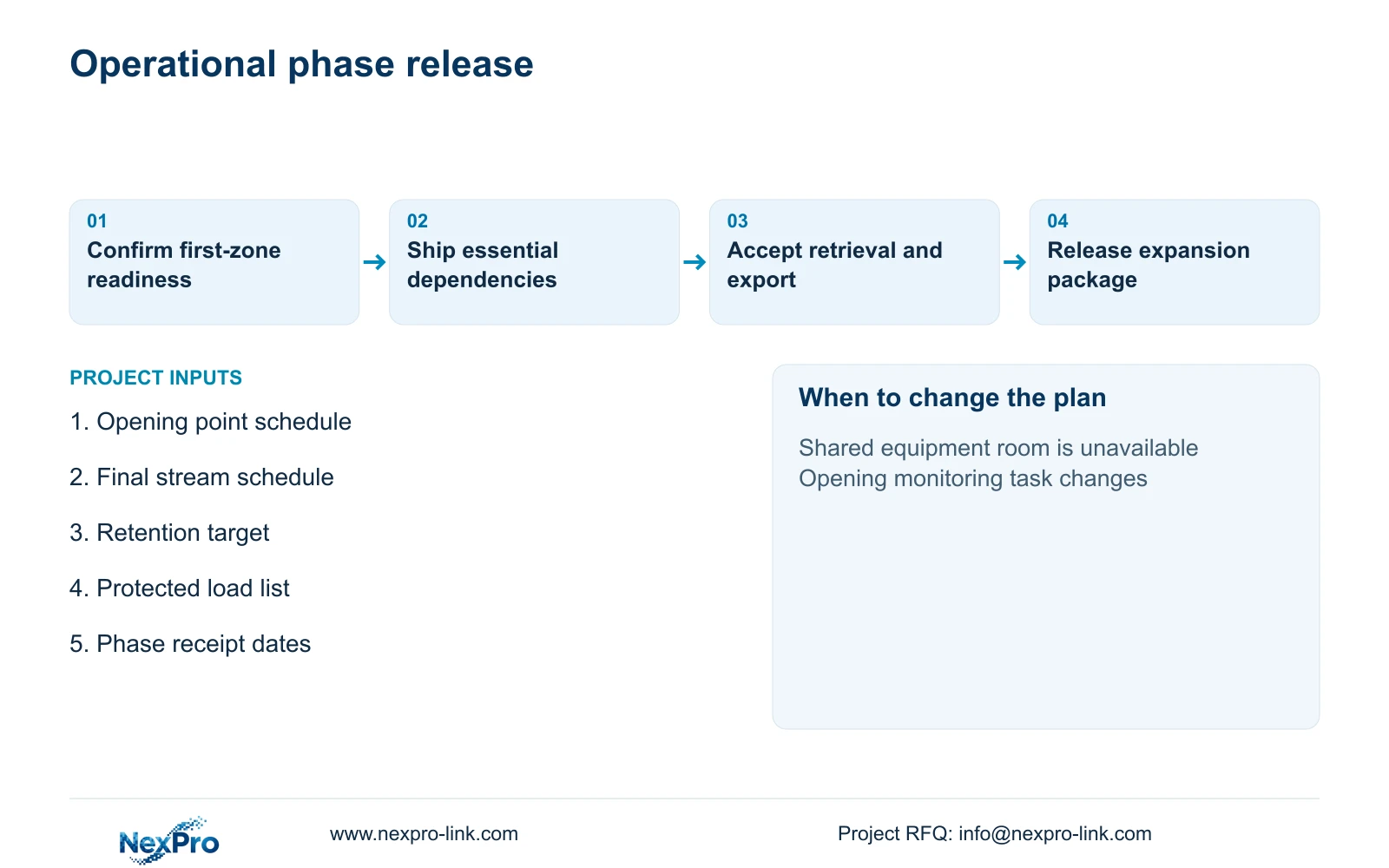
Create a release list for shared devices needed by more than one phase. Assign their first operational destination and later capacity duty once, then check readiness before releasing cameras dependent on them.
Section 01
Define what the first opening must be able to record
Create a release list for shared devices needed by more than one phase. Assign their first operational destination and later capacity duty once, then check readiness before releasing cameras dependent on them. If a shared node is delayed, revise the usable opening package explicitly rather than counting delivered cameras as a completed phase.
Phased factory shipments should deliver the cameras, recording, network and power dependencies needed for the first operational zone together. Begin with the required opening task and work backwards through its dependencies. A shipment of cameras alone is incomplete if the site cannot power them, carry their streams, retain footage or retrieve an event.
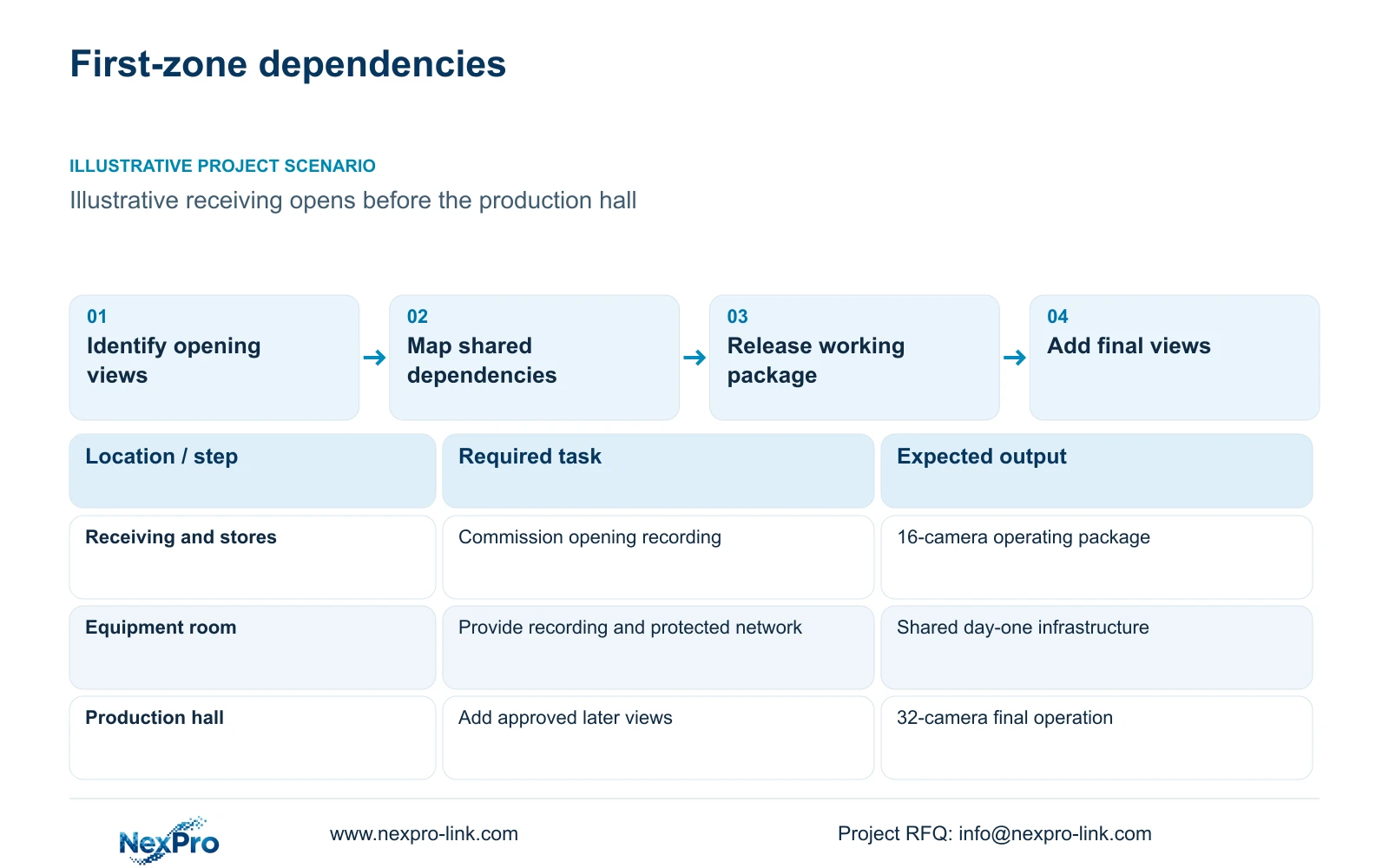
Illustrative project scenario: A new plant opens receiving and storage before its main production hall. The supplied phase illustration assumes 16 cameras at opening and 32 at final operation, each averaging 4 Mbps with 30 days of continuous recording. CASE01 provides the separate final 32-camera CNC-factory background. The 16-camera opening allocation is a teaching assumption, not an established phase of a completed project.
Ask the owner to identify the first areas accepting valuable goods and the evidence needed there. The engineer should map those views to the actual recorder, switches, cabling and protected circuits. The project manager then assigns each dependency to shipped, already available or locally provided scope, with confirmation before scheduling the first installation.
Section 02
Group the first delivery around a usable service
The first package should contain the selected opening cameras and all unavailable dependencies needed to commission them. Include recording disks, appropriate network equipment, mounting and termination materials, and the agreed operator access. Shared equipment belongs in the first delivery when the opening views depend on it, even if later cameras will use most of its final capacity.
CASE01 uses NexPro-NVR4449-4K as a recorder candidate, with published 49-channel and 320 Mbps input fields and four SATA bays supporting up to 18 TB per bay. Its summary distinguishes 49x5MP from 9x4K. The phase illustration assumes streams within the supported selected mode; the channel number does not establish unrestricted decoding or an all-8MP expansion path.
Pack opening devices by approved point or zone allocation and keep the common recorder and power equipment identifiable. Customer artwork and packaging languages can support issue control, but should not delay essential configuration records. If laser branding is requested, retain technical identity and keep software naming rights separate from physical marking.
Section 03
Price repeated delivery and mobilisation explicitly
Ask for a quotation for each shipment group using actual packing and route inputs. Show repeated preparation, freight, destination handling and site receiving where applicable. The local installer should identify any repeated mobilisation or commissioning work. No supplied rate supports a numerical freight saving or labour penalty, so keep the comparison structural until quotations are available.
Separate planned later quantities from unresolved design changes. Sixteen deferred cameras are different from an uncertain future annex. For known final requirements, request reserved recorder capacity, cabinet space and interfaces as explicit scope. For uncertain expansion, state what has been allowed and what would trigger redesign rather than buying speculative devices.
Record who holds deferred goods and who confirms readiness for the next release. Include artwork and configuration revisions in the phase register so later units do not arrive with an unreviewed change. NexPro-Link's project preparation and overseas supply coordination can be discussed against that register, while the contractor retains responsibility for local readiness and installation sequencing.
Section 04
Size opening and final recording resources separately
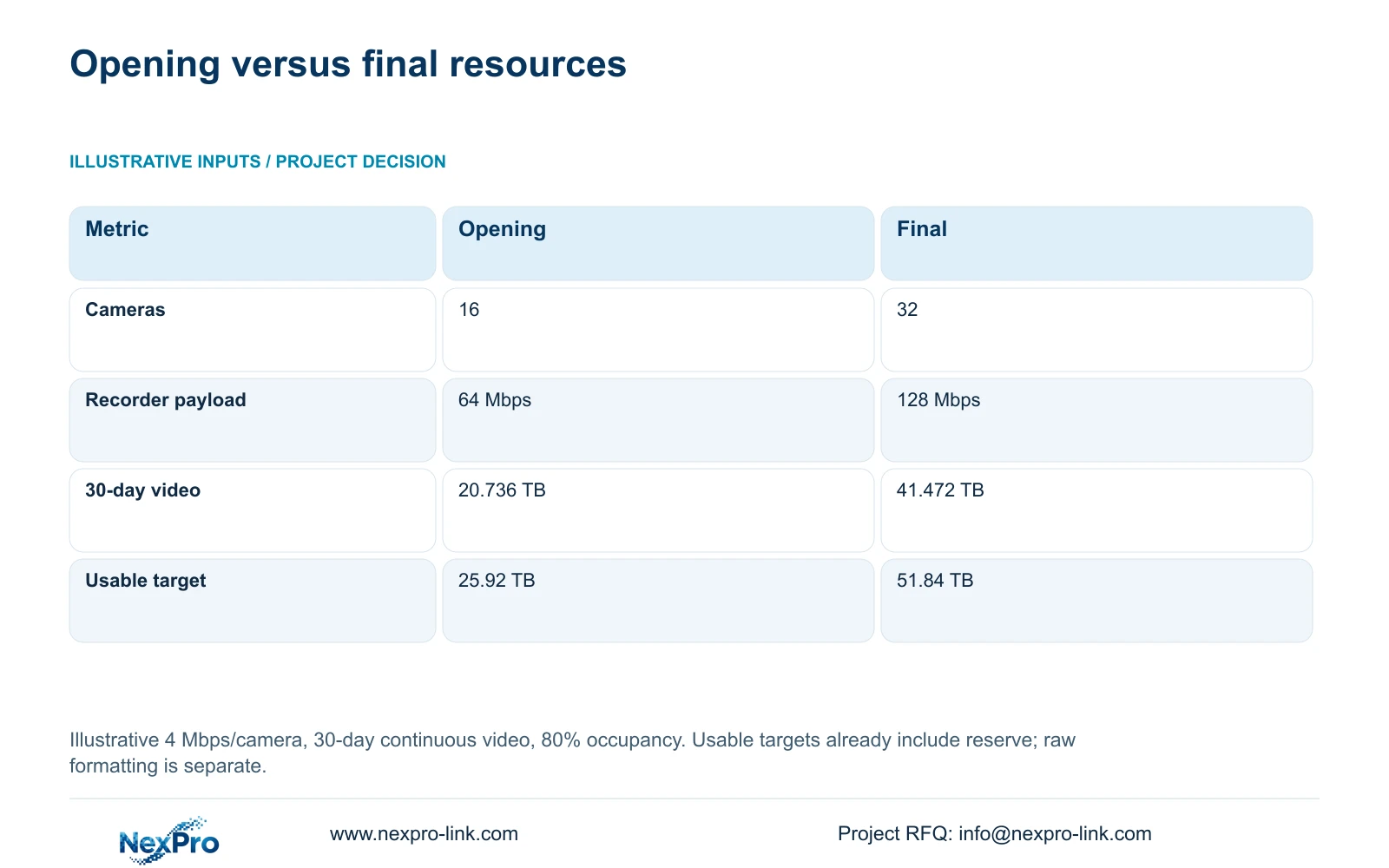
Using the supplied illustrative inputs, required_Mbps = 4 x n. The opening 16 cameras produce 64 Mbps; the final 32 produce 128 Mbps. For decimal storage, video_TB = 0.0108 x average_Mbps x cameras x days, where 0.0108 converts one Mbps-day into TB. At 4 Mbps and 30 days, opening video is 20.736 TB and final video is 41.472 TB.
At an assumed maximum 80% occupancy, required usable capacity = video_TB / 0.80. Opening requires 25.92 TB and final operation requires 51.84 TB. The decisive difference is that both recording payload and storage target double. These are planning inputs, not fixed camera bitrates or measured retention outcomes.
CASE01's final four 16 TB drives provide 64 TB raw. Its illustrative budget is 64 x 0.95 x 0.80 = 48.64 TB for video, which exceeds 41.472 TB. Equivalently, 60.8 TB after assumed formatting exceeds the 51.84 TB usable target. The reserve is already included in those comparisons and must not be applied twice.
| Metric | Opening phase | Final operation |
|---|---|---|
| Cameras | 16 | 32 |
| Recording payload | 64 Mbps | 128 Mbps |
| 30-day video | 20.736 TB | 41.472 TB |
| Usable target at 80% occupancy | 25.92 TB | 51.84 TB |
Section 05
Reserve shared capacity without pretending power scales evenly
For the stated two-phase plan, select the shared recorder and its supported final stream mode early, then decide when disks are installed against the retention requirement. The case's four-drive final configuration is a useful reference, but any smaller opening configuration needs a compatible, separately checked capacity plan. Multi-bay provision does not establish RAID or automatic protection during disk changes.
Do not halve the final UPS load merely because half the cameras are opening. Recorder, disks, core equipment and operator loads may already be present. Rebuild the opening load list from the actual supplied equipment, then check W, VA and the requested battery duration. UPS capacity references and calculated load energy cannot prove the installed runtime.
The optional four-panel LCD wall can be deferred when ordinary operator viewing meets opening needs. Change that choice if simultaneous monitoring is part of the accepted first task. Prefer controlled phased preparation where the first zone can operate independently; choose one complete delivery when the split would postpone essential infrastructure or create unmanaged repeated work.
Section 06
Use release gates tied to site readiness and acceptance
For each phase, issue a contents schedule with device identities, shared dependencies, allocation and local-work responsibilities. The site team should confirm cable routes, mounting access, rack readiness and electrical provision before shipment release. Equipment arrival alone is not evidence that the phase can be commissioned.
The opening acceptance should demonstrate the required views, recording, playback, export and user access. Preserve its configuration and records before adding later devices. When the final phase arrives, verify that new camera settings, retention and network load match the updated schedule, and check that the existing opening service still works.
Keep unresolved items visible in the phase handover. A delayed accessory, optional wall or unapproved artwork change should not disappear into a generic completion percentage. The useful delivery output is a versioned equipment and packing register showing which accepted operating functions each phase provides, what remains later, and who authorises the next release.
Section 07
Buyer questions
Must all final disks be shipped in the opening package? Only the approved opening storage plan determines that. The first configuration must meet its retention target, and the expansion method must be confirmed for the actual recorder. Do not assume adding disks later preserves footage automatically.
Can the later cameras be bought now but shipped later? That can be discussed as a commercial arrangement. Specify storage custody, configuration revision and release conditions separately from the decision to reserve final recorder and network capacity.
What if receiving opens before the equipment room is ready? Provide an approved working recording and power location or revise the opening plan. Shipping cameras cannot compensate for an unavailable recorder, network path or electrical node.
Section 08
Define the first usable factory package
Send your opening-zone camera schedule, final camera schedule, recording and backup objectives, and phase receipt dates with destination to info@nexpro-link.com for a dependency-led shipment scope.
Engineering references
These sources support the general planning principles. Always use the selected product's current datasheet and applicable project standards for final design.