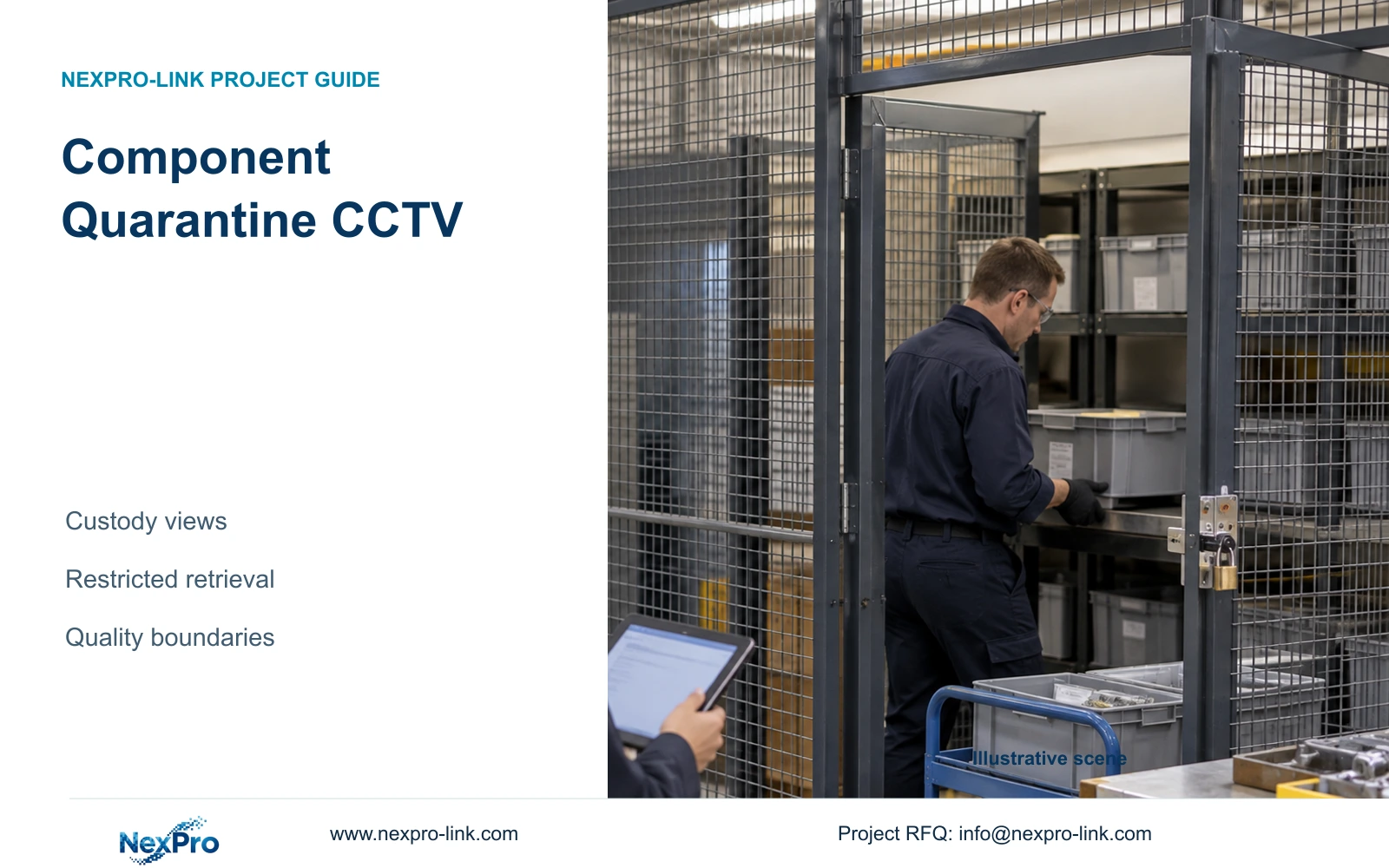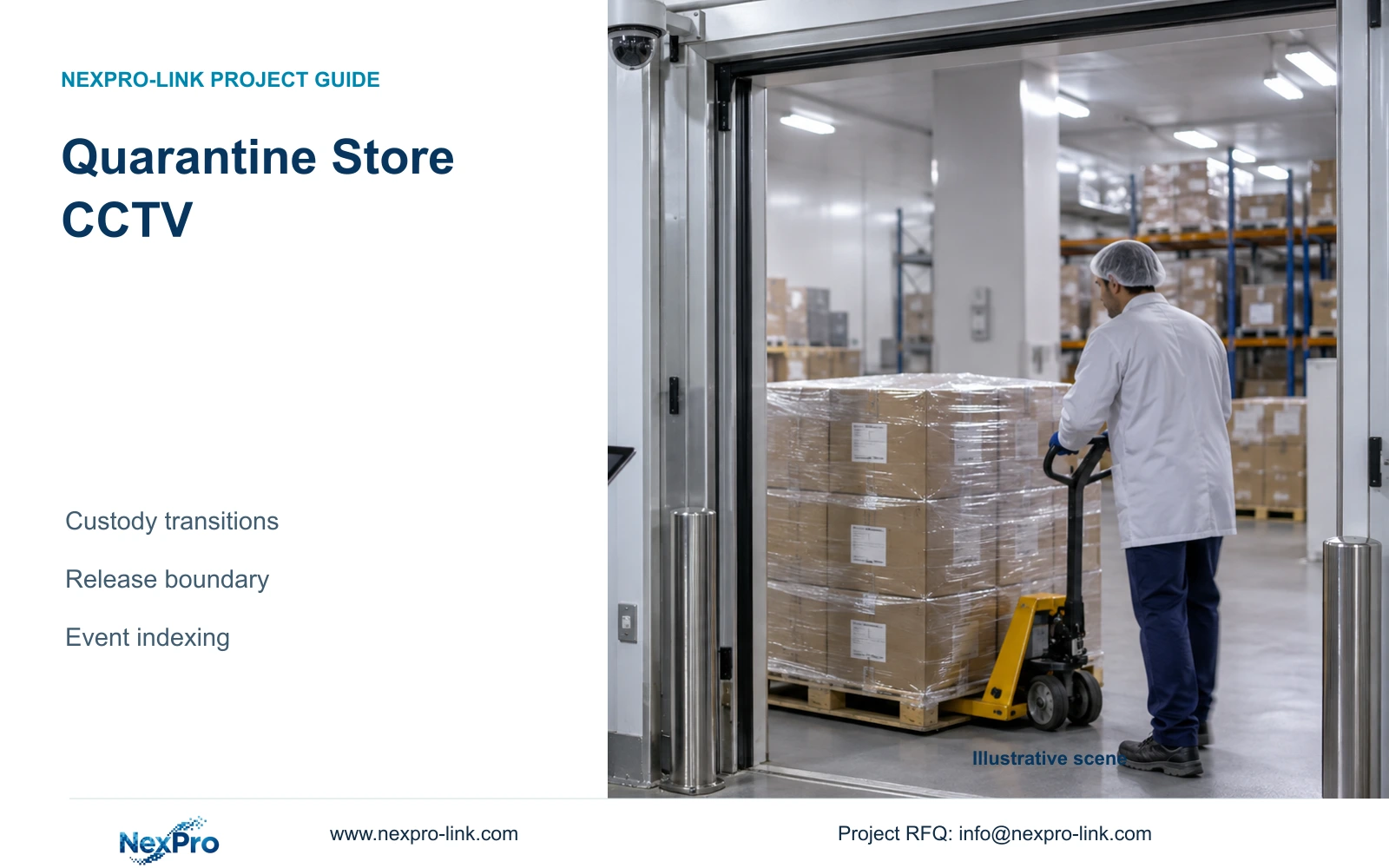
When a release record changes after a transfer, preserve the original movement time, later status decision and their separate authorizations. Retrieve footage around the movement, not just the amendment timestamp.
Section 01
Observe the physical transition without deciding stock status
When a release record changes after a transfer, preserve the original movement time, later status decision and their separate authorizations. Retrieve footage around the movement, not just the amendment timestamp. Ask the quality owner to resolve the discrepancy; an observed crossing cannot backdate release authority or validate an amended quality record.
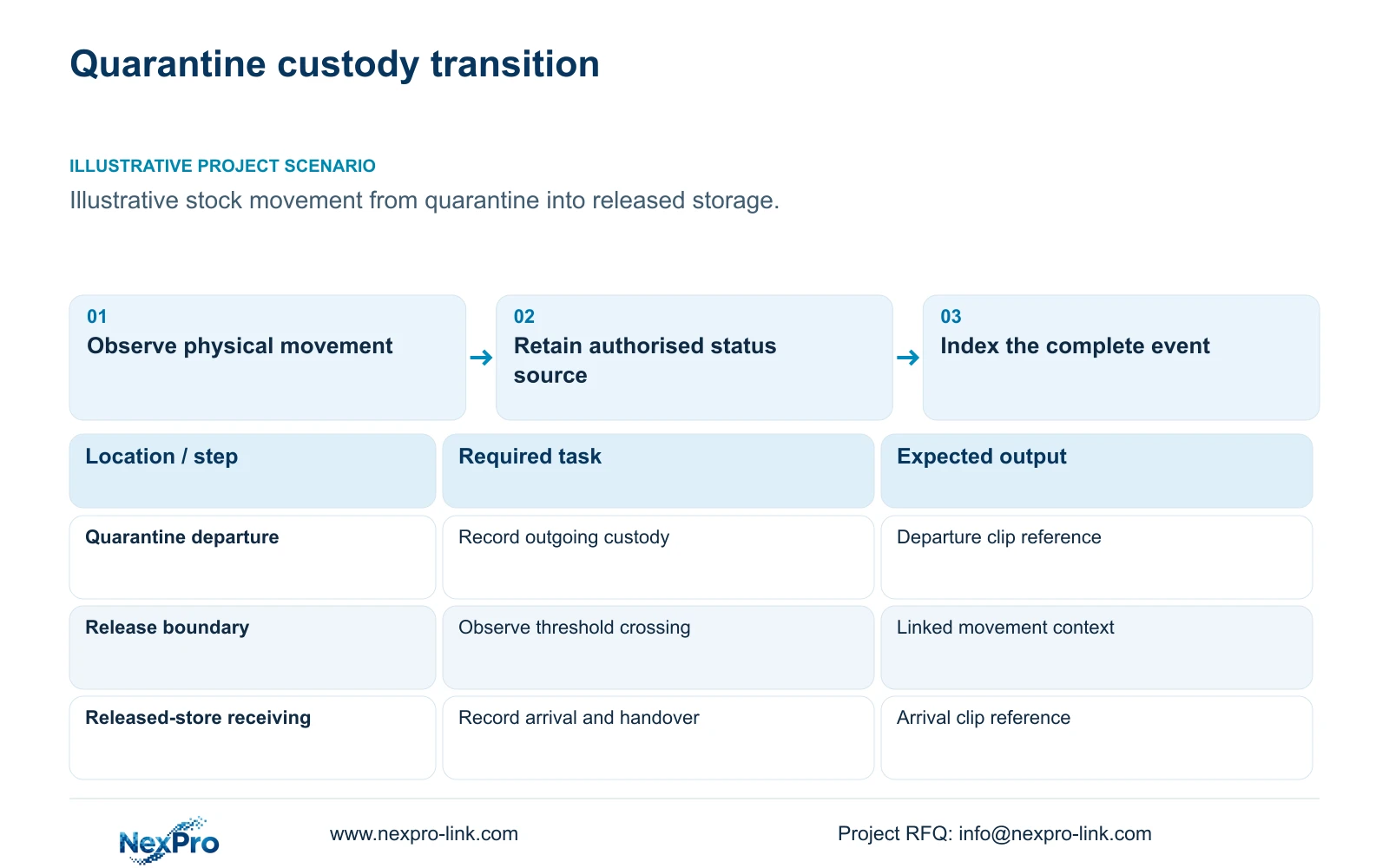
CCTV in pharmaceutical quarantine stores should record physical movement and connect it to an authorised record. A visible crossing into released storage cannot by itself establish product release status or regulatory acceptance. The project manager should define the custody transition that needs observation and identify the separate system and personnel responsible for status decisions before approving camera locations.
Illustrative project scenario: A distribution team wants context when quarantined stock moves into released storage. Assume the proposed route passes a controlled transfer threshold, with one view of departure and another of receiving custody. These are planning assumptions for an evidence workflow, not a validated installation or completed customer case. The review task is to establish what physically happened and compare it with the authorised event.
Map the permitted route and any alternative exits, temporary holding locations or bypasses relevant to that task. Confirm the environmental and classification basis at each camera position. A room named quarantine does not establish ordinary-equipment suitability, and a specialist requirement should remain separately specified. The view schedule should identify the transition being observed, not simply list cameras by room.
Section 02
Keep release authority outside the CCTV interpretation
The authorised material-status system remains the source for the release decision. Video may show a pallet moving, a person handling it or a door opening; those observations do not prove that every required approval occurred. Avoid naming a video bookmark or camera group in a way that implies the stock was authorised merely because it appeared on the released side.
For the proposed workflow, the material team supplies the approved event reference and status information, security supplies the camera map, and the reviewer compares both. If the recorded movement and the authorised record disagree, route the discrepancy to the responsible personnel. Do not resolve it by changing a CCTV label or inferring status from container colour, signage or apparent destination.
Confirm the permitted use of footage with the quality and site management teams. CCTV remains a security and custody-context system under this procurement scope, with regulated records and validation handled separately. If the owner asks for video to become part of a regulated release workflow, that is a material scope change requiring those responsible teams to define and assess it.
Section 03
Index the transfer to views and time references
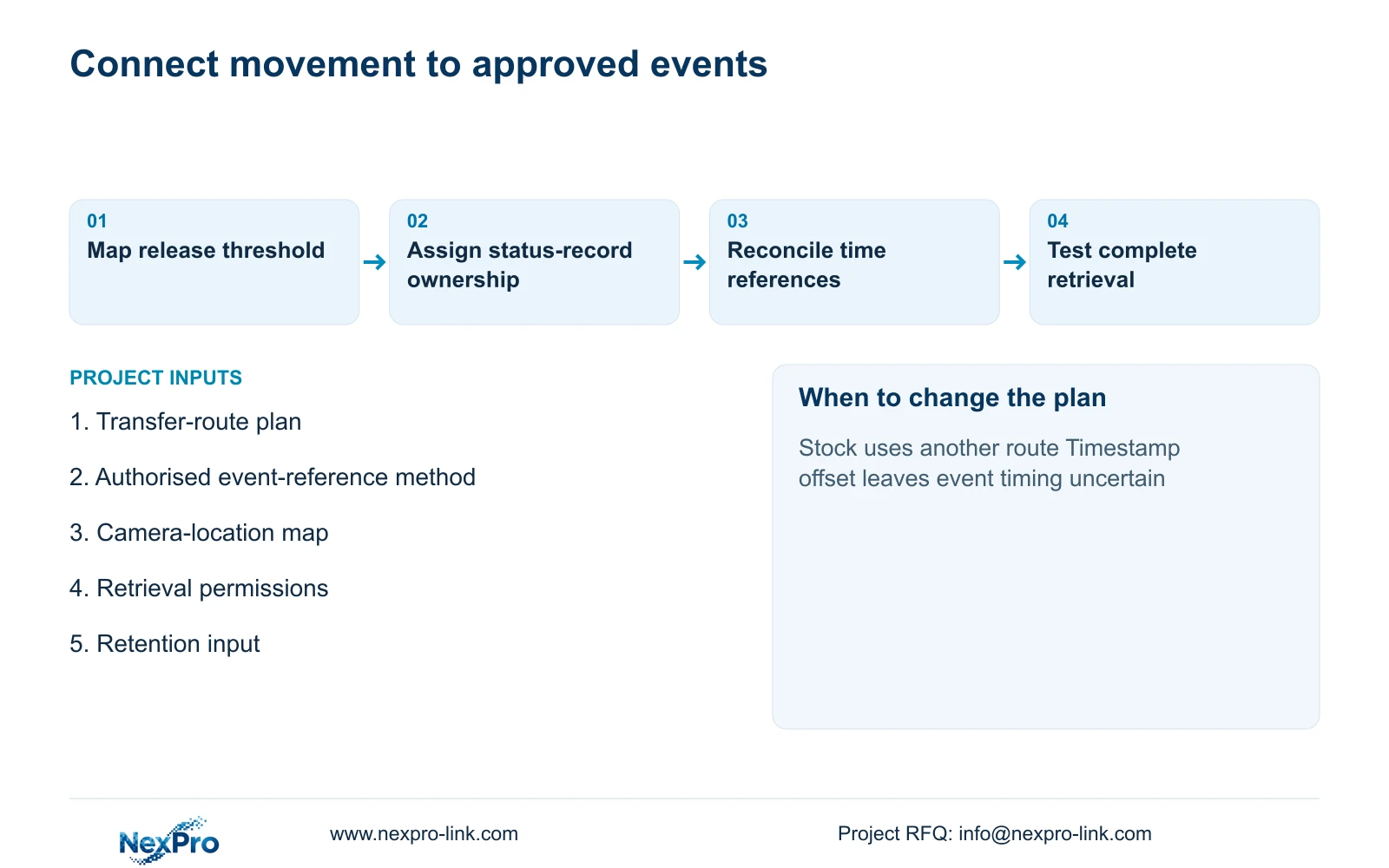
Use an event index that points to the original authorised reference without trying to reproduce its full confidential content. As a project-method example, record the transfer reference, origin, destination, relevant camera identifiers and a time interval. Include any known offset between the material-system timestamp and the recorder. The index can be a controlled manual register unless a separately specified integration is justified.
A request based only on a release timestamp may miss earlier staging or a delayed receiving step. Ask the requester to explain which part of the transition is disputed. The reviewer can then select departure and arrival footage with enough surrounding context, expanding to intermediate views if the sequence is incomplete. Selection should follow the event, rather than force every investigation into a standard short clip.
Define who may create the reference, review footage and export material. Test those tasks on the selected platform. No source establishes an automatic batch lookup or immutable audit function for the cited equipment. Keep exported-file handling under the owner's approved procedure, documenting selected cameras, intervals and recipients without claiming a guaranteed legal evidence status.
Section 04
Compare request sizes while preserving the complete crossing
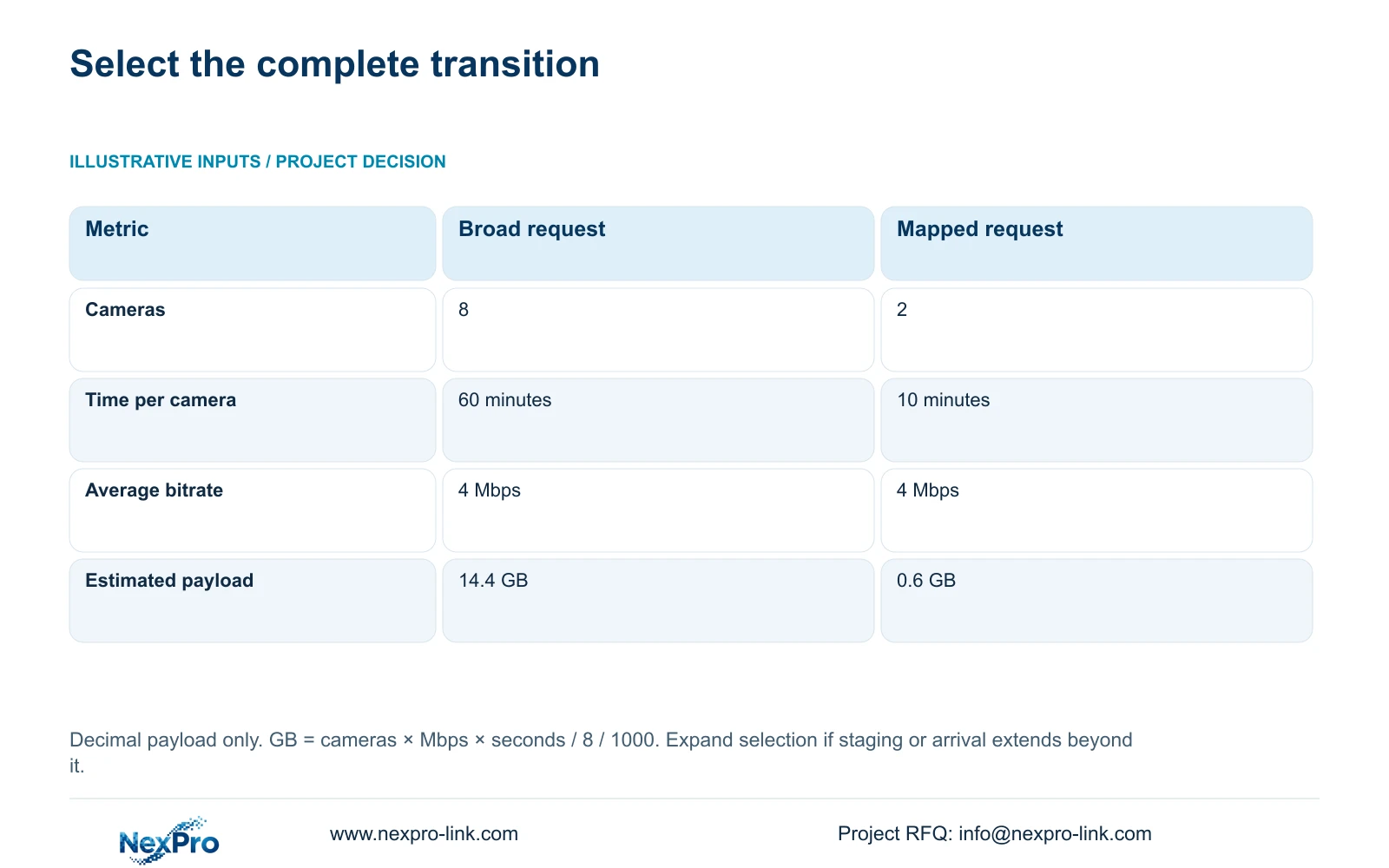
The illustrative broad request selects eight cameras for 60 minutes each at an average 4 Mbps. The targeted request selects two relevant cameras for 10 minutes each at 4 Mbps. Using decimal units, GB = cameras × Mbps × seconds / 8 / 1000. The calculations are 8 × 4 × 3600 / 8 / 1000 = 14.4 GB and 2 × 4 × 600 / 8 / 1000 = 0.6 GB respectively.
The two-camera request is suitable when departure and arrival footage cover the required custody transition and the ten-minute interval contains the complete event. It becomes unsuitable if staging began earlier, the stock paused elsewhere or another exit matters. The comparison therefore supports an approved selection process. It does not justify discarding context simply to reach the smaller payload.
Both requests retain the same assumed bitrate per camera. The difference comes from the selected views and duration, not from reducing source quality. Actual variable bitrate, audio and export packaging can change the file amount. Export speed and reviewer effort require their own observations; the 14.4 GB and 0.6 GB figures are not measured time savings or evidence-acceptance results.
| Metric | Broad investigation | Mapped transition |
|---|---|---|
| Cameras selected | 8 | 2 |
| Time per camera | 60 minutes | 10 minutes |
| Average video bitrate | 4 Mbps | 4 Mbps |
| Estimated payload | 14.4 GB | 0.6 GB |
| Reason to choose | Uncertain route or timing | Complete mapped event confirmed |
Section 05
Preserve retrieval through the recording infrastructure
Choose views and equipment that preserve the physical sequence under normal handling. At a suitable ordinary position, the NexPro-BL2812M55-5MP-DIC-AI reference lists a 2.8 to 12 mm motorized lens and 2880×1620 output in its 5MP family. These are selection fields, not a guarantee that a stock label will be readable through wrapping, motion or obstruction. Define a representative acceptance task using the actual route.
The supplied 40-camera reference separates 32 ordinary positions from eight specialist positions. Its retention example assumes 4 Mbps per stream, continuous recording and 30 days, giving 51.84 TB video. Four 18 TB disks give 72 TB raw and 72 × 0.95 × 0.80 = 54.72 TB recording budget. The video fits that illustrative budget, which already includes formatting and reserve; it is not a pharmaceutical retention rule.
NexPro-NVR4449-4K is a candidate capacity reference with 320 Mbps input and four SATA bays up to 18 TB each. Confirm actual stream modes, drive compatibility and the playback/export task separately. Keep camera power, access switching and recording on the intended protected circuits, and locate ordinary racks in suitable service areas. A retrieval display is sufficient unless the owner defines additional simultaneous monitoring needs.
Section 06
Accept the movement-to-record workflow before ordering volume
Recommend linked custody views and a controlled event index, with release authority retained in the authorised system. Reconsider the view plan when routes, staging locations or status-record timing change. If the existing platform cannot deliver the required permission separation or usable export, identify that gap before comparing a replacement hardware package with a retained-system option.
NexPro-Link can help convert the accepted observation schedule into camera and recorder matching, technical submittals and supporting equipment scope. The owner supplies the record boundary and retrieval roles; the local project team resolves specialist installation and environmental approval. Clearly mark retained systems, newly supplied equipment and optional integration so a supplier quotation does not quietly absorb unapproved quality-system responsibilities.
Acceptance should follow one representative transfer from the authorised reference to departure footage, arrival footage and a playable approved export. Include a test with an uncertain interval to confirm that the reviewer can expand the selection. Preserve the camera-location map at handover and keep project labels free of sensitive material-status data. Any failure to retrieve the required sequence is a functional issue to resolve before volume release.
Section 07
Buyer questions
Can footage settle a disagreement about whether stock was released? It can show physical movement and handling context. The responsible personnel must resolve release status using the authorised records and approved procedures; CCTV does not supply release authority.
What if the event reference has no reliable timestamp? Start with the available route and interval information, search a broader selection and document the uncertainty. Improve the event-index method before promising a precise automated lookup.
Should every transfer be exported immediately? That is an owner-defined operating choice, not a default equipment requirement. Retained recording and an event index may support later approved retrieval; routine export creates a separate copy-handling scope.
Section 08
Map the quarantine release boundary
Send the transfer-route plan, authorised event-reference method, retrieval permissions and retention/environment requirements to info@nexpro-link.com to discuss a custody-recording package.
Engineering references
These sources support the general planning principles. Always use the selected product's current datasheet and applicable project standards for final design.