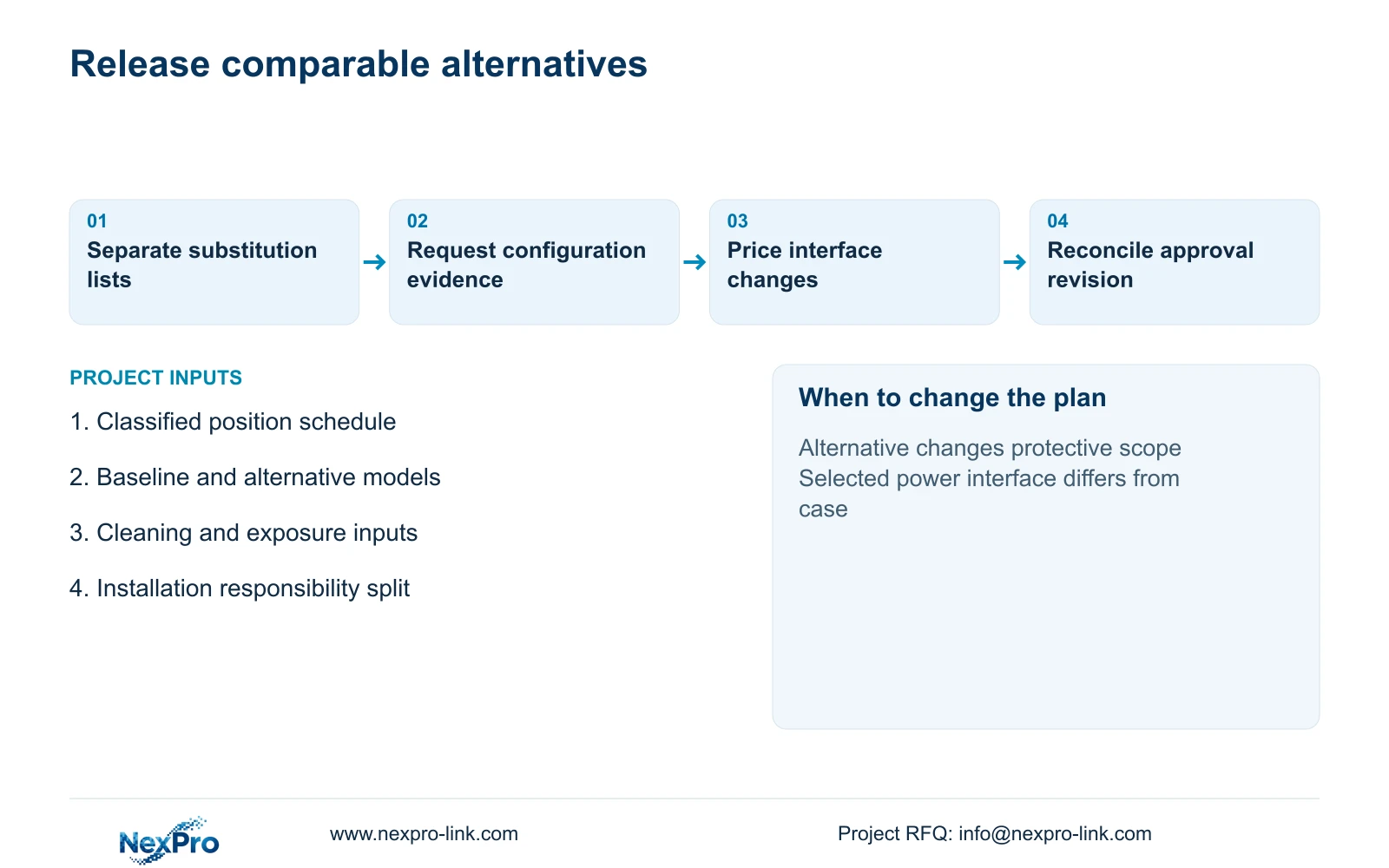
For a proposed warehouse-only substitution, retain the specialist schedule as a locked comparison baseline. Record changed ordinary lines, unchanged protective scope and affected interfaces separately.
Section 01
Build separate comparison lists for each location class
For a proposed warehouse-only substitution, retain the specialist schedule as a locked comparison baseline. Record changed ordinary lines, unchanged protective scope and affected interfaces separately. Ask whether each offer includes the same interface work before ranking price. A partial alternative is not an approval to replace the remaining protected positions.
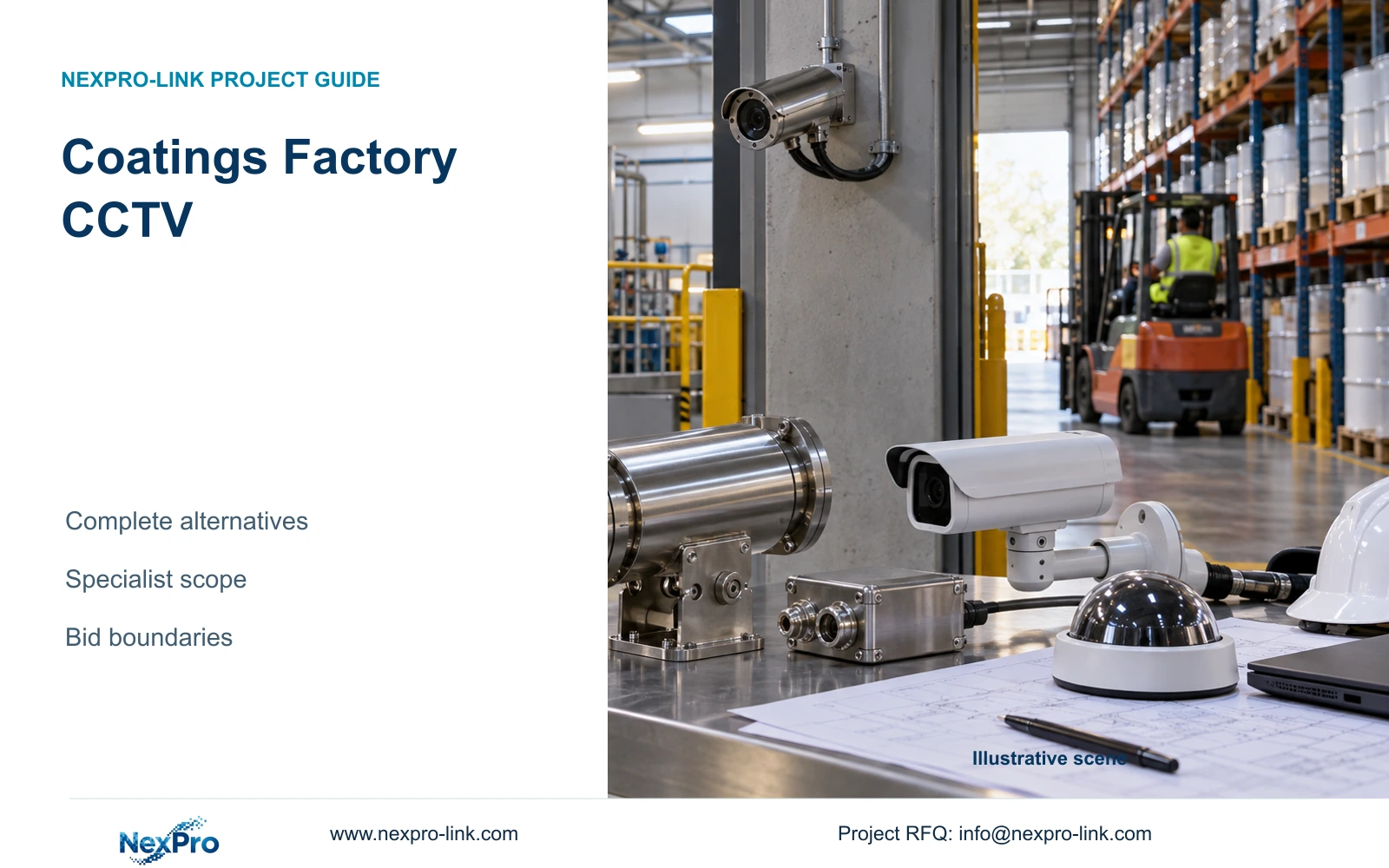
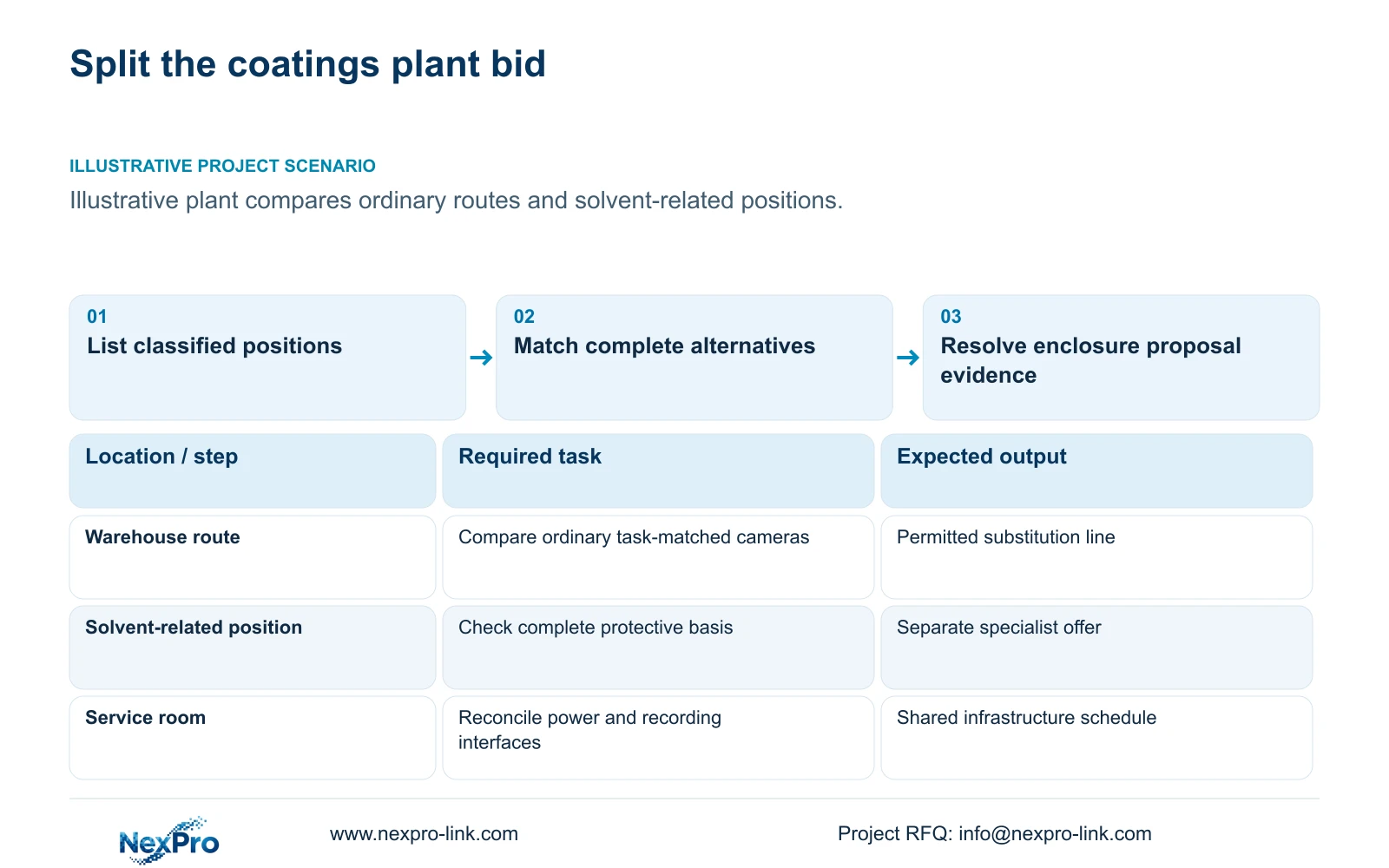
Paint and coatings factory CCTV proposals should compare ordinary equipment only at suitable ordinary locations. Specialist positions need the relevant complete product and installation basis. Split the camera schedule before requesting brand alternatives so procurement does not compare a normal warehouse camera with a protected solvent-area device as if they perform the same complete job.
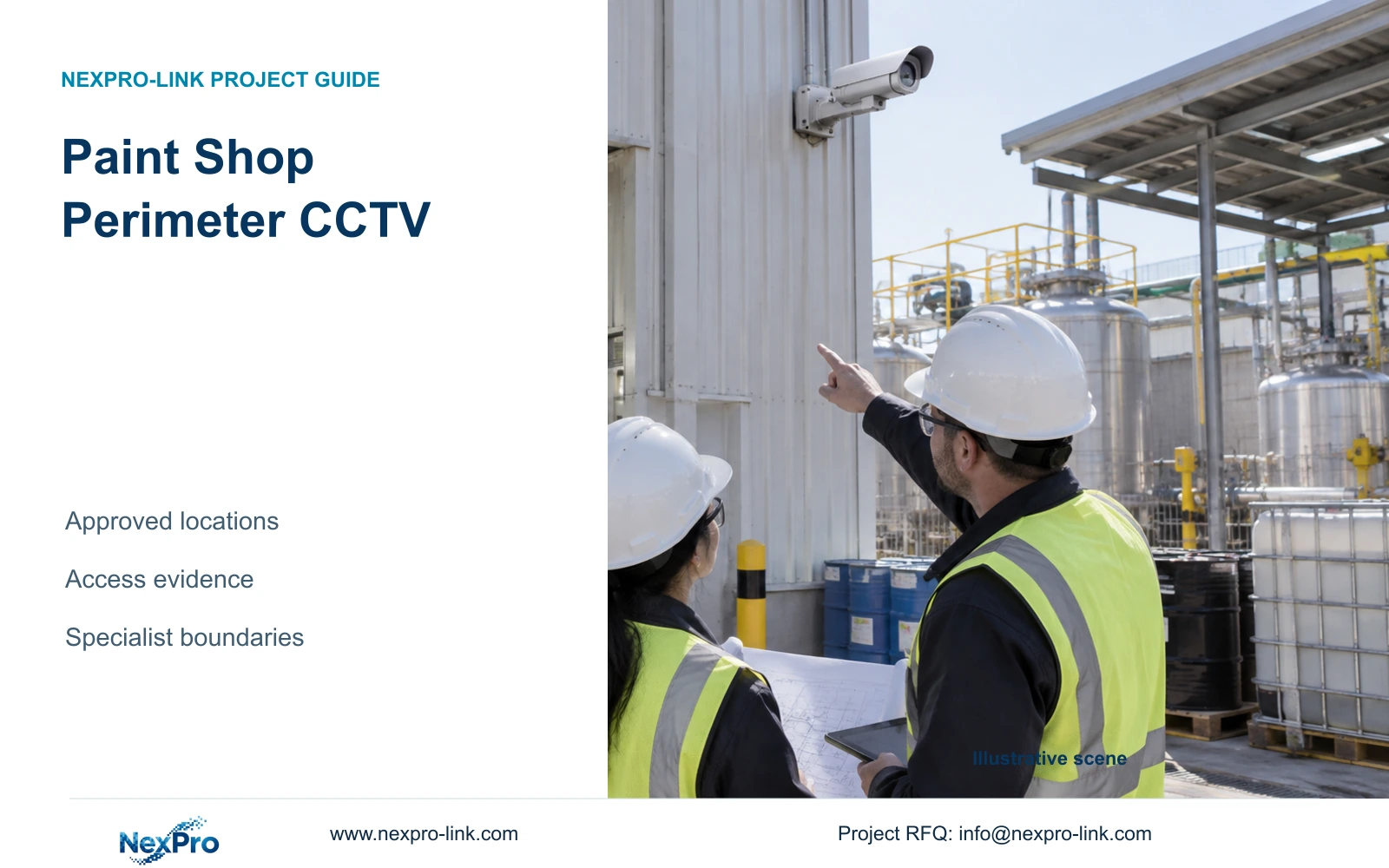
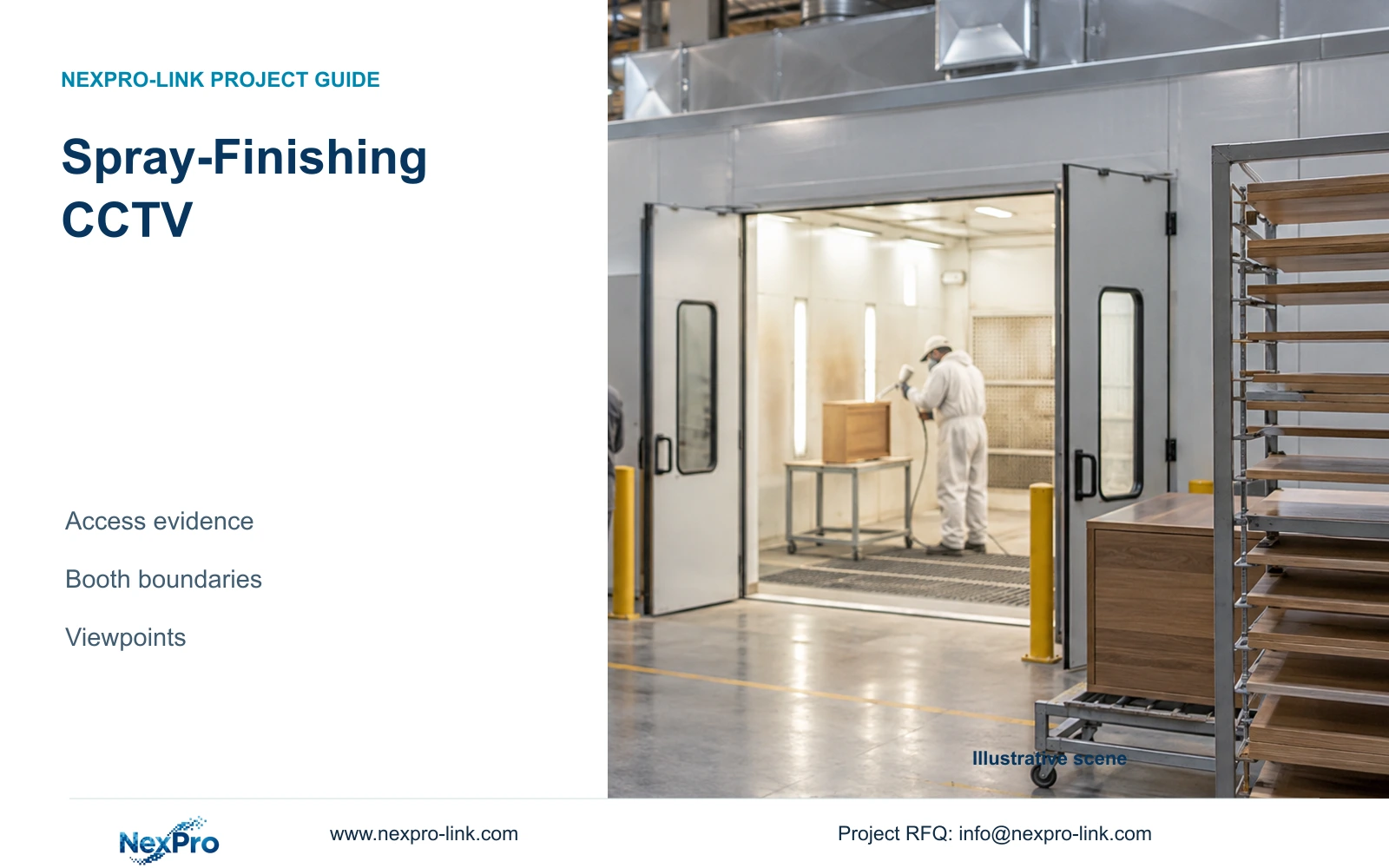
Illustrative project scenario: A coating plant is choosing equipment for solvent-related areas and normal warehouse routes. Use the supplied 32 ordinary plus eight specialist reference as a planning structure, without assuming those quantities classify the actual plant. The engineer places each proposed mounting position against the approved area drawing and records its observation task. Any unresolved position stays outside the approved ordinary substitution scope.
Describe the view and the equipment location separately. A camera may observe access near a solvent-related process from a different mounting location, but the equipment and its connections still need review. Record the drawing revision, relevant environmental conditions and service access. The comparison list should identify confirmed ordinary candidates, separately specified specialist candidates and positions awaiting information.
Section 02
Compare complete alternatives within the same scope
For ordinary routes, hold the accepted view, operating period, recording mode and support scope constant when comparing offers. For specialist positions, also hold the applicable protective and installation requirements constant. A supplier may propose a different architecture, but it should show how the complete arrangement preserves the required observation and location suitability rather than presenting a lower camera price alone.
AXIS P1468-XLE is a specialist reference whose official scope lists Zone 2/22 and Class I/II/III Division 2 applications. It illustrates a documented product category for a location-qualified comparison. Its listed scope does not cover every possible plant position, and an ordinary NexPro-Link model is not an equivalent protective replacement. The exact variant and applicable documentation must be checked against the actual position.
Ask each bidder to identify included connections, mounting accessories, preparation, local installation and service responsibilities. Keep exclusions visible, particularly where the protective configuration relies on an item supplied by another party. The responsible designers verify current local requirements and the project approval basis. This article supplies a purchasing method, not a hazardous-area assembly or installation instruction.
Section 03
Require evidence for any proposed camera assembly
If a bidder proposes a standard camera inside a protective enclosure, ask which documented complete configuration is being supplied. The enclosure's identity alone does not establish the suitability of the camera, its thermal behaviour, entries, connections or modifications. The qualified designer and responsible supplier must determine whether the proposed arrangement falls within the applicable protective scope.
Treat an unsubstantiated enclosure proposal as an unresolved alternative, not as a priced equivalent ready for substitution. Require the bidder to name the party responsible for the complete configuration and provide the relevant product and installation basis. Do not fill that gap with a generic barrier-and-box wiring recipe or infer suitability from metal construction and an ingress rating.
Preserve the security/process boundary throughout this review. CCTV can record approach and handover context, but the ordinary security package does not take over process alarms, safety trips or validated production records. If a proposed alternative changes that functional boundary, it needs a separate scope review before the cost team can compare it with the accepted baseline.
Section 04
Use independent qualification gates for warehouse and process positions
Apply the supplied decision rule: location conditions AND complete product scope AND approved installation requirements must all fit. No numerical score is needed. The filled matrix identifies the evidence required for ordinary warehouse routes and specialist solvent-related positions in this hypothetical plant. A failed or unknown protective requirement cannot be offset by a favourable lens or temperature field.
The BL2812M and DM2812M ordinary references list IP66 and minus 20 to plus 60°C. The 5MP-family specification retains its listed 2880×1620 output and 2.8 to 12 mm motorized lens range. These can support a suitable ordinary view. They do not establish explosion protection, chemical resistance, direct washdown suitability or operation outside the documented temperature range.
The decisive difference is whether the complete offered arrangement meets the actual position requirements. A warehouse candidate should pass its environmental and image checks before price comparison. A specialist candidate additionally needs its applicable protective and installation basis. Both still need an accepted view and recording workflow; protective suitability alone does not demonstrate that the camera captures the required handover.
| Gate | Ordinary warehouse route | Specialist solvent-related position |
|---|---|---|
| Temperature | Check listed minus 20 to plus 60°C | Verify complete required operating envelope |
| Cleaning exposure | IP66 plus actual exposure review | Confirm materials and cleaning conditions |
| Protective basis | No explosion scope established | Applicable complete product documentation |
| Installation | Suitable ordinary route and mounting | Approved connections and installation conditions |
| Commercial scope | Task-matched ordinary package | Complete specialist equipment and services |
Section 05
Keep shared infrastructure changes visible in the alternative
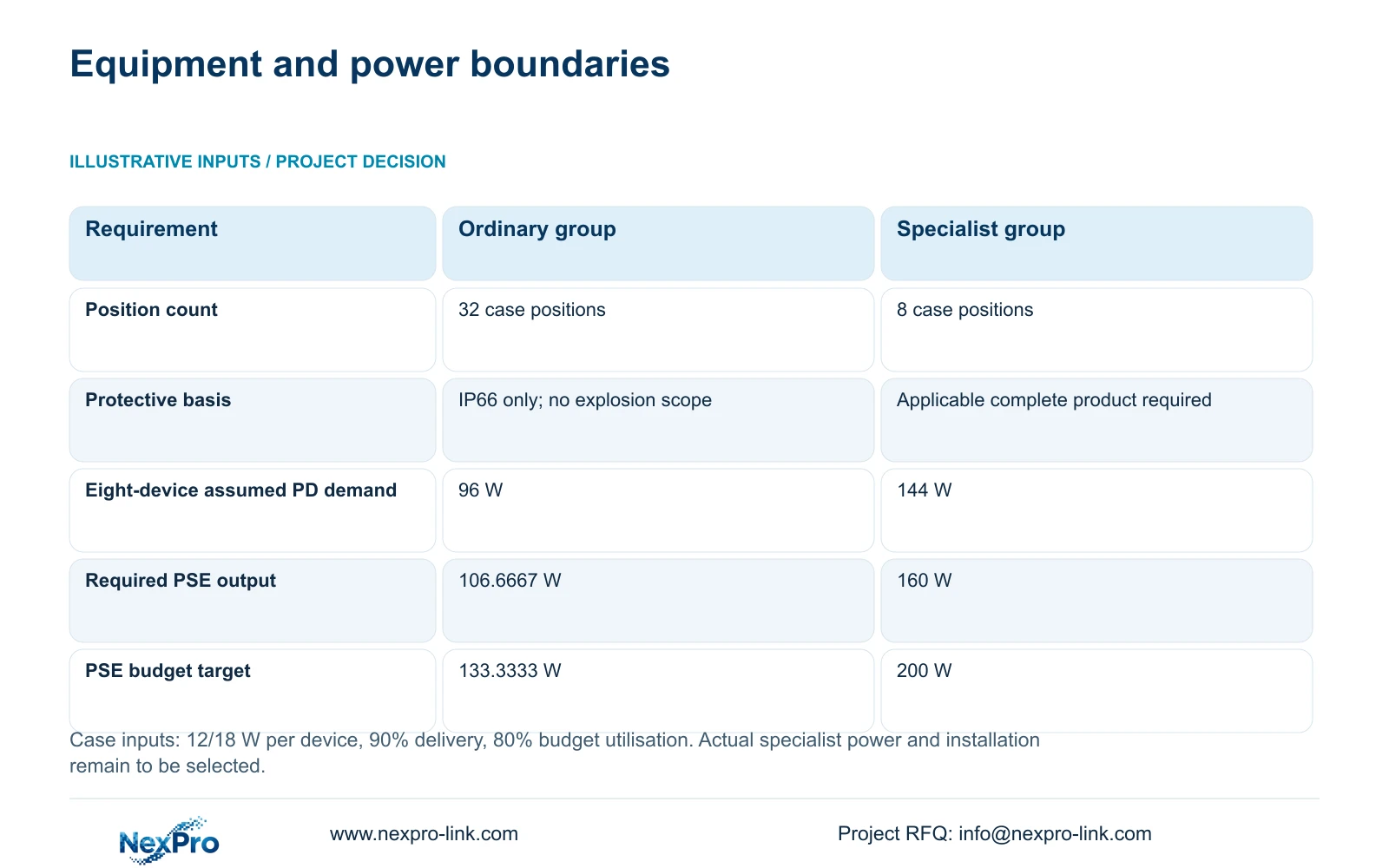
Recommend a coordinated package with separate ordinary and specialist schedules. Shared recording can remain an option if the actual selected streams and interfaces pass acceptance. The reference case assumes 40 compatible 5MP-class streams at 4 Mbps each, giving 160 Mbps input, with the recorder and ordinary support equipment in a suitable service room. That is a planning input, not a specialist camera compatibility result.
Power differences must also remain explicit. In the reference, an eight-camera ordinary group assumes 12 W per device: PD demand is 96 W, required PSE output is 96 / 0.90 = 106.6667 W, and the 80% utilisation budget target is 133.3333 W. The specialist group assumes 18 W per device, giving 144 W PD demand, 160 W PSE output and a 200 W budget target. Those assumed watts are not published camera measurements.
A real specialist configuration may use a different power arrangement, so replace the inputs after selection. Revisit switch ports, network interfaces, backup circuits and cable transitions together. Keep an optional monitoring wall outside the essential recording scope unless the operating task requires it. Compare current complete quotations; no matched prices or tests are supplied here to establish a cheaper or better brand.
Section 06
Issue alternatives with a clear approval and delivery split
The engineer should release a comparison schedule that names the baseline, proposed alternative, position class and remaining evidence for each change. Procurement can then distinguish a permitted ordinary substitution from a specialist option requiring further review. If the tender makes a brand mandatory, retain it where required and identify only the additional scope in which alternatives are allowed.
NexPro-Link can discuss ordinary CCTV model matching, BOQ deviations, supporting equipment and project preparation within its public supply scope. Specialist supply and local installation remain separately assigned. Request position-linked technical documentation so a warehouse-camera approval cannot be reused against a solvent-area line. Project packing should preserve the same position references used in the accepted schedule.
Before the purchase order, reconcile the alternative's equipment, interfaces and local services with the approved drawing revision. Reopen the affected lines if process use, cleaning conditions or camera location changes. The result should be a procurement-ready ordinary package and separately specified specialist scope, with unresolved costs and dependencies disclosed rather than treated as zero.
Section 07
Buyer questions
Must every camera in a coating plant be a specialist device? The actual location and conditions decide. Confirm suitable ordinary positions independently, while retaining specialist equipment wherever the approved location basis requires it.
Can an alternative retain the specialist cameras and change only warehouse cameras? Yes, when the specification permits it and the resulting interfaces preserve the accepted recording task. Show the retained and changed items separately.
How should an incomplete enclosure proposal appear in the bid comparison? Mark it unresolved or non-equivalent for the required protective scope. Do not rank its price against a complete accepted specialist offer until the configuration evidence and responsibilities are established.
Section 08
Compare a complete coatings plant alternative
Send the classified position schedule, proposed alternative list, exposure/cleaning conditions and installation responsibility split to info@nexpro-link.com for a scoped equipment comparison.
Engineering references
These sources support the general planning principles. Always use the selected product's current datasheet and applicable project standards for final design.