A coordinated overseas hotel order needs a system schedule, named supply responsibilities and a release plan that preserves the complete recording path.
Section 01
Define the international project scope
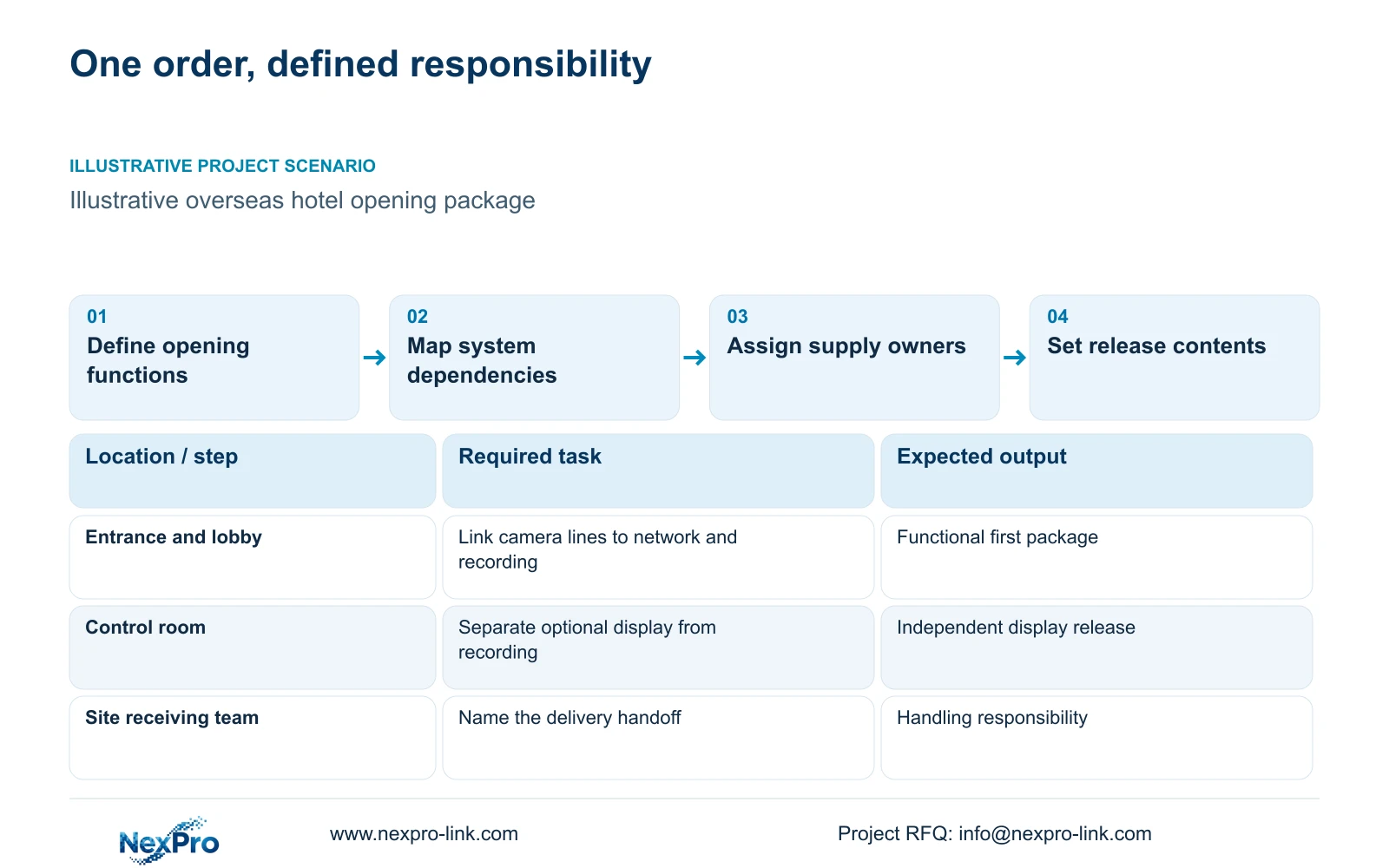
Organize the overseas order by system, exact configuration and delivery stage, with a named responsible party for each category. Use a consolidated shipment when its contents can reach a ready site together. Change to staged releases when a delayed optional item would hold back a complete, usable recording package.
Start from the functions required at opening: approved public-area views, retained recordings and an agreed outage state. Identify the equipment needed for those functions and the local work needed to make it operate. Dispatch, arrival, installation and acceptance need separate milestones because completion of one does not establish completion of the others.
Record the destination and exact delivery point alongside the scope. A proposal ending at a port leaves a different handoff from one ending at the hotel receiving area. Assign onward transport, unloading and site storage explicitly. NexPro-Link's hotel project supply record supports coordinated equipment proposals; it does not establish that local construction or every destination requirement is included.
| Required task | Given information | Decision still needed |
|---|---|---|
| Recording available at opening | Camera schedule and retention target | Complete first-release equipment and site readiness |
| Equipment delivered to the receiving team | Destination country | Named delivery point and onward-handling responsibility |
| Recording continues during an outage | Required operating state | Protected local nodes and supported battery configuration |
Section 02
Consolidate the equipment schedules
Create a master schedule with a stable line reference for each device or service. Keep the system, model, quantity, accessories and installation zone visible. A camera line can then connect to its mounting items and access node without concealing shared equipment inside an undefined system allowance.
Use the illustrative CASE01 arrangement as a dependency example: 32 public-zone camera positions connect through four access nodes to recording equipment. Its quantities are teaching inputs, not a purchase instruction for another hotel. The receiving schedule should distinguish equipment assigned to a zone from central recording resources and optional display equipment.
Reconcile the technical schedule before consolidating the order. A common commercial reference does not establish interoperability. Resolve exact recording modes and disk arrangements separately from channel counts. Where a source contains an unresolved parameter, keep that field open in the offer instead of allowing a larger headline value to become a procurement commitment.
Attach each approval to the line it controls. Technical approval can release configuration preparation, while accepted artwork can release the corresponding marking or packaging work. Parallel processing is appropriate only when neither branch needs an unfinished decision from the other.
Section 03
Separate product and local-service responsibilities
Name who selects the equipment, who supplies it and who installs and verifies it at the hotel. NexPro-Link's scope combines a CCTV manufacturing core with coordination of supporting categories. The written proposal should identify those category boundaries and the route for technical questions or replacement requests.
Local installation needs its own scope for cabling, mounting and electrical work. Hotel IT should own the approved network-access arrangements. Supplier support can help interpret configuration requirements, but remote guidance does not establish local attendance or transfer electrical and site-safety duties.
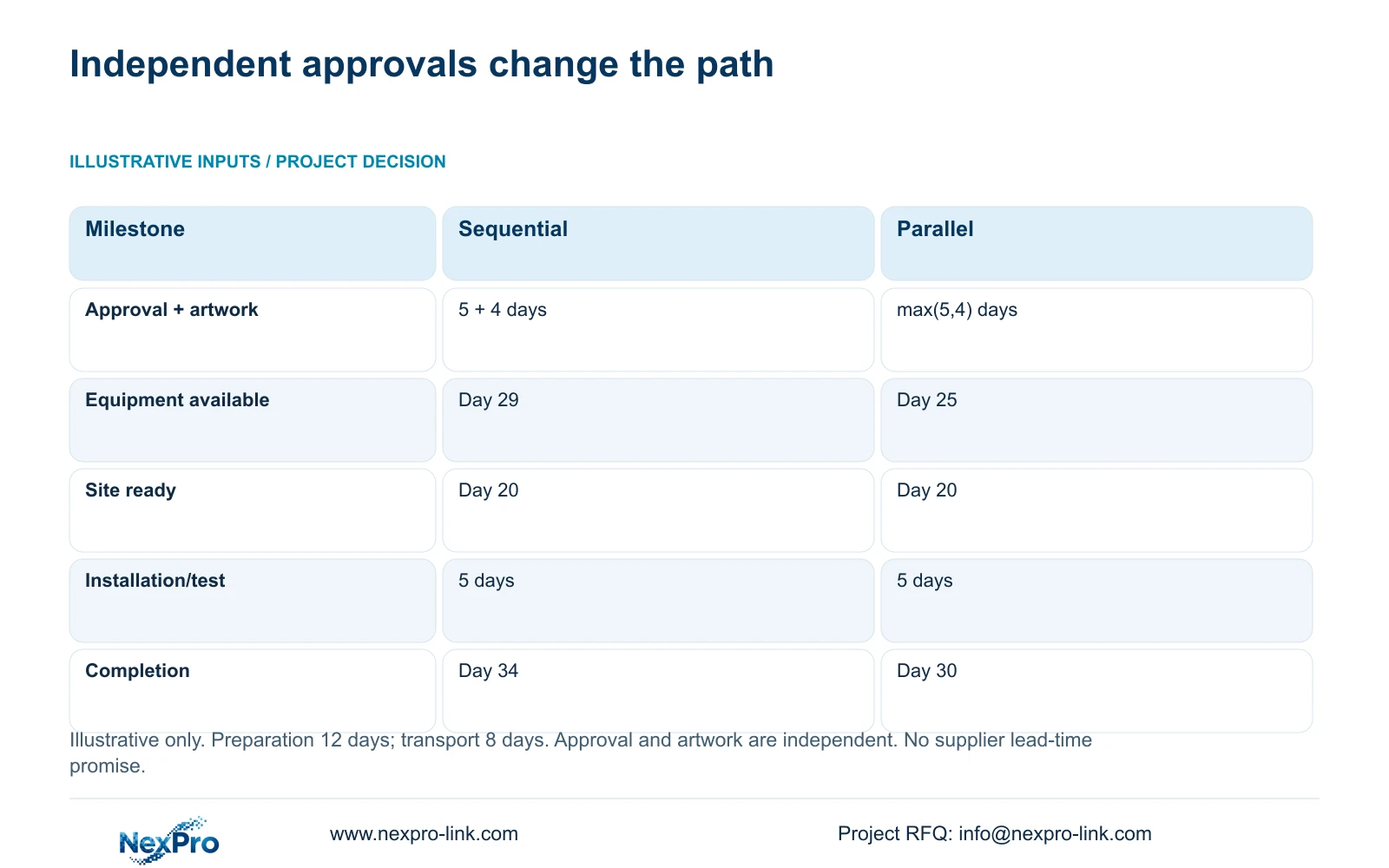
Assign a decision owner to each schedule dependency. In the illustrative programme, technical approval takes five days and artwork takes four days from day zero. Preparation takes twelve days, transport eight days, site readiness twenty days and installation/testing five days. These are teaching durations, independent of CASE01 equipment totals.
The ready-to-install day is the later of equipment availability and site readiness. With independent approval branches, equipment availability is max(5,4) + 12 + 8. Completion adds the five-day installation/testing period after that controlling milestone.
Section 04
Map documentation and packing requirements
Connect the approved schedule to carton references and the packing list. Preserve exact model identities and serial references where applicable, with project-zone labels as additional fields. Customer branding must leave the information needed for configuration and service traceable.
The schedule comparison below shows why document ownership affects the release date. Treating independent approval and artwork branches as sequential gives equipment availability on day 29. Running them in parallel gives day 25. Because the assumed site is ready on day 20, equipment availability controls both completion dates.
Freeze the packing fields needed for the actual release: zone grouping, accessory contents and the accepted artwork revision. Required battery transport information belongs to its own review path. The four-day difference is a result of the stated dependencies, not a promised NexPro-Link lead time or evidence that any transport review finishes within those durations.
| Metric / condition | All branches sequential | Actual parallel branches |
|---|---|---|
| Approval + artwork treatment | 5 + 4 | max(5,4) |
| Equipment available day | 29 | 25 |
| Site ready day | 20 | 20 |
| Illustrative completion day | 34 | 30 |
| Actual commitment | Depends on real sequence and agreed dates | Requires actual project inputs |
Section 05
Compare single and staged shipments
A single shipment keeps receiving and inventory reconciliation together when all required items share an acceptable release date. It becomes a poor choice if an optional display package delays cameras, recording and their required network equipment. Compare that delay against the additional handling and coordination of a split release.
Define a functional first package before discussing its freight date. Sending cameras ahead without their required network or recording dependencies may help mounting work, but it does not create an operational security system. Record the interim installation outcome accurately and keep the remaining dependencies visible.
A split release also needs clear treatment of shared accessories, documentation and shortages. Assign each item to one shipment and retain the master-order reference across both. The cost manager should evaluate the actual additional transport and receiving scope; this article assumes no freight saving or fixed split-shipment premium.
Section 06
Agree on a practical release plan
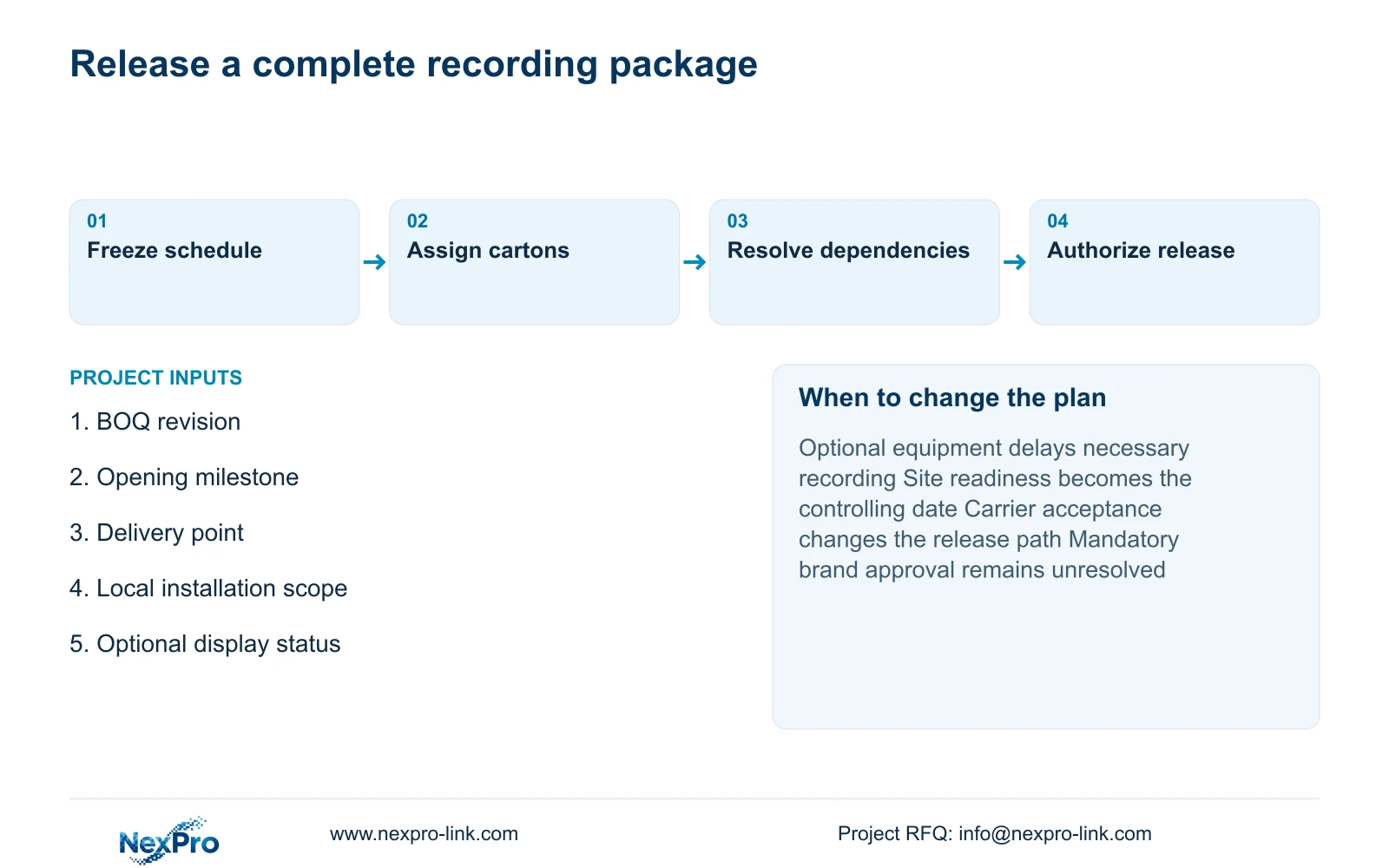
Use a release record that states the approved schedule revision, contents, destination handoff and decisions still outstanding. Separate forecast dates from authorized order instructions. If configuration changes after approval, show which lines and dependent documents change before using the revised version for preparation.
Recommend consolidated supply with category-specific responsibilities and parallel independent approvals. Change the shipment structure when a verified delay blocks necessary opening functions and a complete earlier package remains feasible. Recalculate the programme if site readiness, carrier acceptance or model approval becomes the controlling dependency.
Support terms should remain attached to the supplied categories. The supplied policy record dated October 7, 2026 gives applicable main equipment a baseline of 24 months of limited hardware warranty from receipt. Batteries, disks, cabling and OEM terms follow their scoped records and controlling written order; local labour and return transport need explicit treatment.
Send info@nexpro-link.com the relevant BOQ revision, destination and delivery point, local installation scope and required opening milestone. Identify any mandatory brand restriction. NexPro-Link can then discuss model matching and coordinated supply against a defined release package.
Section 07
Buyer questions
Can one coordinated order include equipment from different supply categories? Yes, within the agreed proposal. Keep category-specific product identity, interface requirements and service contacts attached to each line. A shared order does not establish that every item is manufactured by the same party or that software integration is included.
Must retail-style packaging be finished before equipment can ship? Only if that packaging is required for the approved release. Compare project cartons and installation-zone labels with the requested branded presentation. Any change needs agreement on the affected packing scope, while model information and required markings remain intact.
Can an indicative delivery programme authorize production? No. Use it to identify dependencies and outstanding decisions. Preparation and release should follow the agreed order version and its authorization, not an unconfirmed forecast quantity.
Engineering references
These sources support the general planning principles. Always use the selected product's current datasheet and applicable project standards for final design.