Factory, port and hotel-site prices cover different handoffs. Normalize the destination, equipment scope and excluded costs before choosing an offer.
Section 01
Identify the quoted delivery basis
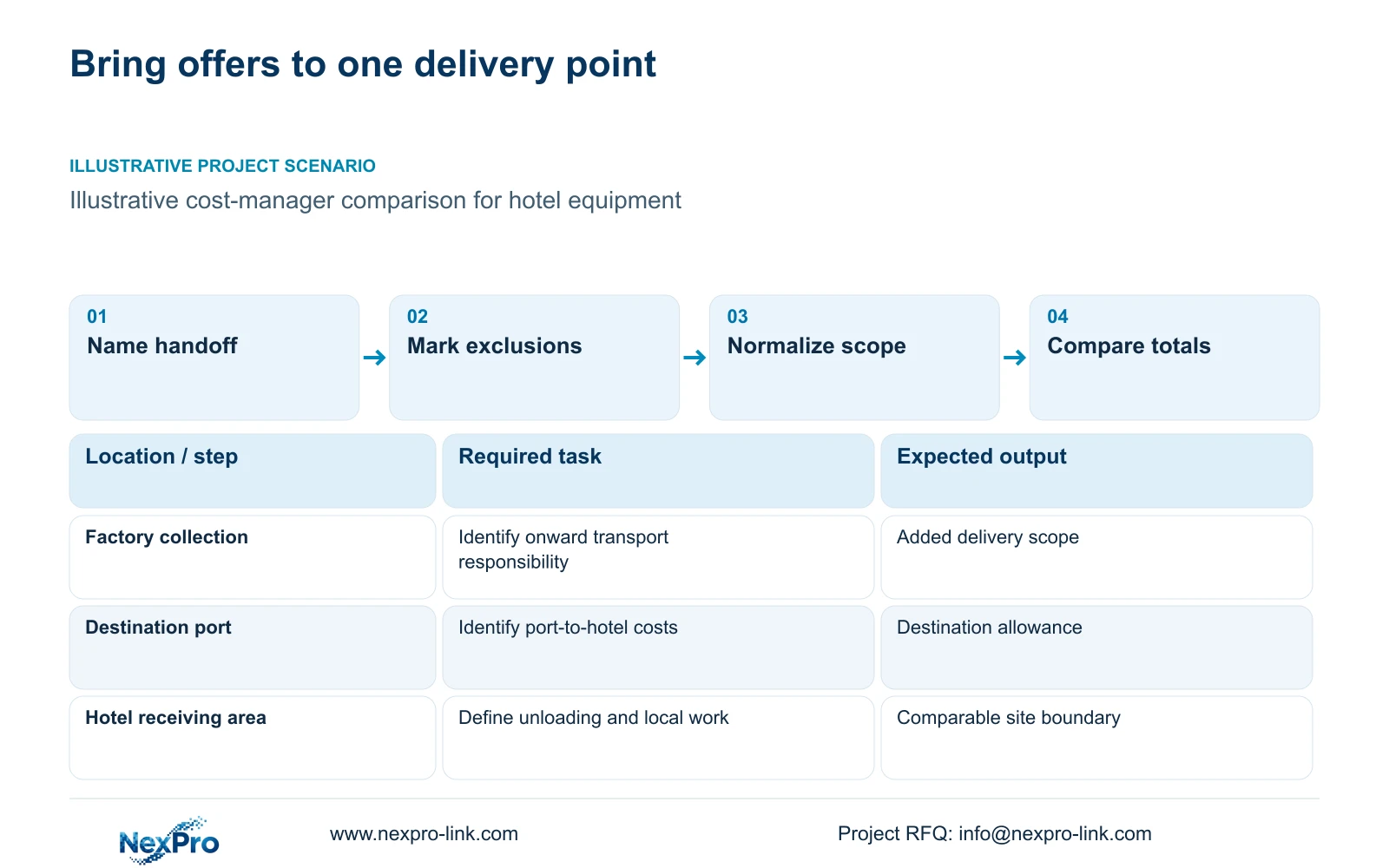
Compare factory, port and hotel-site offers at one agreed delivery point, adding the costs each offer leaves to the buyer. Choose the lower complete evaluated cost only after the equipment and service outcomes match. Reopen the comparison when the destination handoff or a material excluded charge changes.
A factory price can leave transport work outside the offer; a port price can leave the onward route unresolved. A site offer also needs an exact receiving location and an explicit unloading boundary. Write down the actual handoff instead of interpreting a short price label as a complete logistics agreement.
Work backwards from installation readiness. Equipment at the destination does not establish that the hotel has accepted it or can use it. Assign the movement from the quoted handoff to the work area, and identify any storage or site-access dependency. NexPro-Link's hotel supply scope supports discussion of these boundaries without guaranteeing all local delivery services.
| Required task | Given information | Decision still needed |
|---|---|---|
| Move equipment from origin | Factory collection offer | Transport scope and receiving handoff |
| Bring equipment from port to hotel | Named destination port | Onward transport, handling and excluded charges |
| Receive at the installation site | Hotel-site delivery offer | Exact location, unloading and storage boundary |
Section 02
List included and excluded cost layers
Keep equipment, software and local installation separate in the comparison. Add freight and the actual insurance scope, then identify taxes and destination handling according to the agreed responsibility. An excluded item with an unknown cost remains unresolved; entering zero would create an unsupported price advantage.
Check technical completeness before evaluating logistics. An offer without required storage or protected network equipment can look inexpensive while failing the same hotel task. The illustrative CASE01 package distinguishes necessary recording dependencies from optional display equipment. Its quantities and calculations are independent of the cost example used here.
Mark each cost layer as included, excluded or awaiting confirmation, with the responsible party beside it. Reconcile package contents to avoid adding an accessory or service twice. If installation is separately contracted, preserve that contractor's scope in the evaluated total even when the overseas equipment supplier does not invoice it.
Branding and project packing belong in the comparison when requested. Separate an authorized logo or carton arrangement from technical configuration. Hardware branding does not establish rights to rename a third-party client or remove its licensing requirements.
Section 03
Normalize destination and currency
Issue the same destination and delivery-point description to every bidder. A country name alone leaves the port, receiving location and onward route open to different assumptions. If alternatives use different routes, show their differences before converting them into one evaluated delivery scope.
Choose the evaluation currency and document the conversion basis used by the cost team. Preserve each original quoted currency alongside the converted amount. No exchange rate is assumed here. If payment timing or quote validity differs, keep that exposure visible instead of presenting converted totals as permanently fixed.
Match quantities and technical outcomes at the same time. Exact device and software identities matter because a similar housing or channel count does not establish the same lens, recording mode or supported workflow. Service comparisons also need the same handling assumptions for batteries, disks and other accessories.
Normalize the single-shipment delivered scope before considering recurring costs. Record the quoted currency, named handoff point and each excluded cost with its responsible party. An unknown allowance is unresolved, not zero. The optional life-cycle illustration in the next section is a separate comparison and supplies no export charge.
Section 04
Compare complete evaluated totals
For the export comparison, add the equipment and other non-duplicated costs needed to reach the same agreed handoff. The worksheet below identifies included, excluded and unresolved lines. ICC's Incoterms rules allocate delivery obligations, costs and risks between buyer and seller; record the agreed rule and named point, then confirm the actual quotation and contract rather than inferring all charges from a country name.
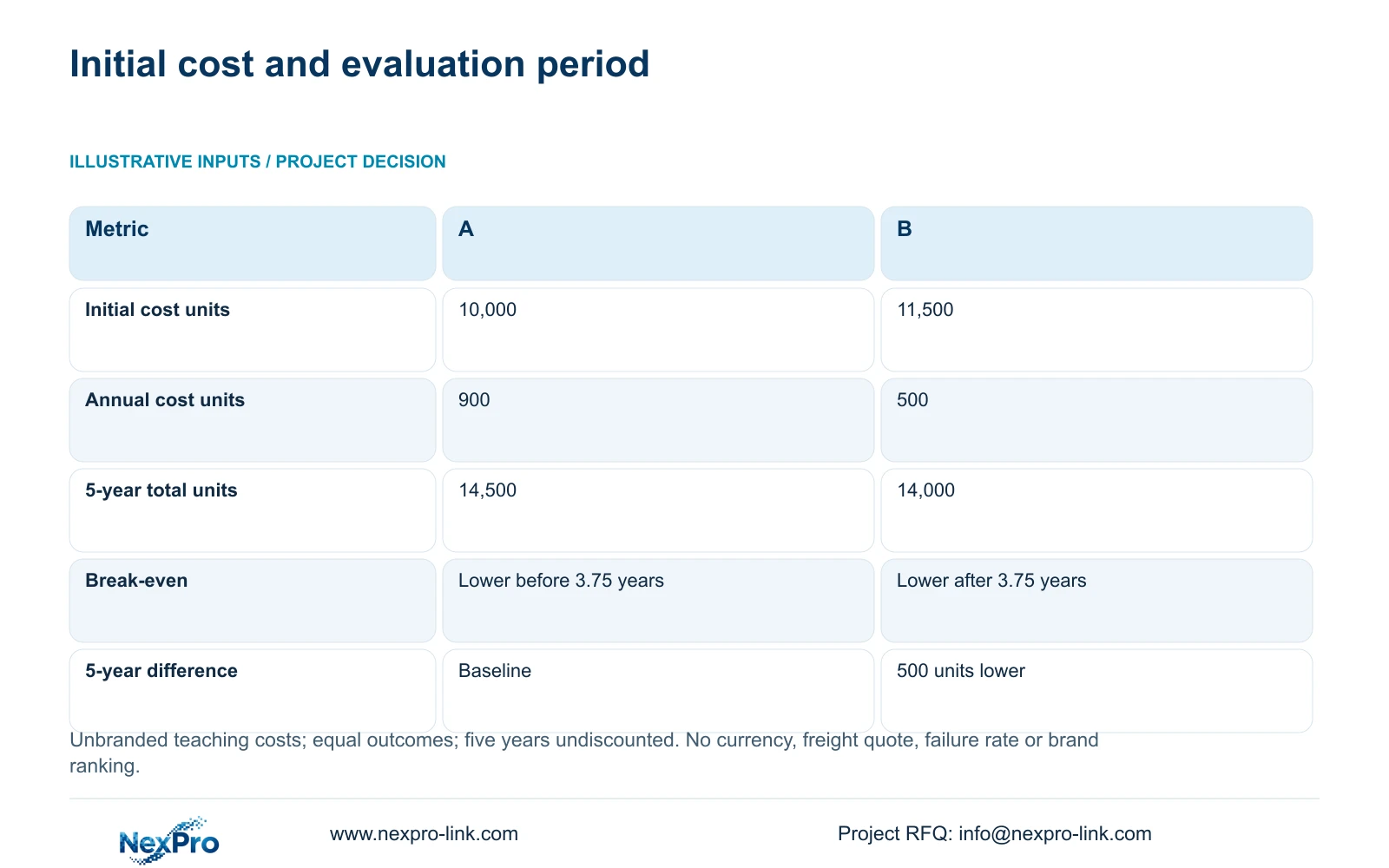
The retained illustration is an independent undiscounted life-cycle example: A starts at 10,000 cost units plus 900 annually; B starts at 11,500 plus 500 annually. Five-year totals are 14,500 and 14,000, with simple break-even at (11,500 - 10,000) / (900 - 500) = 3.75 years. These teaching values are not freight, tax, exchange-rate or supplier inputs.
Do not rank export offers using that illustrative 500-unit life-cycle difference. First resolve the actual shipment scope and comparable handoff, including charges not quoted by the supplier. Add a separate service-horizon comparison only when credible recurring-cost inputs exist.
| Cost or scope line | Record against each offer | Unresolved or double-count risk |
|---|---|---|
| Equipment and required accessories | Same quantities and operating requirements; quoted currency | Missing disks or fittings are not an equivalent saving |
| Packing and documentation | Included preparation and destination-specific needs | Do not add an already included packing line twice |
| Transport and agreed handoff | Rule, named point, route and quoted segment | A freight payer is not by itself the full delivery/risk boundary |
| Insurance, handling and import charges | Quoted or excluded amount and responsible party | Unknown charge remains open; no tax rate assumed |
| Onward delivery and local installation | Receiving point and separately assigned work | Keep equipment supply distinct from local attendance |
| Evaluation basis | Common currency, conversion date and quote validity | No invented rate or permanently fixed converted total |
Section 05
Separate customs assumptions from confirmed charges
Keep an estimated customs or destination allowance separate from a confirmed charge. Record who supplied the estimate and which goods, route and delivery arrangement it covers. A general equipment article cannot establish the applicable classification or charge for a specific shipment.
Ask the responsible logistics or customs party to resolve the relevant destination inputs before treating the landed total as confirmed. If an amount remains uncertain, show its effect on the comparison as a variable. Do not conceal it within a rounded contingency that prevents the buyer from seeing what changes the recommendation.
The same approach applies to support expenditure. The supplied policy record dated October 7, 2026 states an applicable main-equipment baseline of 24 months of limited hardware warranty from receipt. Battery, storage, cable and OEM scope follows the controlling written terms. That baseline does not establish free local labour, return transport or all later service costs.
Recommend an economic option only after its required performance and service scope remain intact. If the preferred result depends on an unresolved destination fee, carry a conditional recommendation until that fee is confirmed.
Section 06
Request a revised scope-matched offer
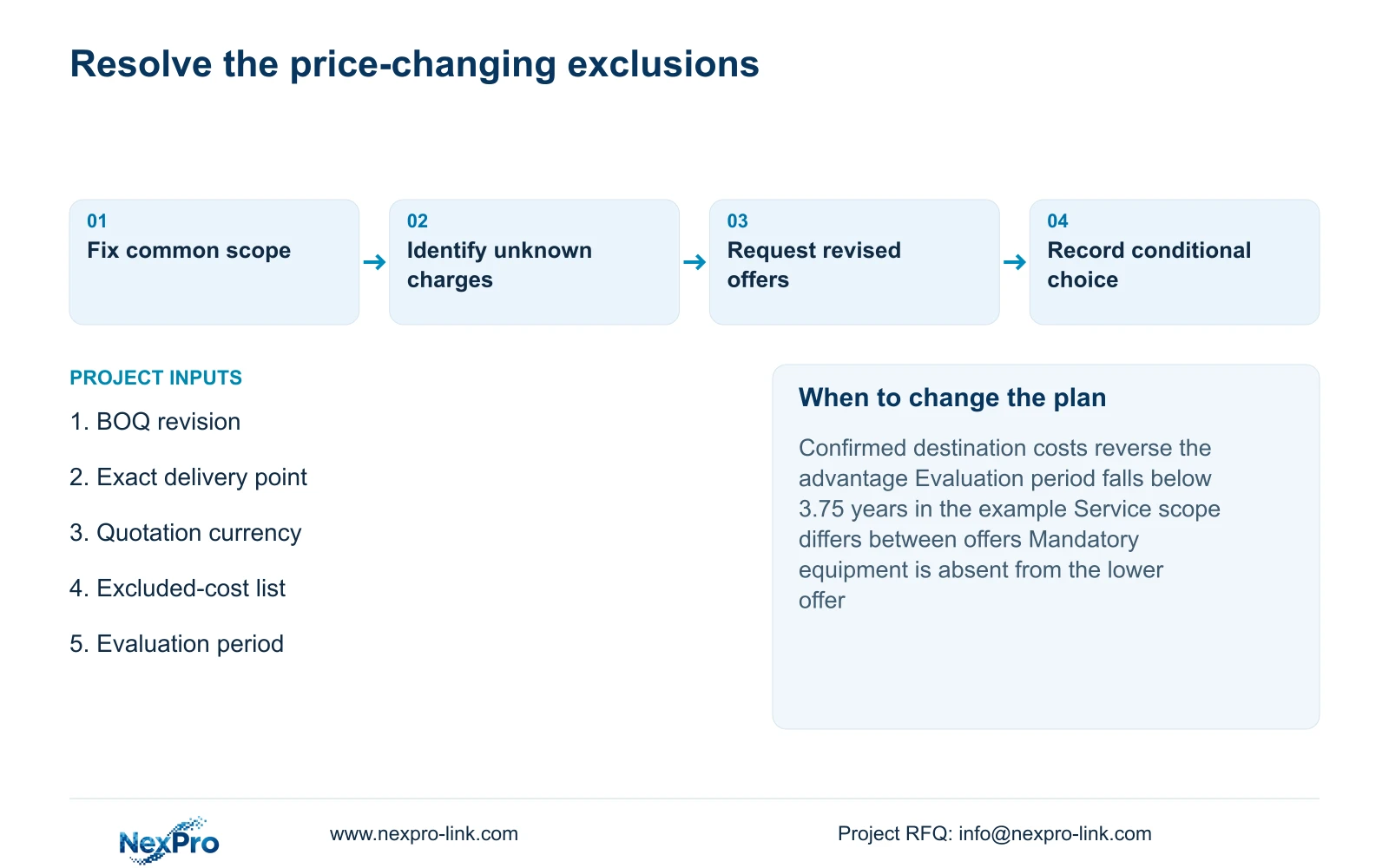
Send bidders a common revision showing the agreed equipment schedule, delivery handoff and missing cost layers. Request a response against the same line references. Separate quantity changes from specification changes and delivery changes so the revised total can be traced to actual decisions.
Keep the original baseline visible. A supplier should identify whether a revised amount comes from added accessories, a different model or a changed transport scope. A comparison calculation does not authorize a substitution or release an order; the accepted version needs to remain the procurement record.
Choose the lower complete total for the approved evaluation period when all required outcomes match. Change that choice if confirmed freight, destination charges or service terms reverse the advantage. Mandatory operator or brand requirements remain part of the baseline even when removing them would reduce price.
Send info@nexpro-link.com the BOQ revision, exact destination and delivery point, requested quotation currency and local installation boundary. Include the evaluation period if recurring services affect the decision. NexPro-Link can discuss a scoped offer and identify which commercial inputs still need confirmation.
Section 07
Buyer questions
Can an excluded charge be entered as zero while awaiting confirmation? No. Mark it unresolved and identify its owner. A provisional comparison can show the charge as a variable, but an unknown exclusion cannot support a confirmed lower delivered total.
Does the five-year example prove that the higher initial offer is preferable? Only under the stated equal-outcome assumptions. B becomes lower after 3.75 years. A shorter evaluation period, changed recurring cost or additional excluded charge can reverse that result.
Can NexPro-Link compare another supplier's offer without confidential project files? A relevant schedule extract and the quoted scope boundaries can support an initial comparison. Include mandatory requirements and whether alternatives are permitted. Omit unrelated commercial material, guest images and access credentials.
Engineering references
These sources support the general planning principles. Always use the selected product's current datasheet and applicable project standards for final design.