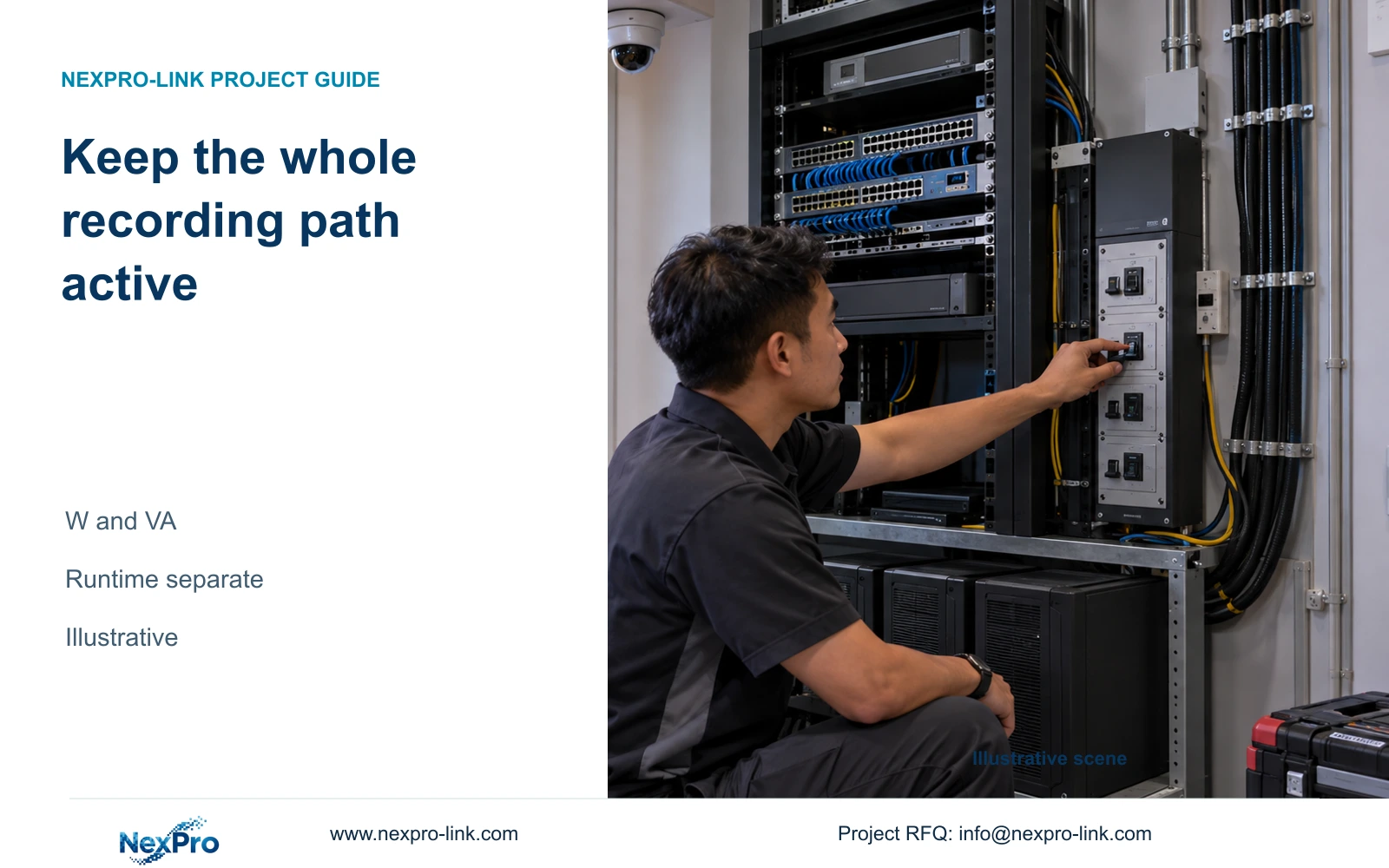
A UPS rating does not describe its shipment battery configuration. Give the selected carrier the actual battery and packing information before booking freight.
Section 01
Identify the actual battery configuration
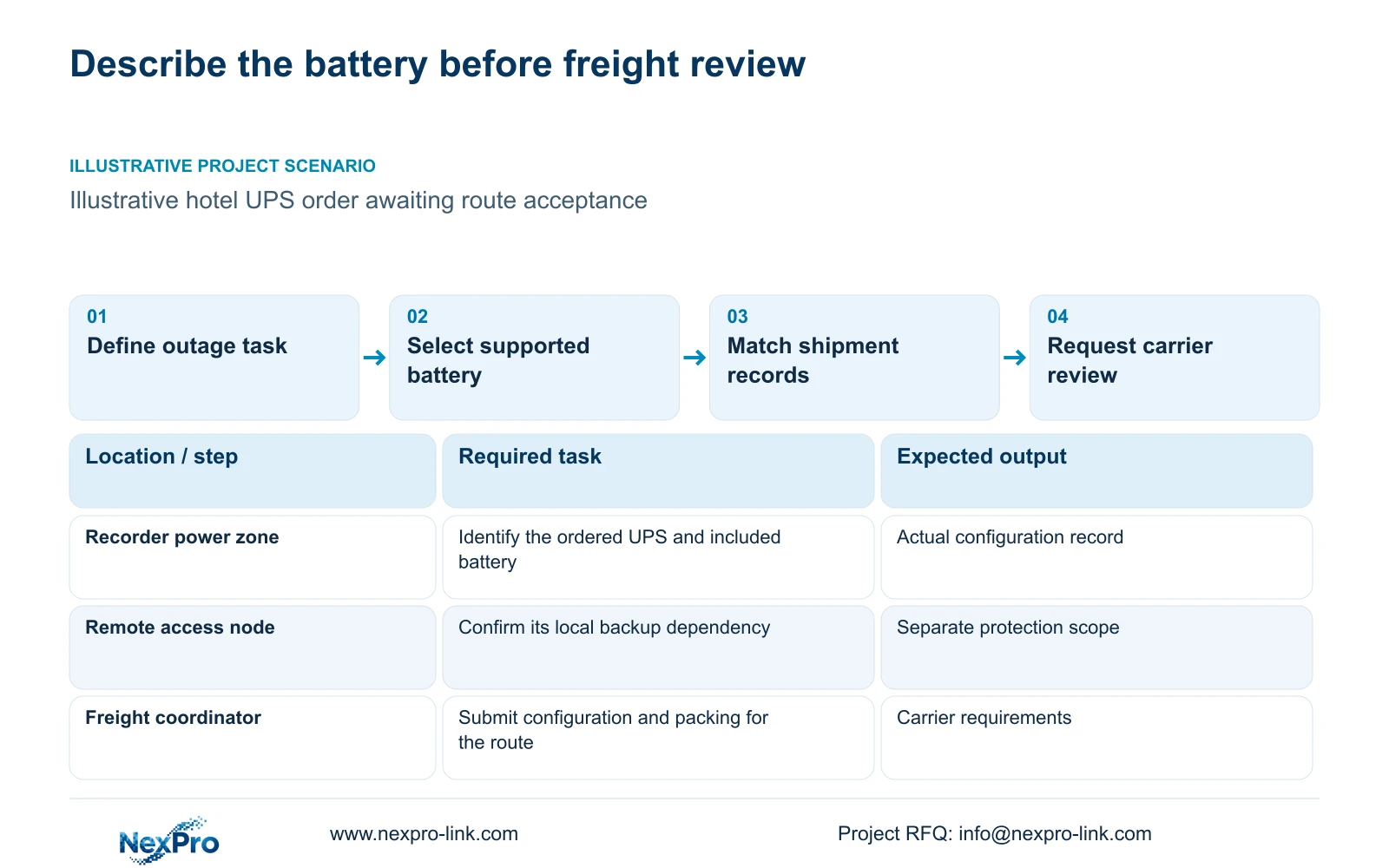
Disclose the actual lithium battery configuration before booking a hotel UPS shipment. Combine it with cameras only when the selected qualified carrier accepts the described equipment, batteries and packing for the intended route. If that acceptance or timing differs, evaluate a separate release without removing the hotel's required backup-power function.
Begin with the outage task and the supported configuration selected to meet it. The shipment record needs to identify the UPS model and the batteries actually included, including whether they are within the equipment or supplied separately. A kVA rating alone cannot fill those fields, and a planning energy calculation cannot establish the battery label.
The supplied product records identify SP2KR(S) as a rack model rated 2 kVA / 1800 W and SP2K(S) as a tower model rated 2 kVA / 2000 W. Both belong to listed LiFePO4 online UPS series, but their actual battery configurations depend on the order. Do not transfer a default model's Wh field to another model.
| Required task | Given information | Decision still needed |
|---|---|---|
| Maintain required recording during an outage | Protected load and runtime target | Supported UPS and battery configuration |
| Describe the battery shipment | Selected UPS model | Actual battery identity, quantity and packing arrangement |
| Book the intended route | Origin and destination | Selected carrier's acceptance and required documentation |
Section 02
Separate equipment and battery documentation
Keep the equipment specification, runtime basis and battery shipment information as distinguishable records. The equipment sheet explains capacity and interfaces. The battery record describes what will physically travel. The selected carrier's document requirements should determine what additional information is needed for that shipment.
Load watts multiplied by outage hours gives output energy needed by the protected equipment. It does not give the exact nominal battery configuration to ship. Supported runtime depends on the chosen battery arrangement and operating conditions. Use the manufacturer's configuration and load curve when selecting the order, then describe that actual selection for transport review.
Tie each document to the same order revision. A later change to battery quantity or an external battery arrangement can leave an earlier packing record inaccurate. Confirm the revised identity before relying on the previous route response. Do not describe unavailable documents as attached or imply that the product page proves transport approval.
Project artwork and zone labels can help receiving, but they must preserve battery and equipment identity. Keep required markings distinct from the customer's logo. The approved process should determine the physical packing; a presentation preference cannot settle a carrier's acceptance decision.
Section 03
Consult the selected carrier's route requirements
Give the qualified transport reviewer and selected carrier the origin, destination, route and exact battery/shipment configuration before booking. IATA's public air-transport guidance identifies battery configuration and watt-hour rating as relevant inputs. Obtain the applicable current requirements and written acceptance for the described goods; this article provides no classification, packing instruction or permission to ship.
Carrier acceptance belongs on the release path with an owner and an identifiable response. An equipment-ready date cannot establish a bookable shipment if battery information remains unresolved. A route or configuration change needs corresponding review before the project relies on the earlier acceptance.
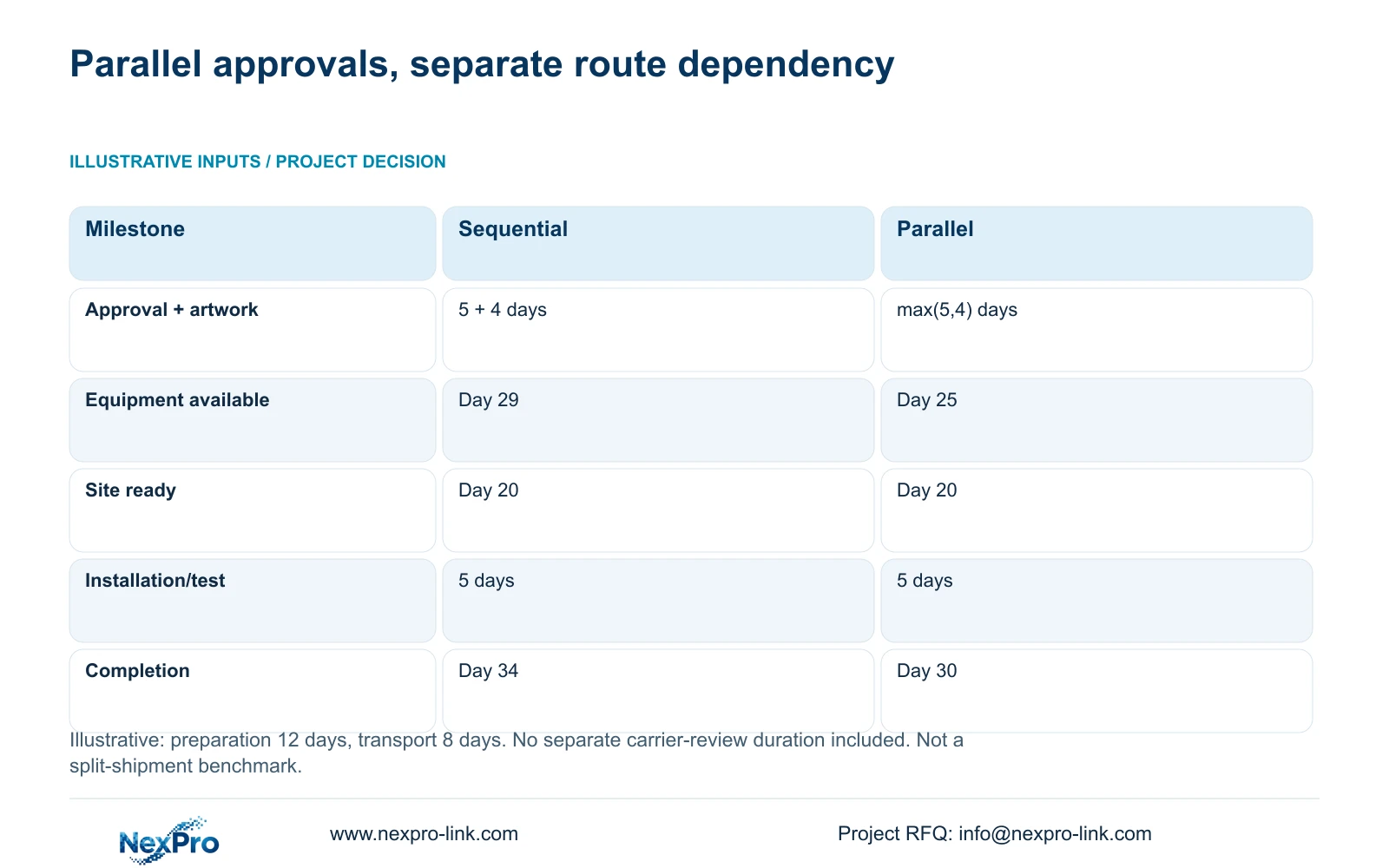
The independent teaching programme assumes five days for technical approval and four for artwork in parallel, followed by twelve days of preparation and eight of transport. Site readiness occurs on day 20, and installation/testing takes five days. Ready-to-install day equals max(max(5,4) + 12 + 8,20). These assumptions contain no separate carrier-review duration.
If the actual battery review creates another prerequisite, add it to the correct branch and recalculate. Leaving it outside the programme would turn a useful dependency model into an unsupported delivery forecast.
Section 04
Compare consolidated and separated release plans
A consolidated release is suitable when the carrier accepts the full described shipment and its date meets the hotel's installation needs. A separated release can allow camera mounting or other preparatory work to proceed while the UPS package follows its accepted route. Describe that interim outcome accurately: installed cameras do not establish completed protected recording.
The retained figure explains an independent schedule: treating parallel approval and artwork as sequential gives equipment day 29 instead of day 25 and completion day 34 instead of day 30. It is not a comparison of battery transport routes. Use the release worksheet below to identify the unresolved battery evidence and authority before relying on any delivery date.
Use the result to organize independent decisions early, including artwork and technical configuration. Then compare real release alternatives using their accepted transport paths. Do not select separation solely because the teaching parallel case is faster, and do not treat its eight-day transport assumption as a carrier commitment.
Any earlier package needs its accessory and interface boundaries preserved. Local teams must know what they can install or test before the remaining equipment arrives and which outage requirement remains outstanding.
| Release input | Evidence for the actual consignment | Hold boundary |
|---|---|---|
| Battery identity | Exact ordered chemistry, configuration, label rating and quantity | Do not substitute a similar UPS's watt-hour value |
| Shipment arrangement | Installed, packed with equipment or separate goods as actually offered | Qualified reviewer confirms applicable requirements |
| Route and transport mode | Origin, destination, intended mode and carrier | Prior acceptance does not automatically cover a changed route |
| Required documents and packing review | Applicable current requirements and responsible qualified party | Do not improvise classifications, labels or packing |
| Written release | Configuration-specific acceptance and purchasing instruction | Equipment readiness alone is not shipment permission |
| Interim package | Named installable tasks and missing power/interface items | Mounting is not completed protected recording |
Section 05
Map schedule dependencies
Connect shipment arrivals to the actual power-protection zones. A hotel with remote access switches may need protected power at those locations as well as at the recorder. Fiber carries data and does not automatically supply remote equipment. A central UPS carton cannot establish that every required camera path has backup.
CASE01 illustrates this separation between recording dependencies and optional display loads. It is a teaching reference, not a delivered hotel. Its load and battery budgets are independent of this article's schedule durations and must not be converted into transport battery declarations.
Identify who supplies the missing input, who acts on it and who can authorize a change. The project manager controls the programme, while the responsible engineering team confirms the functional package. The carrier determines acceptance for its route. A forecast demand or proposed split does not authorize alteration of the equipment order.
When comparing split releases, include actual extra receiving and local configuration work. If the required opening outage state cannot be achieved before the later battery arrival, retain that milestone as incomplete or agree a supported revised solution. Do not assume an unspecified local battery substitute will work.
Section 06
Confirm the shipment scope before booking
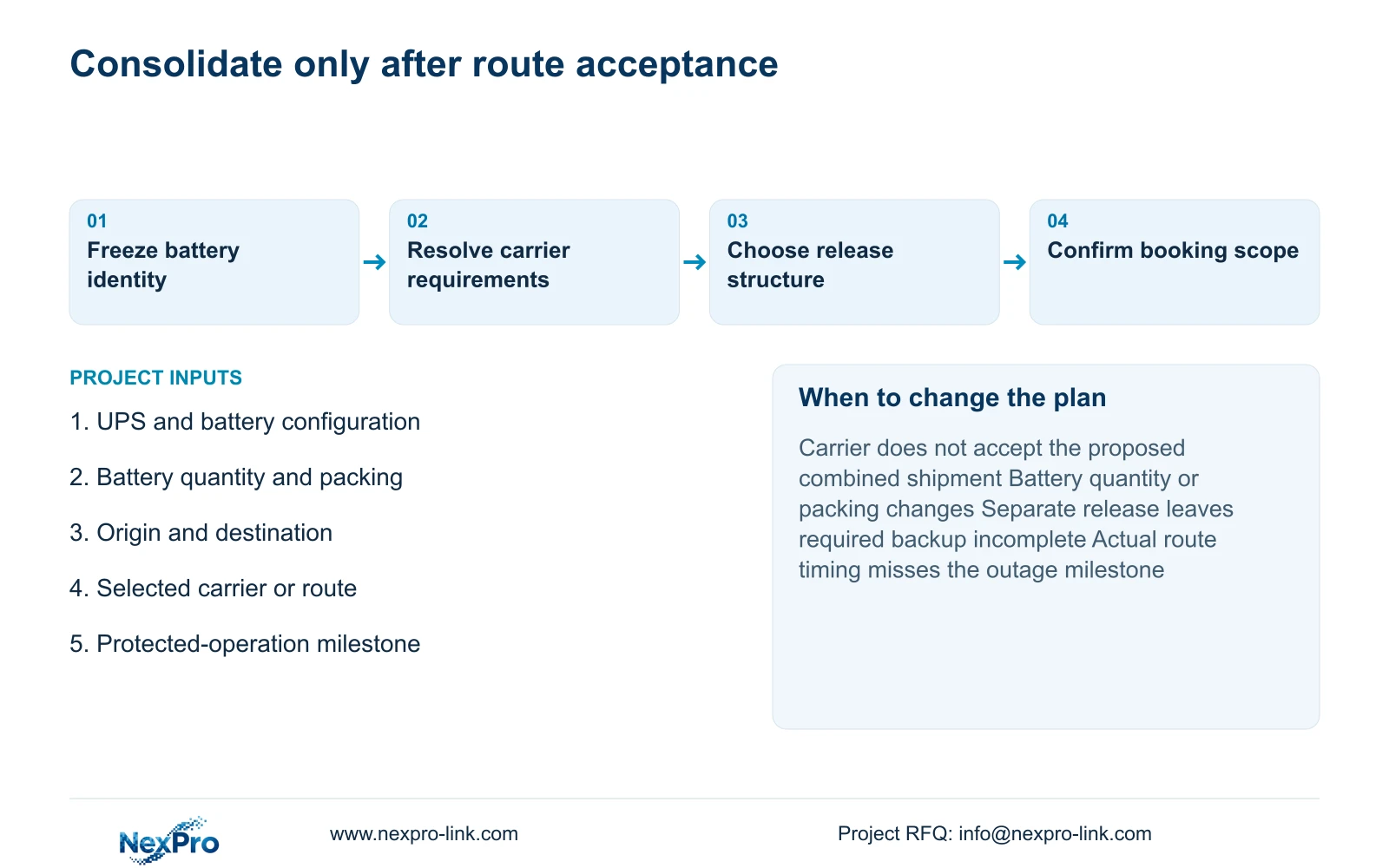
Before booking, reconcile the accepted equipment and battery configuration with the shipment contents and the selected carrier's response. Retain the model revision, battery quantity and packing references used for that decision. If any of them changes, resolve the effect on acceptance and schedule before release.
Recommend early route review for the actual supported battery configuration, with independent project approvals running in parallel where feasible. Change to separated releases only when the carrier and project requirements support them and the interim work has a defined purpose. Change the equipment proposal if its accepted delivery cannot meet a mandatory outage milestone.
NexPro-Link can discuss UPS selection and coordinated hotel supply within the written scope. Local electrical installation and full-path switching tests remain separately assigned. Battery warranty and service arrangements follow their actual order terms; the main-equipment policy baseline must not be extended automatically to the battery.
Send info@nexpro-link.com the proposed UPS and battery configuration, destination and delivery point, intended carrier or route, and required protected-operation date. If selection is unfinished, provide the protected load and runtime target so the equipment decision can be resolved before the transport record is finalized.
Section 07
Buyer questions
Can the UPS rating supply the battery energy field for freight review? No. The rating describes electrical capacity. Obtain the actual battery configuration for the order; a runtime estimate or a default series-page field is not a shipment declaration.
Does separating the cameras from the UPS complete the opening package earlier? It may permit mounting or other preparatory work earlier. The required recording and outage functions remain incomplete until their dependencies are present and verified. Compare actual accepted routes and the hotel's milestone before deciding.
What information is useful when the UPS model is still undecided? Provide protected load, runtime target and protection-zone locations, plus destination and intended route. Resolve the supported battery configuration before final carrier acceptance or booking.
Engineering references
These sources support the general planning principles. Always use the selected product's current datasheet and applicable project standards for final design.