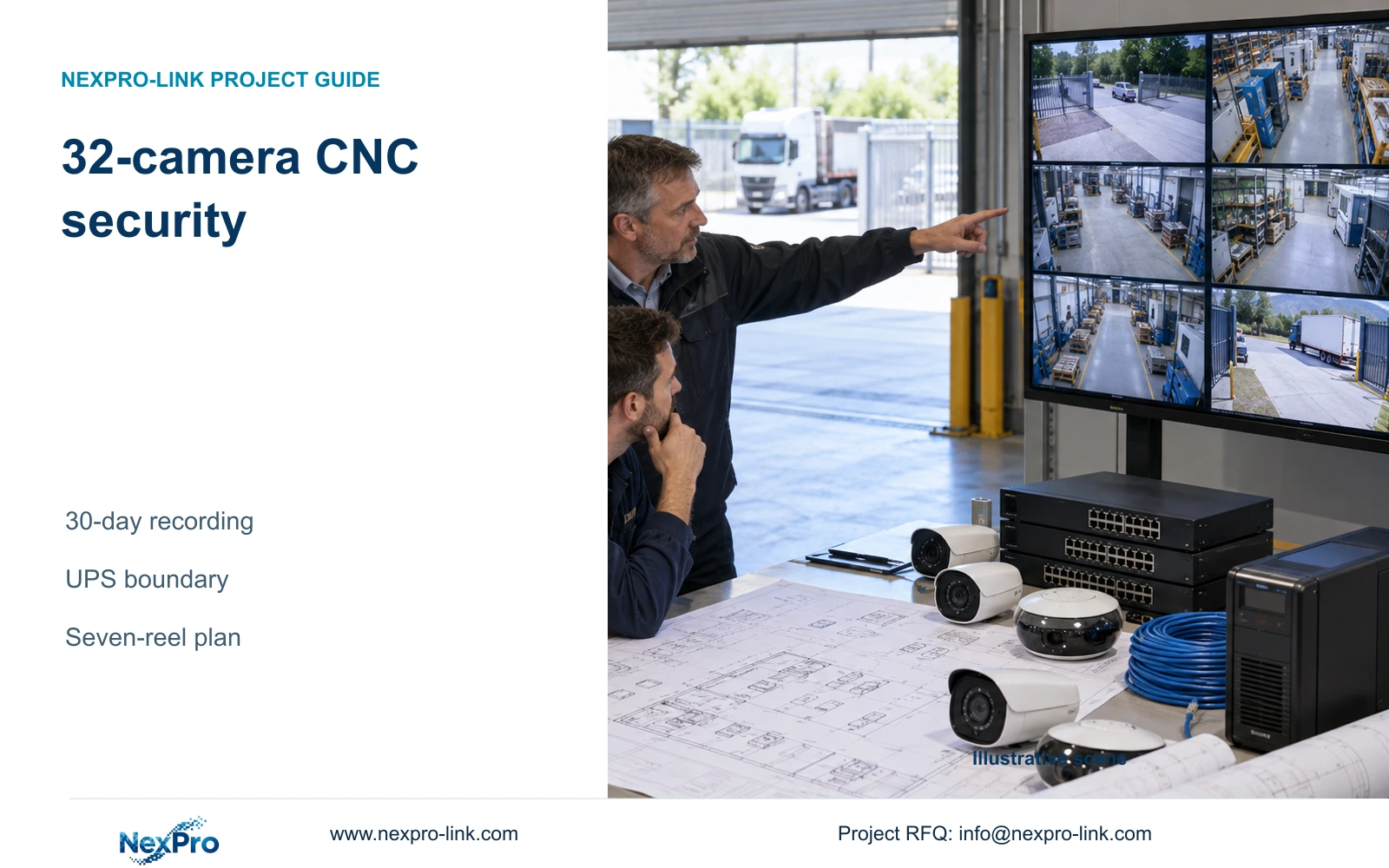
A coordinated CCTV order can still require separate packing and transport decisions for batteries and displays. Build one project register without assuming all goods can travel together or share the same handling.
Section 01
Identify each cargo category before choosing consolidation
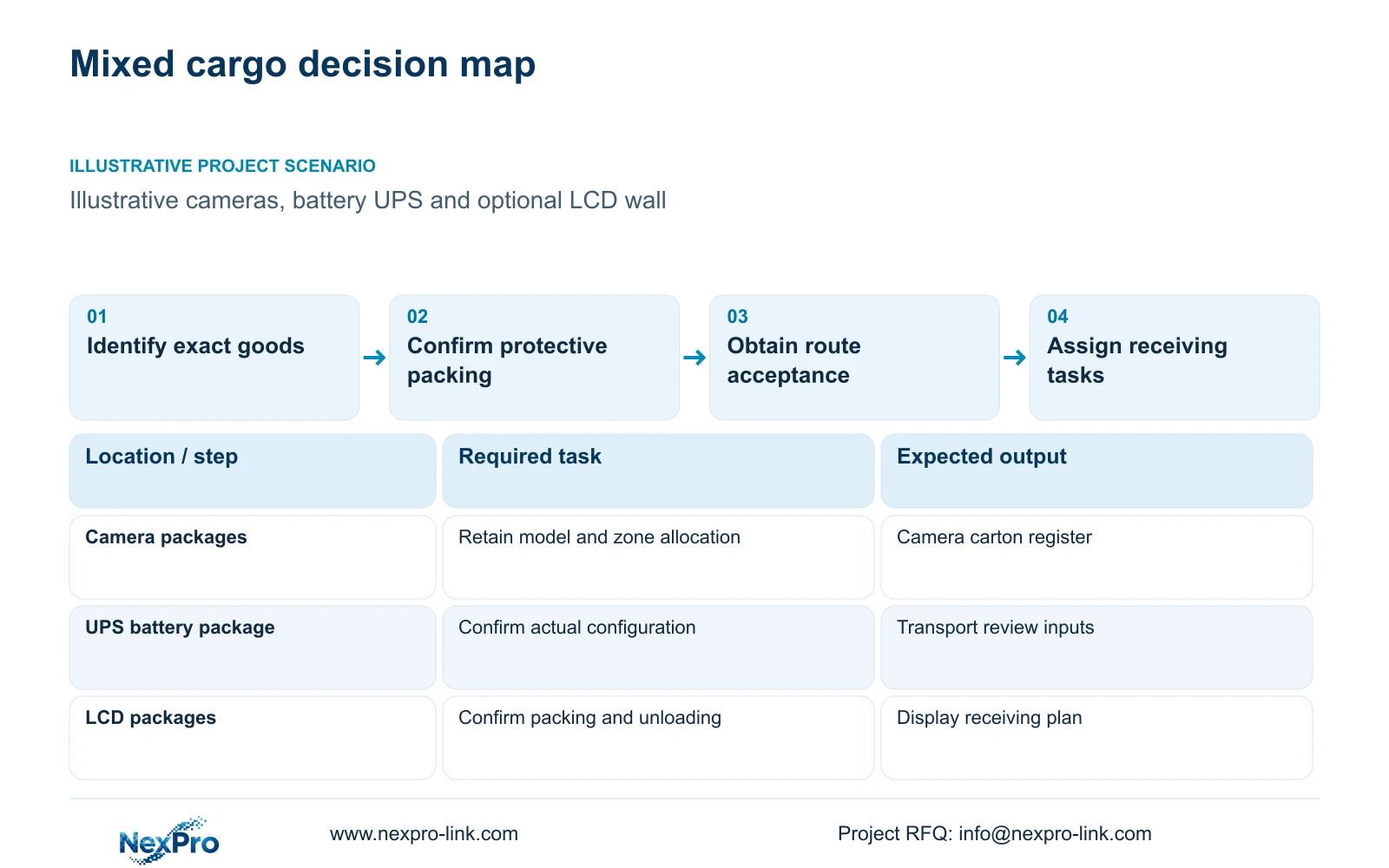
Overseas factory CCTV delivery should use a shipment plan accepted for the exact goods and route. List cameras, recorders, battery-equipped UPS units and displays separately, then confirm their packing and transport arrangements. A single procurement contact can coordinate those tasks, but it does not establish that every item can use the same shipment or protective packing.
Illustrative project scenario: The order combines compact cameras, battery-equipped UPS units and fragile displays. CASE01 supplies the hypothetical background: a 32-camera CNC factory with one recorder, four access-switch groups and a local UPS candidate. Its optional display package adds four LCD panels and a decoder. Assume the buyer is considering that optional package for overseas delivery.
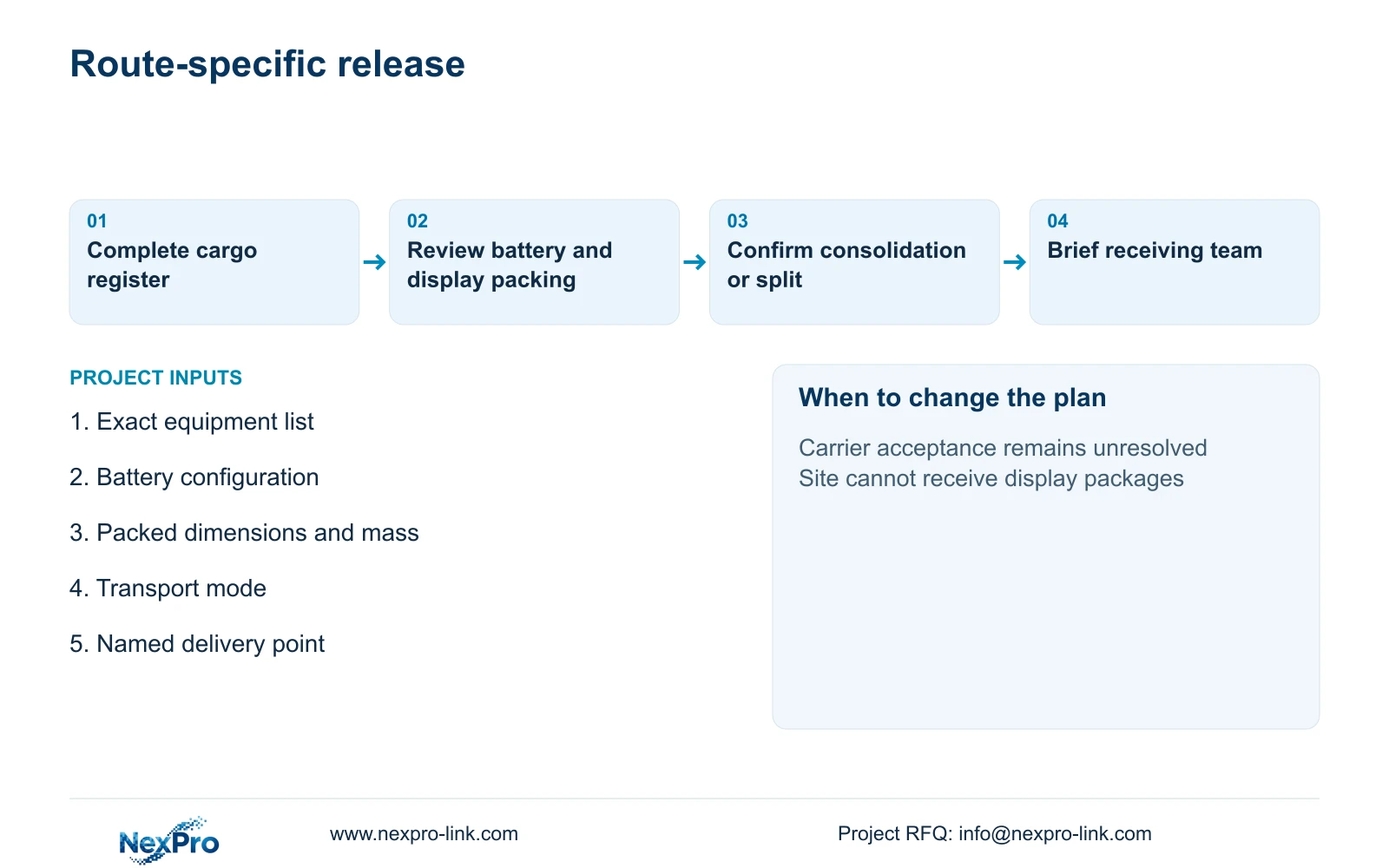
Start with exact models, quantities, actual battery configuration and destination. Include proposed transport mode and receiving location when available. Keep unknown mass, dimensions and battery documentation visible. The project manager needs an item-level cargo register before comparing consolidated and split delivery, because camera carton counts cannot describe the complete mixed order.
Section 02
Confirm transport acceptance using the actual battery and display
The rack UPS source identifies a LiFePO4 online series with SP1KR(S), SP2KR(S) and SP3KR(S) capacity references. These model ratings do not establish the selected battery's transport particulars. Obtain the actual configuration and supporting documents for review by the appointed logistics provider. Confirm applicable route, carrier and destination requirements before booking; this article makes no new legal classification claim.
For the display scope, NX-VP-5535 is a 55-inch LCD reference, not a direct-view LED panel. Ask for its actual packed dimensions, mass and proposed protective arrangement. Review how the shipment will be unloaded and moved to storage. Neither the catalogue screen size nor the number of panels establishes the packed cargo volume.
Have the supplier and logistics provider reconcile the final packing list before dispatch. Camera kit labels can retain building allocation while batteries and displays use their separately accepted packing. Customer artwork and packaging languages should be applied without obscuring necessary cargo or product identification. Approval of an OEM box design does not constitute acceptance of the transport arrangement.
Section 03
Assign ownership from packing through final receipt
Write down who prepares the packing list, who confirms carrier acceptance, who arranges destination clearance and who receives the goods at the agreed location. Record the named delivery point rather than using 'overseas delivery' as the full description. If a local contractor handles final movement, confirm the receiving access and storage arrangement with that contractor.
The supplier can provide the agreed equipment and packing records; the appointed logistics party evaluates the proposed route; the buyer identifies destination-side responsibilities. Treat that division as a project agreement to be confirmed, not as an automatic feature of one-stop supply. Unassigned work should remain an open action rather than becoming an invisible allowance.
CASE01's recording-first package and optional LCD package should appear as distinct delivery groups. If the wall is not selected, remove its panels and decoder from the cargo plan. If it is selected but ships later, preserve the first package's recording and operator needs. A common shipment register should show the operational consequence of each split.
Section 04
Use camera carton counts within their stated boundary
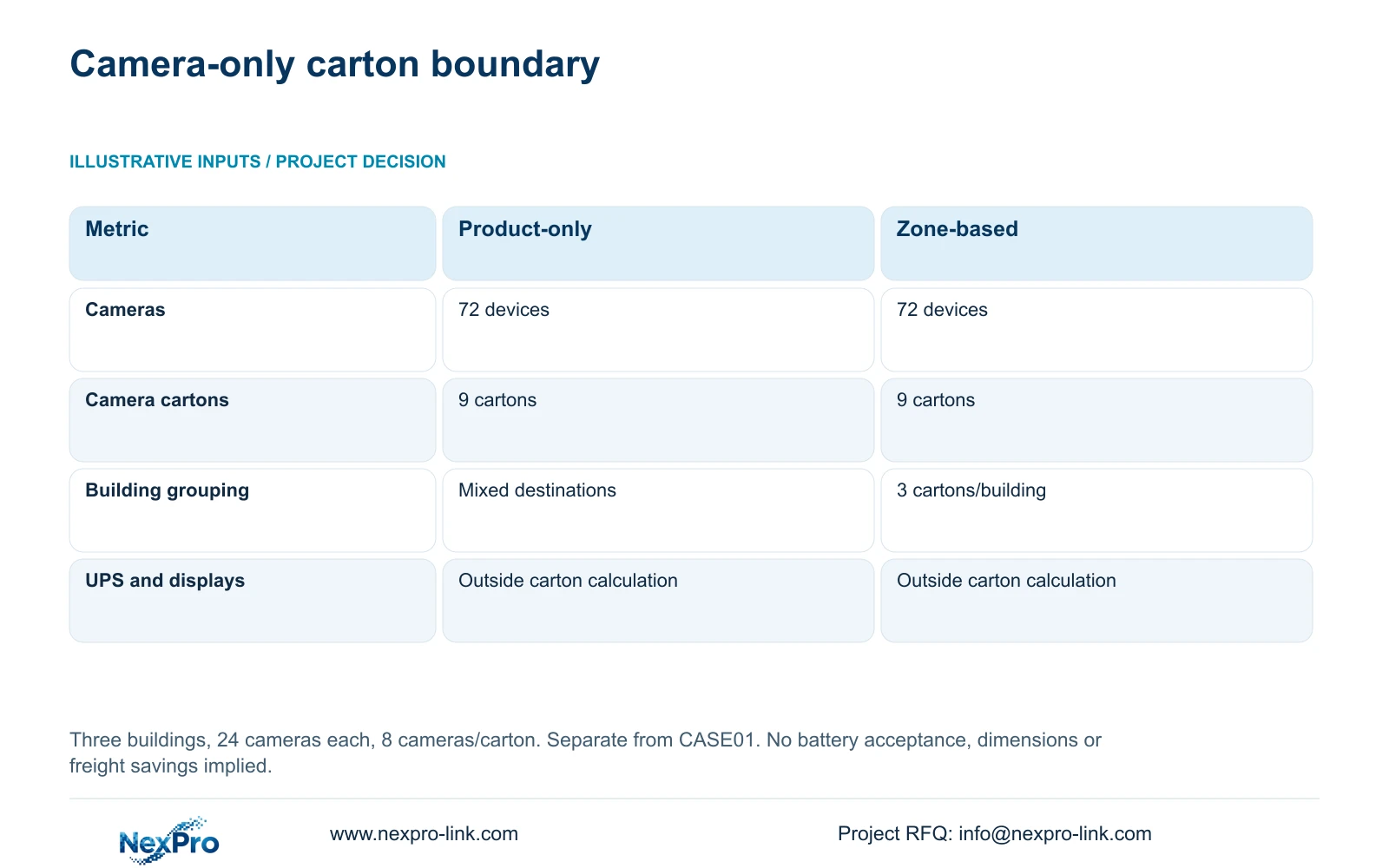
The supplied packing comparison is a separate illustration for three factory buildings, each with 24 cameras. With an assumed eight cameras per carton, total camera cartons = 72 / 8 = 9, while each building receives 24 / 8 = 3. These quantities do not describe CASE01 and exclude the UPS, batteries, recorder and displays.
Both options use nine camera cartons. Product-only packing leaves destination sorting to the site; zone-based marks allocate three cartons to each building. The useful difference is identification and accessory allocation. It does not establish freight savings, fewer handling operations or transport acceptance for the mixed goods.
Retain a separate shared-scope register for recorders and UPS equipment in either option. Add actual display and battery packages only after their packing is confirmed. This prevents a project summary stating 'nine cartons' from being mistaken for the complete shipping quantity. Final freight comparison needs the actual package dimensions, masses, route and quoted handling scope.
| Metric | Product-only option | Zone-based option |
|---|---|---|
| Camera devices | 72 | 72 |
| Camera cartons | 9 | 9 |
| Building grouping | Mixed destinations | 3 identified cartons/building |
| Recorder and UPS | Separate shared-scope register | Separate shared-scope register |
| Destination task | Site sorts camera stock | Carton marks carry assigned building |
Section 05
Consolidate only when the route and programme support it
Choose consolidated delivery when the logistics provider accepts the exact cargo, the packing arrangements are ready and the site can receive all goods at the intended time. This can simplify project coordination, but any cost conclusion must come from actual quotations. NexPro-Link's project supply scope provides a basis for coordinating equipment preparation, packing and overseas supply tasks.
Choose separate movements when one cargo category lacks confirmed acceptance, display installation is later or the site cannot safely receive the full package. Keep the project register common so the buyer can see what remains outstanding. A split should preserve the required first operating package rather than sending convenient cameras while deferring the equipment needed to record them.
Compare both options on the same delivery point and complete handling scope. Identify extra packing, repeated receiving and any storage obligations. Keep duties, taxes and destination work explicit and obtain current local confirmation where needed. A coordinated supplier offer should not be described as guaranteed clearance, local installation or a fixed transit outcome.
Section 06
Prepare the site to receive and verify mixed equipment
Issue the final packing register to the receiving team before dispatch. Include package identities, models, quantities, allocated destination and the records needed to check discrepancies. Keep equipment serials linked where applicable. A shipment marked for the guardroom may contain several product categories with different storage and unpacking needs.
Confirm who checks visible condition and contents, who records exceptions and who decides whether affected goods can enter commissioning. Keep actual product instructions available for battery storage and display handling. The supplied case's assumed panel loads and UPS energy calculations are electrical planning inputs; they provide no packing or storage instructions.
If OEM artwork is included, reconcile its revision with the final goods and technical labels. Do not use a rebranded description that hides the actual model from receiving or support staff. The resulting handover should be a versioned packing and delivery record with accepted responsibilities, allowing the project manager to track a complete order even when goods travel separately.
Section 07
Buyer questions
Does one purchase order require one physical shipment? No. One order can be tracked through separately agreed delivery groups. Record each group's contents, delivery point and operational dependencies so consolidation is a deliberate choice rather than an assumption.
Can the UPS capacity rating identify the battery shipping configuration? No. Obtain the exact battery-equipped variant and its transport particulars. A W or VA rating describes UPS capacity, and the selected battery configuration needs separate identification.
Should display equipment delay the recording package? Only if it is required for the first accepted operating task. Where ordinary operator viewing is sufficient, the project can consider a later wall delivery while keeping recording, network and protected power complete.
Section 08
Coordinate your mixed equipment delivery
Send the itemised equipment list, exact UPS battery configuration, destination and proposed transport mode, and required site receipt sequence to info@nexpro-link.com for a coordinated packing and delivery discussion.
Engineering references
These sources support the general planning principles. Always use the selected product's current datasheet and applicable project standards for final design.