When a bidder changes one assembly component, obtain evidence covering the complete proposed configuration and its installation limitations. Refer acceptance to the qualified project team before supply.
Section 01
Use the approved location requirement as the selection gate
When a bidder changes one assembly component, obtain evidence covering the complete proposed configuration and its installation limitations. Refer acceptance to the qualified project team before supply. Keep the previous assembly approval with its original identity; similarity of camera bodies cannot transfer a protective scope to a different combination.
Ordinary factory CCTV cannot replace explosion-protected cameras where the location requires specialist protection. Retain the applicable specialist product class, and seek ordinary-area value only at positions confirmed suitable for ordinary equipment. A camera's ingress rating, metal housing or PoE connection does not establish explosion protection.
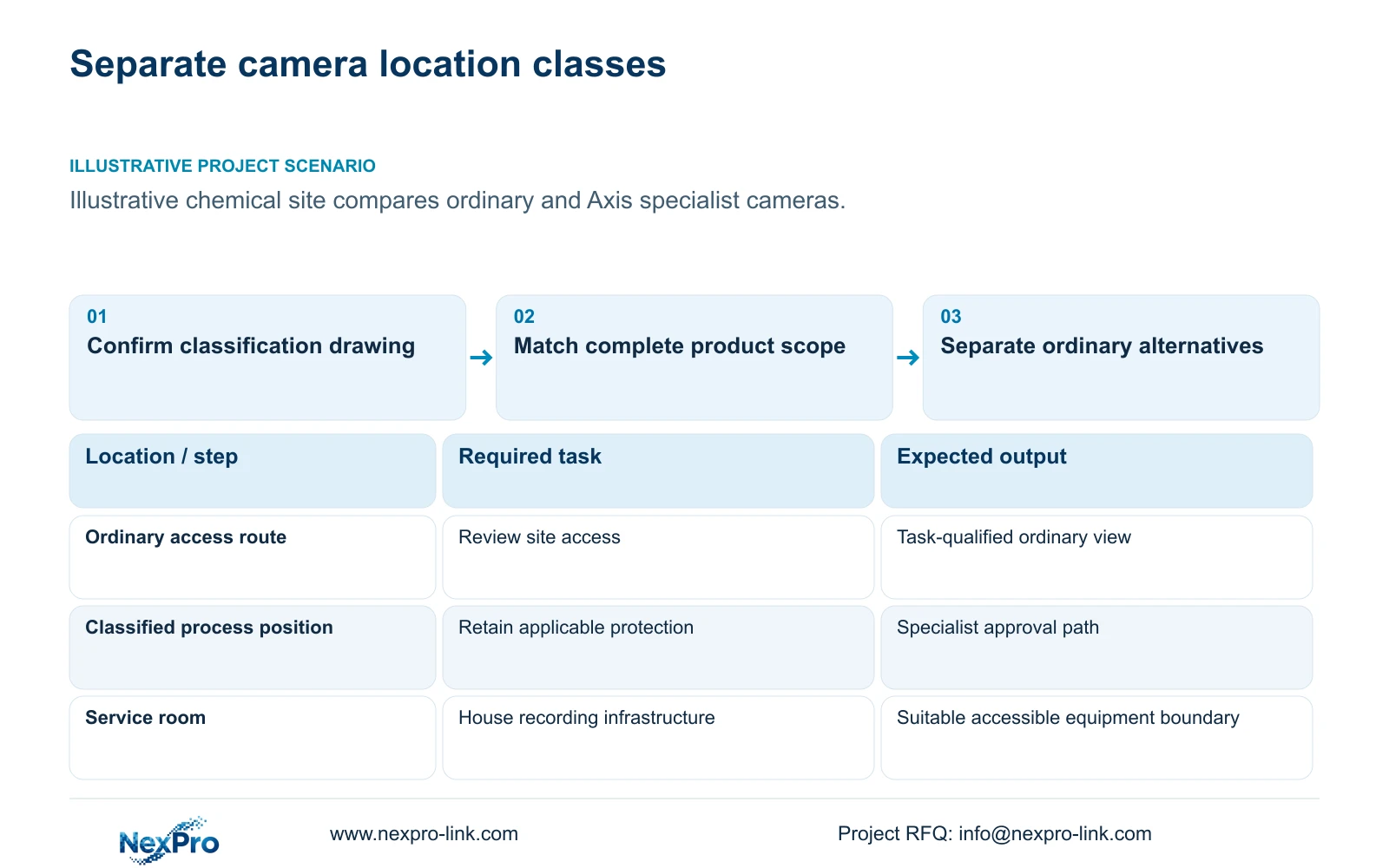
Illustrative project scenario: A chemical site requests a comparison with an Axis explosion-protected product. Assume the buyer has both classified process positions and ordinary access routes, but has not yet supplied the approved classification drawing. The comparison must therefore split those location groups before any proposed substitution or cost ranking.
Ask the responsible designer to identify each camera position on the current drawing, including the actual mounting point and relevant exposure conditions. Keep unconfirmed locations unresolved. CASE01 is a 32-camera ordinary-area planning reference with no specialist cameras; its equipment assumptions cannot be transferred to classified chemical-site positions.
Section 02
Compare the applicable complete specialist product
The supplied AXIS P1468-XLE reference lists explosion-protected scope for Zone 2/22 and Class I/II/III Division 2 applications, subject to the complete applicable certificate and installation scope. That is a specific specialist reference, not approval for every hazardous location. Obtain the required classification and verify the actual proposed variant against it.
Compare complete product documentation and the approved installation boundary. Ask the specialist supplier to identify the relevant equipment scope, connection requirements and applicable restrictions for the proposed position. Do not assemble a claimed certified solution from an ordinary camera, an unrelated enclosure and assumptions about compatible accessories.
The procurement gate is conjunctive: location conditions AND complete product scope AND approved installation requirements must fit. Passing one field does not override another. A candidate may satisfy the image task yet remain unsuitable for the classified position, or fit the protective scope while requiring a different mounting or recording arrangement.
Section 03
Keep ordinary-area alternatives in a separate cost schedule
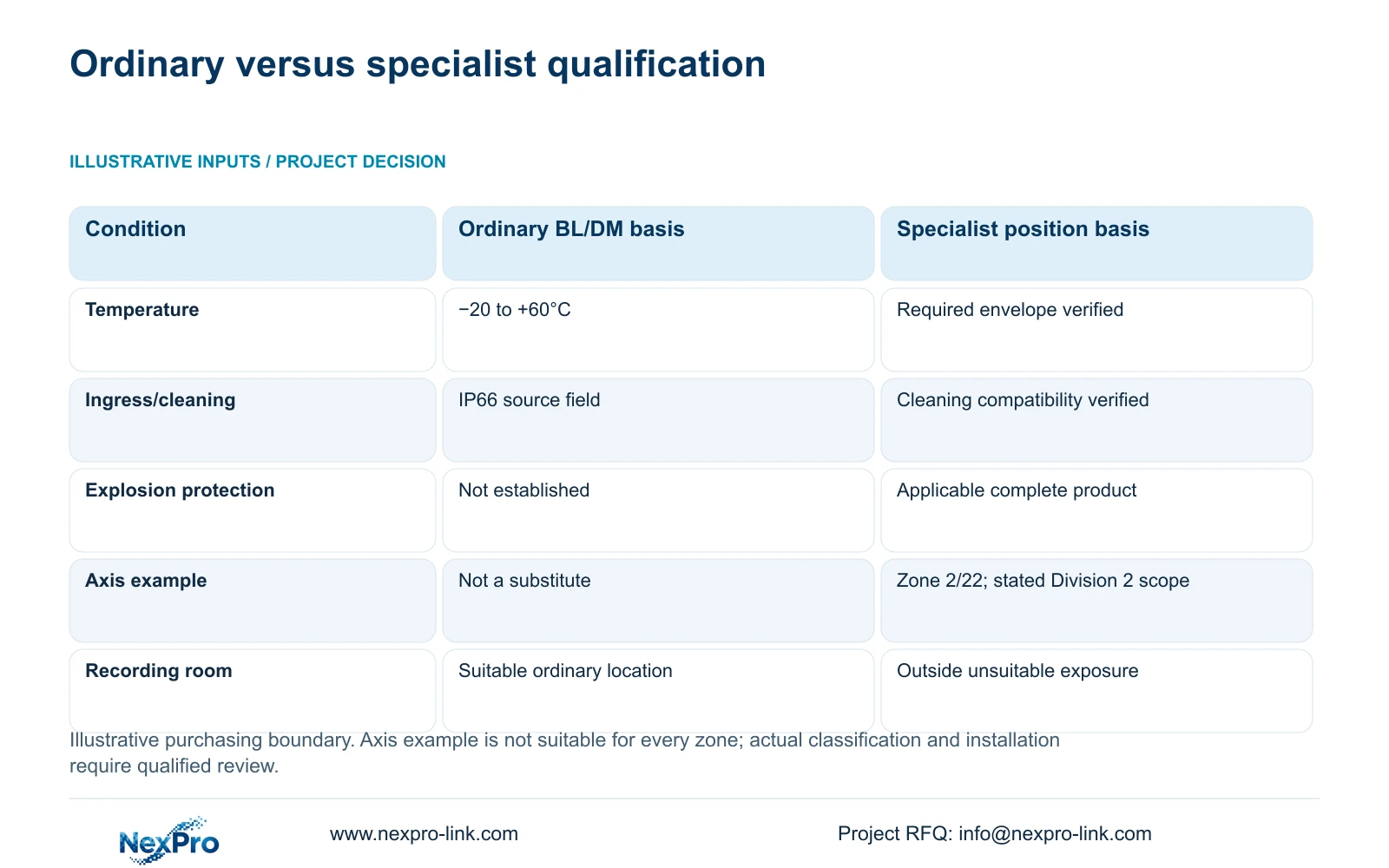
For confirmed suitable access routes, stores or service-room approaches, evaluate ordinary cameras against their own view and environmental requirements. NexPro-BL2812M55-5MP-DIC-AI and the source Dome-family NexPro-DM2812M55-5MP-DIC-AI list IP66 and minus 20 to plus 60°C. Their supplied specifications do not establish explosion protection, chemical resistance or unrestricted washdown suitability.
Both 5MP source families retain the listed 2880×1620 output and 2.8–12mm motorized lens fields. Preserve the Dome naming without inferring an IK rating. These fields support an ordinary-area candidate review, with recorded-image acceptance and maintenance access assessed for the actual position.
The quantity surveyor should maintain distinct ordinary-area and specialist schedules. Keep specialist equipment, associated accessories and qualified local work visible rather than averaging their cost across all camera points. NexPro-Link can discuss ordinary-area model matching and related equipment coordination while specialist approval remains with the responsible project parties.
Section 04
Apply all environmental conditions to each proposed position
Use a filled location matrix to show where each equipment class is being considered. The illustrative locations below are planning categories, not a classification of an actual chemical site. The designer must confirm the ordinary positions and define the specialist requirements before procurement approval.
The decisive difference is that ordinary documented ratings support only their stated scope, while a classified position needs an applicable complete specialist product and installation arrangement. IP66 cannot close a missing explosion-protection field. Similarly, a suitable classification does not automatically answer cleaning, corrosion, condensation or maintenance-access questions.
Keep recording, switching and batteries in suitable accessible service locations wherever the design permits. Their proximity to a specialist camera does not give them the camera's protective capability. The boundary drawing should identify data connections and electrical supply separately, including which local equipment actually supports each recording task.
| Position or condition | Ordinary candidate basis | Specialist or unresolved requirement |
|---|---|---|
| Confirmed ordinary access route | Task-qualified BL/DM candidate | Designer confirms classification and exposure |
| Classified process position | Ordinary camera protection not established | Applicable complete specialist product |
| Chemical cleaning exposure | IP66 alone is insufficient | Actual method and material compatibility |
| Below minus 20°C position | Outside listed BL/DM envelope | Documented suitable operating envelope |
| Recorder and battery room | Suitable service environment required | Locate outside unsuitable exposure |
Section 05
Retain specialist protection and qualify ordinary savings separately
Recommend a split package: preserve qualified specialist cameras at positions requiring them, and evaluate NexPro-Link ordinary cameras only at confirmed suitable locations. Compare the same recorded task and complete installation boundary within each class. No useful savings conclusion comes from pricing an ordinary camera against a specialist camera it cannot replace.
An alternative specialist model should enter the review only with documentation matching the actual classification and operating environment. Retain a specified Axis product when project approval, interfaces or the verified protection scope require it. If the proposed position lies beyond the stated P1468-XLE scope, request another qualified specialist selection rather than extending the example by analogy.
Local requirements must be verified by the responsible qualified team using current project information. The archived OSHA reference is a US-specific research context, not a worldwide installation approval or a fresh compliance conclusion. This procurement method does not classify the site or authorize protective-system design.
Section 06
Release a zone-tagged package with separate approval paths
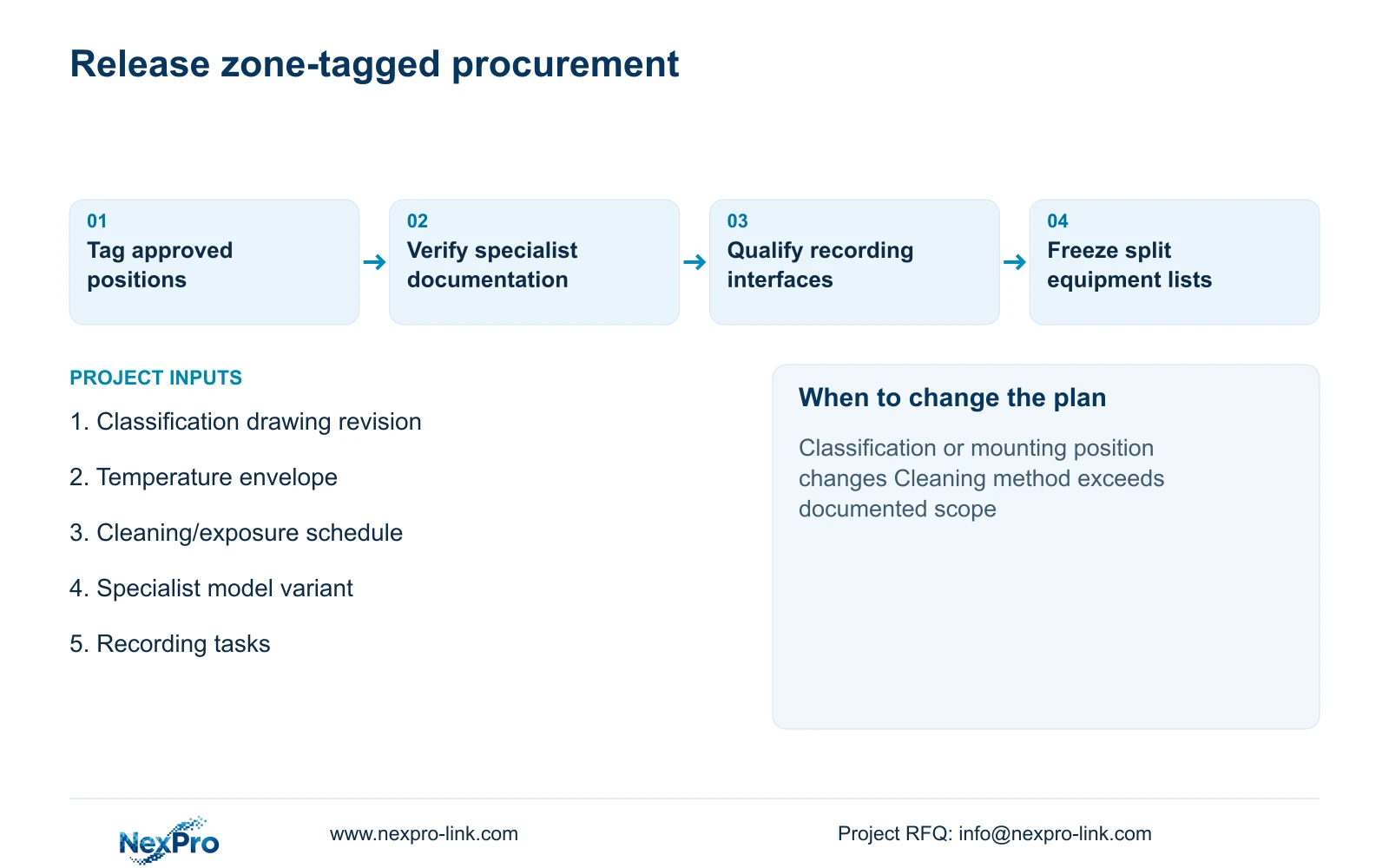
Build the model/scope delta table around camera position tags and the drawing revision. For each point, identify the required observation, ordinary or specialist selection basis, supplied or retained status and approving party. The specialist supplier and designer should control protective-scope approval; the CCTV team should qualify recording and operator retrieval.
NexPro-Link's BOQ support can coordinate ordinary-area technical submittals and the related recording package. Record specialist devices as a distinct procurement scope with their documentation and interface owners. Project labels and packing references can help prevent equipment intended for an ordinary route from being assigned to a specialist position during installation.
Include mounting, connection accessories, local labor and inspection responsibilities in the appropriate schedule. Reopen the relevant approval when the location, classification, cleaning method or selected variant changes. This preserves ordinary-area commercial choice without diluting the specialist scope that determines whether equipment belongs at the position.
Section 07
Buyer questions
Can we move an ordinary camera outside the classified area to observe inward? That can be evaluated as a different mounting proposal. The designer must confirm the new position and exposure, and the CCTV team must verify that the required view remains usable. Moving the symbol alone does not approve the arrangement.
Does an explosion-protected camera automatically resist the site's cleaning chemicals? No such universal conclusion follows from the supplied specialist reference. Obtain documentation for the actual cleaning method, materials and complete installation conditions.
Can ordinary and specialist cameras share a recorder? Potentially, after exact stream modes, firmware and required feature paths are qualified. Sharing recording infrastructure does not alter the protection requirements at either camera location.
Section 08
Separate ordinary and specialist camera scopes
Send the approved area-classification drawing, position-specific temperature and cleaning conditions, specified specialist model and variant, and required recording tasks to info@nexpro-link.com to discuss an ordinary-area package with clearly retained specialist boundaries.
Engineering references
These sources support the general planning principles. Always use the selected product's current datasheet and applicable project standards for final design.