Explosion-protected CCTV procurement needs evidence for the complete offered configuration. Compare product identity, entries, interfaces and installation conditions without assuming an enclosure certificate transfers to its contents.
Section 01
Identify the complete configuration being offered
Explosion protected CCTV procurement should compare complete applicable products and approved installation details. Do not assume certification transfers to an arbitrary camera-and-housing combination. Begin with the exact model and variant, the configuration covered by its documentation and the actual location requirement. Keep ordinary recording and backup equipment in suitable service areas where practicable.
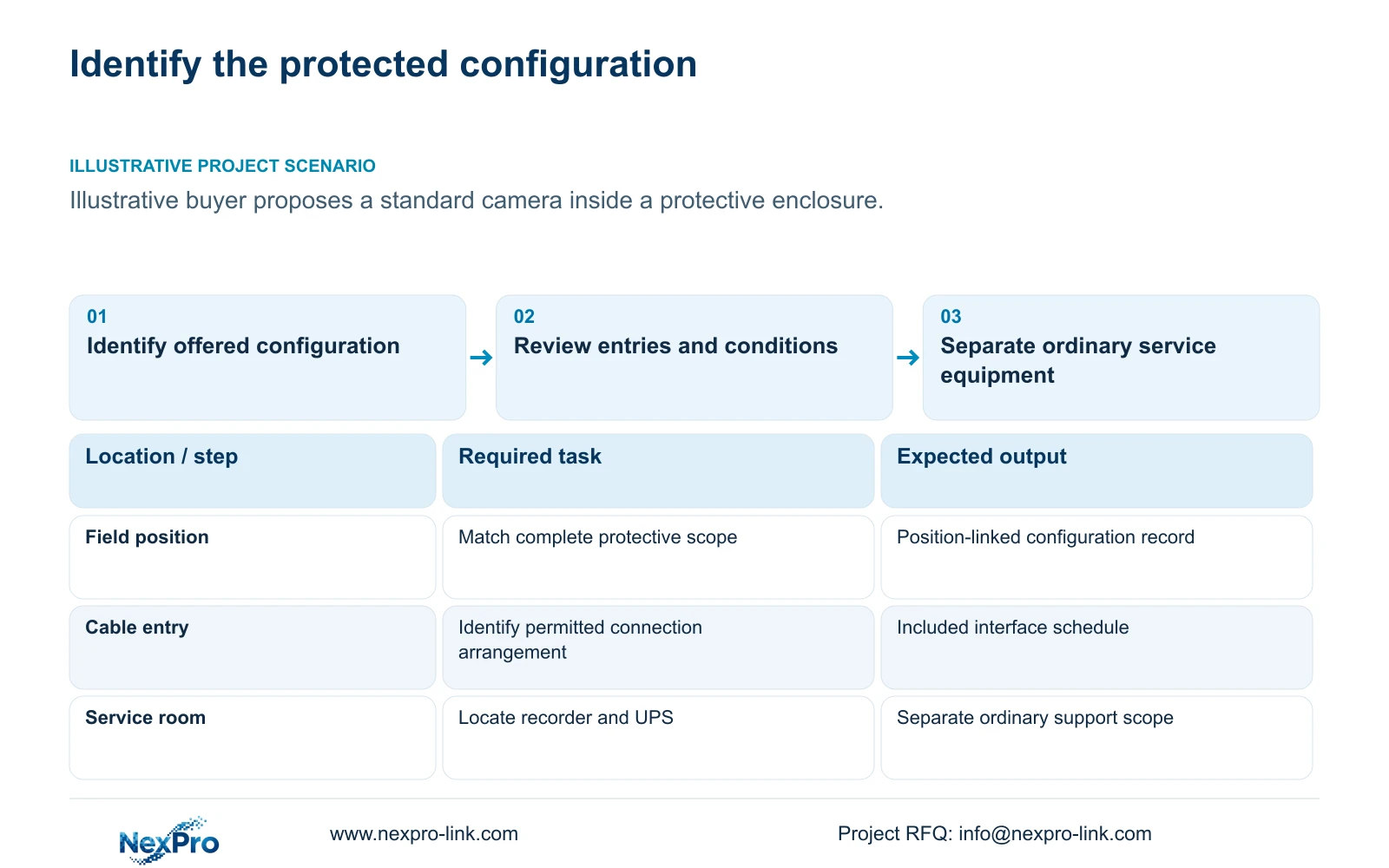
Illustrative project scenario: A buyer proposes placing a standard camera into a protective enclosure to reduce cost. Assume the quotation names a camera and an enclosure separately but does not identify a documented complete assembly. This is an unresolved procurement alternative, not an approved conversion or a demonstrated saving. The engineer should request the configuration basis before allowing its price into an equivalent-offer comparison.
Match the offered identity across the quotation, technical submittal, product marking and installation documents. Record which supplier accepts responsibility for the complete arrangement. If those documents describe different variants or leave the installed contents unspecified, retain the item as unresolved. A recognisable housing shape, metal construction or catalogue protection label cannot answer which configuration is actually being supplied. IECEx's equipment-scheme overview distinguishes a certificate for complete Ex equipment from a component certificate; a component requires further certification when incorporated. For an IECEx offer, check the certificate type and exact configuration, not just the issuer's name. Other approval schemes need their own applicable review.
Section 02
Include entries and installation conditions in the review
Ask the responsible specialist supplier to identify the permitted cable entries, connection requirements and installation conditions for the exact configuration. The qualified designer should reconcile those requirements with the route and location drawing. Procurement needs a complete schedule of included and excluded items, so entries and interfaces do not appear later as generic accessories chosen independently of the protective basis.
Document environmental limits and maintenance conditions alongside the protection information. An enclosure can change the operating conditions experienced by its contents, so the camera's standalone temperature range is insufficient to qualify an undocumented combined arrangement. The supplier must provide the applicable complete basis rather than asking the buyer to infer suitability from individual component data.
A changed cable route, connector or mounting arrangement can reopen this review even when the camera name stays unchanged. Keep those changes linked to the same position and configuration revision. Local requirements and the current approval basis need confirmation by the responsible project team. This purchasing review does not specify barrier wiring, enclosure assembly or a certified installation method.
Section 03
Separate specialist field equipment from ordinary service racks
The supplied reference case separates 32 ordinary cameras and eight specialist positions, with a local recording node. Use that structure to distinguish the field protective scope from ordinary recorder, switch and UPS infrastructure. Their suitable location, cooling and maintenance access still need confirmation; a protected field camera does not qualify the service rack for the same environment.
Draw data and power separately. The permitted camera interface connects through the approved network arrangement to recording and authorised viewing. The UPS supplies only equipment on its actual protected circuit. If a remote access node has an independent mains supply, a central UPS does not protect it merely because the node appears on the same network diagram.
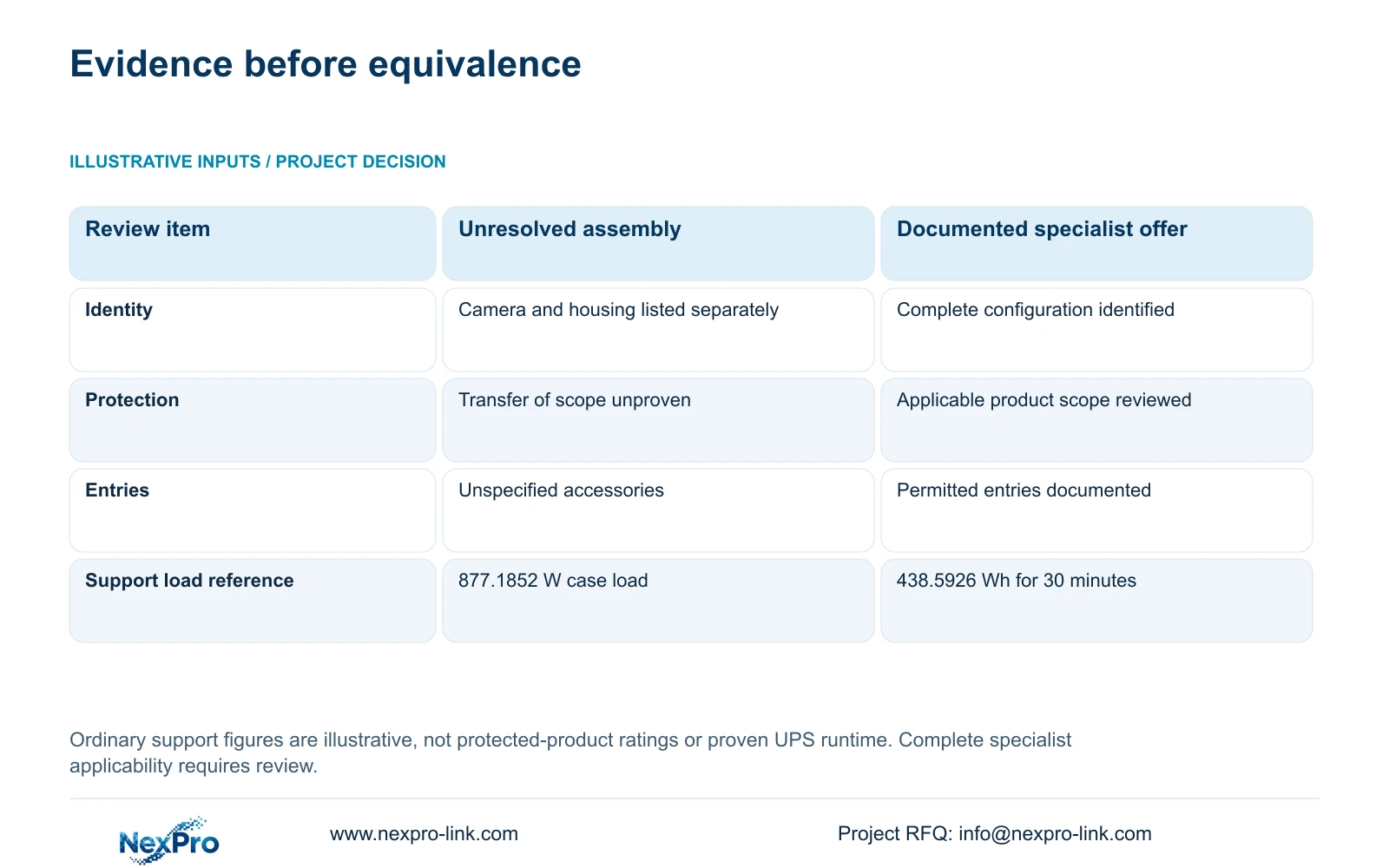
The reference assumes a recording-priority AC load of 877.1852 W and a 30-minute objective, corresponding to 438.5926 Wh at the load. Its SP2KR(S) candidate has quoted 2kVA/1800W capacity. These are distinct fields: the load and energy are illustrative design inputs, while capacity is a model reference. Actual battery configuration and runtime evidence are still required; load-side Wh does not prove achieved backup duration.
Section 04
Apply qualification gates to the complete offered scope
The supplied rule requires location conditions AND complete product scope AND approved installation requirements to fit together. Use that conjunction to compare a documented ordinary package for suitable locations with the specialist package required at classified positions. An undocumented camera inside a separately certified enclosure remains a third, unresolved proposition; it should not inherit the specialist column's acceptance.
Ordinary BL2812M and DM2812M references list IP66 and minus 20 to plus 60°C. Those documented fields can be relevant to ordinary service locations, but they do not establish explosion protection, chemical resistance or cleaning compatibility. Their image specifications, including the listed 2880×1620 5MP-family output, also cannot fill a missing protective scope.
AXIS P1468-XLE illustrates a specialist product with stated Zone 2/22 and Class I/II/III Division 2 applications. Match the exact applicable documentation and installation conditions to the location rather than extending that reference to every classified area. The decisive difference in the table is the complete protective basis. No price weighting or favourable camera feature can compensate for an unresolved qualification gate.
| Review gate | Ordinary package | Specialist package |
|---|---|---|
| Temperature | Listed model envelope verified | Complete configuration envelope verified |
| Ingress and cleaning | IP66 plus exposure assessment | Actual materials and cleaning requirements |
| Protective scope | No explosion protection established | Applicable complete product documentation |
| Entries and installation | Suitable ordinary connection arrangement | Documented permitted entries and conditions |
| Rack location | Suitable accessible service area | Ordinary racks separately located and qualified |
Section 05
Compare lifecycle responsibilities before the camera price
Recommend a documented complete specialist product for the required positions, or another complete arrangement accepted through the responsible design process. Keep ordinary cameras and support equipment as a separate supply scope. A proposed assembly may remain under review if its supplier can provide the relevant complete evidence, but it should not be treated as equivalent while that evidence is missing.
Compare the same observation task, recording interfaces, installation services and maintenance responsibilities. Include the documentation, permitted replacement configuration and service access in the offer. A lower equipment subtotal can omit specialist installation or configuration responsibility, so unresolved exclusions should remain visible to the cost team. There are no matched quotations here to establish a saving.
Define how replacement parts will be controlled. The supplier should identify which configuration must be preserved and which changes require review; procurement should not replace a camera or entry item solely because it fits physically. CCTV remains a security system under this scope and does not become a safety instrumented system or validated process recorder through protective product selection.
Section 06
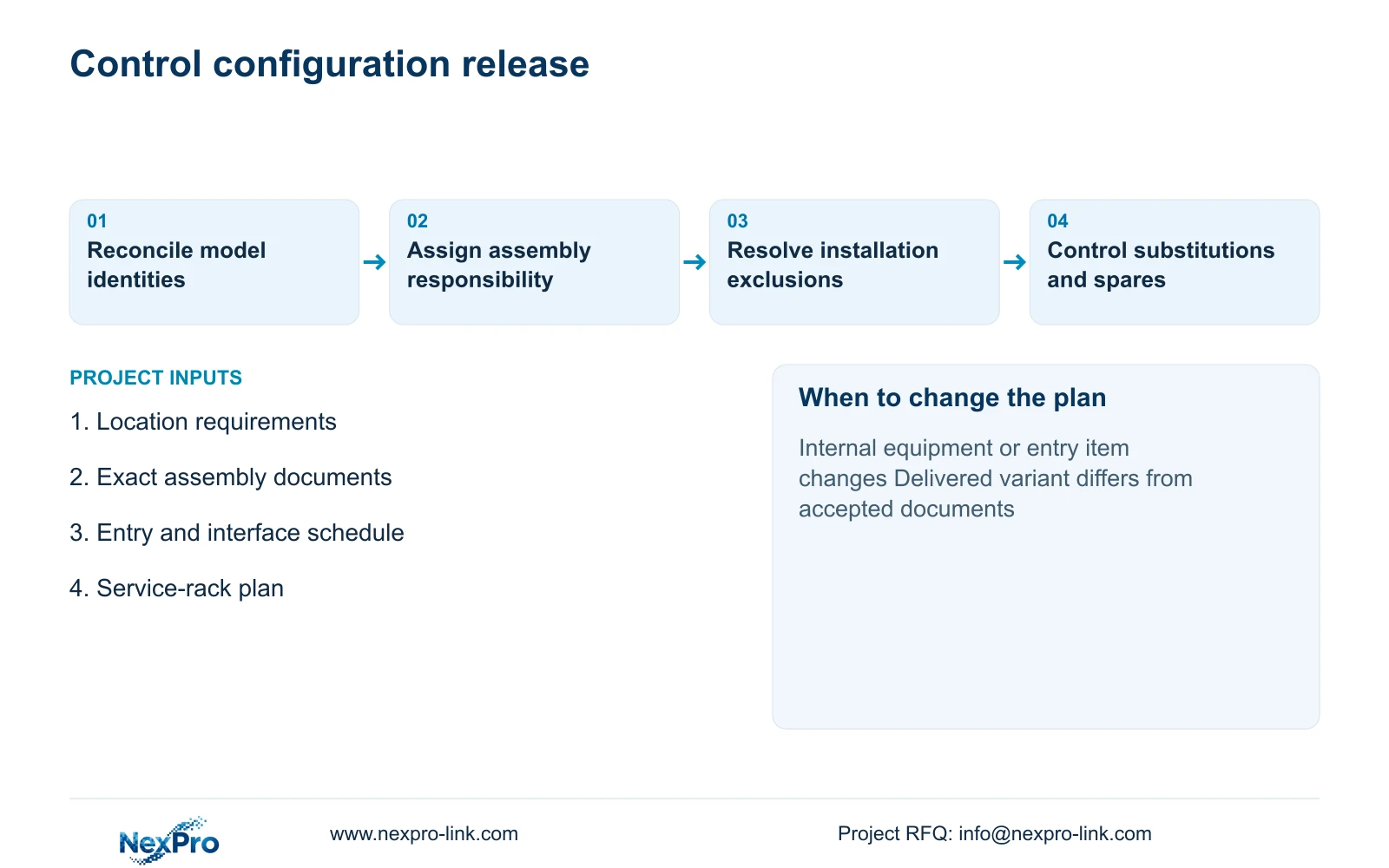
Release the order against a configuration record
The order package should connect each specialist position to an exact configuration and its accepted documentation. Separate unresolved items from approved purchase lines. The local designer and installer retain the location and installation approval responsibilities assigned by the project. Supplier coordination should make those boundaries easier to follow, not imply that a single quotation grants approval for the complete site.
NexPro-Link can support the ordinary security schedule, model matching, technical submittals and related project equipment coordination. Keep any separately specified specialist supply clearly identified. Packing labels may carry position references, but they must preserve product identification and avoid implying a new protective rating. Optional branding is subordinate to the configuration and traceability requirements accepted for the item.
Before release, reconcile the delivered identity, accessories and installation instructions against the approved record. Repeat that reconciliation for substitutions and later replacement orders. If the camera contents, entries, route or service-rack location changes, reopen the affected review before treating the configuration as unchanged. This gives procurement a concrete stopping point without inventing a universal enclosure-conversion recipe.
Section 07
Buyer questions
What should procurement do with an enclosure-only certificate? Identify exactly what it covers and request the complete offered configuration basis. Keep the camera assembly unresolved until the responsible supplier and designer establish its applicability.
Can ordinary recorder and UPS equipment support specialist cameras? They may form a separate support scope in suitable locations when the selected interfaces, power arrangement and recording workflow are accepted. The specialist camera's protection does not extend to them.
Does replacing an internal camera with a similar model preserve the arrangement? Do not assume so. Reconcile the replacement with the documented permitted configuration and obtain the review required by the responsible supplier and project designer.
Section 08
Review the complete offered configuration
Send the location requirements, exact proposed assembly documents, entry/interface schedule and service-rack plan to info@nexpro-link.com to discuss the ordinary support and separately specified specialist scope.
Engineering references
These sources support the general planning principles. Always use the selected product's current datasheet and applicable project standards for final design.