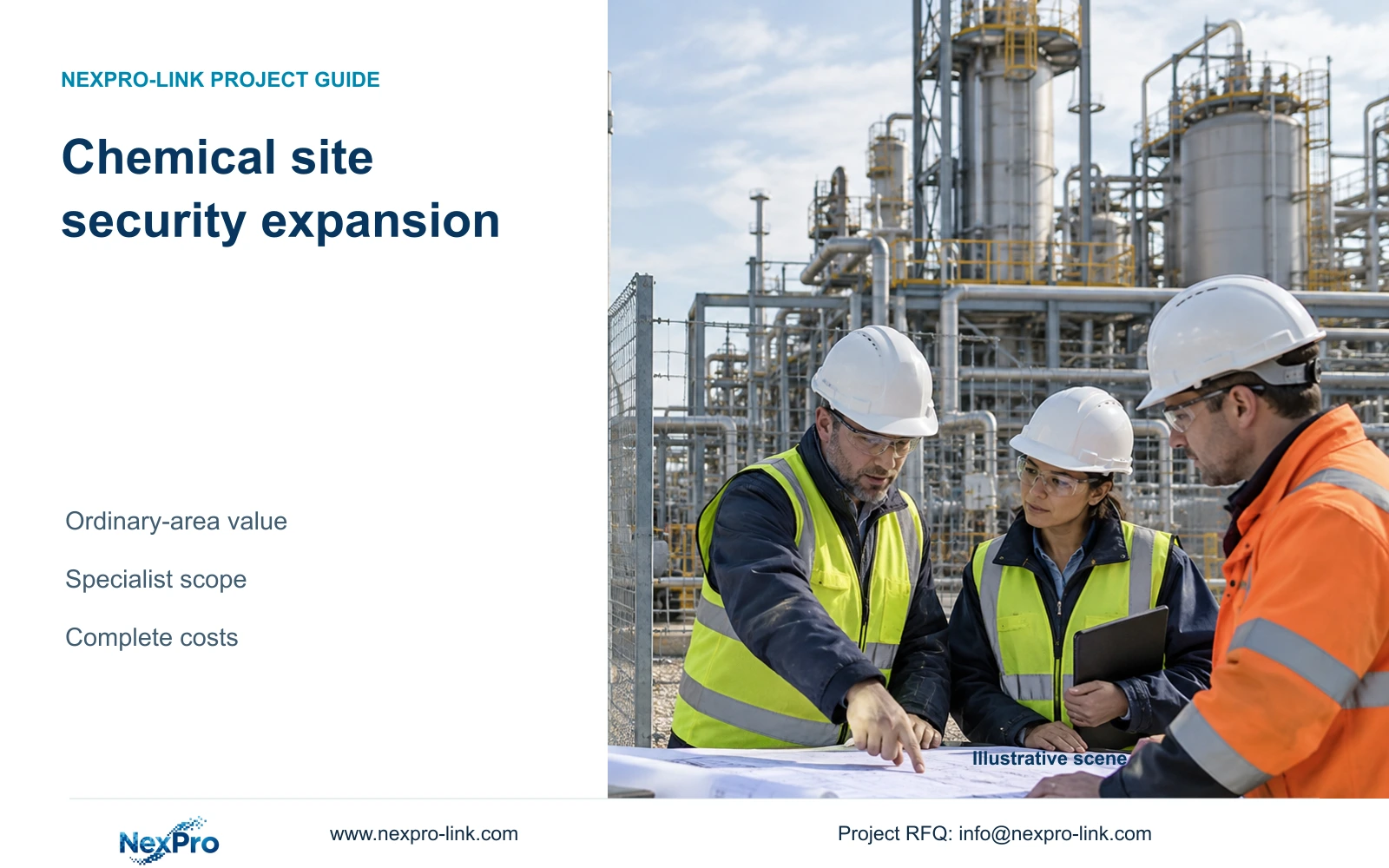
A chemical site's new warehouse can use a separately priced ordinary security package while specialist equipment remains intact. Compare reuse evidence and complete costs before choosing an alternative.
Section 01
Protect mandatory scope before seeking savings
Reduce chemical site security expansion costs by comparing the independent ordinary-area package and documented reuse opportunities. Keep specialist equipment requirements, required interfaces and installation responsibilities intact. A lower ordinary camera price is useful only when the resulting package still delivers the accepted security views, recording period and operator workflow.
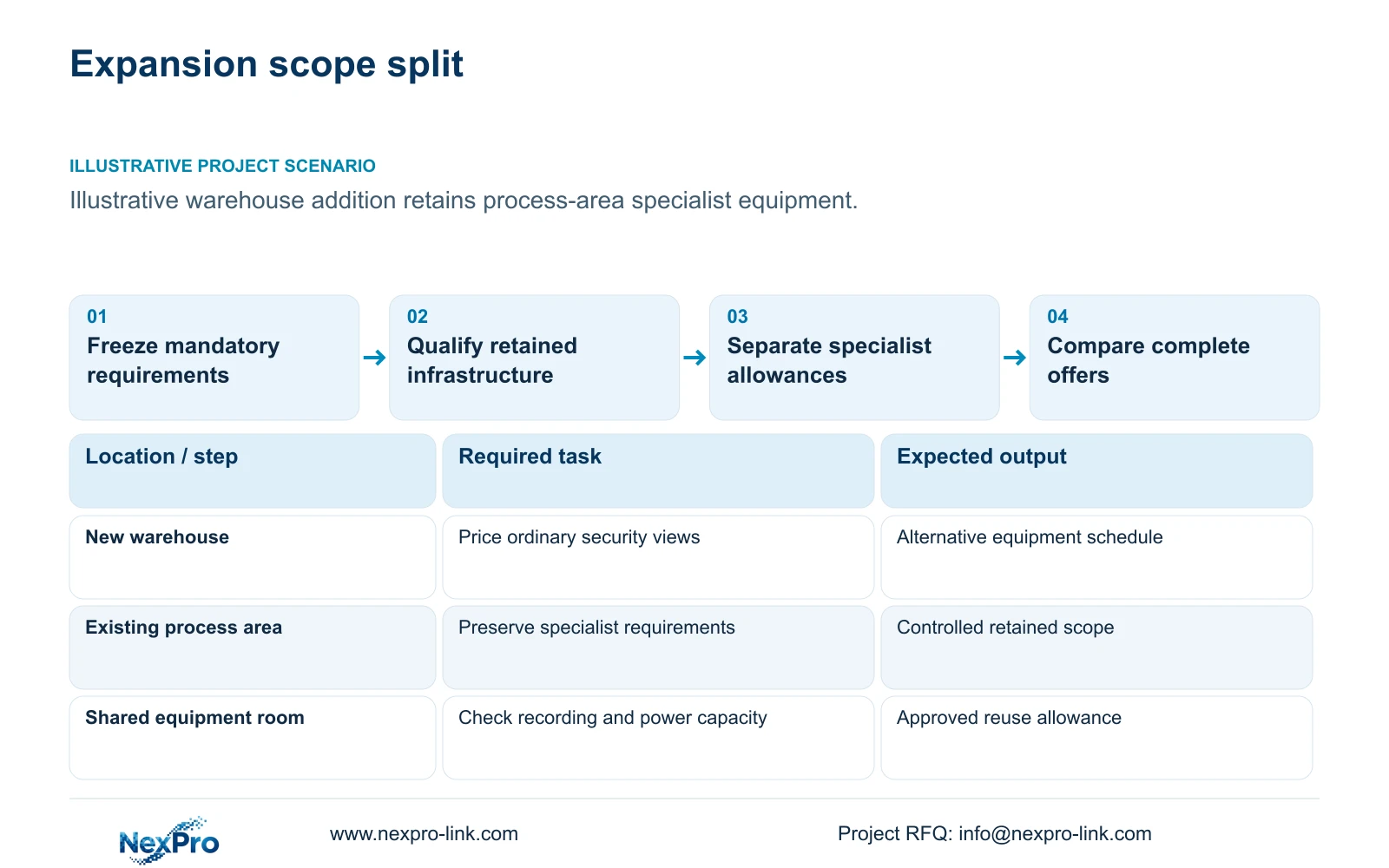
Illustrative project scenario: A site adds a normal warehouse while retaining certified equipment near existing process areas. Assume the owner permits alternatives for warehouse security equipment but requires the existing specialist scope to remain unchanged. CASE07 provides a reference division of 32 ordinary positions and eight specialist positions. It is a hypothetical 40-camera package, not evidence that the expansion needs those quantities or that retained equipment has passed inspection.
Give each BOQ requirement a status: mandatory performance, approved retained asset, proposed new supply or separately priced option. Use the current classification drawing and exposure conditions to establish where ordinary candidates may be considered. A monitoring wall can be an option if a normal operator screen meets the task; required protection at a specialist location cannot be removed to fund it.
Section 02
Price reuse only after checking the dependency
List the existing links, switch ports, recording resources and viewing clients proposed for reuse. Assign an evidence requirement to each asset: cable test record, available PoE budget, accepted stream mode or demonstrated client workflow. Price inspection and any remedial work explicitly. An existing item should remain a provisional reuse allowance until its condition and capacity are accepted.
CASE07 assumes all 40 cable links are new, totaling 2,340 m with a feasible eight-reel cutting plan using 305 m reels. It contains no saving from retained cabling. For this expansion, replace that assumption with surveyed routes and approved retained links. Separate permanent links from patch cords and select the appropriate test configuration; the supplied Fluke guidance distinguishes typical 90 m permanent links from 100 m complete channels.
Recorder reuse needs more than vacant channels. CASE07 assumes 40 compatible streams at 4 Mbps each, giving 160 Mbps input. Thirty days of continuous recording requires 51.84 TB of video through cameras × average_Mbps × 10^6 × 86400 × days / 8 / 10^12. Its 72 TB raw installation gives 54.72 TB recording budget after 0.95 formatting and 0.80 reserve factors. Check actual occupied storage and modes before assigning any expansion capacity.
Section 03
Keep specialist allowances and responsibilities visible
Separate specialist supply into identifiable lines for equipment, mounting and connection accessories, installation, documentation and acceptance. The responsible designer determines the complete applicable scope. If the existing specialist equipment remains in place, identify whether the expansion changes its viewing destination or network connection, because retained hardware can still require interface work.
Use a scope-status table to prevent a supplier's exclusion from disappearing inside the total. In this illustrative allocation, warehouse equipment is new supply, process-area equipment is retained subject to review, and the display wall is optional. Local work has its own owner. Mark unpriced requirements as unresolved, rather than entering zero and assuming another contractor will absorb them.
Ordinary candidates can be assessed against a view schedule. NexPro-BL2812M55-5MP-DIC-AI lists a 2880×1620 main output and a 2.8–12mm motorized lens, supporting a discussion of framing at suitable warehouse positions. Those specifications do not establish chemical resistance or hazardous-location approval. Any changed location or exposure condition returns to the design team for selection and verification of current local requirements.
| Item | Required task | Scope status | Responsible party |
|---|---|---|---|
| Warehouse cameras | Accepted access and handover views | New ordinary supply | Security supplier and designer |
| Process-area cameras | Preserve approved specialist observation | Retained, subject to review | Specialist designer and site team |
| Existing copper links | Carry accepted data and power | Reuse only after testing | Local cabling contractor |
| Monitoring wall | Additional simultaneous viewing | Optional | Owner and video integrator |
Section 04
Compare complete quotation totals
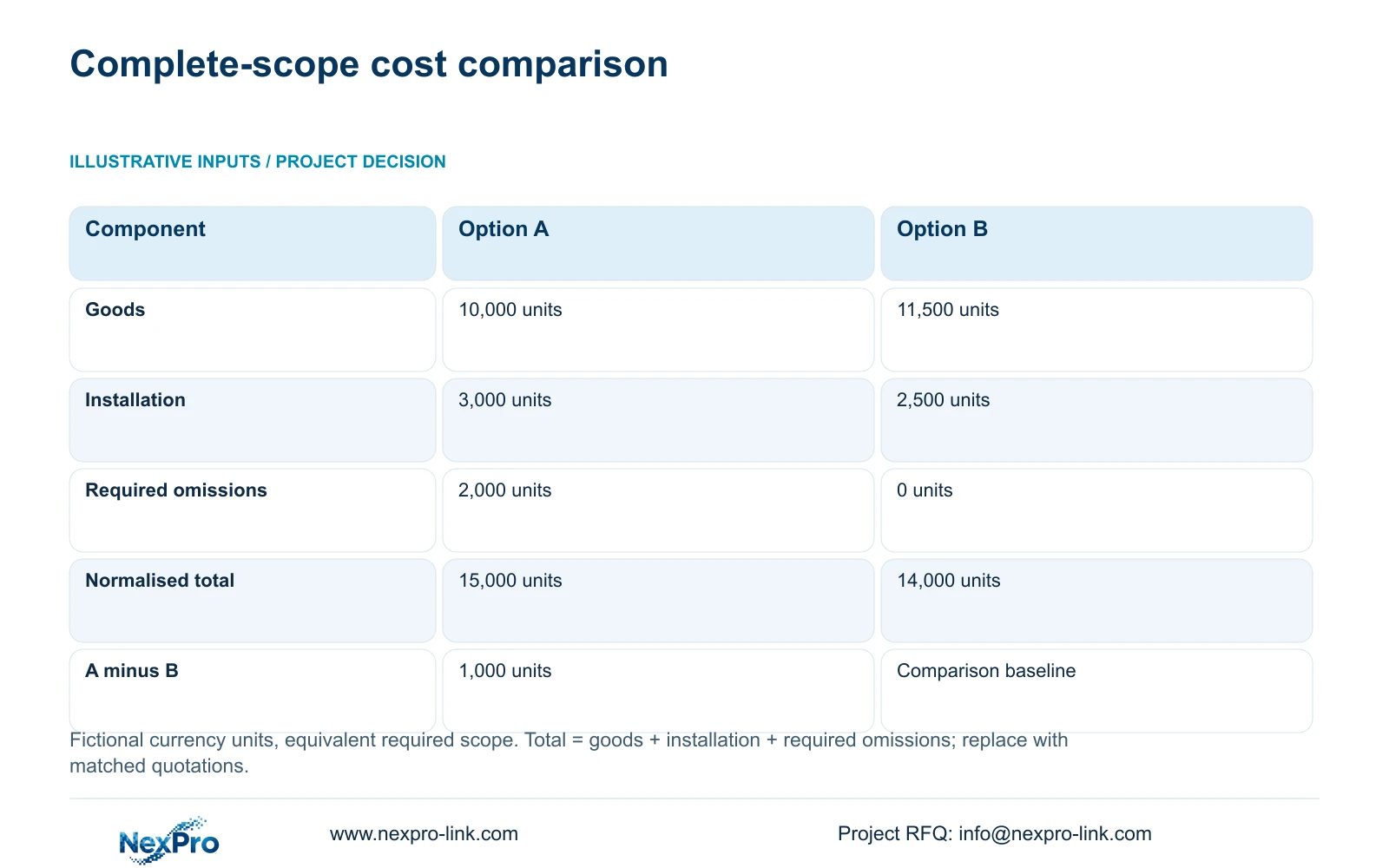
Use the following fictional currency-unit example to examine two equivalent required scopes. Option A quotes goods at 10,000 units, installation at 3,000 and required omitted scope at 2,000. Option B quotes goods at 11,500 units, installation at 2,500 and no omitted requirement in this simplified example. These are teaching inputs, not NexPro-Link or competitor prices.
The formula is normalized_total = goods + installation + required_omitted_items. Option A becomes 10,000 + 3,000 + 2,000 = 15,000 units; Option B becomes 11,500 + 2,500 + 0 = 14,000 units. The difference, A_total minus B_total, is 1,000 units. The lower goods offer therefore becomes the higher complete-scope total once the stated omissions are included.
With those fictional goods and installation inputs unchanged, A reaches B's 14,000-unit total when omitted scope equals 1,000 units. That threshold shows which unresolved allowance matters to the decision. Replace every input with same-date, same-quantity, same-currency quotations covering equivalent delivery and service boundaries. Record freight, exclusions and other commercial differences separately where applicable, and obtain project-specific commercial advice rather than treating the example as tax guidance.
| Cost component | Option A | Option B |
|---|---|---|
| Quoted goods | 10,000 units | 11,500 units |
| Installation | 3,000 units | 2,500 units |
| Required omitted scope | 2,000 units | 0 units |
| Normalised total | 15,000 units | 14,000 units |
Section 05
Select the ordinary package with fewer unresolved dependencies
Recommend an independently priced ordinary-area alternative when the owner permits substitution, accepted views remain achievable and its recording and client workflows are demonstrated. Preserve specialist scope as a controlled schedule. Choose the retained platform instead when a mandatory integration, operator standard or tested migration requirement makes the alternative incomplete.
In the fictional comparison, Option B is preferred on complete-scope cost despite its higher goods subtotal. Real bids need equivalent checks for retention, supported streams, maintenance access and local commissioning. The NexPro-NVR4449-4K reference has 49 channels, 320 Mbps input and four SATA bays up to 18 TB per drive, but its summary separates 49×5MP from 9×4K. Do not value unspecified RAID or simultaneous decoding as included features.
Keep display and backup choices separate from ordinary camera substitution. CASE07 adds four LCD panels and a decoder to its recording-priority option, increasing assumed demand from 877.1852 W to 1,457.1852 W. Its 30-minute load-side energies are load_W × 0.5 h, or 438.5926 Wh and 728.5926 Wh. These figures identify an additional power scope; they do not demonstrate runtime or justify buying a wall without an operator requirement.
Section 06
Issue a divided package with one revision record
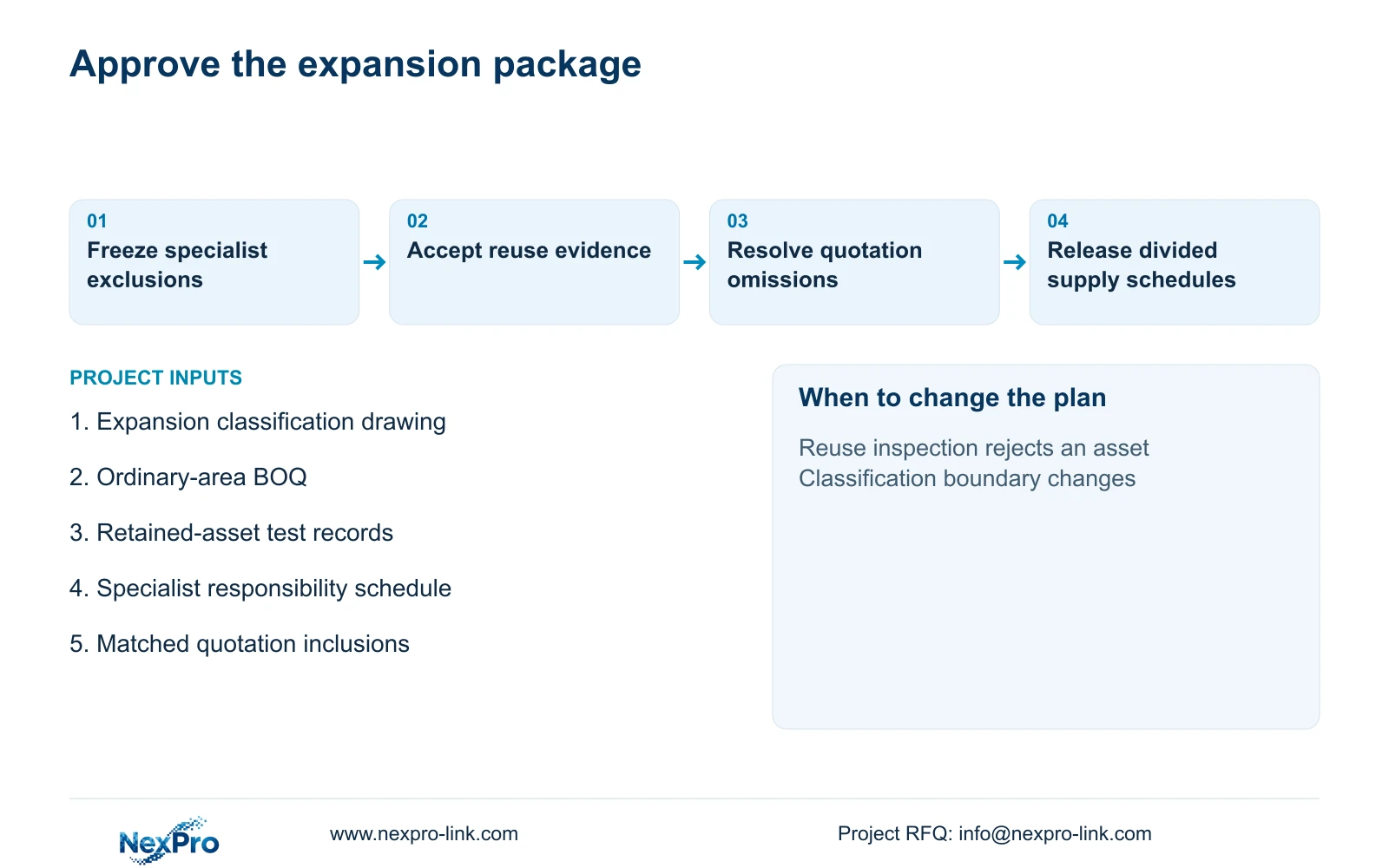
Prepare the RFQ as an ordinary supply schedule, a retained-asset register and a specialist responsibility schedule sharing one drawing revision. Require alternatives to list deviations against each relevant line. The quantity surveyor can then compare substitution effects without losing the installation or interface work that makes the package usable.
NexPro-Link's factory project and BOQ support pages describe equipment coordination, model matching and technical submittal support. Apply that scope to the warehouse package and its supporting records; leave specialist approval and local construction with the assigned parties. Coordinated project labels and packing may simplify equipment allocation, but any preparation service should be priced and described rather than converted into an invented saving.
Reopen affected allowances when classification boundaries move, warehouse storage changes sightlines or reused assets fail inspection. Keep the original accepted requirement visible beside the revision. This lets procurement distinguish a justified scope change from a supplier substitution and avoids cancelling a necessary specialist item merely to preserve an earlier headline budget.
Section 07
Buyer questions
How should an unpriced reuse inspection appear in the comparison? Carry it as an unresolved required allowance with an owner and a pricing deadline. Do not count the asset as a confirmed saving until inspection, capacity and any remedial work are accepted.
Can the new warehouse use a different camera brand from the process area? Potentially, if the owner permits it and the required recording, viewing and maintenance workflows are demonstrated. Keep specialist hardware approval unchanged and identify any cross-system client or licensing work.
What if two suppliers exclude different specialist items? Restore both offers to the same approved specialist schedule before ranking totals. Obtain missing prices from the responsible supplier or contractor, and keep unresolved exclusions visible until comparable totals are available.
Section 08
Request a scope-normalised expansion offer
Send the expansion classification drawing with environmental notes, the ordinary-area BOQ, the proposed retained-asset register, and the specialist scope exclusions to info@nexpro-link.com for an ordinary equipment offer with clearly separated dependencies.
Engineering references
These sources support the general planning principles. Always use the selected product's current datasheet and applicable project standards for final design.