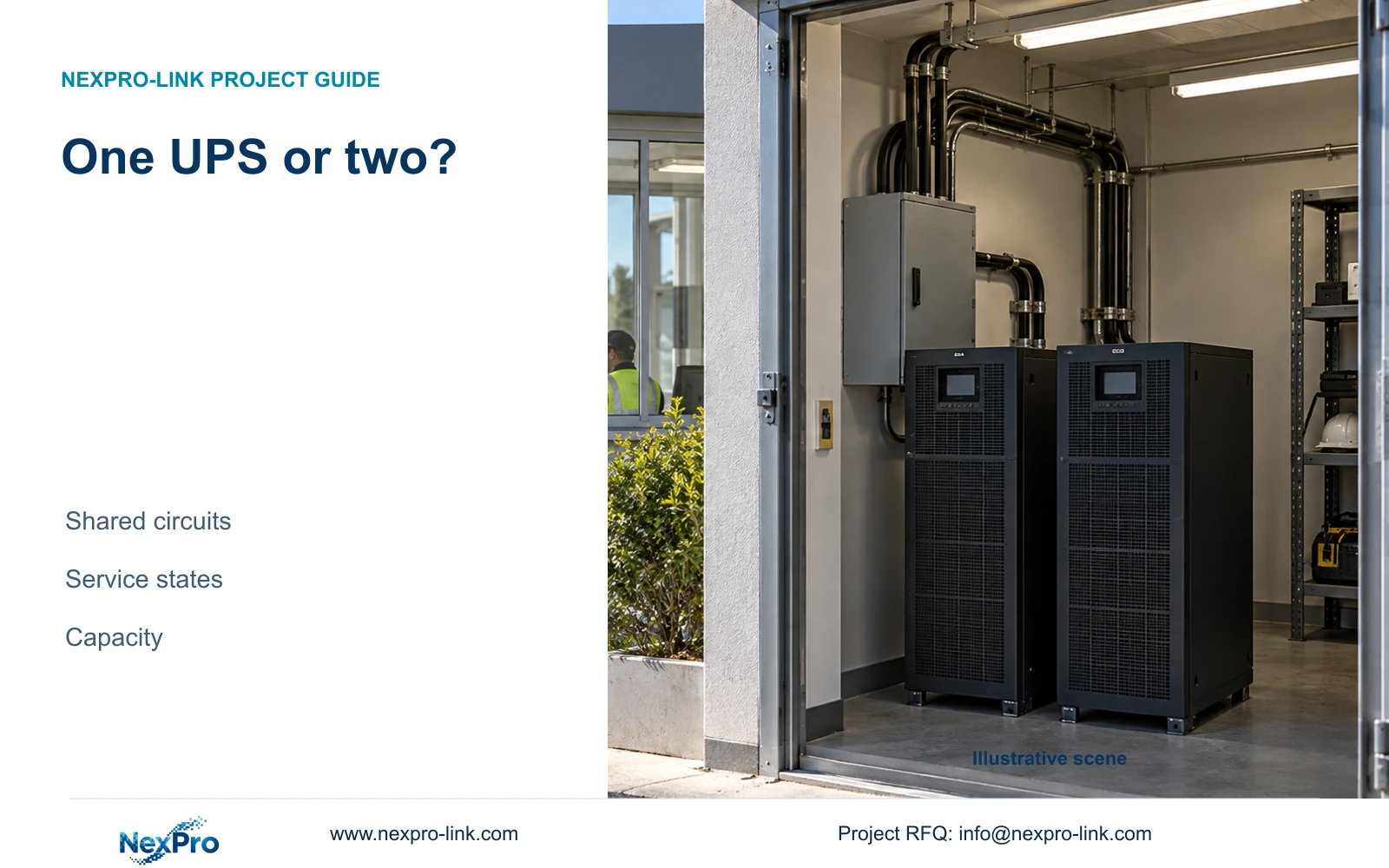
Choosing one UPS or two at a factory gatehouse requires a load-transfer decision and a dependency drawing. Two units on one circuit do not establish full redundancy.
Section 01
Choose the supply arrangement from the required failure response
Use one appropriately sized UPS when the owner accepts a shared supply path and planned service interruption. Consider two units when separating loads or supporting an approved alternative supply arrangement provides a defined benefit. Before calling either arrangement redundant, trace upstream circuits, downstream distribution and the actual method by which a load remains powered after a failure.
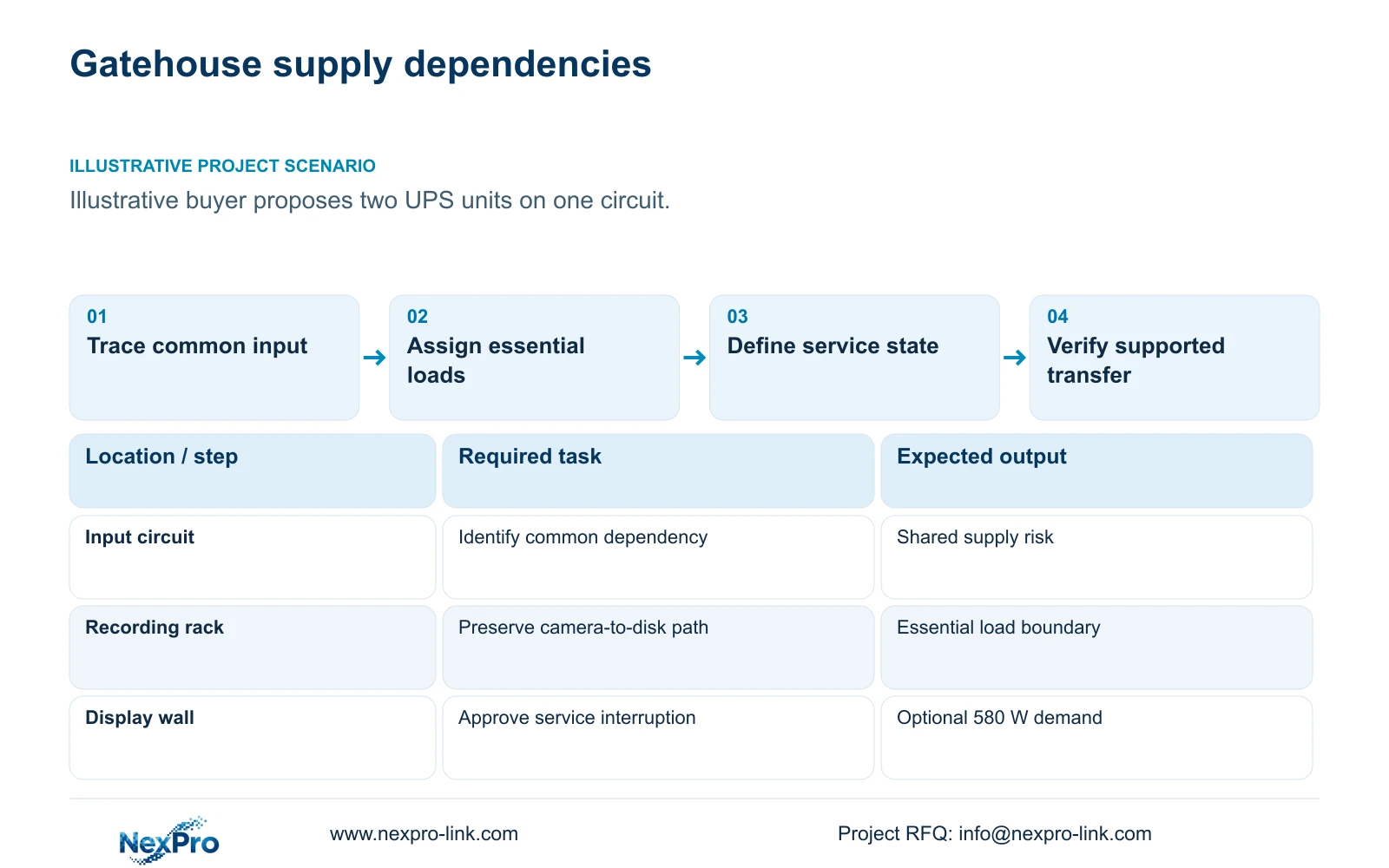
Illustrative project scenario: A factory buyer proposes two UPS units supplied from one circuit and describes the gatehouse as fully redundant. Use CASE01's 32-camera security package as an illustrative load reference, not as a measured gatehouse installation. Assume procurement needs a clear distinction between separating recording and display loads and preserving the same essential loads through UPS failure.
Have the electrical designer identify the common input circuit, protective devices, generator connection and output distribution. The CCTV engineer should identify every switch, recorder and link device needed for the required recording task. Two battery-backed units may address some local conditions while retaining common upstream risks; their mere presence does not establish supported parallel operation or an automatic transfer path.
Section 02
Distinguish split duties from alternative supply paths
A split-duty arrangement can place recording equipment on one UPS and optional display equipment on another. It may make display service less disruptive to recording, provided the data and power dependencies are genuinely separate. It does not make either load redundant: failure of the recording UPS can still stop its cameras and recorder.
An alternative-path arrangement needs exact support for the connected equipment and the approved transfer behaviour. Identify single-input loads, any qualified transfer equipment and the capacity required when one path is unavailable. Do not join UPS outputs or infer parallel capability from equal ratings. Those questions belong to the manufacturer-supported electrical design.
Keep the network path in view. A protected recorder cannot receive cameras through an unprotected switch, and a second UPS does not repair a common failed uplink. The useful decision is therefore which task survives which failure. Label the drawing accordingly, leaving common dependencies visible to the owner and cost team.
Section 03
Size the service state before promising continuity
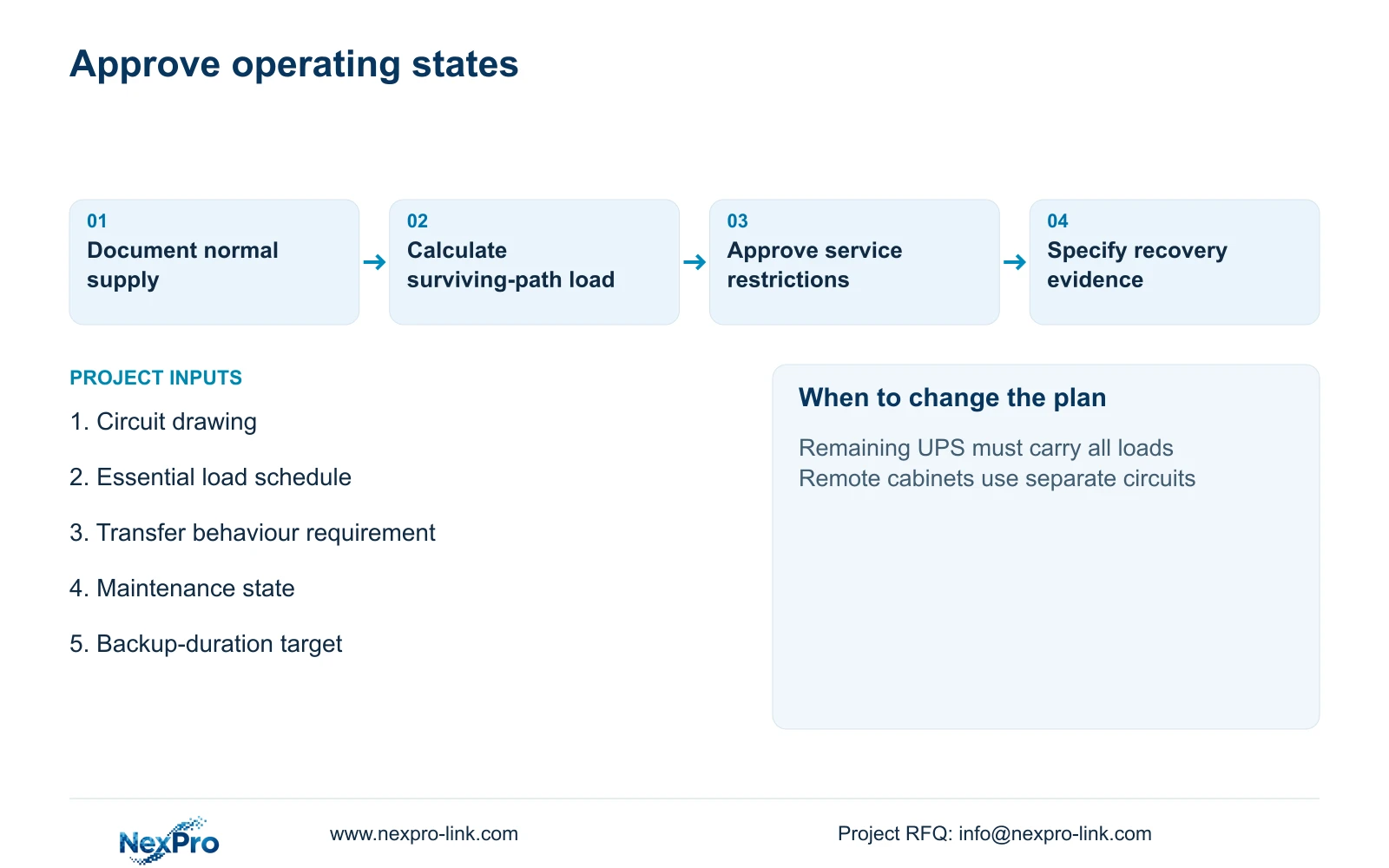
Write a load schedule for normal operation and every proposed maintenance state. If the plan expects one remaining UPS to carry both recording and displays, calculate that combined demand rather than relying on the units' normal split loads. Include distribution and transfer equipment where they consume power or constrain the arrangement.
Alternatively, the owner may permit the display wall to be unavailable during service while retaining the original operator screen and recording path. That is an operational restriction to approve in advance. It requires a supported method and a documented load boundary; it should not be improvised when the service crew arrives.
Assign the electrical service method to qualified personnel, the essential-load decision to the owner and recording verification to the integrator. The maintenance work plan should state what remains powered, what loses battery protection and what evidence confirms recovery. Avoid claiming zero downtime before those conditions have been established.
Section 04
Compare recording-only and display-expanded demand
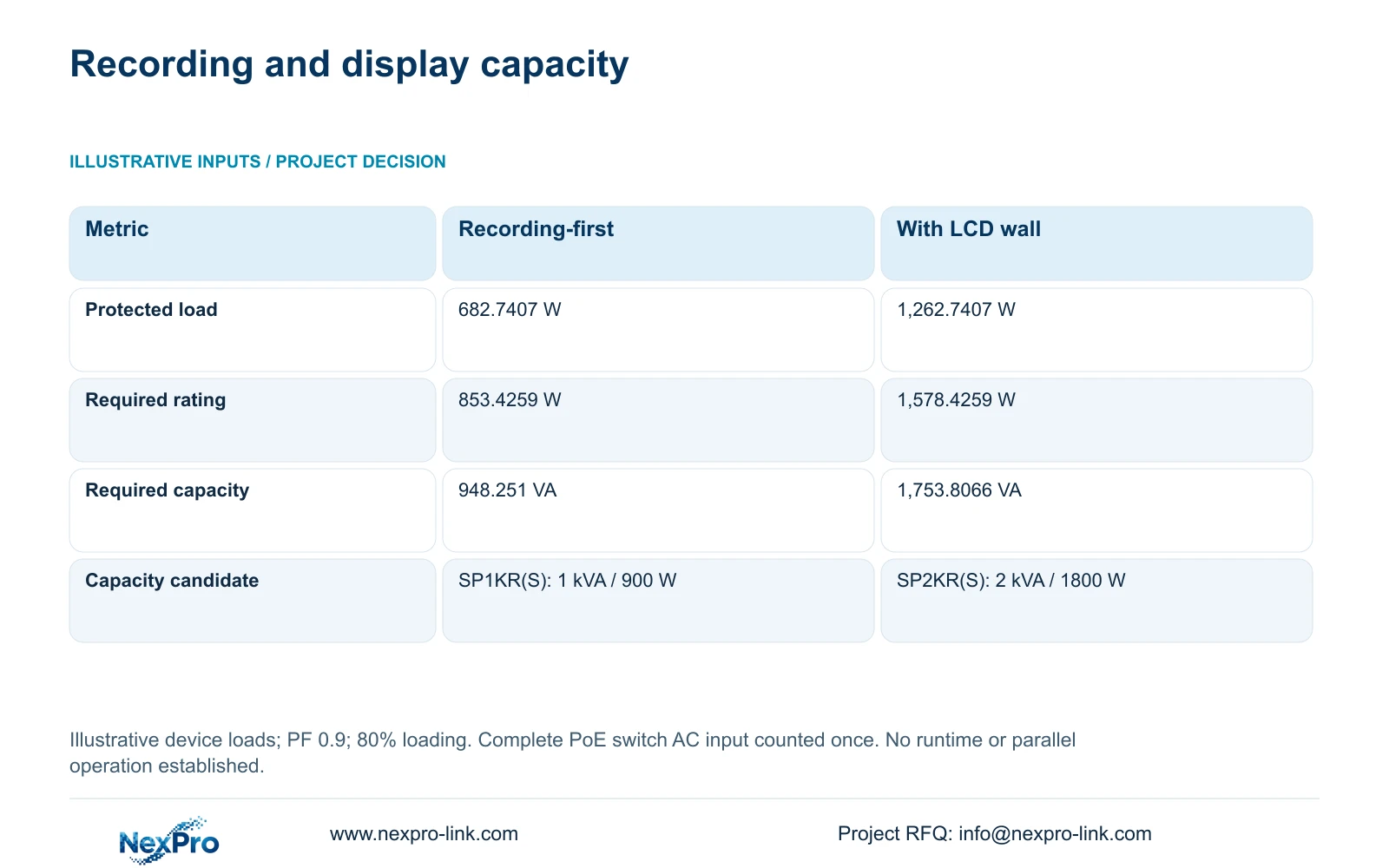
The illustrative inputs are 32 cameras at an assumed 12 W each, four eight-camera PoE groups, 90% cable delivery, 15 W switch electronics per group and 90% PSU efficiency. Complete switch AC demand per group is ((8 × 12 / 0.90) + 15) / 0.90 = 135.1852 W. Add a 30 W recorder, four disks at 8 W each, 25 W core, 15 W router and 40 W operator screen.
Option A totals 682.7407 W. Option B retains that screen and adds four panels assumed at 120 W each plus a 100 W decoder, reaching 1,262.7407 W. The panels are LCD in this reference; their assumed draw is not a published measurement. Because complete switch input already includes PoE delivery, camera watts are not added again.
Using aggregate PF 0.9 and an 80% loading target, required_UPS_W = P_AC / 0.8 and required_UPS_VA = P_AC / (0.9 × 0.8). The table shows the resulting requirements. The decisive difference is the additional 580 W display demand, which changes the capacity candidate and any proposed surviving-unit requirement.
| Metric | Option A | Option B |
|---|---|---|
| Protected load | 682.7407 W | 1,262.7407 W |
| Required rated output | 853.4259 W | 1,578.4259 W |
| Required rated capacity | 948.251 VA | 1,753.8066 VA |
| Capacity candidate | SP1KR(S): 1 kVA / 900 W | SP2KR(S): 2 kVA / 1800 W |
Section 05
Select a complete path with explicit residual risks
For the buyer's proposed common-circuit arrangement, reject the full-redundancy description until the dependency and transfer design supports it. If the objective is affordable recording continuity during mains loss, start with the complete recording-first path and a correctly configured capacity candidate. Add a second UPS only for a documented task, such as separating optional display service.
SP1KR(S) is quoted at 1 kVA / 900 W; SP2KR(S) at 2 kVA / 1800 W. Under the illustrative table, the former is a candidate for A and the latter for B. A plan expecting one SP1KR(S) to carry B cannot meet the stated capacity target. The named models are not assumed to support parallel outputs or any particular transfer equipment.
Change the design when uninterrupted service through UPS failure is required, when remote cabinets use separate mains circuits, or when the generator transition exceeds the verified battery capability. Request exact battery configuration and runtime evidence for each protected path. APC/Schneider's sizing guidance supports treating W, VA and runtime as separate selection questions.
Section 06
Price the operating states and their responsibilities
Issue one schedule covering normal, failed-path and maintenance operation. Mark each load as essential, conditionally retained or permitted to stop. Show the supplying UPS and outlet or distribution responsibility without providing a generic wiring recipe. This gives bidders a common basis for identifying missing transfer, protection or service scope.
NexPro-Link can discuss rack UPS capacity references and coordinated security equipment through its project and BOQ support. Request model-specific documentation alongside the proposed battery and distribution scope. Local circuit design, installation and service authorisation should remain separately assigned in the quotation.
Compare one-unit and two-unit offers on the same accepted recording task, runtime conditions and maintenance behaviour. Include commissioning and post-service playback checks. A cheaper two-box offer with undefined transfer behaviour is not equivalent to a supported continuity design, and a single well-sized unit should not be described as redundant merely because it has sufficient spare watts.
Section 07
Buyer questions
Can two UPS units share one input circuit and still be useful? Yes, for a defined split-load or other supported arrangement. They retain the shared circuit dependency, however, so the benefit must be described by the failures and service tasks addressed rather than as full supply independence.
Does a larger UPS automatically provide longer backup? No. Output capacity and stored energy are different. Compare the exact battery configuration and runtime curve at the accepted load, including the conditions under which that evidence applies.
Can the display wall be excluded during maintenance? It can be an agreed operational restriction if essential viewing and recording remain available through an approved arrangement. Record that state in the service plan and verify the remaining load capacity.
Section 08
Compare a supported gatehouse power scope
Send your input-circuit drawing, essential load schedule, required maintenance or transfer behaviour and backup-duration target to info@nexpro-link.com. NexPro-Link can discuss capacity candidates and the documents needed for a comparable equipment quotation.
Engineering references
These sources support the general planning principles. Always use the selected product's current datasheet and applicable project standards for final design.