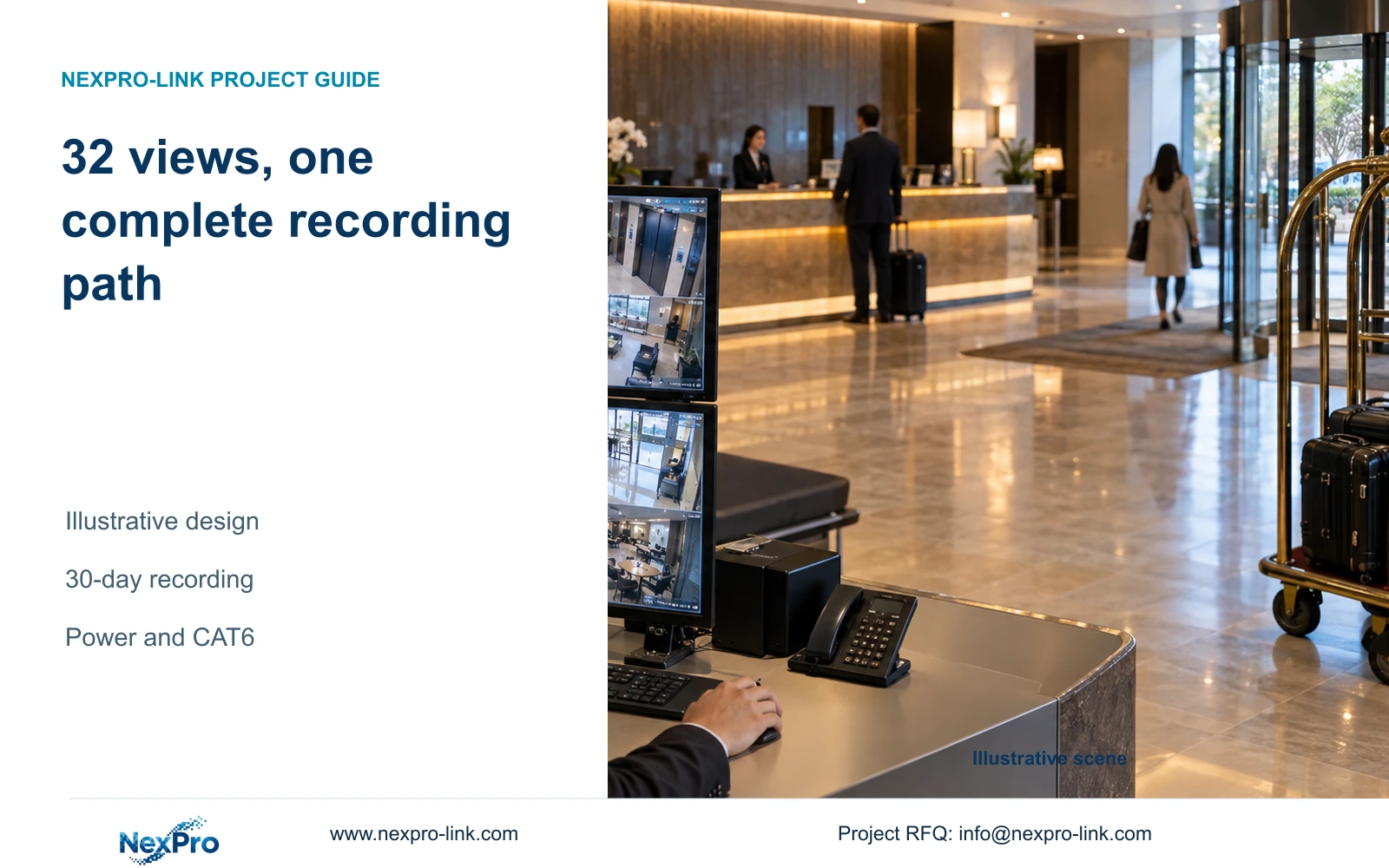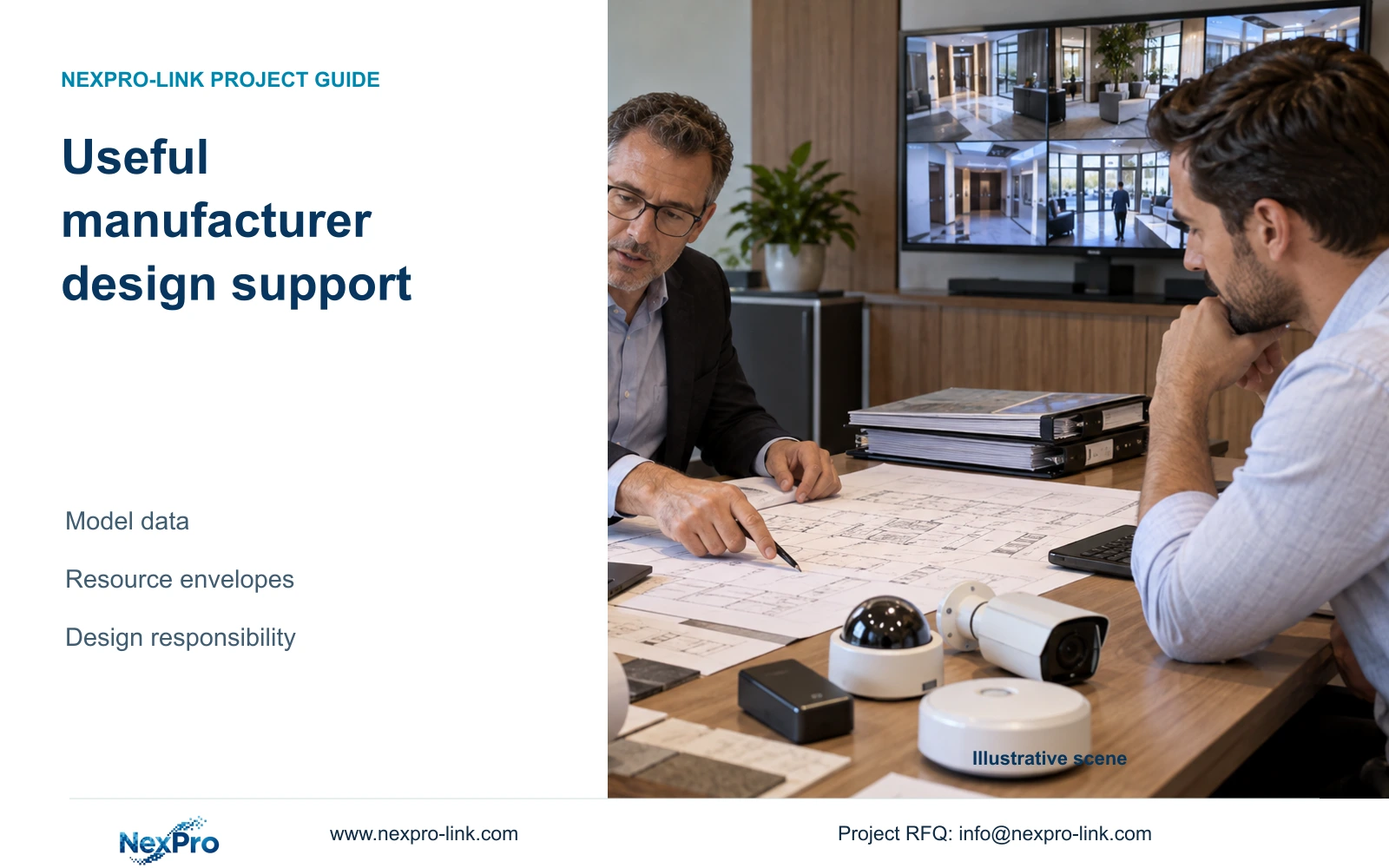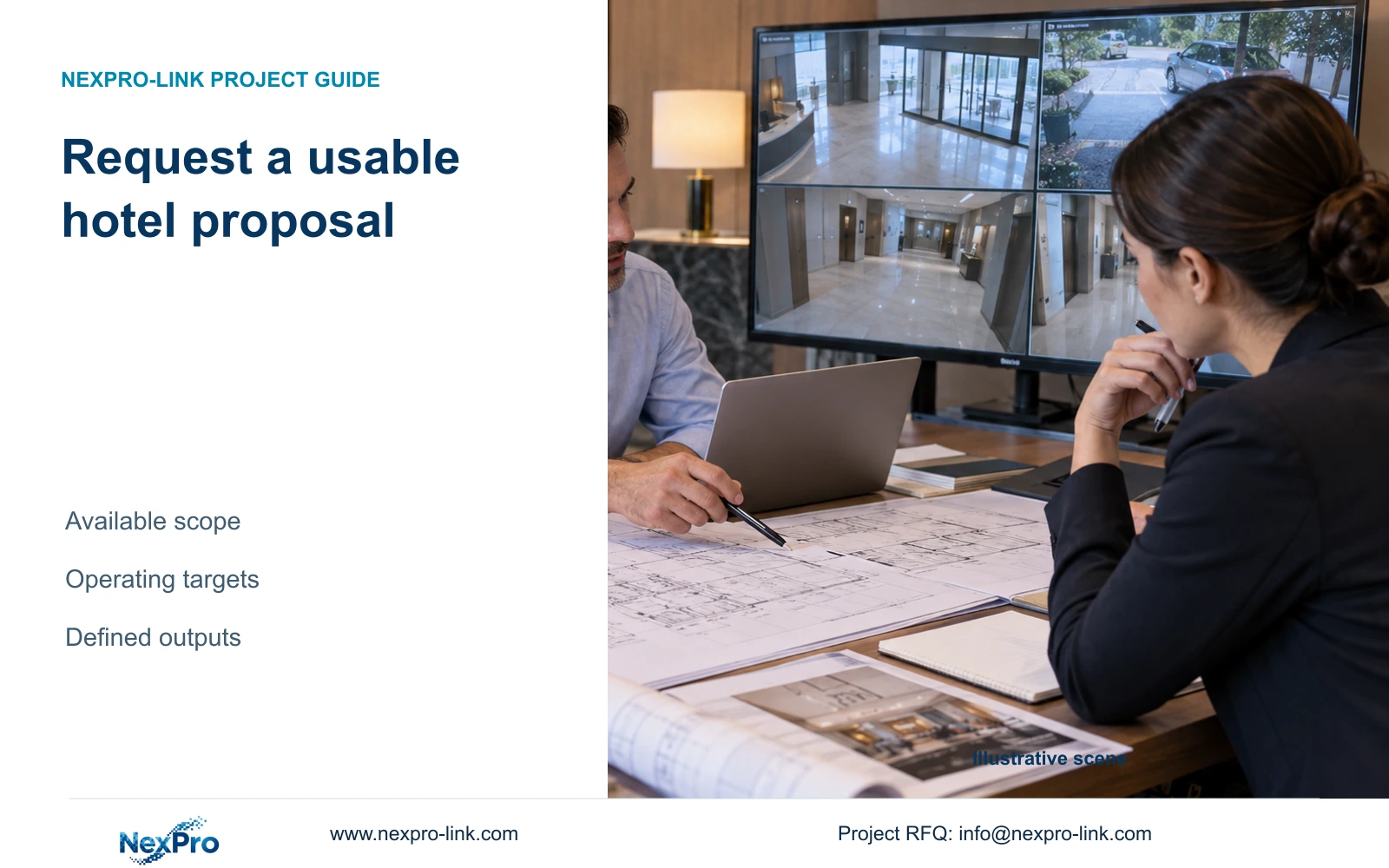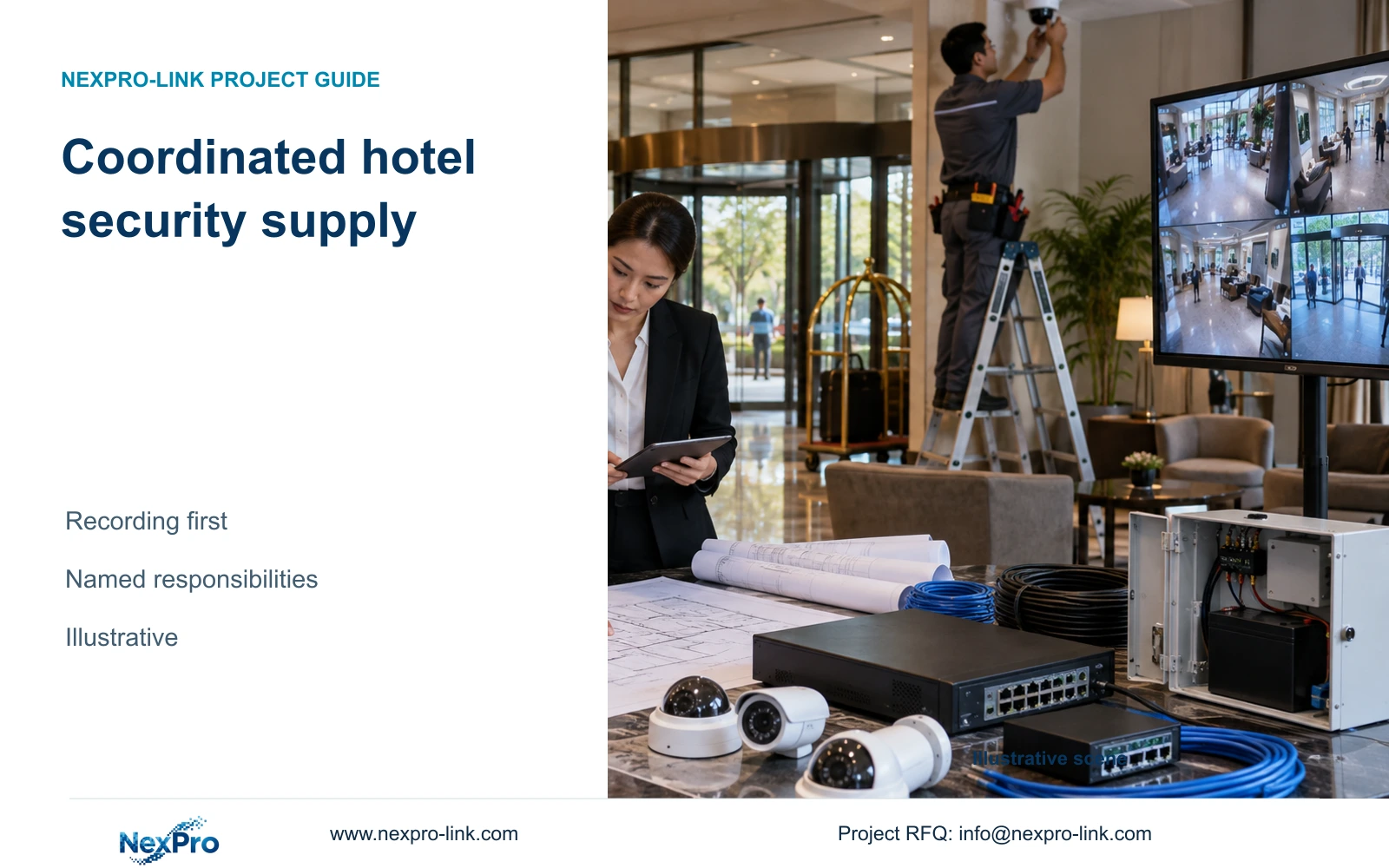
Choose coordinated hotel security supply when one proposal connects the required equipment, interfaces and responsibilities. Separate the CCTV manufacturing core from accompanying supply and local installation.
Section 01
Map the hotel's complete equipment needs
Choose a coordinated hotel security package when the proposal connects required recording functions to equipment, interfaces and named supply responsibilities. Start with the essential recording path and add optional display or recovery scope only for a defined operating need. Keep an existing mandatory platform or locally contracted service arrangement where the coordinated offer cannot meet it.
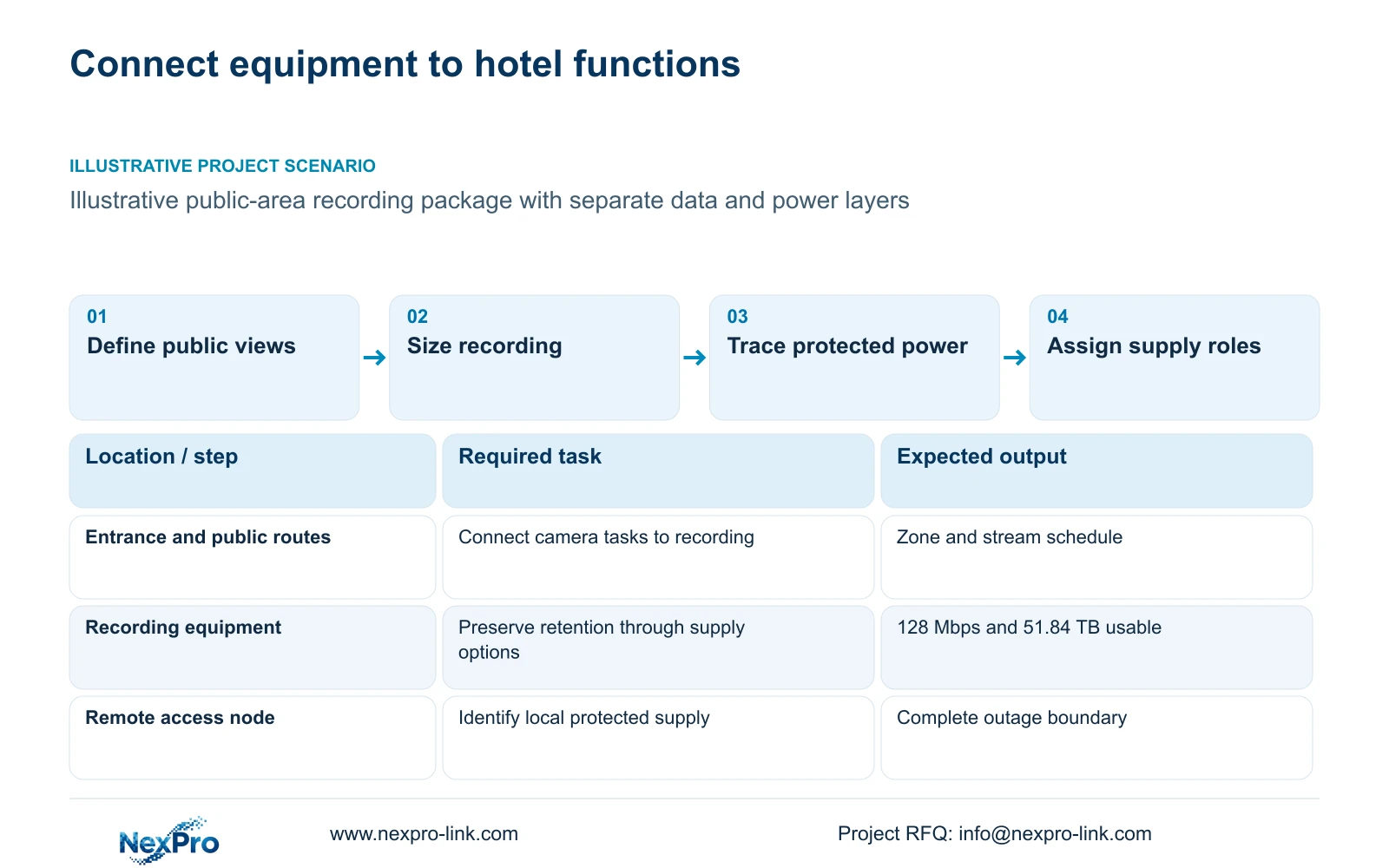
Build the package from public-area tasks. Entrances, reception, public circulation and service routes need defined views; room count does not determine camera quantity. Connect the camera schedule to recording, retrieval and the agreed outage state. Guest-room interiors and other sensitive spaces are outside this reference's routine surveillance scope.
The supplied CASE01 teaching reference illustrates 32 public-area camera positions and an equipment relationship, not a delivered hotel or final construction design. Its value here is showing how a schedule generates supporting requirements. The buyer's actual drawings must establish quantities and routes. The initial scope record should also distinguish necessary equipment from optional operator displays.
| Required task | Given information | Decision still needed |
|---|---|---|
| Capture required public-area views | Zone-based camera schedule | Lens, position and environment |
| Retain and retrieve recordings | Stream and retention requirements | Recorder, disks and authorized workflow |
| Continue during the agreed outage | Protected-function target | Every required power zone and battery configuration |
Section 02
Describe manufacturing and partner roles
Describe NexPro-Link's CCTV manufacturing core separately from coordinated accompanying supply. A single equipment proposal can organize UPS, displays and cabling without asserting that every item comes from the same factory. Name who provides model information, confirms the configuration and handles the equipment's service route.
Product roles need accurate identities. NexPro-BL2812M55-5MP-DIC-AI is a supplied 5MP camera candidate with a 2.8 to 12 mm motorized lens and PoE; its PDF does not provide a verified maximum wattage. SP5648 is a Cat6 48-port patch panel, not a cable-reel SKU. NX-VP-5535 is a 55-inch Full HD LCD panel, not direct-view LED.
The proposal should retain those distinctions through the BOQ and packing list. Authorized OEM labels and project packing can assist receipt and installation, while real model and traceability information remain visible. Hardware customization does not establish third-party software renaming rights. A coordinated supply description is useful only when the buyer can identify the responsibility behind each line.
Section 03
Connect interfaces and dependencies
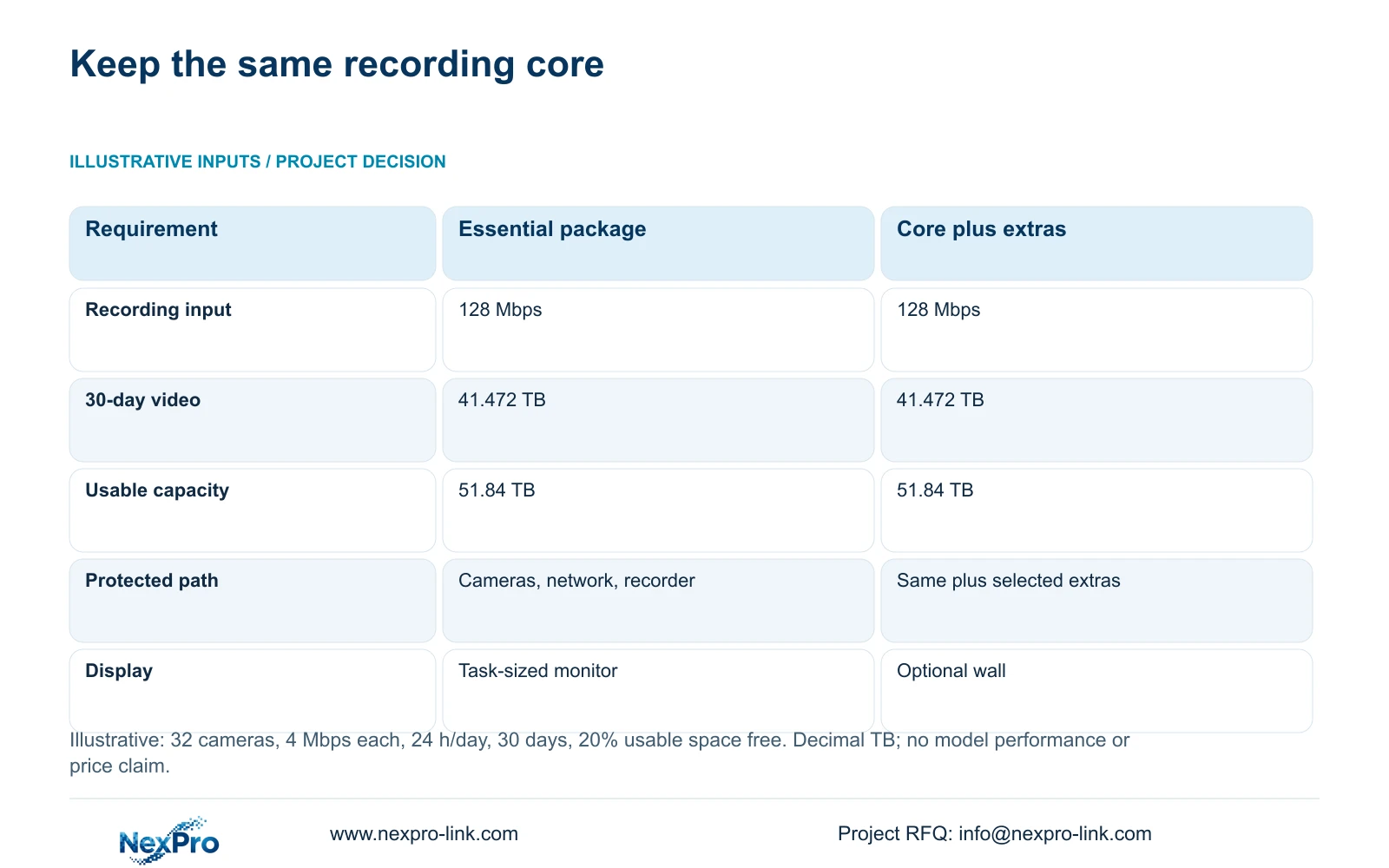
Calculate recording input and storage from the stream schedule before selecting the recorder. This illustrative comparison assumes 32 cameras averaging 4 Mbps each, continuous recording for 30 days and 20% of usable space kept free. Those are planning inputs, not values implied by camera resolution, product tests or legal retention requirements.
Input bandwidth is 32 × 4 = 128 Mbps. With Mbps converted to bits per second and bytes converted to decimal TB, continuous video data is 0.0108 × 32 × 4 × 30 = 41.472 TB. Required usable capacity is 41.472 ÷ 0.80 = 51.84 TB. Keeping 20% free requires division by 0.80, not adding 20% to the video quantity.
Keep power accounting separate from data flow. Trace cameras through access networking to the recorder, then map the protected AC supplies and PoE outputs. A remote switch remains a power dependency even with a fiber backbone. If UPS load uses the switch's complete AC input, do not add its cameras again. The display is a viewing branch, not a required recording node.
| Metric / condition | Essential recording-first package | Same core plus optional display/recovery scope |
|---|---|---|
| Recording input (Mbps) | 128 | 128 |
| 30-day video data (TB) | 41.472 | 41.472 |
| Required usable capacity (TB) | 51.84 | 51.84 |
| Protected path | Cameras + network + recording | Same plus explicitly selected extras |
| Operator display | Task-sized monitor/workstation | Optional wall; independent recording |
| Cost comparison | Complete scope quotation required | Add only documented incremental scope |
Section 04
Compare fragmented and coordinated supply
Several suppliers can provide a workable package when the contractor owns the interfaces and consolidates configuration information. A coordinated supplier can organize that work within its agreed scope. Compare the resulting schedule, exclusions and responsibilities; the number of invoices does not demonstrate functional completeness.
Both illustrative options retain 41.472 TB of video and require 51.84 TB of usable capacity. An optional wall does not reduce that obligation. NexPro-NVR4449-4K lists 49 channels, 320 Mbps input and four SATA positions with an 18 TB per-drive field. Its stated recording combinations and unspecified RAID detail still require checks; those fields alone do not prove the selected configuration.
Other dependencies need equally explicit responses. NexPro SW-POE1618G has conflicting access-speed descriptions and no stated numerical total PoE budget in the supplied record. SP2KR(S) is rated 2 kVA and 1800 W, but that rating does not establish battery runtime. Require the missing configuration information and compare complete quotations before attributing any price or service advantage to coordinated supply.
Section 05
Identify the local installation boundary
Allocate physical installation to the parties contracted for the site. Camera mounting, cable routes and local electrical work need project-specific inputs. Actual horizontal and vertical routes, turns and termination allowances determine copper lengths. A straight-line distance or an example reel count cannot establish the hotel's cable procurement quantity.
The coordinated proposal can identify equipment and information interfaces, while local specialists address electrical protection, grounding and safe installation. Distributed access nodes need a defined local supply and outage arrangement. A central UPS rating cannot establish protection for remote locations that have no designed power connection.
Add display scope when sustained observation or multiple operator positions justify it. Otherwise, retain a task-sized monitor and authorized client. Additional displays introduce installation, heat and power requirements without changing the essential retention target. Applicable main equipment has the supplied 24-month limited hardware baseline from receipt, subject to written order terms; local labor, batteries, disks, cable and return costs need separate scope.
Section 06
Offer a single structured RFQ route
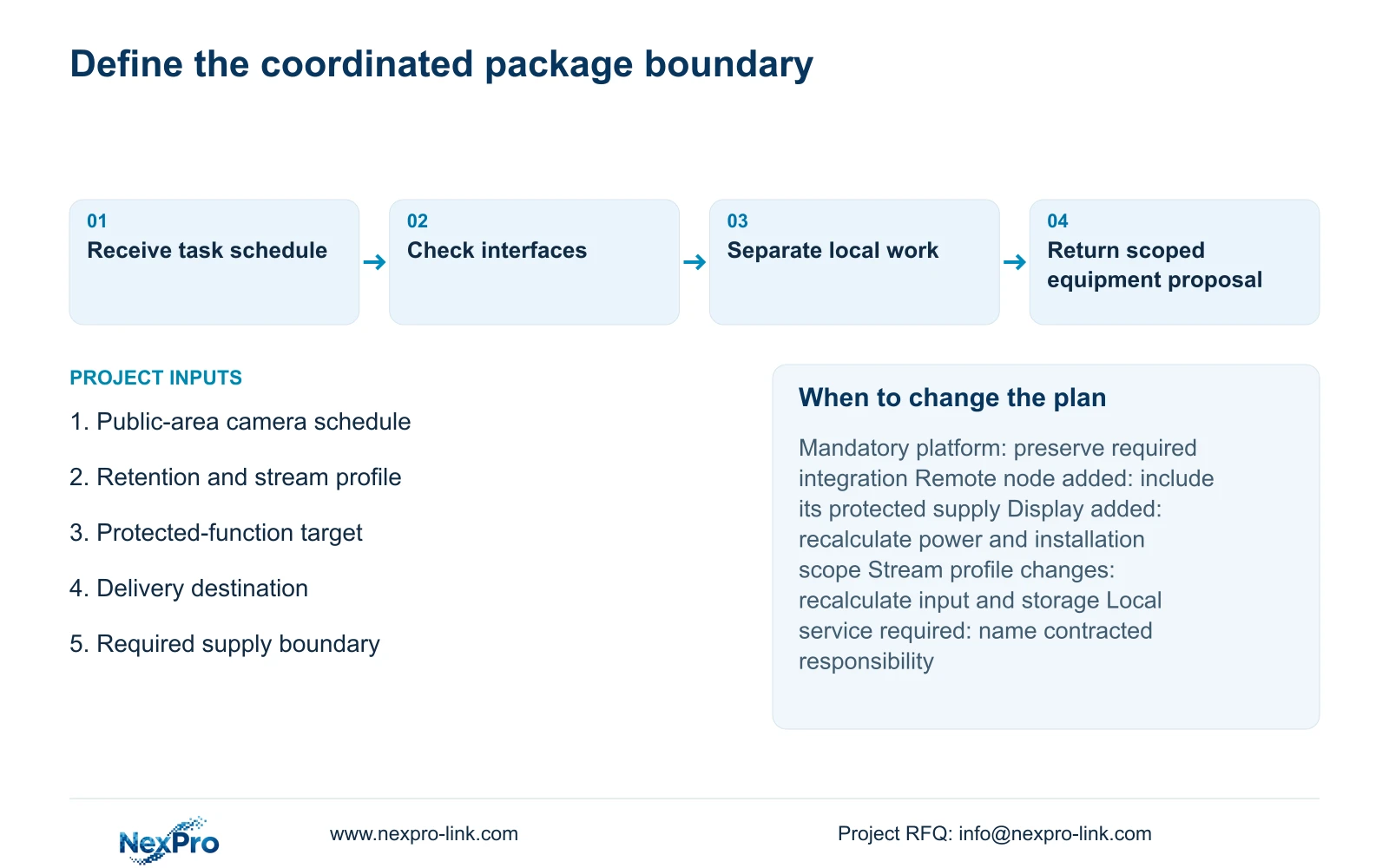
Send one organized inquiry that identifies the required outcome and allows each equipment category to receive a scoped response. The public-area plan or camera schedule, retention policy and protected-function target are the most useful technical inputs. Add the destination and identify which equipment, packing or local services belong in the requested supply boundary.
NexPro-Link's hotel project and BOQ support routes can help connect these inputs to model matching and a coordinated equipment schedule. Require assumptions and exclusions to stay beside the relevant lines. If an existing component can remain in service, review its interfaces before replacing the whole package. One commercial route should preserve the identities and responsibilities of the constituent systems.
Email the available schedule, retention target and outage requirement to info@nexpro-link.com, with a brief statement of the requested supply scope. Select the recording-first package when it meets the approved tasks. Add display or recovery scope when the operator defines its benefit and the supporting configuration is established. Reconfigure if actual streams, routes, mandatory platforms or local responsibilities invalidate the planning assumptions.
Section 07
Buyer questions
Does one coordinated order prove equipment compatibility? No. Verify the functions and versions that matter to the hotel. ONVIF profile matching can support relevant checks, but it does not prove every event, audio, retrieval or application-binding function works across the proposed equipment.
Can the quotation use existing hotel equipment? Yes, if its condition and supported interfaces allow the required task. Identify the retained item and who confirms its configuration. Keep any replacement option separate so the buyer can compare the complete incremental scope.
Why is raw disk capacity insufficient for the RFQ? The 51.84 TB example is a usable-capacity requirement. Formatting, a supported array layout and any spare disks can reduce the space available from raw drives. State those boundaries before selecting the disk combination.
Engineering references
These sources support the general planning principles. Always use the selected product's current datasheet and applicable project standards for final design.
- N01: Hotel & Hospitality Project Supply
- N02: BOQ & Tender Support
- N04: NexPro-NVR4449-4K product information
- N05: NexPro SW-POE1618G product information
- N07: Structured Cabling
- N09: Rack Online UPS
- N10: Video Wall and Decoder System
- N12: OEM/ODM scope
- N14: Warranty policy
- O01: ONVIF Profiles
- Supplied BL2812M Series product specification