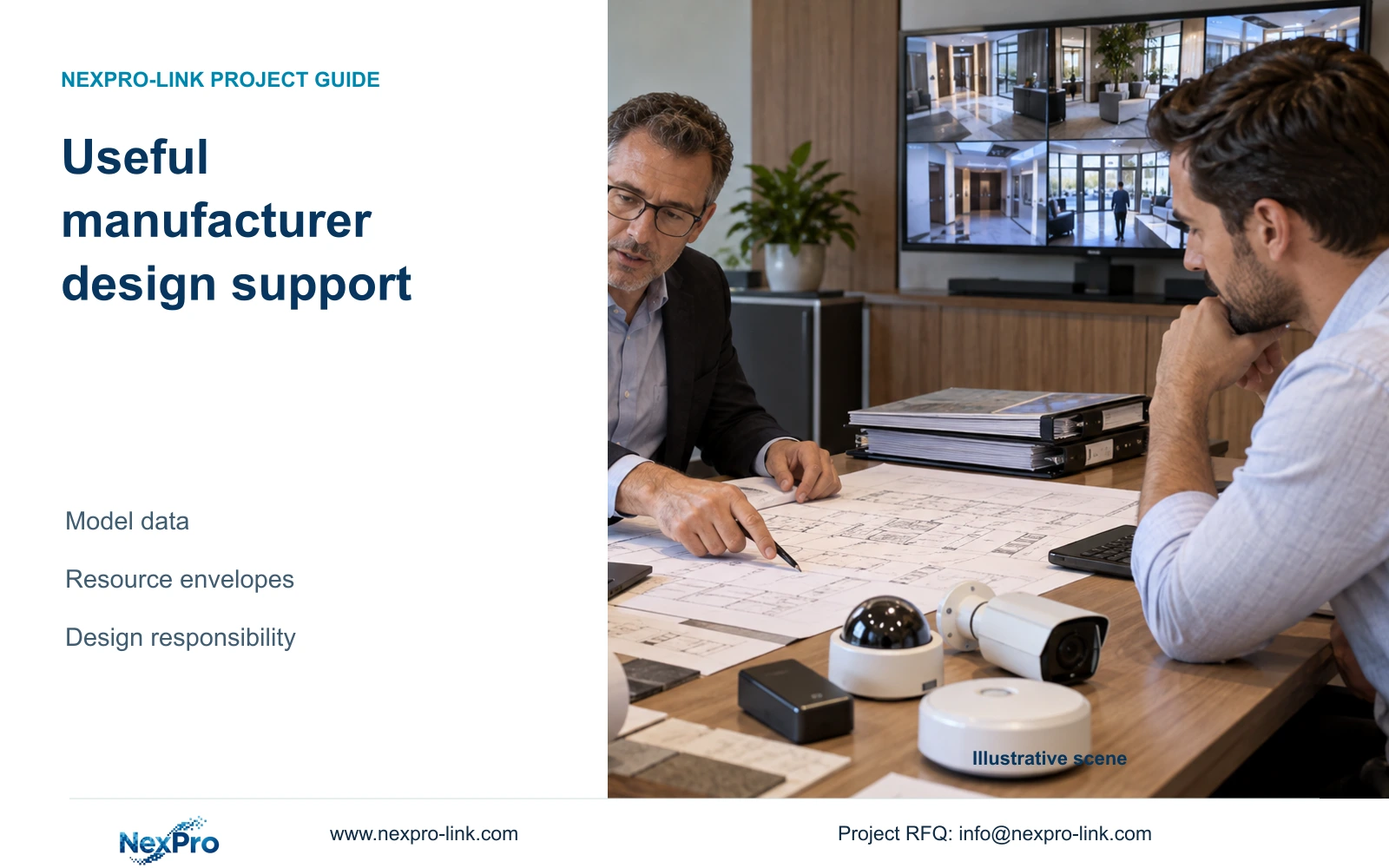
A hotel consultant can request equipment schedules, interface information and calculated resource requirements before design freeze. The useful submission identifies the decision, its assumptions and who retains design authority.
Section 01
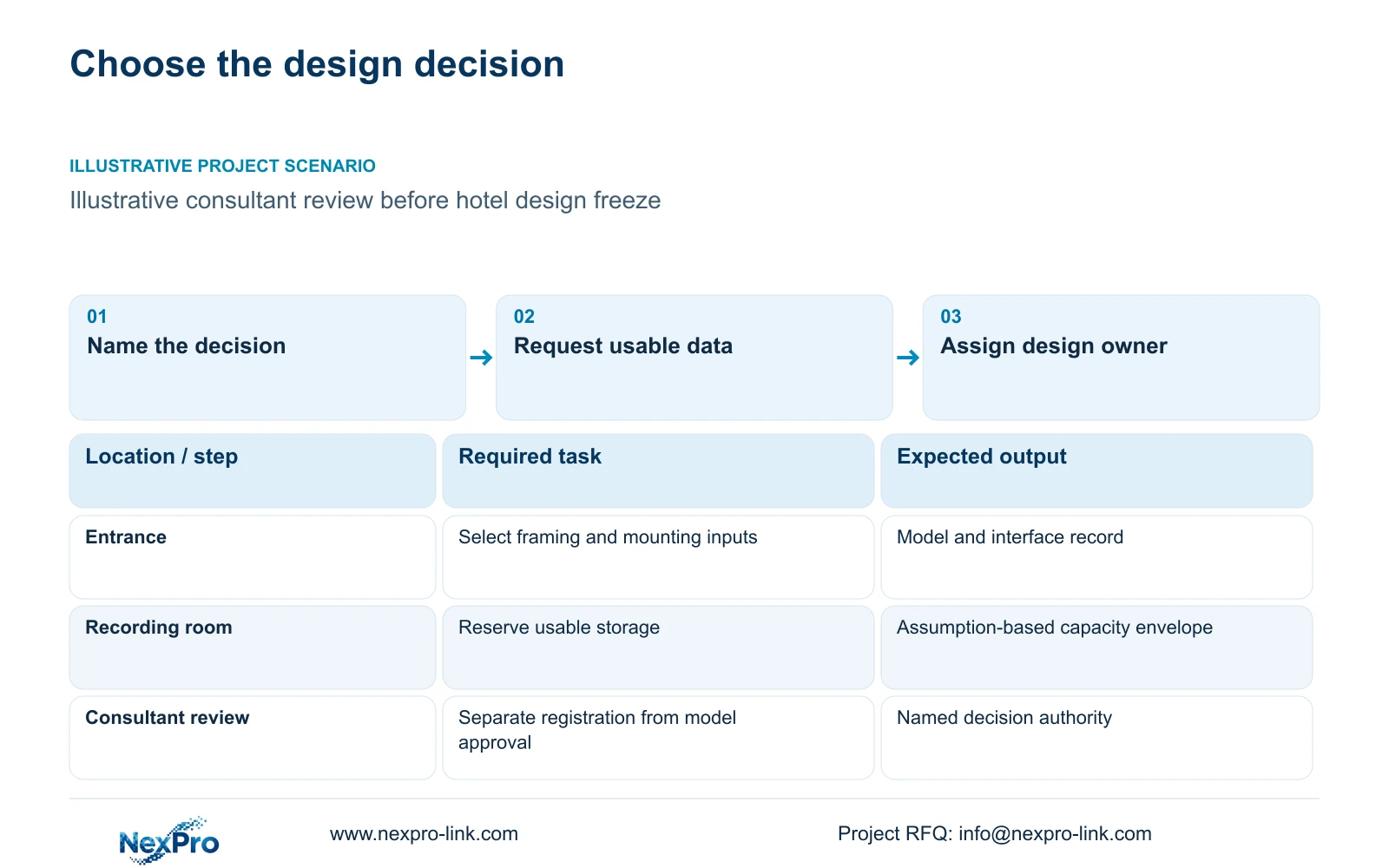
Define the consultant's current decision
Request a focused design-support package when the hotel layout or equipment selection is still developing. It should contain usable model parameters, installation interfaces, capacity calculations and an equipment alternative schedule. Keep the consultant responsible for the final design and the relevant local specialists responsible for their disciplines. Expand the supplier's submission only when the next design decision needs additional information.
Identify whether the current review concerns supplier registration, brand acceptance, a particular model or purchase authorization. These decisions need different evidence. A company introduction can support registration, while a recorder selection needs its recording modes, disk arrangement and operating requirements. A favorable technical discussion does not authorize an order.
Define the purchasing category as well. NexPro-Link's CCTV manufacturing core and coordinated supply of supporting equipment should have named responsibilities. A combined proposal for cameras, power and cabling does not establish that every item is manufactured by the same company or that local installation is included. This distinction helps the project manager route unresolved questions to the appropriate party.
| Required task | Given information | Decision still needed |
|---|---|---|
| Entrance view selection | Public entrance task and permitted mounting area | Model, framing and installation interface |
| Recording provision | Preliminary camera schedule | Stream modes, retention and usable storage |
| Supplier review | Purchasing category | Company registration or project model approval |
Section 02
Request model and interface information
Ask for information that another designer can use: exact model identity, supported output modes, mounting details, power requirements and the intended recorder or client interface. Where a parameter is missing, retain it as an open item. Filling a gap with a value from a similar housing can create an incorrect mounting, power or capacity allowance.
The supplied BL2812M and DM2812M product PDFs support 2.8 to 12 mm motorized lens candidates, but they do not give verified maximum camera power. NexPro-DM2812M55-5MP-DIC-AI retains the source output value of 2880×1620. Its Dome series name does not establish an impact rating. A consultant can use these facts for preliminary matching while requesting the missing information needed for installation.
The same interface record helps evaluate replacements. If a camera becomes unavailable during a stated service event, a proposed replacement must preserve the required mounting, power, recording mode and client behavior. Similar appearance or megapixel count is insufficient. Compare local spare availability with the proposed replenishment route without inventing failure rates or assuming that either route restores service automatically.
| Item | Unconfirmed alternative | Documented alternative | Effect on the hotel task |
|---|---|---|---|
| Mounting | Similar housing | Actual fixing and access information | Avoids an unsupported installation assumption |
| Power | Assumed camera watts | Exact peak requirement and PoE type | Allows a defensible switch budget |
| Client behavior | General compatibility statement | Required functions checked by version | Preserves viewing and incident work |
Section 03
Compare technically admissible options
Compare alternatives against the current hotel requirement and the operator's permitted substitution process. If a named brand is mandatory and alternatives are prohibited, retain that baseline. Where alternatives are allowed, identify the proposed model and each departure from the requirement. A supplier's broader catalogue should not obscure a missing capability in the particular configuration being reviewed.
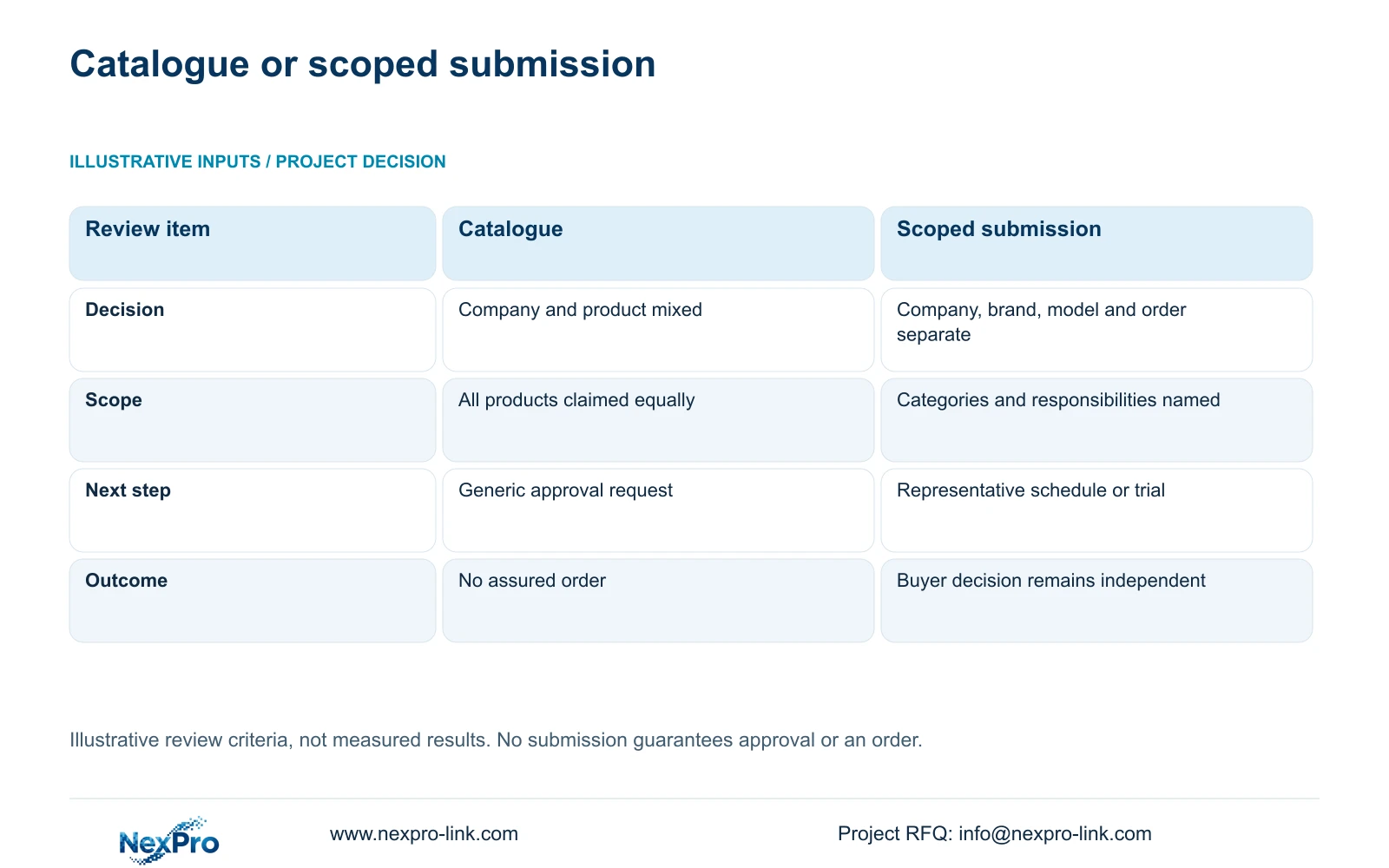
The following matrix compares two illustrative submission methods. Its inputs are review boundaries and responsibilities; it has no numerical performance formula. It contains no site observations, quotations or approval results. The scoped approach is preferable because it gives the consultant a defined object to assess and exposes responsibility gaps.
A representative schedule or trial can address an unresolved issue without requiring the buyer to disclose the entire tender package. Submit the relevant camera task, interface requirement and acceptance condition first. Samples and technical records remain evaluation inputs. The buyer retains an independent decision about registration, technical acceptance and any subsequent order.
| Design decision | Supplier information to request | Confirmation boundary |
|---|---|---|
| Camera task/interface | Exact SKU, modes, lens, mounting and environmental source | Final sightline and local installation remain designer/site inputs |
| Power reservation | Verified peak/mode and supported PoE type; missing fields open | Do not borrow watts from similar housings |
| Recording envelope | Stream groups, hours, retention and raw/usable assumptions | Product input, modes and supported disk layout checked separately |
| Alternative | Baseline clause, named departures and affected accessories | Consultant/buyer acceptance still required |
| Issue status | Source revision, author of input and unresolved decision owner | Preliminary coordination is not order-ready release |
Section 04
Use calculated resource envelopes
Ask the manufacturer to connect each proposed equipment group to a resource calculation. The consultant needs enough information to reserve recorder capacity, switch power and cabinet space without treating provisional values as final quantities. Each calculation should distinguish a published product limit from an assumed design input and identify which revision would invalidate the result.
CASE01 is a separate illustrative 32-camera planning reference. At an assumed average 4 Mbps per camera, its recording input is 128 Mbps. Continuous recording for 30 days produces 41.472 decimal TB of video. Reserving 20% of usable space means dividing by 0.80, giving a requirement of 51.84 TB. These figures describe that case, not the performance of a camera model.
The response schedule above supports a scoped design issue; the case calculations show what that submission can contain. Neither establishes complete suitability. NexPro-NVR4449-4K lists 320 Mbps input and four SATA positions, but recording modes and disk compatibility still need configuration checks. Its channel count does not prove arbitrary 8MP concurrency. Resolve those constraints before converting a resource envelope into a purchase schedule.
Section 05
Separate assistance from design authority
Assign the supplier's output to a design decision and name who accepts it. Model matching and calculation support can inform the consultant's design. Site cable routes, electrical protection, structural mounting and local safety requirements need the appropriate project specialists. A supplier drawing of equipment relationships should not be treated as an installation wiring design.
Purchase additional evaluation work where it closes a material uncertainty. An entrance comparison can help establish whether the proposed framing preserves the required moving detail. A site exercise is justified when hotel lighting or mounting conditions control the result. A factory demonstration cannot resolve conditions that it does not reproduce.
Keep the retained operating outcome visible when adding optional scope. A larger display or a branded carton may serve a defined task, but neither should displace recording capacity or necessary power protection. The cost manager should identify the incremental supply, installation and support cost separately. No sample outcome guarantees consultant approval or the award of an order.
Section 06
Prepare the next design issue
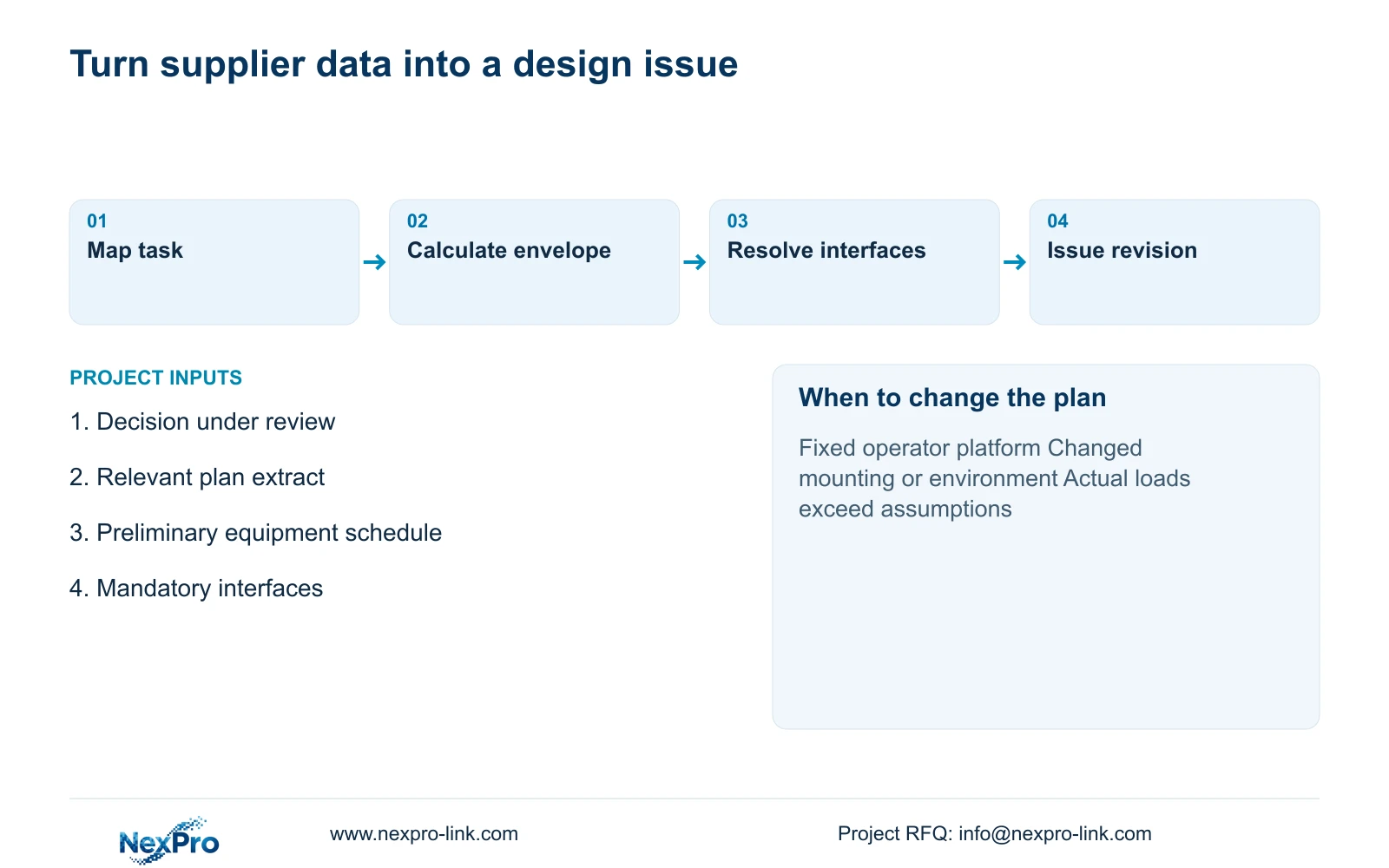
Issue a short response schedule containing the proposed model, source document, assumption and unresolved decision for each relevant item. Mark which information is suitable for preliminary coordination and which requires confirmation before ordering. Preserve the baseline requirement beside every alternative so later revisions can be reviewed without reconstructing the earlier discussion.
Choose the scoped review submission while the current requirement can be represented by a limited equipment schedule. Change the proposal if the operator requires a fixed platform, the site introduces a different environmental duty or actual stream and power data exceed the planning assumptions. Reconfigure the affected items while retaining the required hotel task.
For a useful first response, send the purchasing category, the decision blocking design and a relevant plan extract or preliminary equipment schedule to info@nexpro-link.com. Include the mandatory interfaces and whether alternatives are permitted. Hotel project equipment support and BOQ and tender support can address model matching and coordinated supply. Unrelated confidential files, guest recordings and credentials are unnecessary for this stage.
Section 07
Buyer questions
Can we request design support before construction drawings are complete? Yes. Identify the provisional scope and ask for preliminary model matching or resource calculations. Mark unresolved mounting, power and interface inputs so a preliminary response cannot be mistaken for an order-ready design.
Does a supplier-supported alternative replace consultant approval? No. Submit the alternative through the buyer's permitted review process. Technical assistance, brand acceptance and purchase authorization remain separate decisions.
What should a model substitution preserve? Preserve the observation task and verify mounting, power, recording mode and client behavior. Ask for any changed accessories and configuration requirements to be identified alongside the replacement.
Engineering references
These sources support the general planning principles. Always use the selected product's current datasheet and applicable project standards for final design.