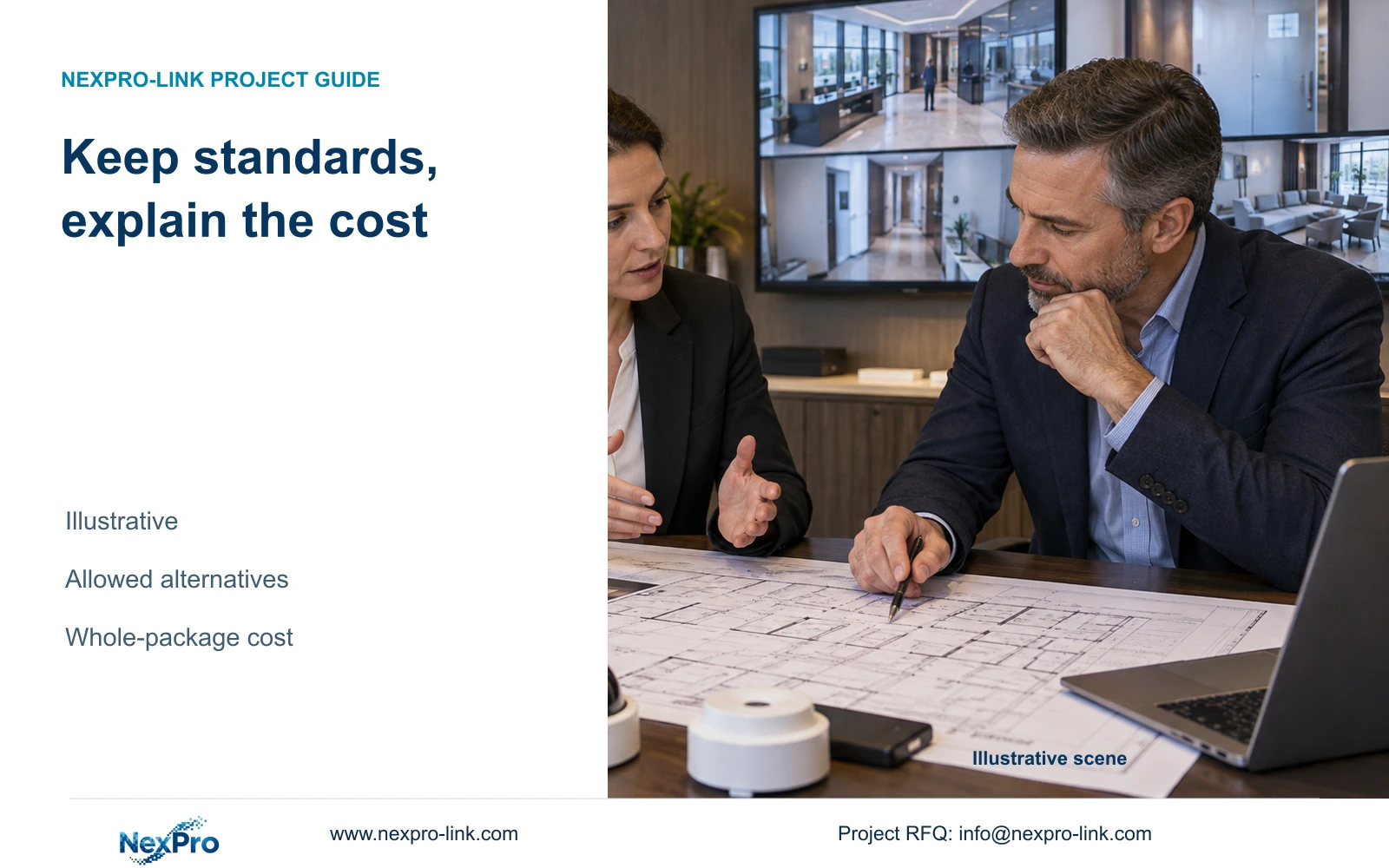
Keep mandatory operator workflows intact. Compare an allowed alternative against a fully priced baseline, with technical deviations and recurring costs visible together.
Section 01
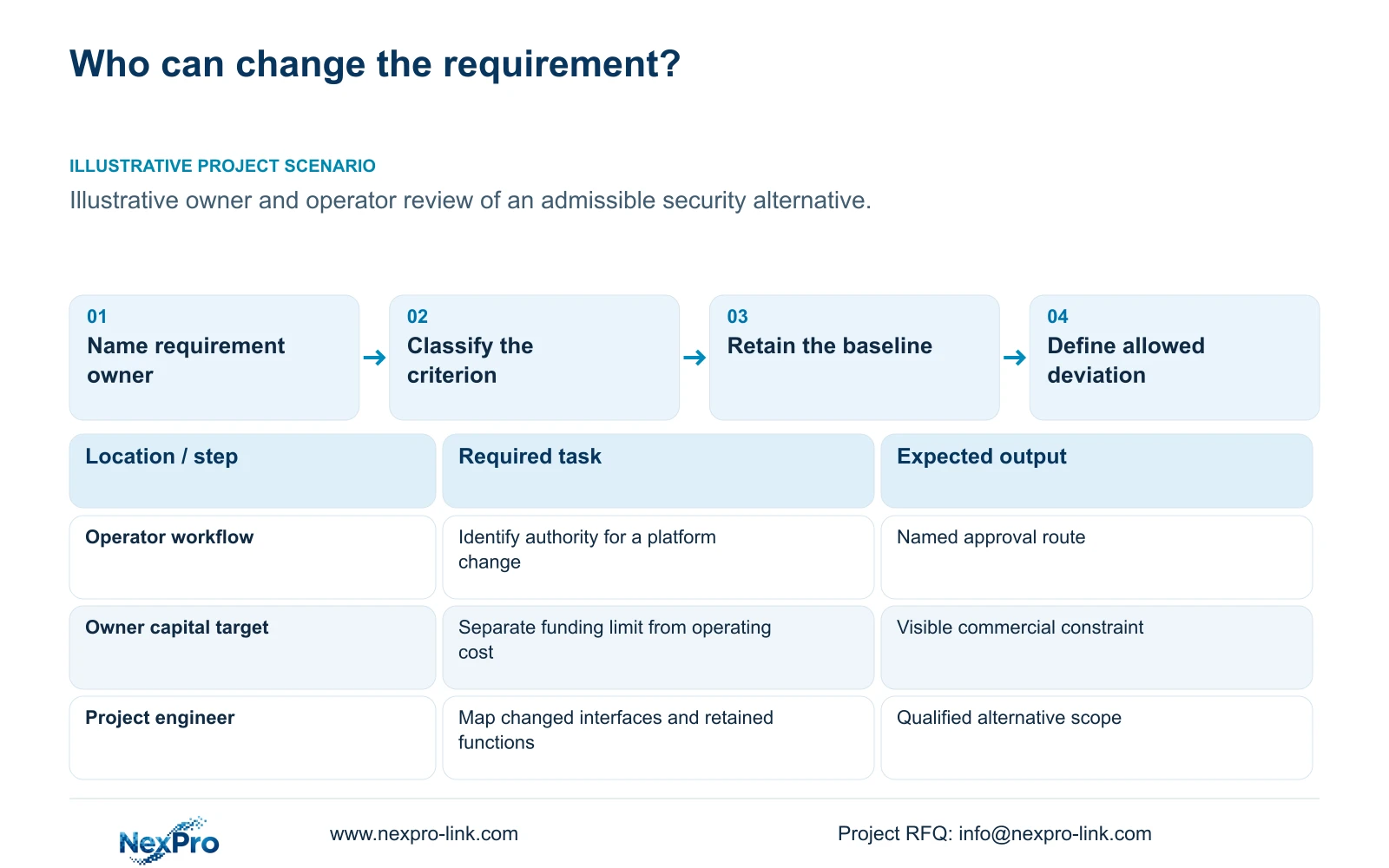
Assign ownership to each security requirement
Retain mandatory operator workflows and propose alternatives only within the permitted scope. Present the technical deviation and complete price effect together. Choose a cheaper package only after it preserves the required outcome and follows the project's approval route; otherwise it remains a different, unqualified scope.
Attach each requirement to its issuing record and decision owner. The operator may define an operating workflow, the owner may set a capital limit, and the project team must establish the actual authority for accepting a deviation. Do not assume that a budget instruction removes a platform or brand requirement.
Fix the comparison boundary before discussing substitutions: public-zone tasks, quantity, retention and service responsibilities, together with destination and currency. An unresolved conflict should state which requirement and cost limit cannot currently coexist. That gives the decision-maker a specific choice between changing scope, changing budget or authorizing a qualified alternative.
| Required task | Given information | Decision still needed |
|---|---|---|
| Authorized incident retrieval | Operator workflow requirement | Who may accept a different supported workflow |
| Meet capital allowance | Owner budget target | Which optional items may be deferred |
Section 02
Separate mandatory and preferred criteria
Classify requirements from the controlling project documents. A specified platform, accepted recording function or required support arrangement should remain mandatory unless the authorized party changes it. Preferred appearance or optional viewing equipment can be evaluated separately, provided the documents allow that treatment.
Define what evidence would support an alternative. A similar resolution or lens range does not establish equivalent operation. ONVIF Profiles provides a framework for checking relevant device and client functions; a general ONVIF statement does not prove all events, audio, recording searches or account binding will work across platforms.
Keep a compliant baseline available where alternatives are allowed. The alternative should name every changed item and its effect on installation, operation and support. If the operator prohibits a substitution, retain the specified item and seek budget changes elsewhere. A supplier proposal cannot create an exception to the operator's standard.
| Item | Baseline | Alternative | Effect on the task |
|---|---|---|---|
| Mandatory platform | Specified workflow retained | Change only with permitted review | Unapproved change cannot be priced as equivalent |
| Optional display | Agreed operator display | Simpler task-capable arrangement | Potential saving if required viewing remains usable |
Section 03
Price the baseline honestly
Price the accepted configuration with its installation, software and delivery boundaries. Record excluded taxes or services as unresolved inputs until valued. Include later charges separately so a lower equipment subtotal does not hide a required subscription, training activity or support arrangement.
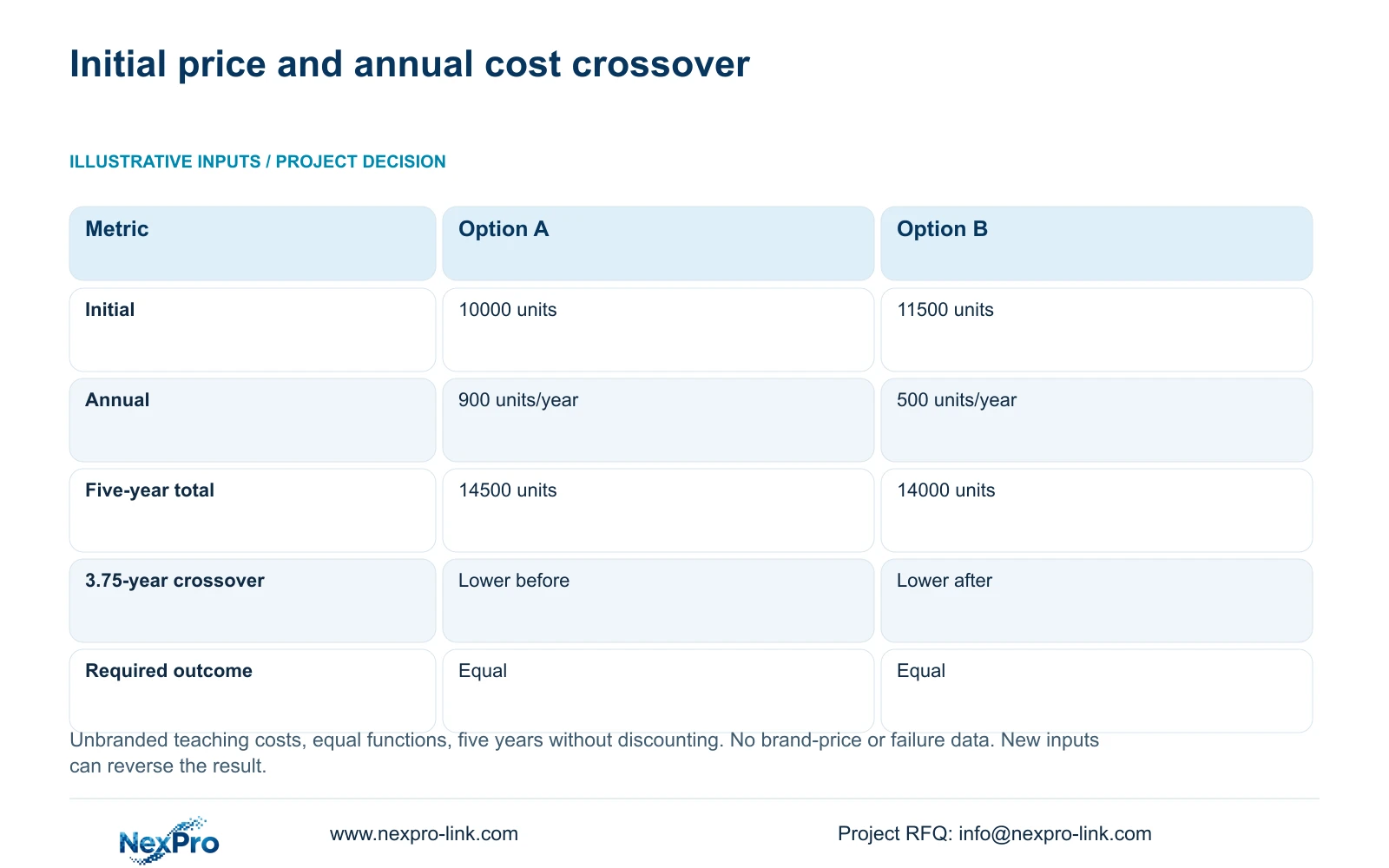
The cost illustration uses unbranded alternatives with equal required outcomes. Option A has an initial teaching cost of 10000 units and an assumed annual cost of 900. Option B starts at 11500 units with 500 annually. The evaluation period is five years without discounting. These amounts are neither quotations nor brand-specific service or failure data.
For each option, five-year total equals initial cost plus five times annual cost. The crossover equals the initial premium divided by the annual difference. Use actual qualified quotations to replace those inputs before recommending a commercial winner. Keep this independent example separate from CASE01, which supplies engineering tasks and quantities without establishing these prices.
Section 04
Cost an admissible alternative
Option A totals 10000 + 5×900 = 14500 teaching units. Option B totals 11500 + 5×500 = 14000. B's 1500-unit initial premium is offset by its assumed 400-unit annual advantage after 3.75 years. At five years, B is 500 units lower.
Under these inputs, select A for an evaluation period shorter than 3.75 years and B for a longer period, once both satisfy mandatory requirements. At the crossover their totals are equal. The result changes if an annual charge, initial inclusion or evaluation period changes; the calculation does not establish that any named brand has lower operating costs.
For a hotel budget decision, this exposes the source of the saving and its timing. If the owner cannot fund B's initial premium, show that constraint explicitly. If B's annual amount excludes a required service, add that service before comparing. A cost advantage cannot compensate for an unapproved loss of operator function.
| Metric / condition | Option A | Option B |
|---|---|---|
| Initial teaching cost | 10000 units | 11500 units |
| Assumed annual cost | 900 units/year | 500 units/year |
| Five-year undiscounted total | 14500 units | 14000 units |
| Crossover | Lower before 3.75 years | Lower after 3.75 years |
| Actual tender ranking | Requires qualified quotations | Not established by this example |
Section 05
Record the approval route
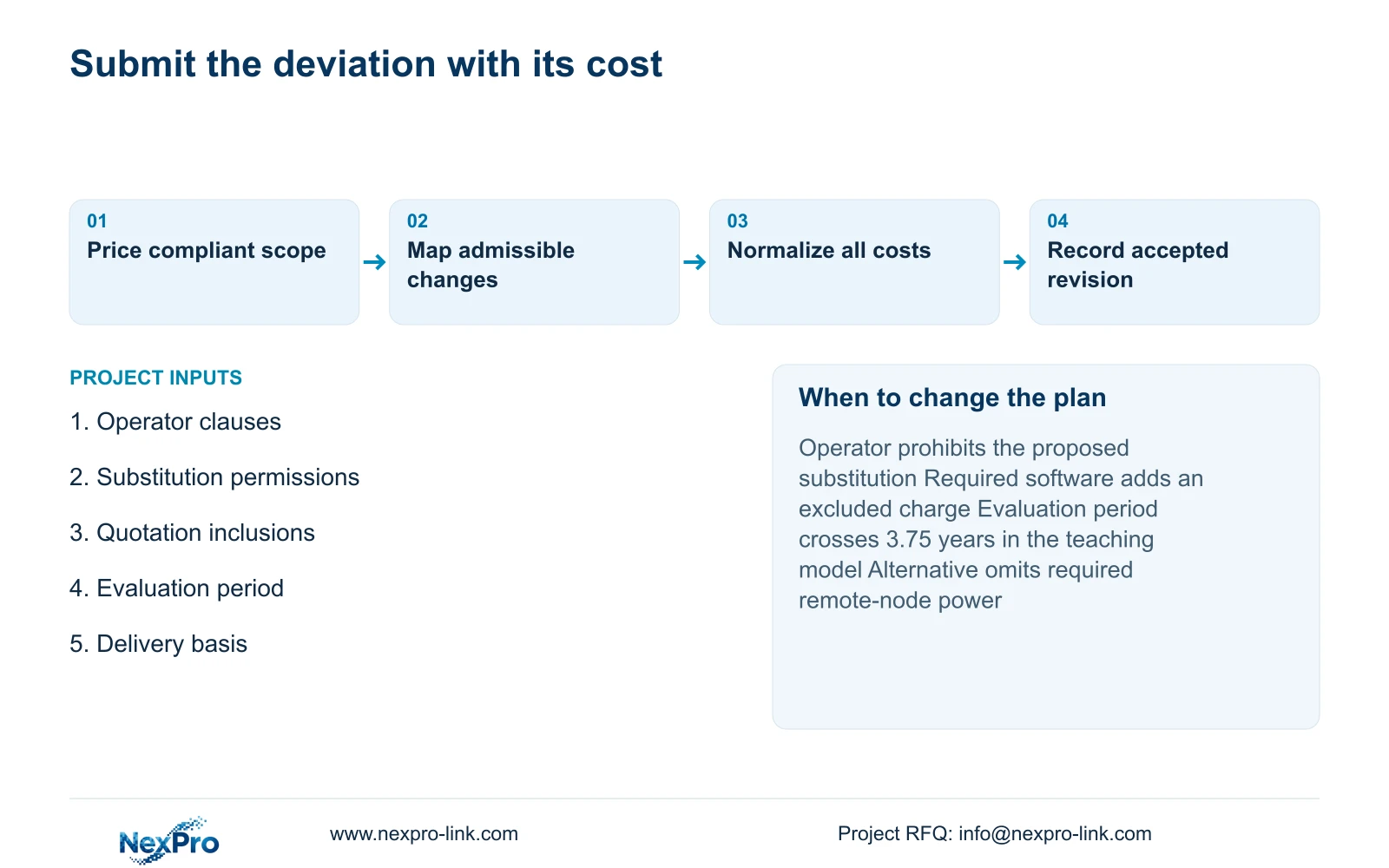
Build the review submission around the affected requirement. Include the baseline model or arrangement, proposed alternative, supported functions and exact deviation. Add the evaluated cost effect on the same record so the owner and operator can see whether the saving depends on accepting a changed task.
Where a network alternative changes the installation, provide the physical route and equipment list. Copper length includes horizontal and vertical routing plus stated termination allowances. A fibre data path can require a remote powered node; it does not automatically supply power to the cameras. Local installation and electrical responsibilities must remain visible in the approval scope.
Distinguish supplier registration, brand acceptance, model approval and order authority. Acceptance at one level does not establish the others. NexPro-Link's BOQ support can help organize model matching and deviations, but consultant acceptance remains the buyer's project decision. Record the accepted revision and carry it into the quotation and purchase schedule.
| Retained outcome | Extra review scope | Worth proposing when | Counter-condition |
|---|---|---|---|
| Required recording path | Changed backbone and local power | Alternative solves a documented route constraint | Remote dependency is omitted |
| Operator workflow | Version-specific functional review | Substitution is explicitly allowed | Specified platform is mandatory without exceptions |
Section 06
Avoid savings that remove required functions
Seek savings in allowed scope while keeping recording, retrieval and outage requirements intact. Defer an optional display where the initial operating arrangement is sufficient, or compare admissible equipment packages with matched inclusions. Removing necessary disks or remote-node protection changes the operating outcome and must be presented as a scope reduction.
Keep support coverage equally clear. The supplied policy record describes a 24-month limited hardware baseline from receipt for applicable main equipment, subject to written order terms. Battery, storage, cable and OEM conditions are separate. Continuing technical support does not establish free local attendance, and longer historical wording should not silently replace the controlling scope.
Send the relevant operator clauses, allowed-substitution rules and scope-matched quotation inclusions to info@nexpro-link.com, with the owner's evaluation period and destination. NexPro-Link can discuss a baseline and coordinated alternative through hotel project support. Its CCTV manufacturing and supporting supply responsibilities should be identified separately, without assuming every coordinated product is self-manufactured or natively integrated.
Section 07
Buyer questions
Can an alternative be offered when the operator names a brand? Only within the stated substitution procedure. Retain the specified baseline and identify the proposed deviation. If alternatives are prohibited, do not silently replace the named equipment to meet the budget.
Does a lower five-year total resolve a capital-budget shortfall? It shows an economic trade-off but does not supply the initial funding. Record the owner's capital constraint separately and compare permitted deferrals or another qualified package.
What makes two support quotations comparable? Match covered equipment, service activities, exclusions and response responsibilities over the same evaluation period. Hardware repair coverage, local labour and recurring software services are separate inputs.
Engineering references
These sources support the general planning principles. Always use the selected product's current datasheet and applicable project standards for final design.