Specify the first response's decision, assumptions and excluded deliverables before requesting a price. Ask for the missing input that changes that decision next.
Section 01
Describe the project and decision stage
Specify the first response's decision, assumptions and excluded deliverables before requesting a price. Ask for the missing input that changes that decision next. Keep preliminary model matching separate from final quantities and installation design. This staged proposal contract prevents an incomplete brief from being mistaken for unconditional technical or commercial acceptance.
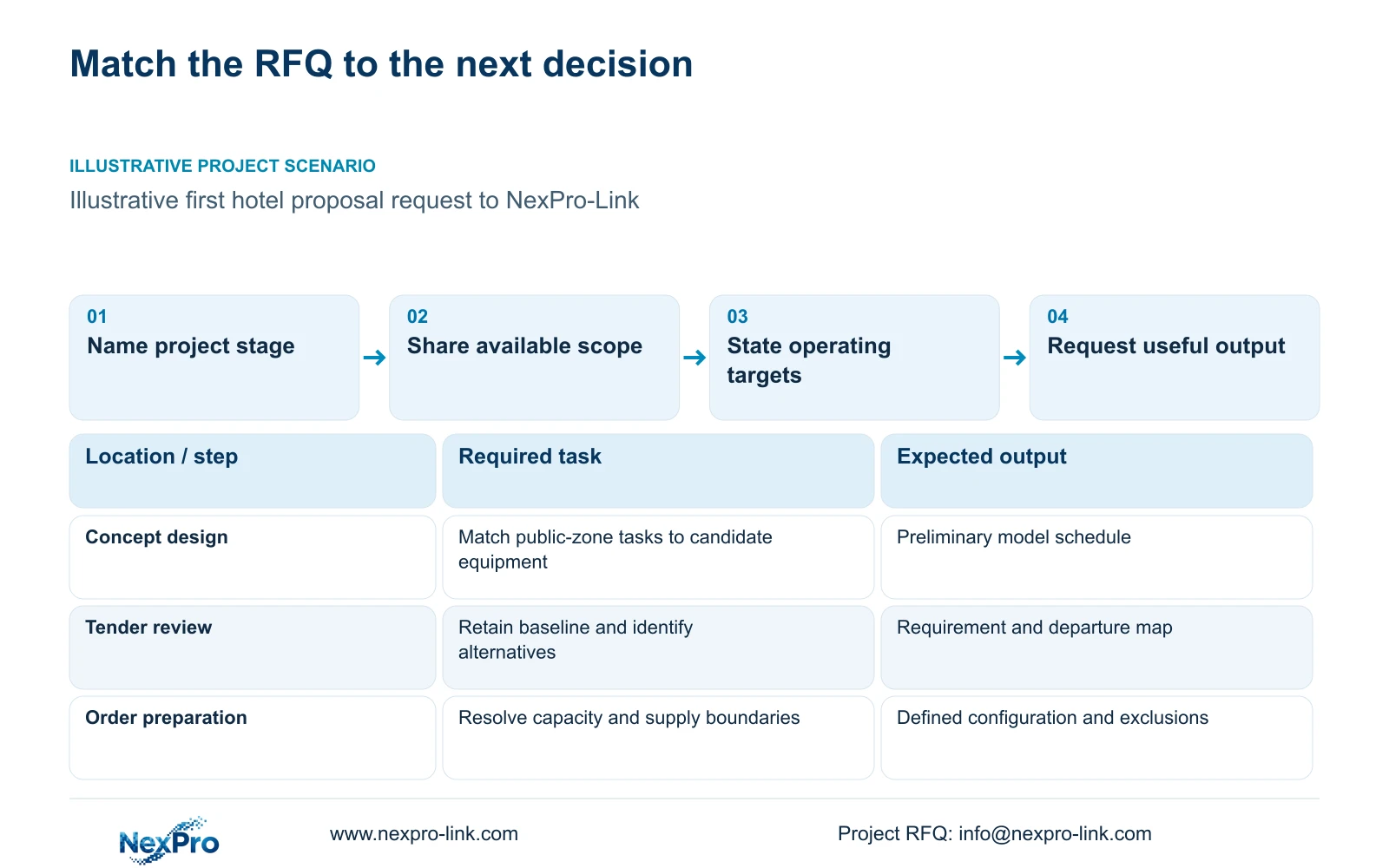
Send NexPro-Link a concise project brief, available drawing or BOQ, recording and backup targets, and the delivery destination. Ask for the response that fits your current decision: preliminary equipment matching, a technical comparison or a scoped quotation. If drawings are incomplete, identify the assumptions and request a limited response instead of waiting for a finished construction package.
Describe whether the hotel is at concept design, tender review, model selection or order preparation. State the immediate obstacle, such as uncertain recorder capacity, an alternative-brand review or an incomplete equipment allowance. This gives the supplier a defined problem and prevents a general catalogue from being mistaken for a complete project proposal.
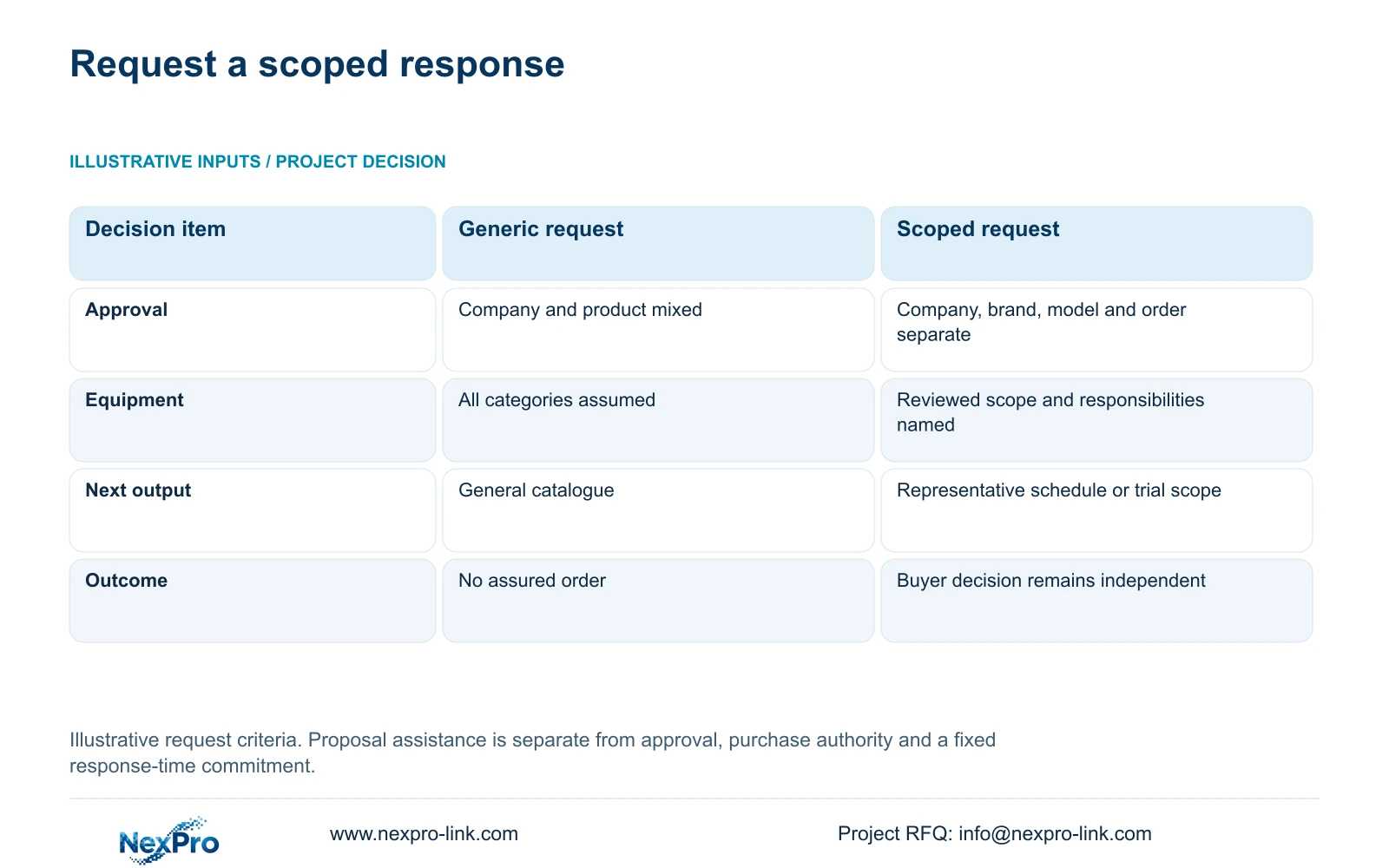
Keep company registration, brand acceptance, model approval and order authority separate. A request for technical assistance does not authorize supply. Name the purchasing category and the party reviewing the response where available. NexPro-Link's CCTV manufacturing core and coordinated supporting-equipment supply should be described accurately, with local installation responsibilities assigned separately.
| Required task | Given information | Decision still needed |
|---|---|---|
| Preliminary selection | Public-zone brief or plan | Suitable model families and missing inputs |
| Tender comparison | BOQ and permitted alternatives | Model mapping and stated departures |
| Order preparation | Reviewed configuration | Final scope, delivery and written terms |
Section 02
Share the available scope information
Attach the most useful information you already have. A marked public-zone plan can explain camera tasks; a camera schedule can show model duties and quantities; a BOQ can define the purchasing package. Include the document revision and identify provisional rows. Room count alone cannot establish camera quantity, recorder capacity or cable length.
For a replacement or extension, identify existing equipment that must remain. Record its model and intended function, then describe the new task. Similar housing or resolution does not prove interchangeability. A replacement needs appropriate mounting and power, a supported recording mode and the required client behavior. Mark uncertain interfaces for clarification.
If the proposal includes spare equipment, describe the service event it should address and who will perform replacement. A local spare and cross-border replenishment have different restoration paths. Do not assign an unexplained spare percentage or use invented failure rates. A short functional schedule can support an initial discussion without disclosing unrelated tender files, guest recordings or account credentials.
| Item | Limited input | More useful input | Effect on the proposal |
|---|---|---|---|
| Coverage | Hotel room count | Public-zone tasks and marked plan | Supports task-based camera matching |
| Replacement | Photo of similar housing | Model and required functional interfaces | Exposes substitution constraints |
| Cable scope | Straight-line distance | Installed route with stated allowances | Supports a usable quantity estimate |
Section 03
State recording and power targets
State the required retention, recording hours and stream assumptions by camera group where known. Identify whether the values are operator requirements, design allowances or measurements. Retention is a project decision based on purpose and applicable requirements; 30, 60 or 90 days should not be presented as a universal hotel rule.
CASE01 illustrates the useful level of detail, independently of the approval comparison below. Its 32 assumed cameras at an average 4 Mbps require 128 Mbps input. Continuous recording for 30 days produces 41.472 decimal TB. Keeping 20% of usable space free requires 51.84 TB, calculated by dividing video data by 0.80. These are teaching inputs, not an automatic specification for another hotel.
For backup, state what must continue and for how long. Identify recorder, core network and remote access nodes within each protected zone, and whether displays are included. A switch's measured AC input already includes its downstream PoE load, so adding the same camera power again would double count it. Ask for separate W/VA capacity and supported battery-runtime responses; a larger kVA nameplate alone does not establish minutes.
Section 04
Identify approved brands and alternatives
Provide the relevant operator or tender clause stating whether alternatives are allowed. If a brand or platform is mandatory, ask for a response that retains it or clearly identifies the permitted review route. If alternatives are acceptable, request a named model comparison against the required tasks. An alternative should not quietly reduce retention, remove an interface or change the support boundary.
Use the request matrix to connect available evidence to the next useful response. It is a scoping method, not a quotation, site result or turnaround commitment. The retained illustration separates approval objects and supply responsibilities; those decisions remain with the buyer even when NexPro-Link prepares the technical response.
Send the relevant purchasing requirement first. A representative schedule or trial scope can support a technical review when a material question remains. Neither sample provision nor model matching guarantees brand acceptance or an order. The manufacturer can provide evaluation inputs while the buyer and consultant retain their respective decisions.
| Input available | Request next | Keep conditional |
|---|---|---|
| Project stage/current obstacle | Preliminary matching, comparison or scoped quotation | Technical assistance is not purchase authority |
| Plan/schedule/BOQ revision | Model mapping and confirmed/provisional quantities | Unmeasured routes and positions |
| Recording/outage task | Assumption-based storage and protected-zone response | Exact modes, loads and runtime configuration |
| Operator restriction | Baseline retained or buyer-permitted departure list | Alternative acceptance and mandatory interfaces |
| Destination/supply boundary | Included/excluded equipment, packing and local work | Current availability, dates and written commercial terms |
Section 05
Define the requested proposal outputs
Ask for a model-matching schedule with quantities and source documents, calculations with explicit assumptions, and a list of unresolved requirements. For a quotation, request included and excluded supply items, destination and delivery basis, and the installation or support boundary. These outputs let the project team assess the response without interpreting catalogue language as a contractual commitment.
Separate the essential recording package from optional scope. CASE01 keeps ordinary incident viewing distinct from an optional larger control-room display. Add a wall or decoder only where a defined observation workload requires it and the selected configuration supports that workload. Price the incremental equipment, mounting and power scope separately without changing the required recording outcome.
Where OEM packing is requested, identify authorized artwork and the receiving or floor-label task. Hardware branding does not establish third-party software renaming rights. For service terms, the supplied policy record gives a receipt-based 24-month limited hardware baseline for applicable main equipment, subject to controlling order terms. Batteries, disks, cable and OEM details require their own scope. Remote guidance does not imply included local attendance.
| Situation | Required record | Decision boundary |
|---|---|---|
| First response requested | Decision and supplied inputs | Define bounded model matching or comparison |
| Critical input absent | Decision it blocks | Ask for that input next |
| Final quantities/design requested | Survey and responsible design scope | Do not relabel a preliminary response as final |
Section 06
Agree on the next technical clarification
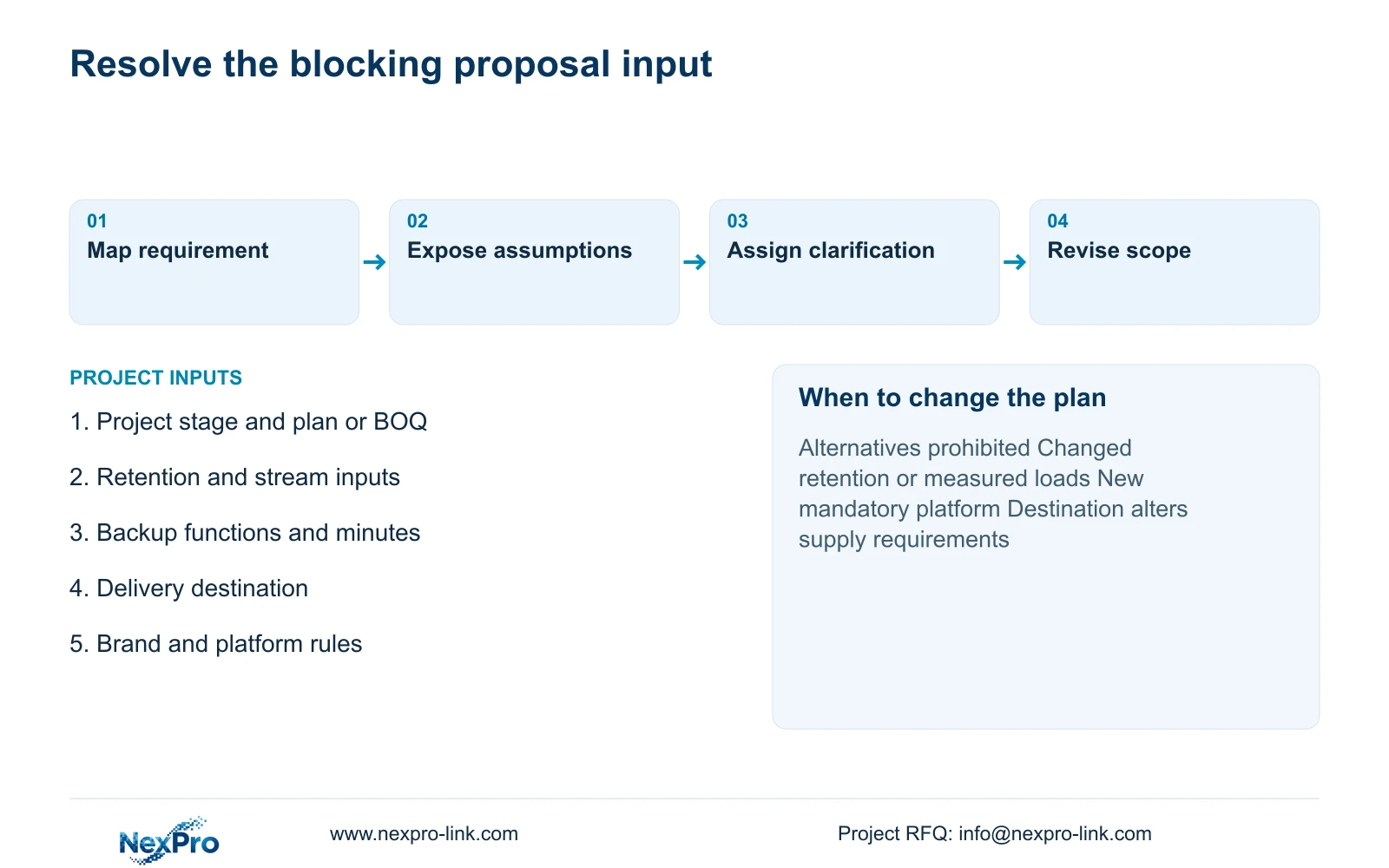
Review the response against the decision named in the first inquiry. Resolve the gap that blocks progress: a recorder mode, usable storage arrangement, camera power requirement or mandatory client interface. Assign an owner to each missing input and retain the document revision. A preliminary response should remain preliminary until its order-critical assumptions are confirmed.
Choose a scoped first proposal when the available information can support a useful equipment comparison. Change the request if a mandatory platform emerges, actual loads exceed assumptions or destination requirements alter the supply package. A representative trial is appropriate when it can answer a specific operating uncertainty. There is no fixed response-time or approval promise in this process.
Send the project stage, available plan or BOQ, recording and backup objectives, delivery destination and permitted alternatives to info@nexpro-link.com. State the output you need next and any required decision date. Hotel project equipment support and BOQ and tender support are the existing routes for discussing model matching and coordinated supply. Keep guest images, passwords and personal access credentials out of the first inquiry.
Section 07
Buyer questions
Can we request a proposal with only a preliminary BOQ? Yes. Mark provisional quantities and identify the decision the BOQ must support. Request a preliminary model and scope response, with assumptions and missing inputs visible, rather than treating it as a final order configuration.
What can NexPro-Link provide in the first response? Depending on the supplied scope, the discussion can cover model matching, equipment coordination, calculation assumptions and quotation boundaries. The agreed response should identify exclusions and unresolved interfaces; no fixed turnaround is established here.
What if alternatives are prohibited? State that restriction at the start and provide the relevant requirement. The response must retain the mandatory baseline or identify a buyer-authorized review route, without silently substituting another brand.
Engineering references
These sources support the general planning principles. Always use the selected product's current datasheet and applicable project standards for final design.