A coordinated factory security package can reduce purchasing handoffs, but its value depends on complete scope, identifiable responsibilities and a like-for-like cost comparison.
Section 01
Count the procurement work each route actually requires
Choose coordinated factory supply when it removes documented purchasing work while preserving technical requirements and clear accountability. Choose separate purchasing when established suppliers, retained infrastructure or specialist responsibilities make those interfaces manageable. The quantity surveyor should compare complete prices alongside the work required to turn each offer into an installable package. Supplier count alone does not establish value.
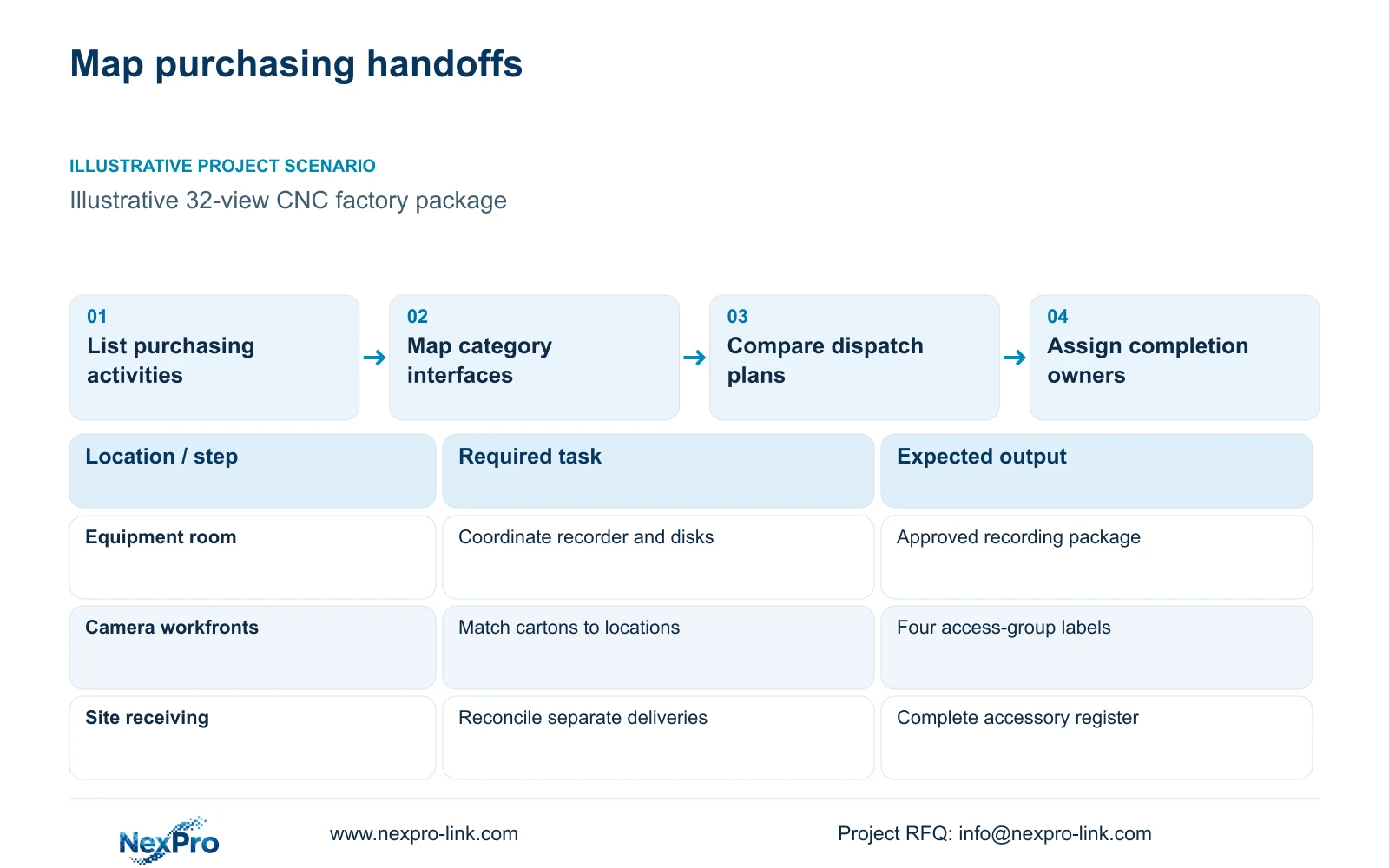
Illustrative project scenario: A contractor can buy categories separately or use a coordinated NexPro-Link package for the CASE01 new CNC factory. The hypothetical scope contains 32 ordinary security views covering gates, stores, permitted material transfers, common routes, dispatch and equipment-room approaches. Local recording, protected power and cabling support those views. Machine inspection and guarding remain outside this security package.
Create an activity register covering technical queries, model approvals, accessory checks, purchase orders, configuration records, packing instructions and delivery reconciliation. Give each activity an owner and identify whether it occurs once, per supplier or per shipment. If labour cost is included, use documented hours and an agreed internal rate. Where hours are unknown, retain the activity as an unresolved workload rather than inventing a saving. This register shows which handoffs a coordinated offer would genuinely remove.
Section 02
Compare dispatch plans against the installation sequence
Separate purchasing may produce individually complete category deliveries that still need sorting into installation groups. A camera carton, recorder shipment and cable delivery can arrive under different references. Ask who reconciles them against the location schedule, where that work occurs and whether installation can start without the remaining categories. A combined shipment deserves the same scrutiny: one arrival date can delay every workfront if a required item is unavailable.
For CASE01, a useful packing proposal would identify the four eight-camera access groups and keep recorder, disk and power equipment traceable to the equipment room. The illustrative cable requirement is 1,872 m, with a feasible cutting plan using seven 305 m reels. Reel count does not replace the cut schedule or route specification. Location labels, a carton index and an accessory list should connect the shipment to the contractor's installation records.
Compare consolidated delivery with a staged release of cabinets, cabling and mounting materials before cameras and recording equipment. Price additional packing, handling and freight where applicable, and state the delivery boundary consistently. NexPro-Link's project supply and OEM/ODM pages describe coordination and packaging options; the quotation must identify the specific work included. Branding is optional unless required by the buyer, and should not obscure model or serial identification.
Section 03
Assign ownership at the equipment interfaces
A coordinated purchasing contact still needs a responsibility schedule. For each item, record its required task, whether it is supplied, retained or optional, and the party responsible for approval and completion. Distinguish hardware preparation from site installation. A supplier can prepare a recorder configuration while the local installer remains responsible for addressing, cable tests and final camera alignment.
In the illustrative factory, the recorder supplier proposes the disk combination and supported stream configuration. The designer confirms retention and operating requirements, while the installer checks the installed recording and export workflow. NexPro-NVR4449-4K provides a relevant reference with 49 channels, 320 Mbps input and four SATA bays supporting up to 18 TB per drive. Those published fields do not establish RAID or unrestricted simultaneous decoding.
Apply the same division to backup power: equipment supply identifies the selected UPS and battery configuration, and the electrical team confirms the protected circuit and installation conditions. An omitted battery or unprotected switch remains a gap even if the NVR appears in the package. Record who handles a fault that crosses categories, such as cameras disappearing after a switch restart. This makes coordination useful during diagnosis as well as purchasing.
| Item | Required task | Scope status | Responsible party |
|---|---|---|---|
| Recorder and disks | Retain agreed video | Supplied | Supplier proposes; designer approves |
| CAT6 links | Connect scheduled camera points | New installation | Local installer routes and tests |
| Protected circuit | Supply essential CCTV loads | Site electrical work | Electrical team installs |
| Project labels | Match cartons to locations | Quoted packing option | Supplier prepares; contractor checks |
Section 04
Normalize complete costs before judging the cheaper offer
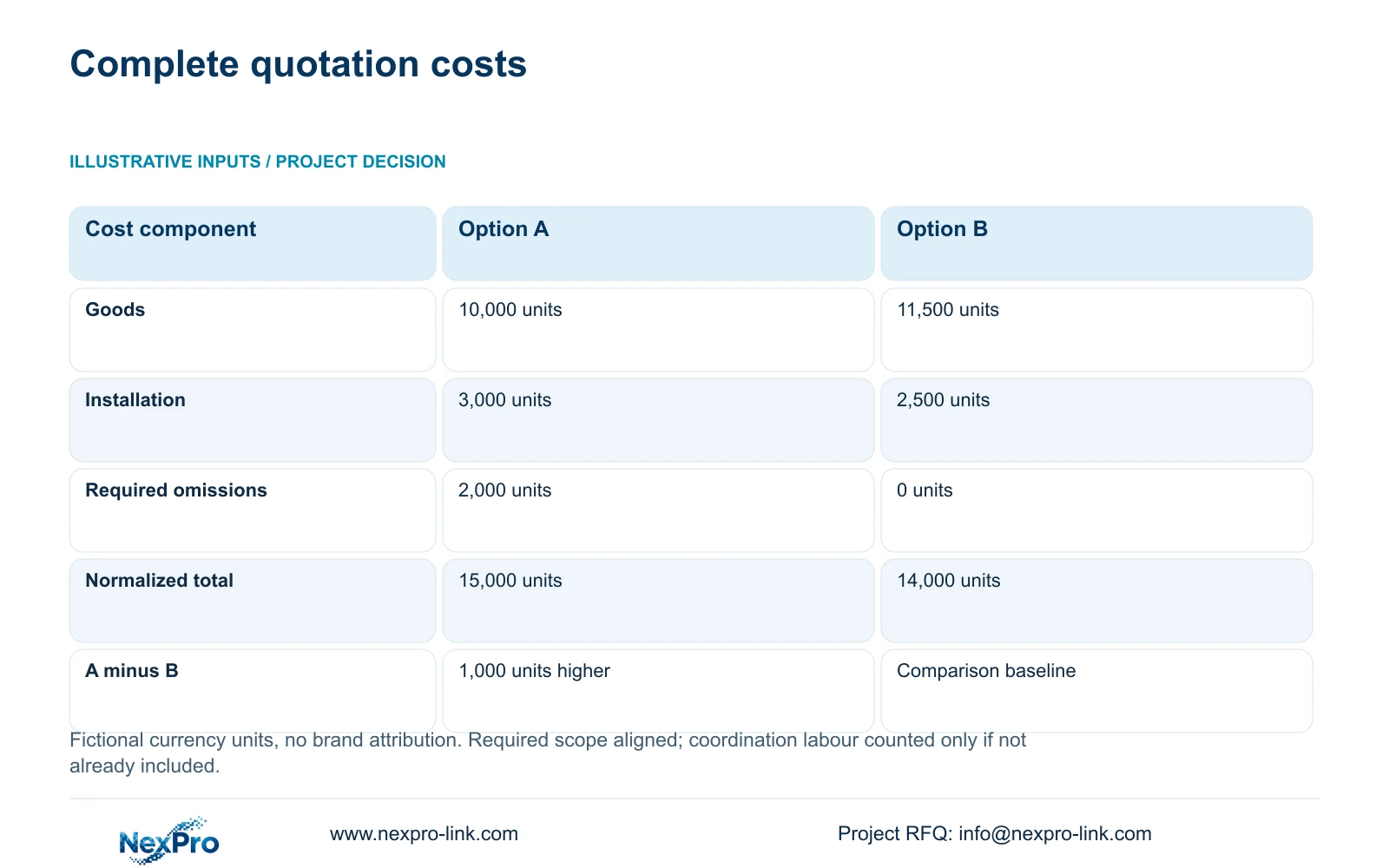
The following comparison uses purely fictional currency units, with no attribution to NexPro-Link or another brand. Option A quotes goods at 10,000 units, installation at 3,000 units and omits required scope valued illustratively at 2,000 units. Option B quotes goods at 11,500 units, installation at 2,500 units and has no required omitted scope within this example. Neither option label represents a purchasing route by default.
Use normalized_total = goods + installation + required_omitted_items. Option A totals 10,000 + 3,000 + 2,000 = 15,000 units. Option B totals 11,500 + 2,500 + 0 = 14,000 units. The difference, A_total - B_total, is 1,000 units. A's 1,500-unit goods advantage is outweighed by its 500-unit installation difference and 2,000-unit omission. The decisive issue is the complete scope, not the lower goods subtotal.
The arithmetic does not prove that consolidated supply saves 1,000 units. Replace every monetary input with current quotations sharing quantities, currency and delivery conditions. Add documented coordination labour only if it is outside the existing installation or service allowance. Do not count the same activity twice. Keep unknown freight, accessories or testing costs visible until priced, because an unpriced exclusion cannot reasonably be treated as zero.
| Cost component | Option A | Option B |
|---|---|---|
| Quoted goods | 10,000 units | 11,500 units |
| Installation | 3,000 units | 2,500 units |
| Required omitted scope | 2,000 units | 0 units |
| Normalized total | 15,000 units | 14,000 units |
Section 05
Select the route that resolves the difficult handoffs
For the illustrative new-build package, invite a coordinated offer where model matching, preparation and project-labelled packing would otherwise fall between suppliers. Require it to preserve the recording, power and cable requirements already agreed. Compare the offer against separate purchasing after completing the cost bridge. A modestly higher equipment subtotal may be acceptable when priced preparation removes site work, but that conclusion needs actual commercial evidence.
Retain separate purchasing where the owner has approved network equipment, a mandatory platform or a specialist contractor whose scope must stay independent. A hybrid arrangement may be more appropriate: coordinated cameras and recording equipment, owner-provided networking and locally installed electrical services. Include interface checks in that arrangement rather than assuming retained equipment will support the new package.
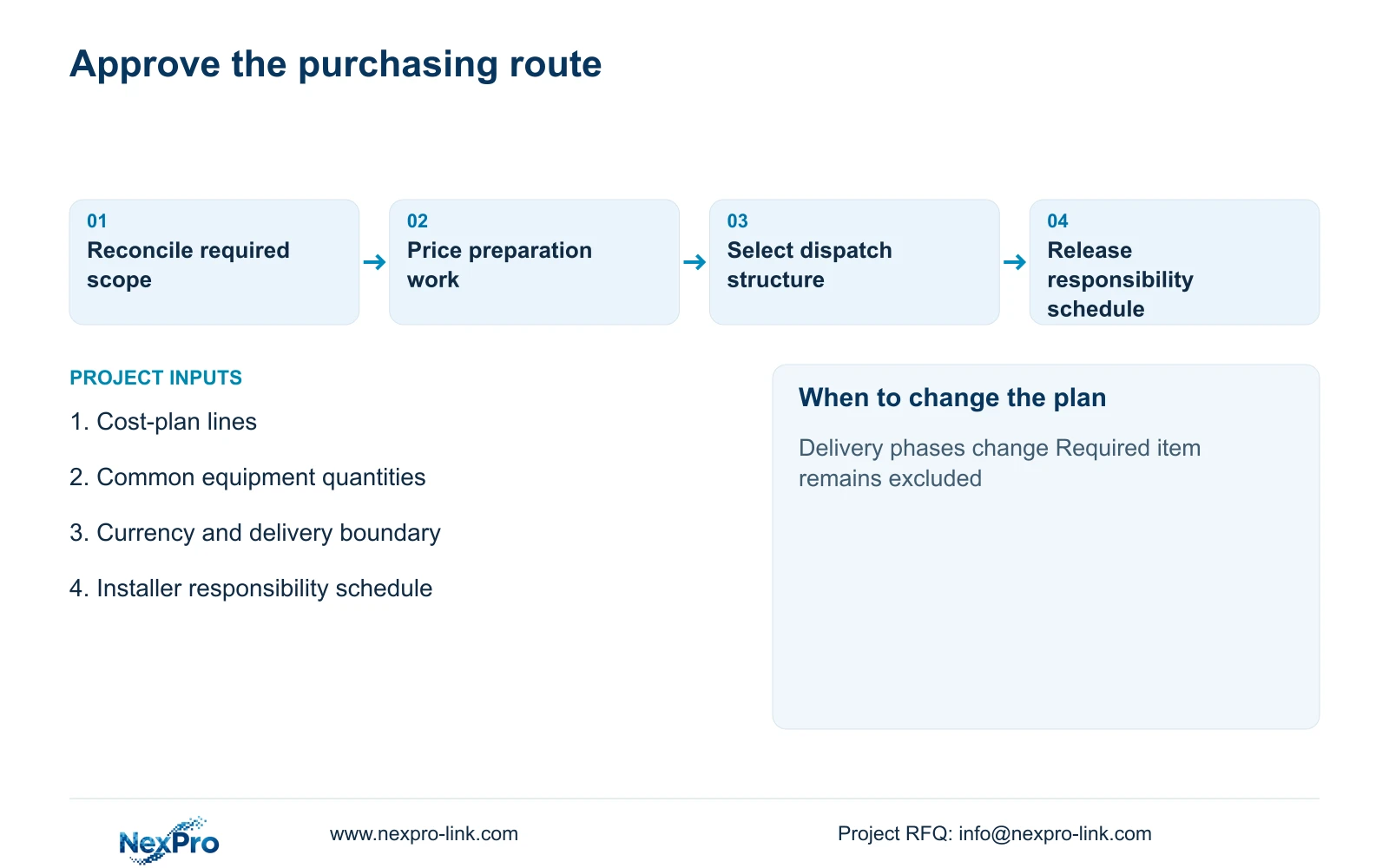
Revisit the recommendation if delivery phases change, a required item cannot be supplied or the installer rejects the proposed preparation method. Removing a handoff is valuable only if the receiving party accepts the result. The approval record should therefore name the chosen purchasing route, unresolved dependencies and conditions that could reverse the decision.
Section 06
Release a package schedule with measurable deliverables
Convert the decision into a procurement schedule with separate lines for equipment, preparation, packing, dispatch and site work. Identify exact models where approved and functional requirements where selection remains open. Attach the accepted technical deviations and exclude optional display equipment from the base total unless the operating brief requires it. This prevents a broad package description from becoming an ambiguous purchase order.
Specify deliverables that can be checked at receipt: carton references matching the equipment schedule, an accessory list, configuration records where included and a list of outstanding site settings. State who resolves shortages and how substitutions are approved before dispatch. These checks apply to both coordinated and separate supply, although responsibility may be distributed differently.
NexPro-Link's Factory & Warehouse project supply and BOQ & Tender Support pages provide relevant routes for discussing a coordinated equipment list and model matching. Keep local installation and final acceptance with the appointed project parties. The commercial output should be a like-scope cost bridge and a conditional recommendation, supported by a delivery plan the installation team can use.
Section 07
Buyer questions
Should fewer purchase orders be assigned a financial saving? Only where the buyer can substantiate the associated work. Count approval and reconciliation activities first, then apply documented hours and agreed labour rates. Fewer orders can simplify administration without producing a measurable reduction in expenditure.
Can owner-supplied equipment remain in a coordinated package? Yes. List it as retained or owner-provided, identify its interfaces and assign compatibility checks. The coordinated supplier should quote its preparation scope without charging for equipment the owner is already providing.
Does project packaging need private-label branding? No. Neutral cartons with location labels may satisfy the installation task. Quote logos, custom boxes and branded documentation separately so the buyer can distinguish operational packing from optional brand presentation.
Section 08
Request a like-scope supply comparison
Send your cost-plan lines, common equipment quantities, quotation currency and delivery/scope conditions to info@nexpro-link.com. NexPro-Link can discuss a coordinated offer with explicit preparation, packing and installation boundaries.
Engineering references
These sources support the general planning principles. Always use the selected product's current datasheet and applicable project standards for final design.