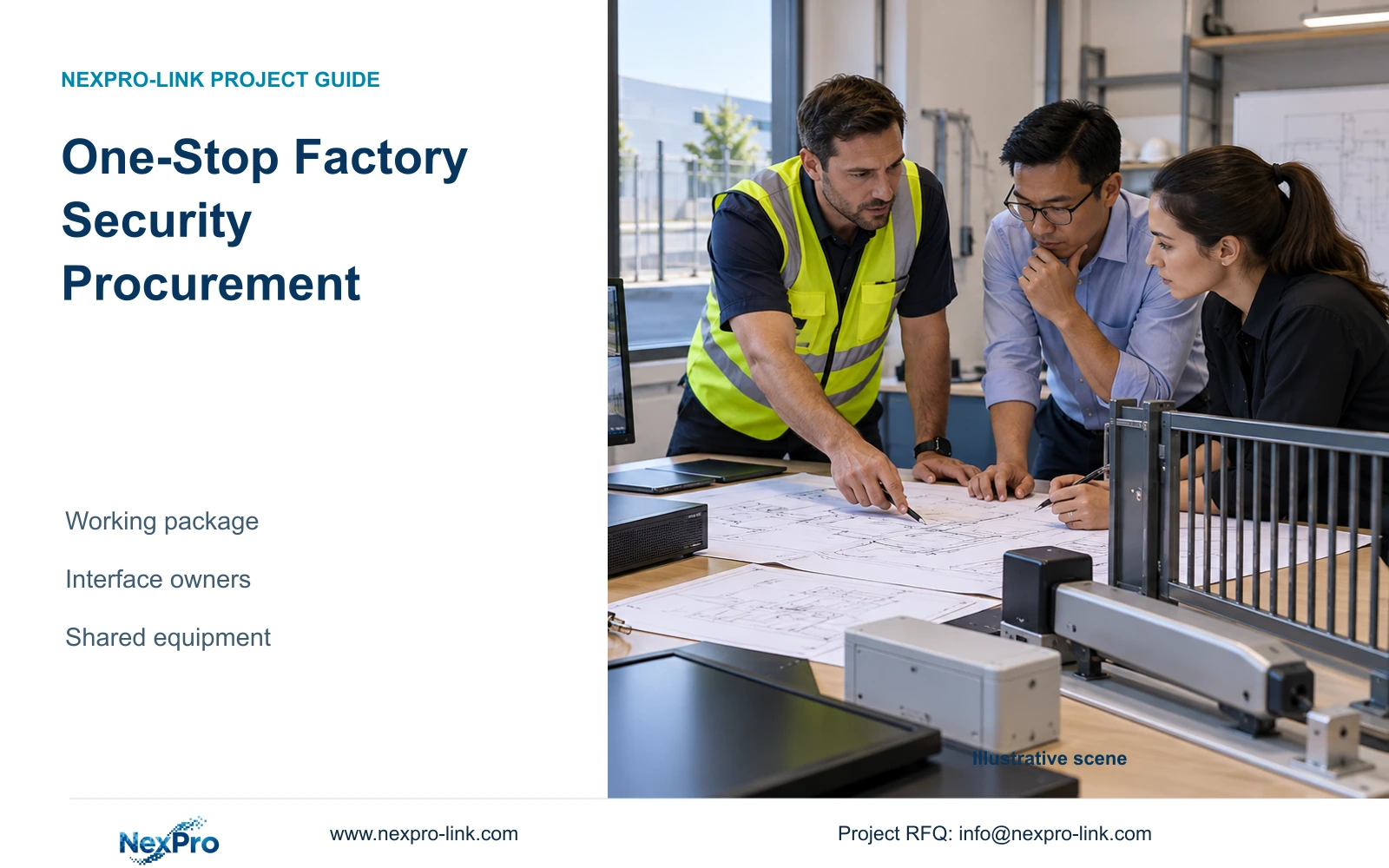
One quotation can coordinate factory security equipment, but a working package still needs named interface owners, complete dependencies and a clear installation boundary.
Section 01
Define the operating chain before combining categories
One-stop factory security procurement should combine the equipment needed for defined operating tasks and assign responsibility for every connection between categories. Start with a usable recording package, then add gates, displays or management functions against explicit requirements. A single invoice coordinates purchasing; it does not establish software integration or include local construction.
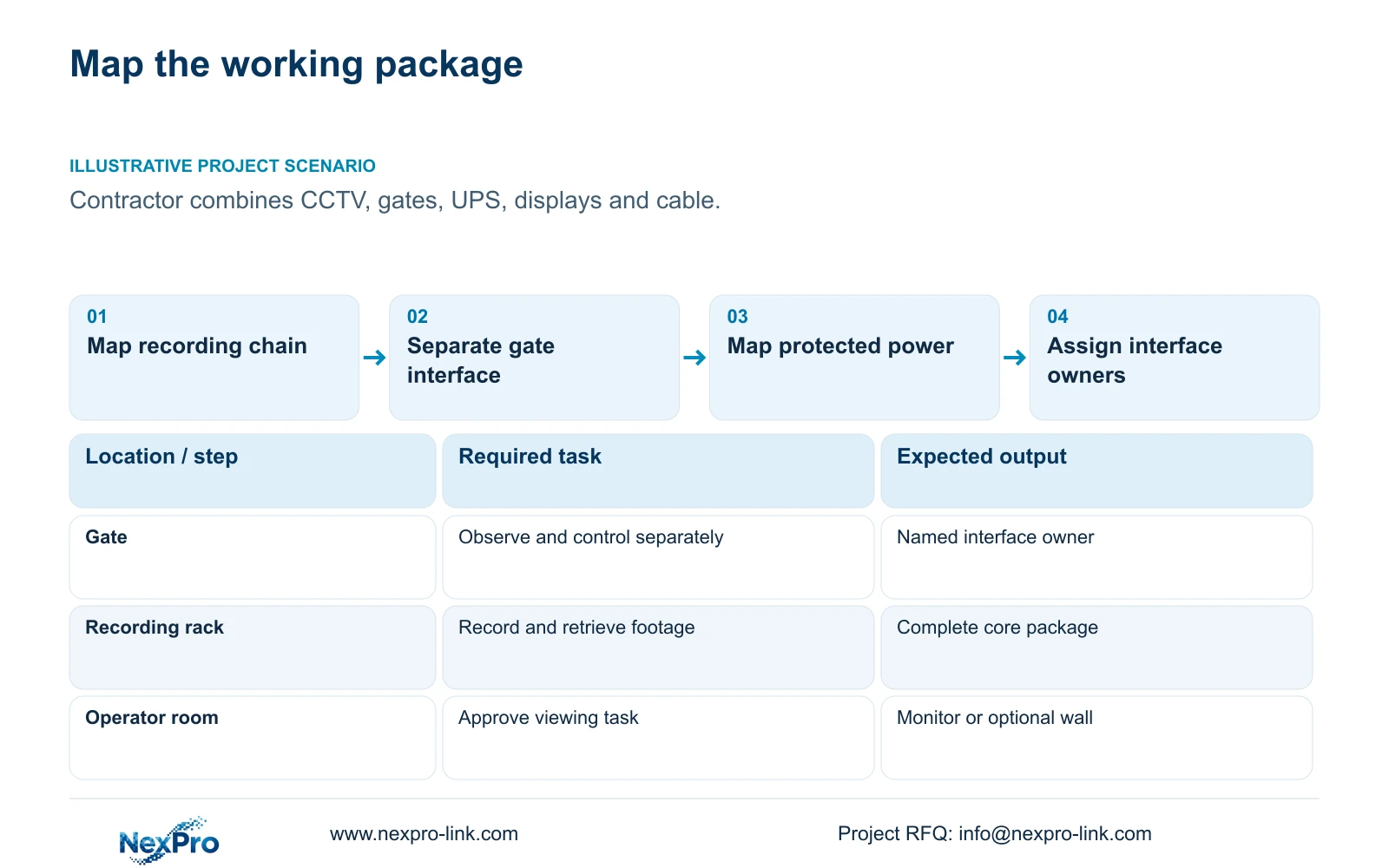
Illustrative project scenario: A contractor wants CCTV, gates, UPS, displays and cable in one quotation. Assume the owner needs footage of material handovers and staff access, while a local crew installs the equipment. The contractor must distinguish observing a gate from controlling it, and retrieving footage from showing selected live views.
Draw the CCTV data chain from camera through access switch and recorder to authorised playback and export. Draw protected power separately from mains through UPS and distribution to the equipment actually connected. Gate controls form another functional chain unless an approved interface connects them. These diagrams expose missing equipment and prevent a category heading from standing in for an operating result.
Section 02
Assign supply, installation and interface work explicitly
For each chain, specify what arrives in the shipment and what the installer provides. Camera supply may include a selected bracket and labelled accessories, while mounting, containment and cable testing remain local work. UPS supply needs an agreed configuration and connection boundary; distribution and site electrical work cannot be inferred from the presence of a UPS line.
Name one coordinating owner for each interface without erasing the participating parties. At the gate, the project manager could assign the gate contractor to confirm control connections and operating behaviour, with the CCTV installer responsible for the accepted view. If automated plate recognition is required, specify its separate camera, processing and interface scope rather than treating ordinary vehicle classification as recognition.
NexPro-Link's project supply scope includes equipment selection, preparation, packing and export coordination. That supports a combined procurement package while leaving local installation with the appointed team. Keep specialist systems and machine safeguarding under their applicable responsibilities. The distinction allows a supplier to offer relevant equipment without implicitly accepting functions outside its documented scope.
Section 04
Separate the usable core from justified integration
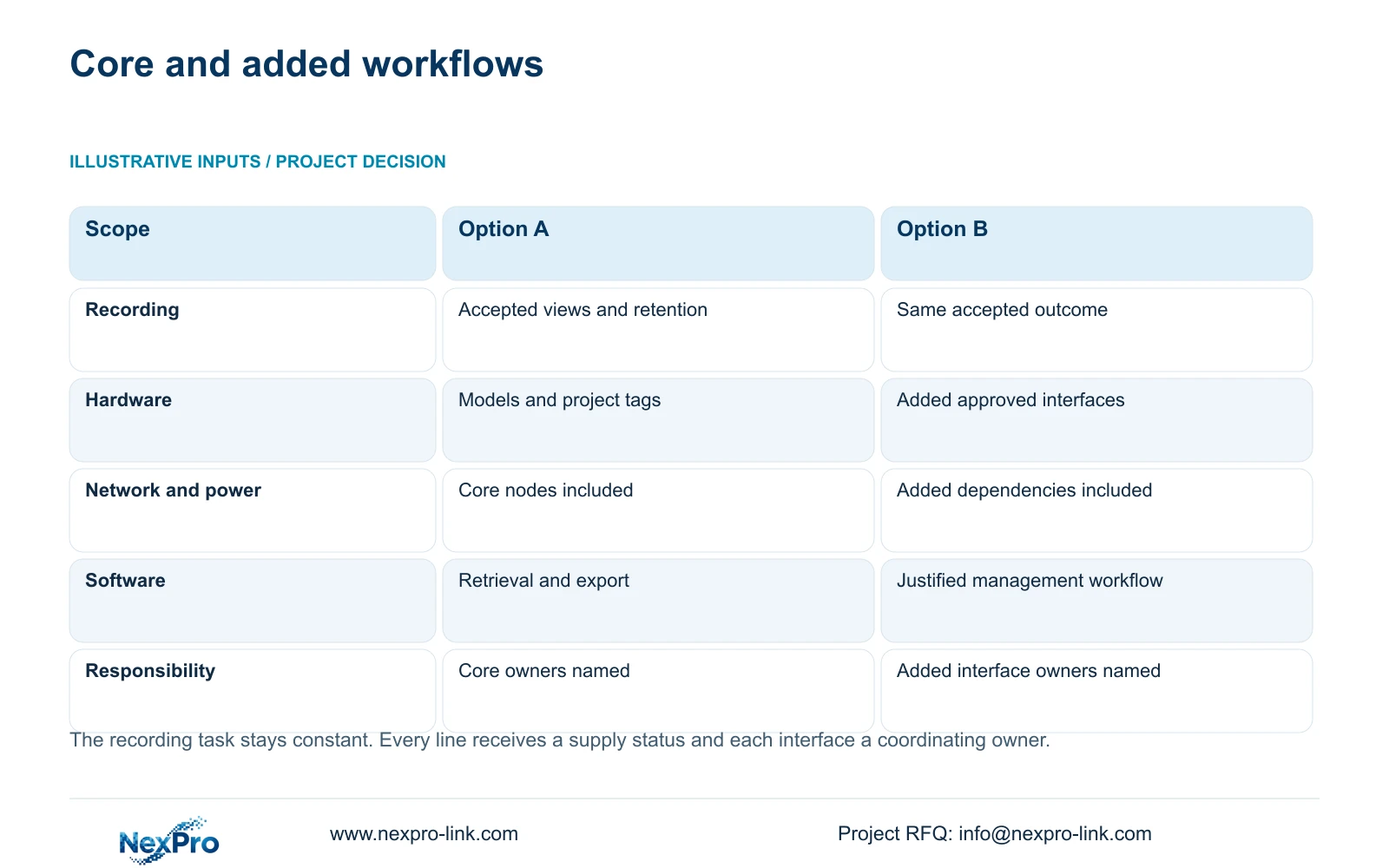
Option A below provides the defined recording and retrieval task with complete infrastructure. Option B preserves that outcome and adds approved workflows. Assign every corresponding order line to supplied, retained, installer-provided or optional. A blank inclusion field needs clarification; it is neither a free item nor evidence that an interface is incompatible.
The decisive difference is the additional workflow and its dependencies. A central management request may add server hardware, software, network access and operator responsibilities. Buying those items makes sense when the owner has a task that the core package cannot complete. A longer list of equipment alone does not justify the expanded option.
For mixed equipment, confirm the exact device and client capabilities involved. ONVIF profiles describe specific interoperability scopes, and basic video connection does not establish event handling, audio or search workflows. Record the expected operation and test it with the selected firmware before promising an integrated handover.
| Decision | Option A: operating core | Option B: approved additions |
|---|---|---|
| Recording outcome | Accepted views and retention | Same views and retention |
| Hardware identity | Exact models and project tags | Same plus interface equipment |
| Network and power | All core nodes included | Added servers and interfaces included |
| Software and access | Authorised retrieval and export | Additional defined workflow |
| Procurement basis | Complete core BOM and owners | Added BOM and interface owners |
Section 05
Choose additions by operator task and service consequence
Start with Option A when operators need local recording, authorised retrieval and a modest viewing arrangement. Add management only for a defined requirement such as coordinating several recording nodes or an approved gate-event workflow. Preserve any owner-mandated platform, because replacing it can change permissions, training and integration work even when camera coverage remains similar.
Treat a display wall as a separate operating choice. The reference case retains its retrieval display and optionally adds four LCD panels and a decoder. Its assumed additional demand is 4 × 120 W + 100 W = 580 W, not measured product consumption. The NX-VP-5535 is an LCD reference, while the NX-VD-4K16 name does not establish every proposed decoding combination.
Adding that wall requires review of layouts, input streams, mounting, power and maintenance access. If occasional playback on a normal monitor meets the task, keep the wall optional. Compare alternative brand packages on the same retained recording outcome and selected additions, including local services, rather than assuming that a coordinated quotation means identical functionality.
Section 06
Turn the combined quotation into installable work packages
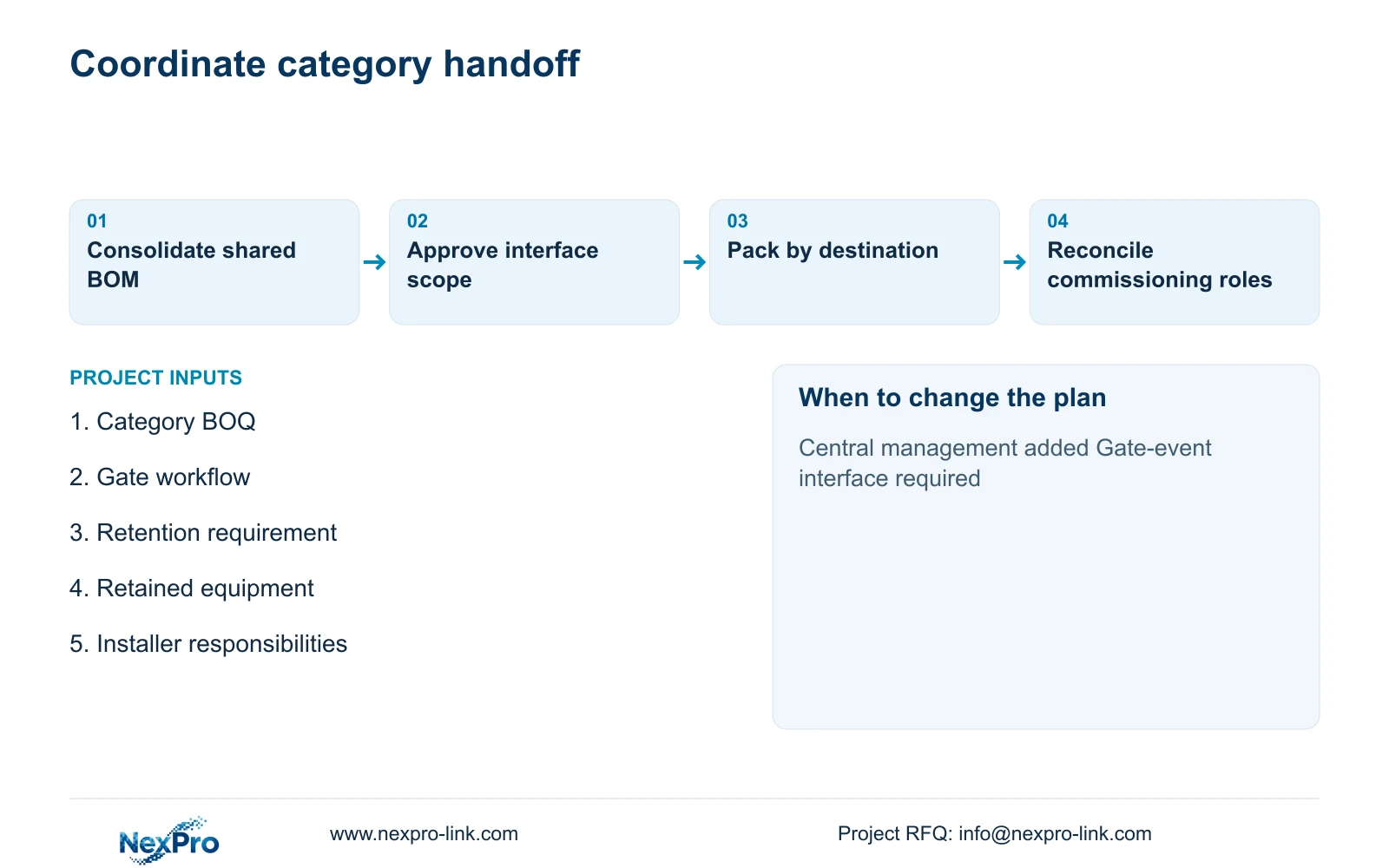
Organise the approved package by installation zone and functional chain, while maintaining a single master BOM. Each carton list should identify the equipment, accessories and project tags for its destination. Shared rack equipment belongs to its own package so it is not lost among gate or dispatch cartons.
Use technical submittals and deviation records to connect the physical supply with the accepted schedule. NexPro-Link's BOQ support can help with model matching and quotation coordination, and project packing can follow those identifiers. Branding choices should remain separate from functional approval; changing a hardware label does not alter third-party software identity or permissions.
Before dispatch, reconcile supplier preparation with local commissioning tasks. Identify who verifies recording, who confirms the gate interface and who demonstrates operator retrieval. Keep unresolved interface additions out of the accepted core total or price them transparently as options. A working package is ready for handoff when its equipment and responsibilities agree.
Section 07
Buyer questions
Can we retain an existing switch or UPS in a combined package? Yes, if its capacity, connections and service condition fit the accepted task. Mark it as retained, identify its owner and include any configuration or connection work. Retention removes a supply quantity, not its dependency.
Who handles a fault that crosses two supplied categories? Agree a coordinating contact and escalation path before the order. The contact should collect the relevant symptom and configuration, while the responsible product or installation party handles its own scope. One invoice alone does not define this process.
Should optional integration delay the recording package? Only if recording acceptance depends on it. Otherwise, define a complete independent core and a later interface milestone, with the additional equipment and commissioning work stated separately.
Section 08
Define your combined security supply boundary
Send your category BOQ, required recording and gate workflows, retained-equipment list and installation responsibility split to info@nexpro-link.com. NexPro-Link can discuss a coordinated core package and clearly identified integration options.
Engineering references
These sources support the general planning principles. Always use the selected product's current datasheet and applicable project standards for final design.