Replacing four cameras can change recorder input and retention requirements without changing channel count. Qualify the new image task, playback combinations and complete equipment scope.
Section 01
Qualify the new camera task on the retained recorder
Retain the existing recorder only after the proposed camera profile passes stream acceptance, recording, required playback and storage checks. Replacing cameras leaves the channel count unchanged, but higher-detail profiles can change incoming bitrate and the local viewing combinations available to operators. Begin with the additional information the factory needs from the upgraded views, then test a representative new camera through the intended protocol and codec. Calculate the complete stream mix and retention requirement before purchasing the remaining units. Spare channel slots alone cannot establish upgrade suitability, and a lower-rate profile that loses the required detail does not complete the upgrade.
This guide follows NVR4.0 user manual CH_V2.4.doc, with V2.2 in its body. Sections 4.4 and 4.10 establish camera-dependent functions; sections 4.4.5 and 4.12.7 cover encoding; sections 5.1, 5.2 and 5.3 question 7 cover storage, model limits and channel resources. TS model references are not mappings to NexPro-Link commercial SKUs.
Record the new camera model, firmware, protocol and relevant permissions. Test required operations separately from basic video. An unavailable control can reflect the supported connection scope, so confirm that scope before calling the camera faulty or assuming the recorder needs replacement.
Section 02
Select an accepted output that preserves useful detail
The manual lists H.264, H.265 and H.265+, while available resolutions depend on IPC capability. Specify the actual output mode, frame rate and rate-control profile for the new camera. A higher megapixel label does not supply its bitrate or prove compatibility through the intended playback path.
Keep a comparable old recording before an authorized profile change. Check the new view against the factory's required detail, then test recording, export and the receiving client. A codec label alone cannot establish a fixed storage saving.
If the new profile fails export or the intended client, investigate the supported mode before ordering the whole replacement group. Accepting a camera because it appears in preview can leave the operator unable to retrieve useful footage later.
Section 03
Check simultaneous playback independently of enrollment
List recording channels, incoming bandwidth, preview decoding, simultaneous playback and monitor output as separate limits. Section 5.2 gives model-specific playback combinations. A recorder's ability to enroll the cameras does not establish that all upgraded recordings can be reviewed together at full resolution.
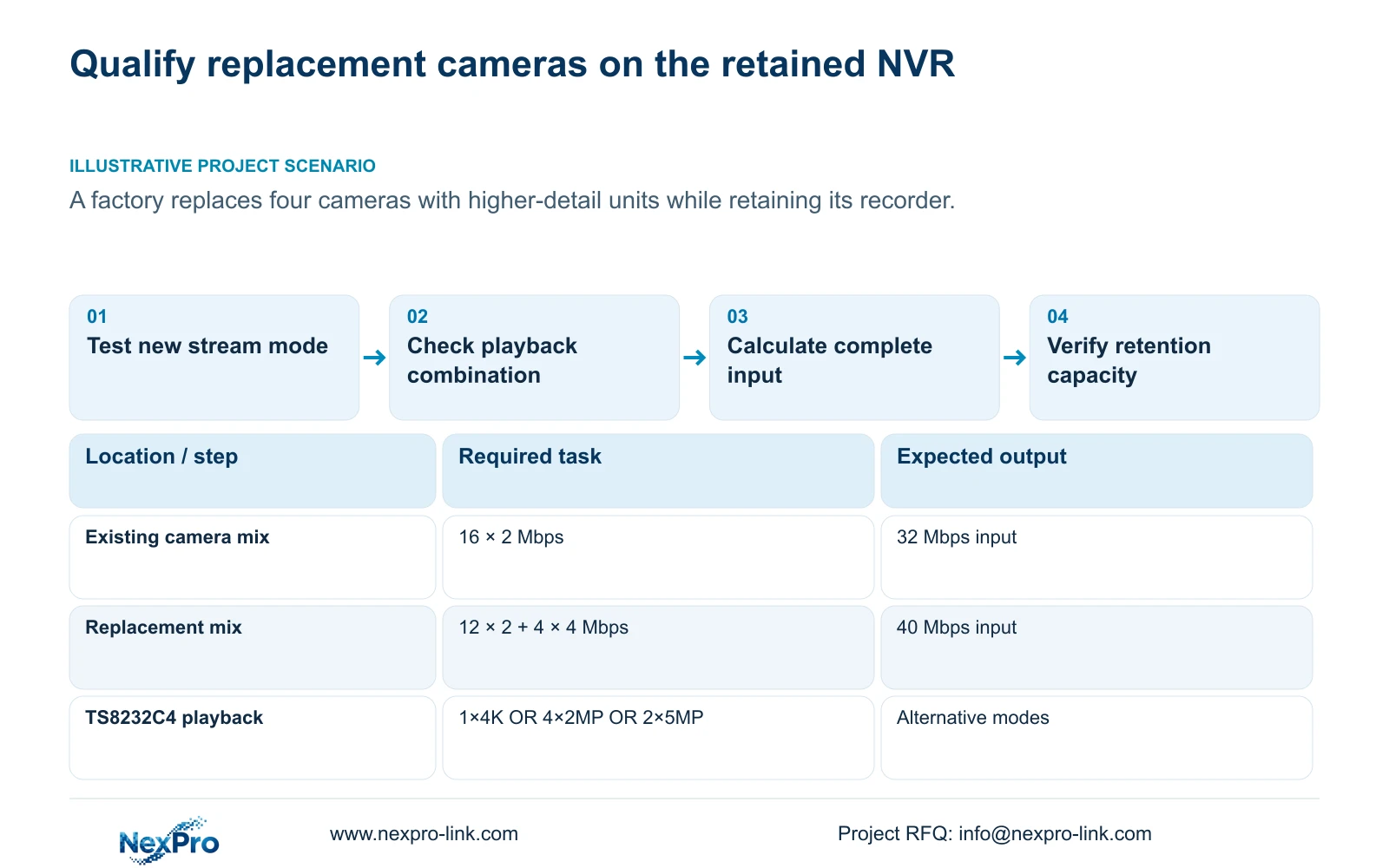
For TS8232C4, the supplied alternatives are 1×4K OR 4×2MP OR 2×5MP. TS8108D7 lists 1×3MP; TS8116D7 lists 1×5MP OR 2×2MP. TS8836M/TS8436M lists 1×4K 30fps OR 2×5MP OR 4×4MP@20fps OR 4×2MP@25fps. Preserve these as alternative modes, not additive capacities.
Ask which upgraded views operators must review simultaneously. Match that task against the actual recorder's documented combination and test it with the selected profiles. Do not transfer a TS appendix limit to a commercial model based on channel count or appearance.
Section 04
Calculate the whole stream mix before reducing quality
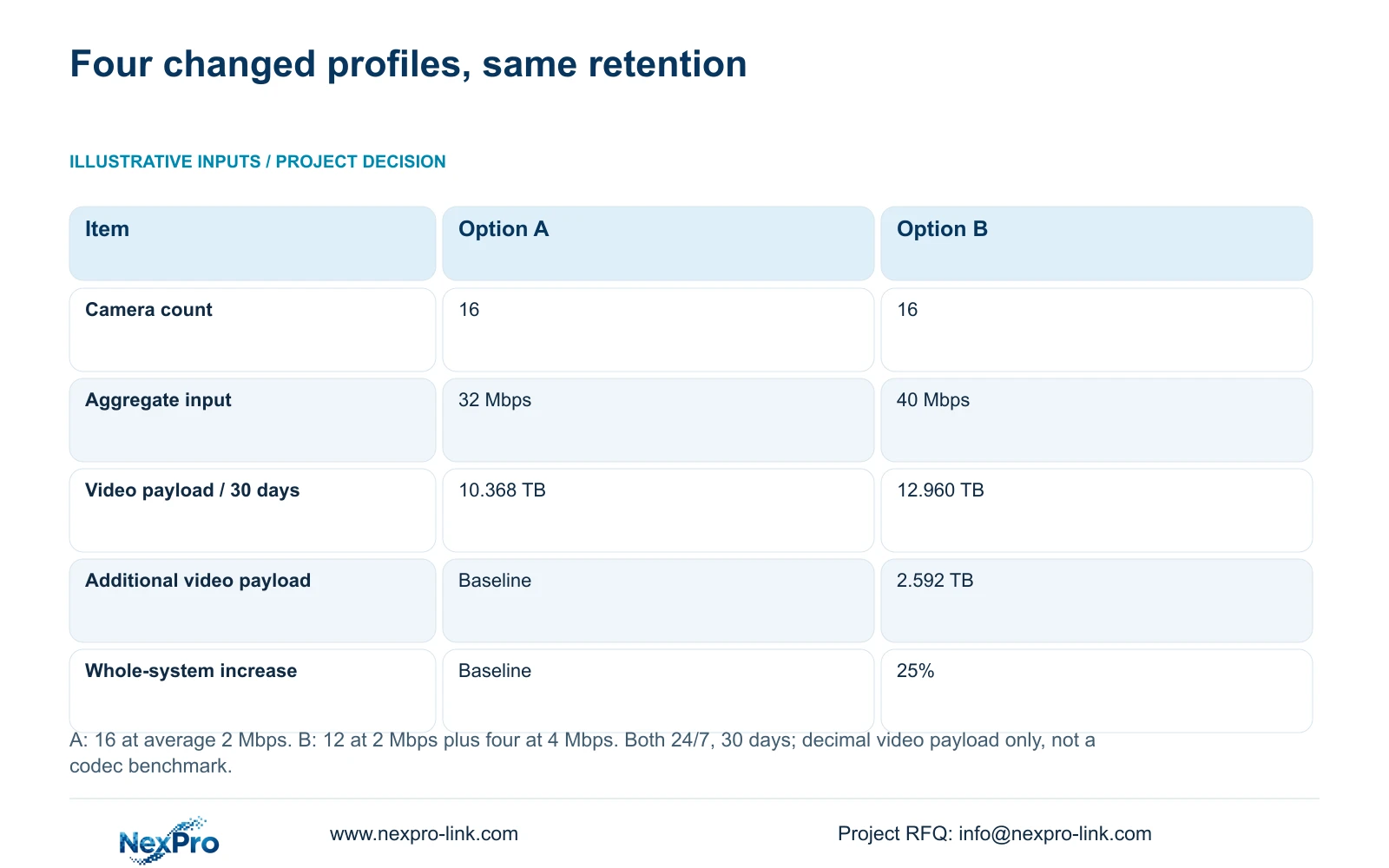
The supplied illustration keeps 16 cameras. Option A assumes all 16 average 2 Mbps. Option B keeps 12 at 2 Mbps and changes four to 4 Mbps. Both record continuously, 24/7, for 30 days. These are planning assumptions, not a measured comparison of resolutions or H.264 against H.265.
Aggregate input = Σ(group channels × average Mbps). Option A = 16 × 2 Mbps = 32 Mbps. Option B = 12 × 2 Mbps + 4 × 4 Mbps = 24 Mbps + 16 Mbps = 40 Mbps.
The increase is 40 - 32 = 8 Mbps. Relative increase = 8 ÷ 32 × 100% = 25%. Only four assumed profiles change, so the complete input increases by 25%; it does not double. Compare that planned average with the actual recorder's input scope and evaluate relevant peaks separately.
Section 5.3 question 7 associates insufficient channel resources with total incoming IPC bandwidth and suggests reducing the affected bitrate. First distinguish incoming limits from local decoding constraints. Any reduced profile must still pass the factory's image task.
| Item | Option A | Option B |
|---|---|---|
| Camera profiles | 16 × 2 Mbps | 12 × 2 Mbps + 4 × 4 Mbps |
| Aggregate input | 32 Mbps | 40 Mbps |
| Recording duration | 24/7 for 30 days | 24/7 for 30 days |
| Video payload | 10.368 TB | 12.960 TB |
| Additional video payload | Baseline | 2.592 TB |
Section 05
Preserve the retention target in the storage comparison
In decimal units, video TB = 0.00045 × Σ(channels × average Mbps × hours per day × days). For continuous recording, 0.00045 × 24 = 0.0108 TB per Mbps-day. The example therefore uses video TB = aggregate Mbps × 0.0108 × 30.
Option A = 32 × 0.0108 × 30 = 10.368 TB. Option B = 40 × 0.0108 × 30 = 12.960 TB. Additional video payload = 12.960 - 10.368 = 2.592 TB. The payload increase is 2.592 ÷ 10.368 × 100% = 25%.
These totals exclude additional audio, storage overhead and reserve. If the approved reserve fraction is r, required usable capacity for the included data = included volume ÷ (1 - r). The example supplies no reserve fraction, so it does not establish a final disk order.
Check the retained recorder's supported disks and actual usable arrangement. Do not infer RAID levels or redundancy from a shared menu. If adequate storage requires a supported disk change, preserve relevant recordings and obtain authority before any formatting operation.
Section 06
Compare qualified reuse and replacement scopes
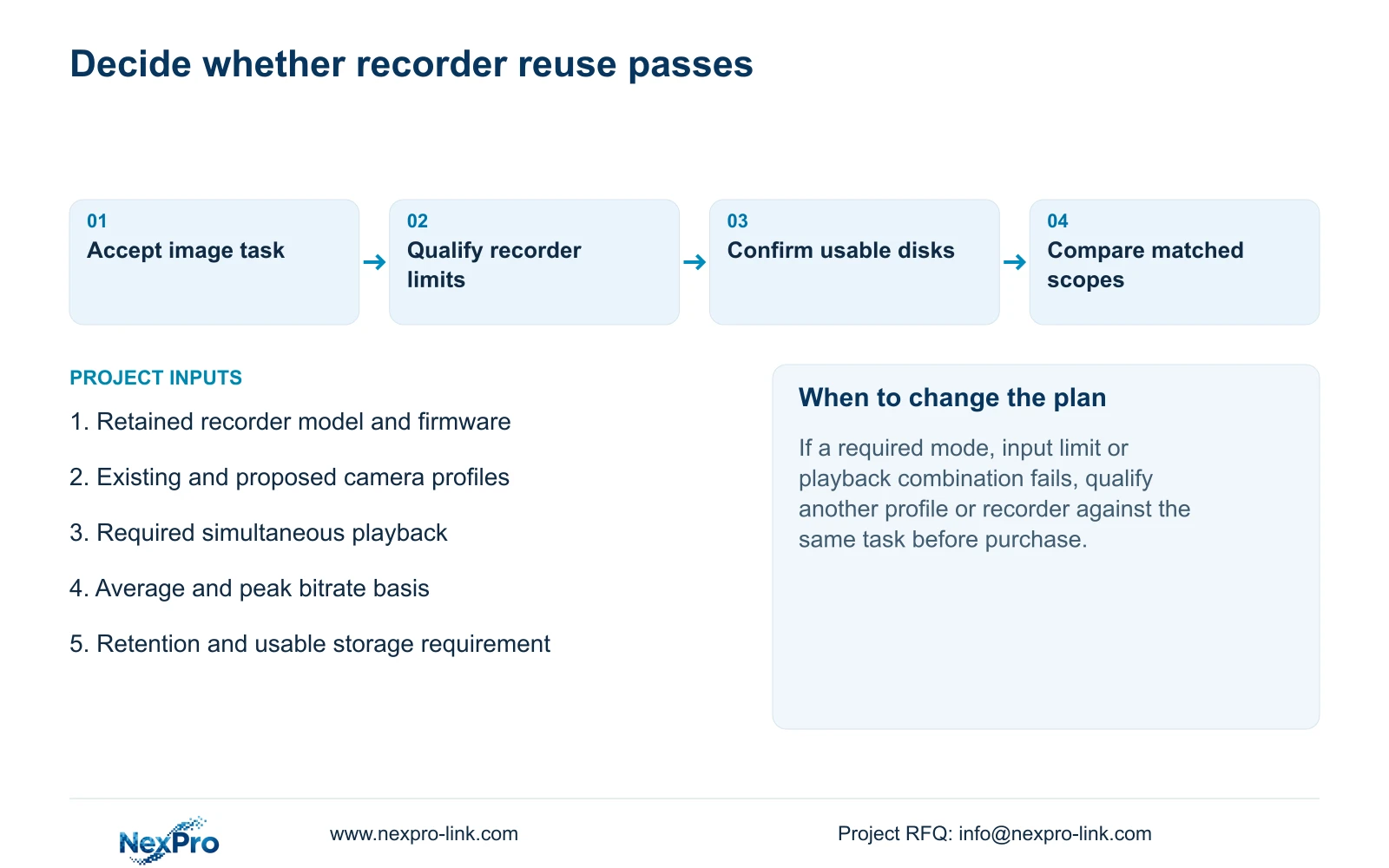
Retain the NVR when the accepted new modes, aggregate input, required playback and usable storage all fit its verified scope. If one constraint fails, identify it explicitly. A storage shortfall, unsupported camera mode and insufficient playback combination require different proposals.
Compare reuse and replacement offers against the same camera tasks, retention and playback requirements. Include disks, accessories, software and configuration or local service responsibilities. A recorder-only price cannot be compared directly with an installed-system price, and this source supplies no matched quotations from which to calculate savings.
Illustrative project scenario: A factory replaces four existing cameras with higher-detail units while keeping the recorder. The engineer qualifies a representative new view, checks the operator's simultaneous playback task and applies the 16-camera stream calculation. The retained NVR remains a conditional choice until the actual model limits and usable storage are confirmed.
For a commercial comparison, the supplied NexPro-NVR4449-4K public page provides limited fields including 49 channels, 320 Mbps input and four SATA positions with up to 18 TB per disk. Those fields can help define an equipment enquiry, but they do not establish TS equivalence, usable RAID capacity or approval of the factory upgrade.
| Qualification result | Decision | Required next evidence |
|---|---|---|
| Modes, input, playback and storage pass | Retain the recorder | Record accepted profiles and operating checks |
| Only usable storage is insufficient | Evaluate supported storage scope | Disk compatibility and usable-capacity basis |
| Required mode or playback combination fails | Evaluate another qualified profile or recorder | Same image task and operator workflow |
| Actual model limits are unknown | Keep the purchase decision conditional | Model-specific technical documentation |
Section 07
Does unchanged channel count mean unchanged demand?
No. The illustration keeps 16 cameras while input rises from 32 to 40 Mbps and video payload rises by 2.592 TB over 30 days.
Section 08
Does higher resolution always double bitrate?
No fixed multiplier is established here. Use the selected profile's measured average or a labeled assumption, then verify that it preserves the required detail.
Section 09
Provide the existing and proposed profile schedule
Send NexPro-Link the retained recorder model and firmware, existing and proposed stream profiles, retention target and required playback combination at info@nexpro-link.com.
Engineering references
These sources support the general planning principles. Always use the selected product's current datasheet and applicable project standards for final design.