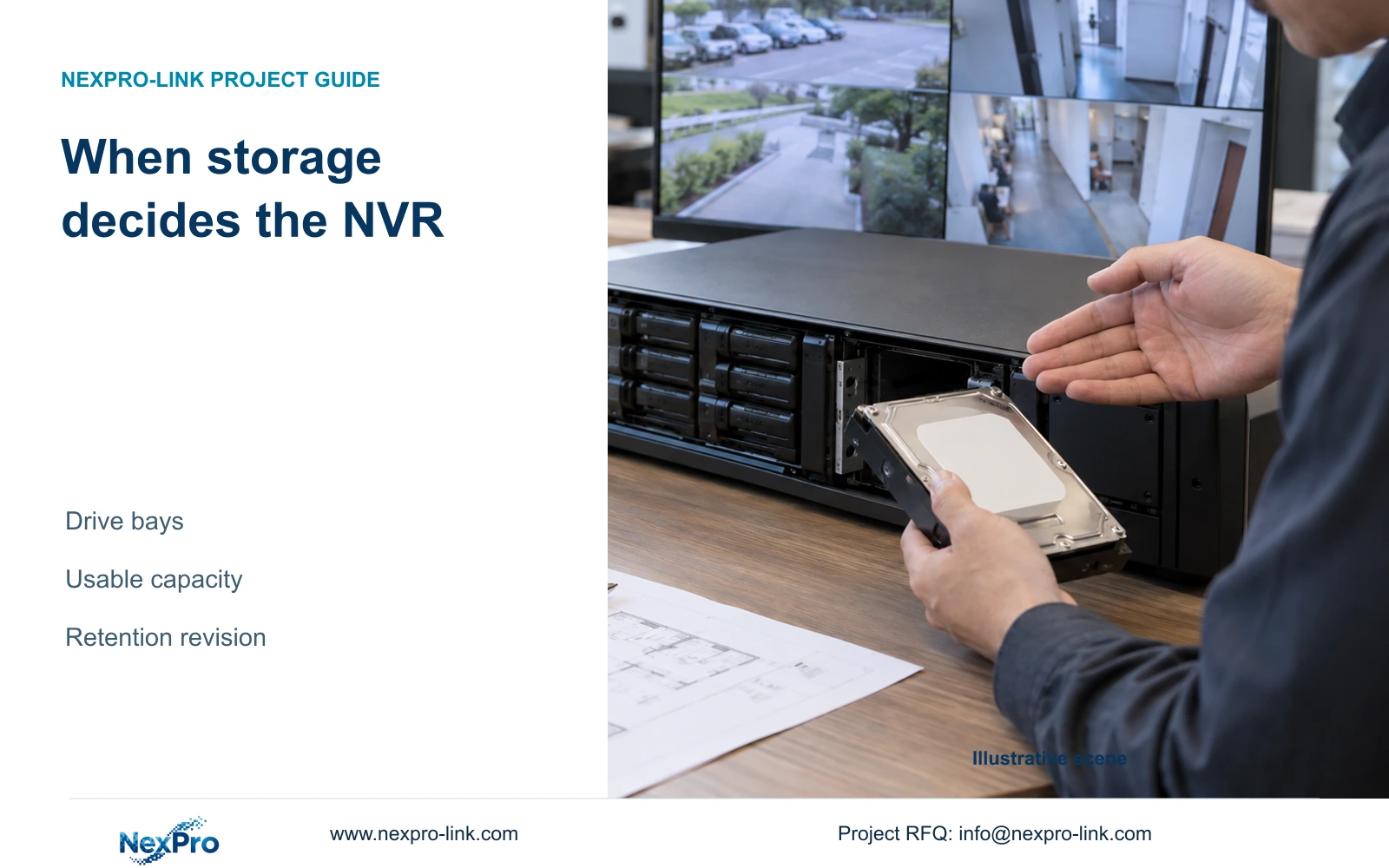
An unchanged camera schedule can outgrow the quoted storage arrangement when retention increases. Identify the exact recorder and supported disks before deciding whether more bays are needed.
Section 01
Identify the resource changed by longer retention
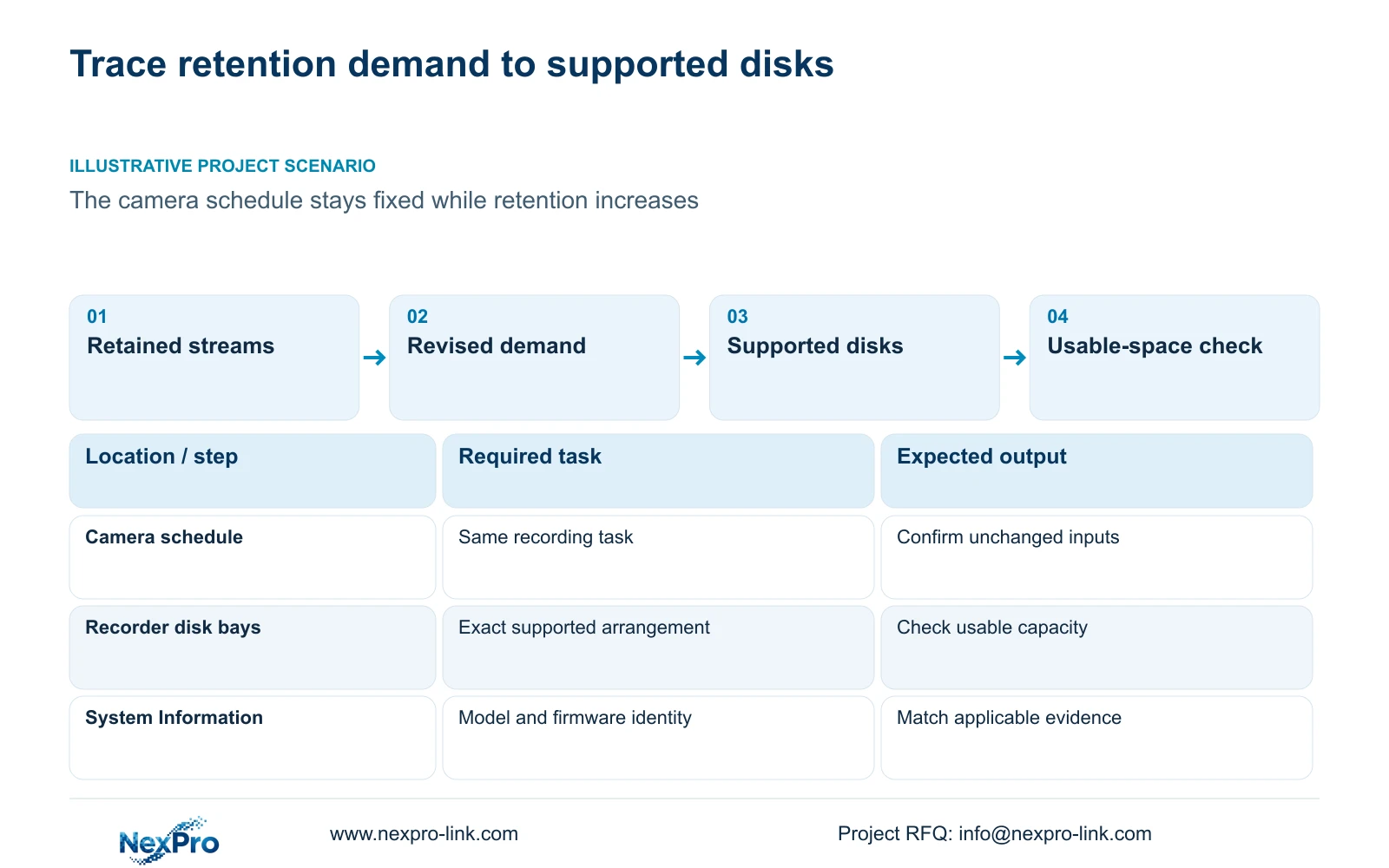
An NVR can retain enough channel slots for every camera while its quoted disk arrangement falls short of a longer retention requirement. Recalculate the recording demand using the unchanged streams, then compare the new usable-capacity requirement with supported disk configurations for the exact recorder. Retain the existing recorder if a qualified arrangement satisfies the revised task. Consider another model when supported storage cannot meet it, while checking input and playback again. Bay count, raw disk totals and a shared NVR4.0 interface do not establish usable space or redundancy. The revision should identify the storage bottleneck without reopening unrelated camera requirements.
Treat the longer retention period as a controlled change to the original brief. Record which requirement changed and which inputs remain fixed. This allows the supplier to investigate storage without assuming that the buyer also wants different cameras, recording quality or operator access.
Section 02
Recalculate demand from the retained camera schedule
Collect each camera group's average video bitrate in Mbps, recorded hours per day and revised retention days. Preserve the recording policy explicitly. A request for more days does not authorize replacing continuous recording with an event-only schedule.
For decimal units, video TB = 0.00045 × Σ(channels × average Mbps × hours/day × days), using the applicable inputs for each group. Account separately for audio, storage overhead and reserved space. This topic supplies no camera count, bitrate or retention figures for its buyer scenario, so no completed project total can be calculated from the scenario alone.
Compare the revised demand with the original estimate using the same unit basis and scope. If other settings also changed, separate their contribution before describing retention as the sole cause. That distinction determines whether a disk revision is sufficient or whether recording input and other resources need a new review.
Section 03
Keep raw disks, usable space and recording allocation separate
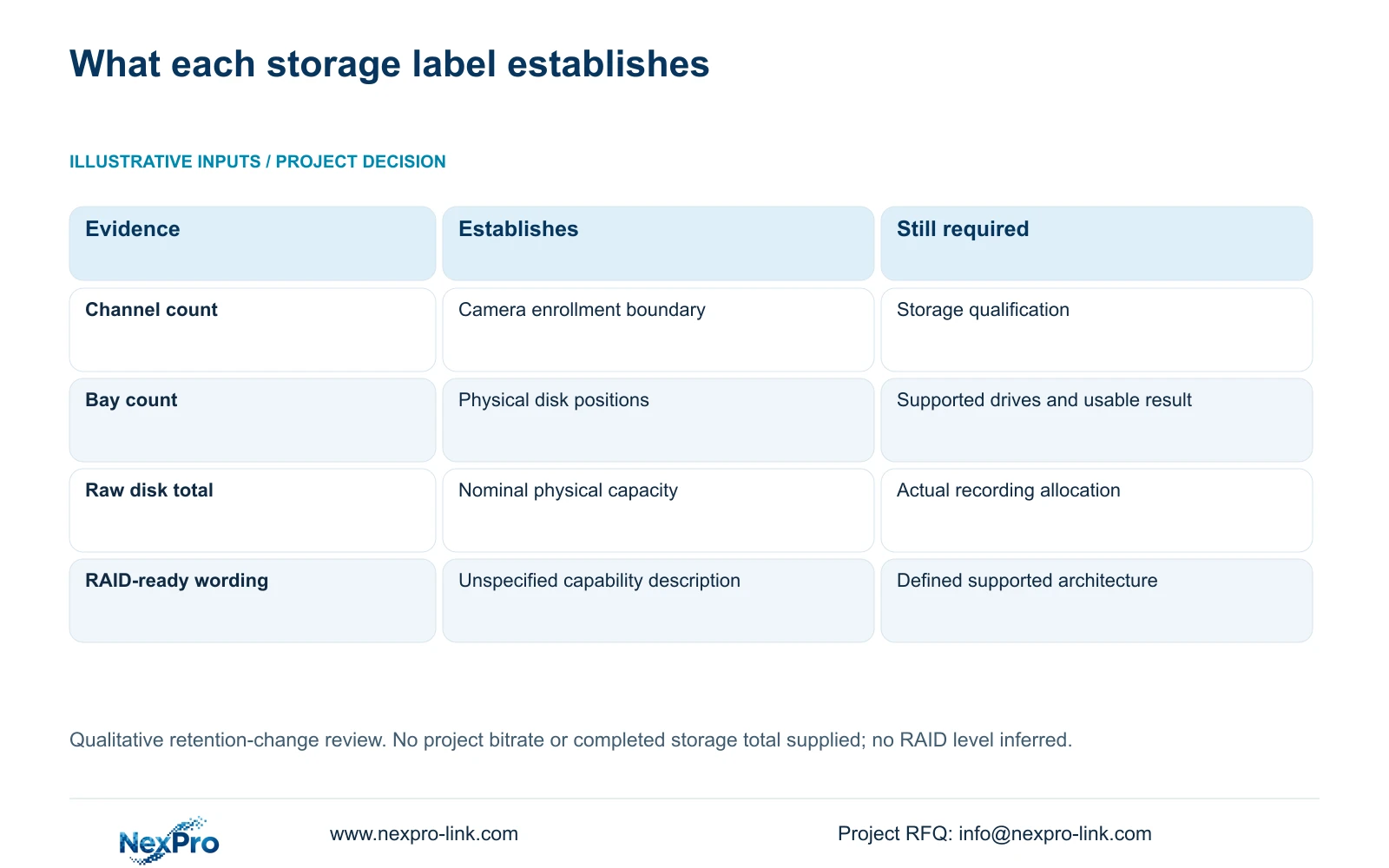
Raw disk capacity is the stated total of the proposed physical drives. Usable capacity is the amount available under the actual supported storage arrangement. The recording allocation is the portion assigned to the intended footage after applying the project's allowance policy. Put those amounts in separate quotation fields.
For a policy that leaves 20% of usable space free, required usable capacity = demand D ÷ (1 − 0.20) = D ÷ 0.80. A demand uplift of D × 1.20 is a different calculation. These are policy definitions, not a completed numerical example or a reserve required by the manual.
If an offer lists only raw disk totals, request the usable result and its configuration basis. Do not treat unspecified filesystem or multi-disk effects as zero. Seetong PC local storage is also a separate object and cannot silently supply the missing recorder capacity.
Section 04
Obtain the supported disk arrangement
Ask for the exact recorder model, bay count, supported per-disk capacity and proposed drives. Connect that arrangement to the revised usable-space requirement. The decision is whether a supported configuration fits, not whether a larger number appears in the model name.
The supplied public fields for NexPro-NVR4449-4K list four SATA bays and a maximum 18 TB per disk. They identify constraints for a candidate discussion, but do not establish a particular usable result or disk compatibility. Its separate 49-channel and 320 Mbps input fields cannot compensate for an unresolved storage arrangement.
Keep the current recorder when qualified disks satisfy the revised retention and its other tasks remain supported. If the storage limit prevents that result, evaluate another configuration. Recheck channel modes, input, playback, interfaces and remote tasks when changing models so the storage remedy does not create a different operational shortfall.
| Observed condition | Selection implication | Next action |
|---|---|---|
| Supported disks meet revised usable demand | Existing recorder may remain suitable | Confirm configuration and revised storage line |
| Raw total is supplied without usable space | Storage qualification is incomplete | Request usable result and configuration basis |
| Supported arrangement cannot meet demand | Storage can decide the recorder model | Compare another qualified configuration |
| RAID description has no defined level | Redundancy and capacity remain unresolved | Obtain exact supported architecture |
| Device identity differs from supporting sheet | Capacity evidence may not apply | Resolve model and firmware identity |
Section 05
Match the evidence to the actual recorder
For an installed recorder, section 4.12.19 describes collecting the product model, hardware version, software version and software date from System Information. Use those details to select applicable documentation. Keep serial references in the appropriate private service record and remove cloud identifiers, QR codes and identifiable site content from public screenshots.
For a proposed purchase, bind the quotation and disk evidence to the precise commercial model. The private manual's TS codes are not established equivalents of NexPro-Link SKUs. If an offer cites a TS table for a differently named commercial recorder, request explicit supporting model information before accepting the storage claim.
A version label helps locate instructions; it does not prove the cause of a storage fault or establish a capacity upgrade. Where documentation and device identity disagree, resolve that difference before ordering replacement drives.
Section 06
Require a defined architecture for redundancy claims
The manual describes a family and applies model-specific limits. Its overview is not a common specification for every recorder, and a shared menu does not establish RAID support. Multiple disk bays also do not establish protection against a drive failure.
The supplied commercial summary's RAID-ready wording has no defined level or calculation conditions. Leave redundancy unresolved until the exact supported arrangement is documented. If a disk change requires formatting or stopping an installed recorder, obtain authorization, preserve required footage and arrange the recording interruption before implementation.
Source scope: This guide uses NVR4.0 user manual CH_V2.4.doc, with V2.2 in its body, sections 5.1, 5.2, 4.12.19 and 1.2. Section references take priority over page numbers; the commercial candidate fields are separate evidence.
Section 07
Show the bottleneck in the revised enquiry
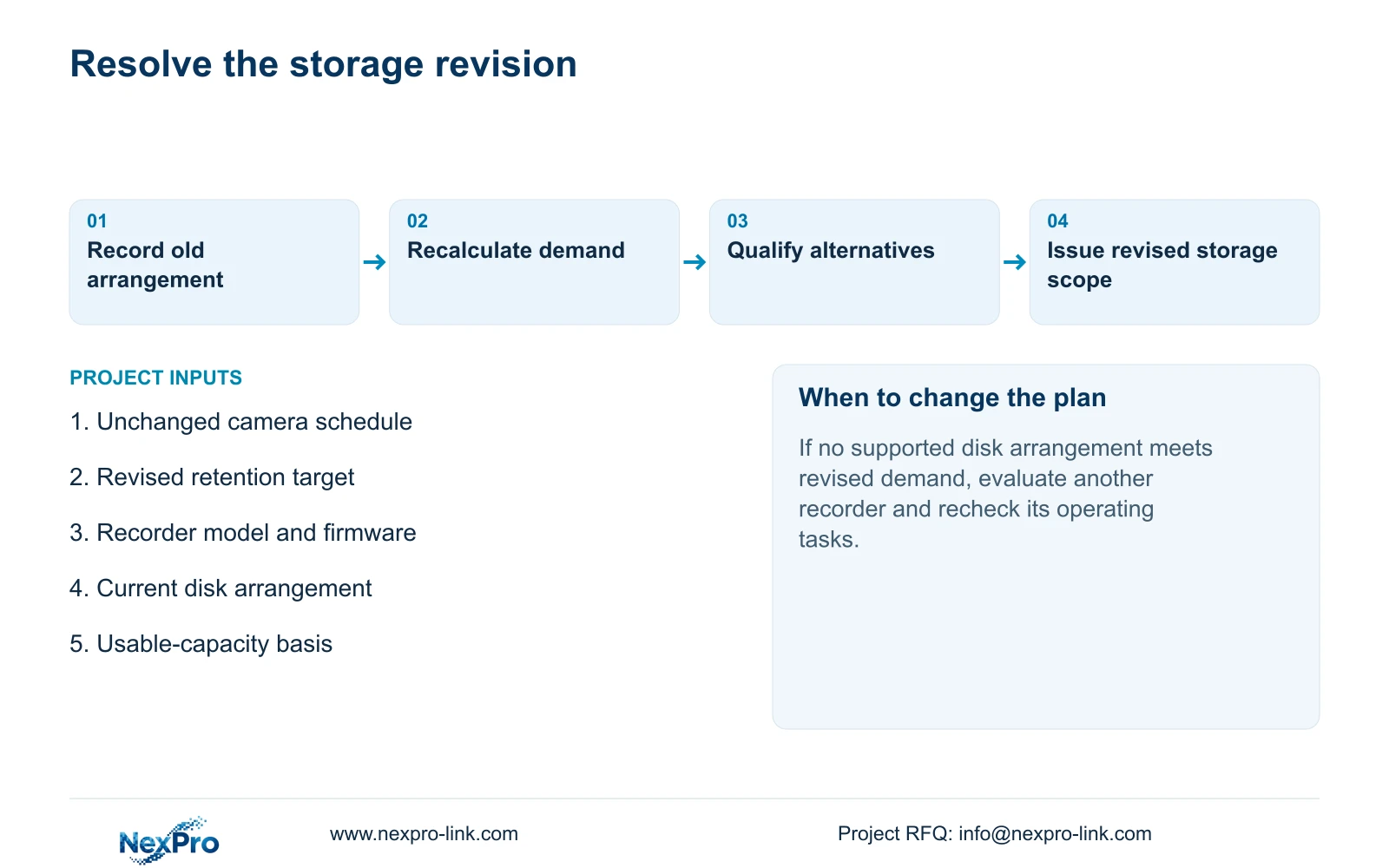
Illustrative project scenario: A buyer keeps the same camera schedule but extends required retention after the initial quotation. The engineer recalculates demand, records the old disk arrangement and tests supported alternatives against the revised usable-space requirement. The enquiry identifies whether disks can change within the existing recorder or whether another model needs review.
Attach the unchanged camera brief, revised retention target, exact recorder identity and current disk arrangement. Label retained hardware, proposed replacements and unresolved configuration details. NexPro-Link's BOQ and tender support is relevant to this scoped revision, without implying that a new recorder is always necessary.
Section 08
Do more drive bays guarantee longer retention?
No. The supported drives and actual usable capacity must meet the recorded demand. More bays provide a different configuration boundary, not a completed retention result.
Section 09
Submit the retention revision
Send the current recorder and disk arrangement with the revised retention requirement to info@nexpro-link.com for a storage-focused configuration review.
Engineering references
These sources support the general planning principles. Always use the selected product's current datasheet and applicable project standards for final design.