Issue separate phase-release records for the twelve-camera opening and eight-camera addition. Keep supported modes, disks and external power as individual conditions in each record.
Section 01
Choose a tier against the full operating task
Issue separate phase-release records for the twelve-camera opening and eight-camera addition. Keep supported modes, disks and external power as individual conditions in each record. Before the later release, reconcile actual opening settings with the planned envelope. A candidate with enough final channels is not qualified for both operating phases until those conditions fit.
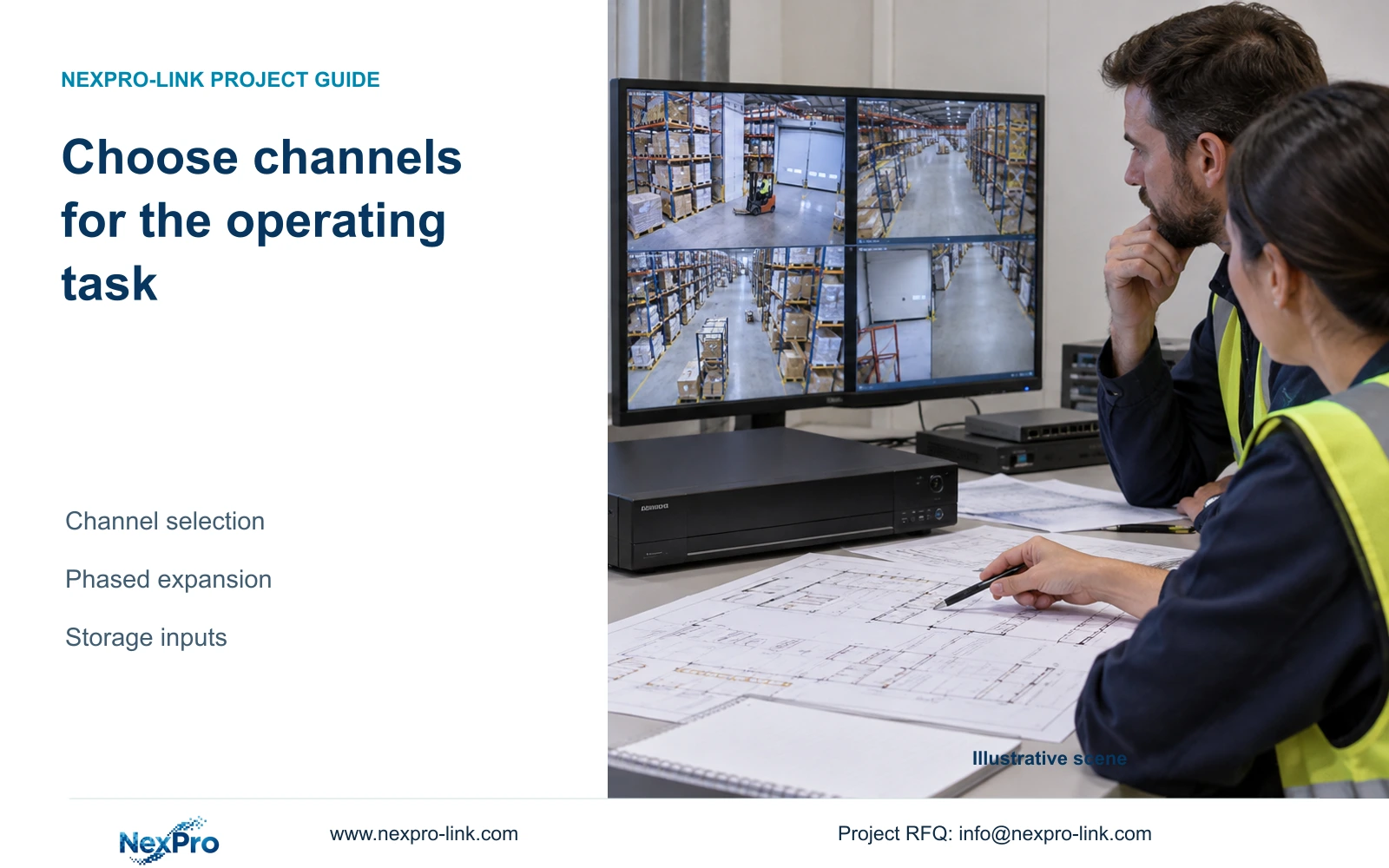
Choose an NVR channel tier by checking the current camera schedule and credible expansion, then qualify recording throughput, local playback, usable storage and physical interfaces. For the warehouse described here, twelve existing cameras plus eight planned cameras require twenty recording channels if one recorder will serve both phases. That excludes an 8-channel unit for the initial phase and a 16-channel unit for the combined phase. A 32- or 36-channel candidate still needs separate checks for stream modes, playback and disks. Spare channels help only when the network and camera-power arrangement can also support the additions. Compare complete qualified configurations before deciding which tier to buy.
Section 02
Keep channel tiers separate from model evidence
This guide uses the supplied private NVR4.0 user manual CH_V2.4.doc, with V2.2 in its body. Sections 1.2 and 5.2 describe the recorder family and model limitations; sections 5.1 and 3.3.1 support the storage and non-PoE discussion. Section references take priority over page numbers.
The manual includes TS8104A3, TS8108A3, TS8216A3, TS8232C4, TS8108D7, TS8116D7, TS8836M and TS8436M. Their specifications are source examples, not established equivalents of NexPro-Link commercial SKUs. Check each offered model's supported channel and stream modes. A shared interface cannot establish common disk capacity, playback performance or audio hardware across these tiers.
Section 03
Write current and expansion demand separately
Keep the twelve existing cameras and eight planned cameras in separate schedule groups. Record the required modes and recording tasks for each group, even if the final recorder serves them together. The future storage area may introduce a different viewing or retention requirement; unused channel slots do not resolve those differences.
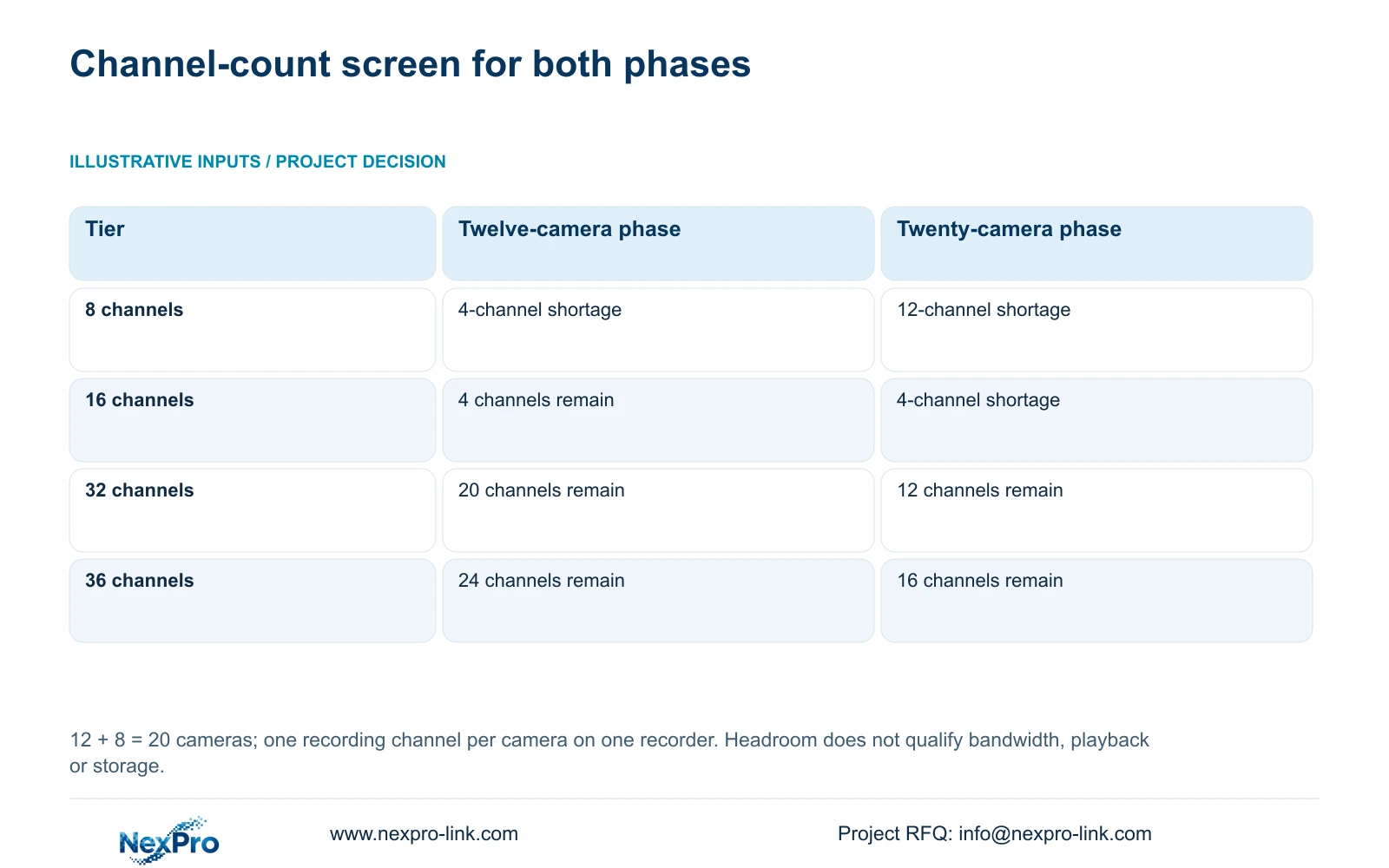
The supplied count arithmetic is 12 cameras + 8 cameras = 20 cameras. Against the named tiers, initial channel balance is 8 - 12 = -4 channels or 16 - 12 = 4 channels. For the combined phase, it is 16 - 20 = -4 channels, 32 - 20 = 12 channels or 36 - 20 = 16 channels. These balances concern channel count only and assume one recording channel per camera on one recorder.
A 16-channel choice can serve the initial count only if its other limits qualify. It leaves a later architecture decision because it cannot hold all twenty cameras. If expansion is part of the approved brief, compare the complete future arrangement now, including any additional recorder and its supporting equipment.
| Tier | Twelve-camera phase | Twenty-camera phase |
|---|---|---|
| 8 channels | Short by 4 channels | Short by 12 channels |
| 16 channels | 4 channels remain | Short by 4 channels |
| 32 channels | 20 channels remain | 12 channels remain |
| 36 channels | 24 channels remain | 16 channels remain |
Section 04
Define what the duty operator must review together
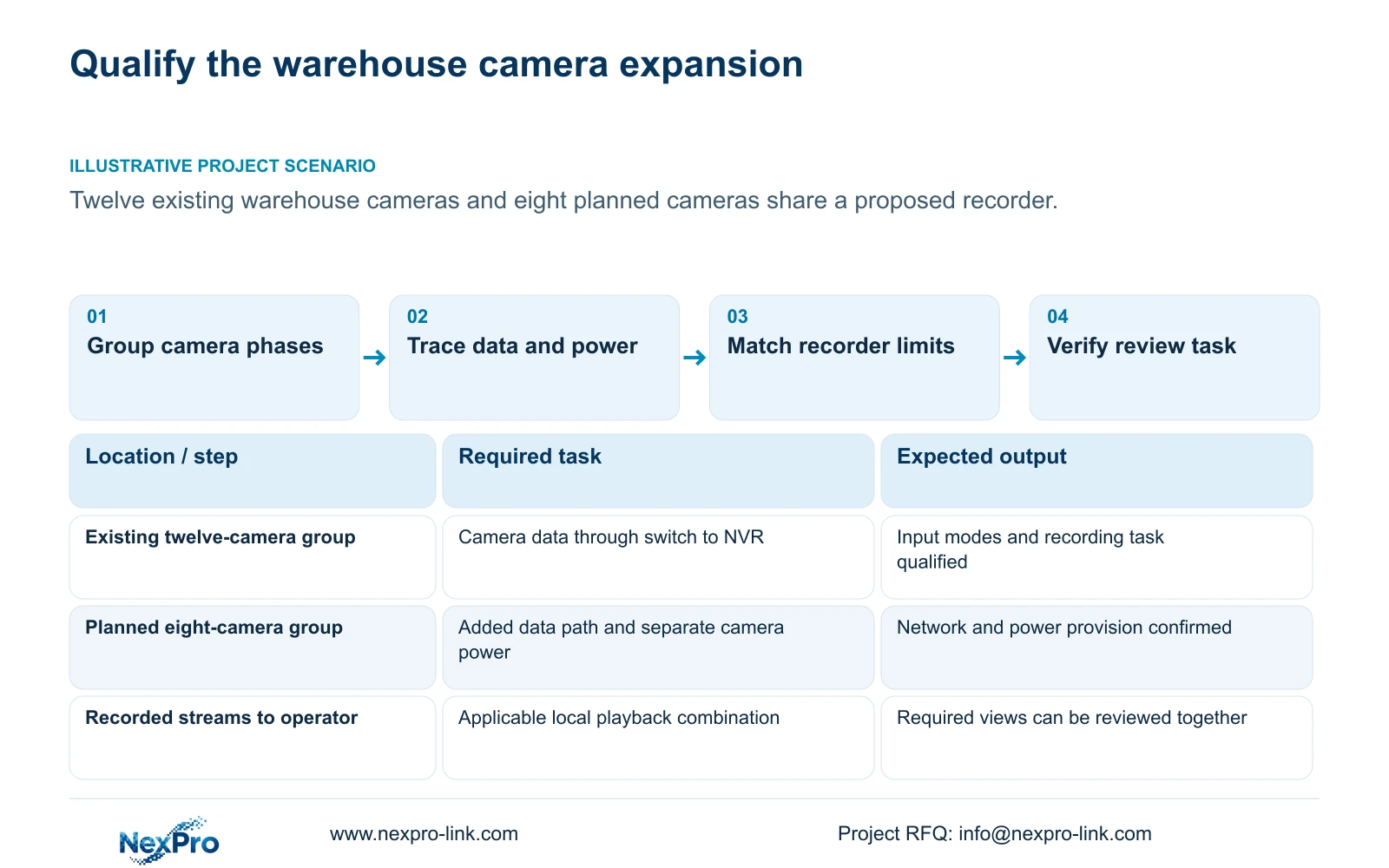
Ask which recorded views the operator must play together during an incident review and specify their recorded modes. Keep that task separate from camera enrollment, incoming bandwidth, live preview decoding and monitor output. A recorder that accepts the full camera schedule may still offer a smaller local playback combination.
Section 5.2 lists TS8232C4 local playback as 1×4K OR 4×2MP OR 2×5MP. Those alternatives cannot be summed or transferred to a different commercial model. Compare the warehouse's actual simultaneous review task with the applicable candidate documentation.
If a candidate records the required inputs but lacks the required local playback mode, determine whether the operator can accept a changed review workflow. Otherwise, select a candidate with supporting evidence. Buying additional unused recording channels alone does not establish that the playback limitation has changed.
Section 05
Calculate recorded volume before selecting disks
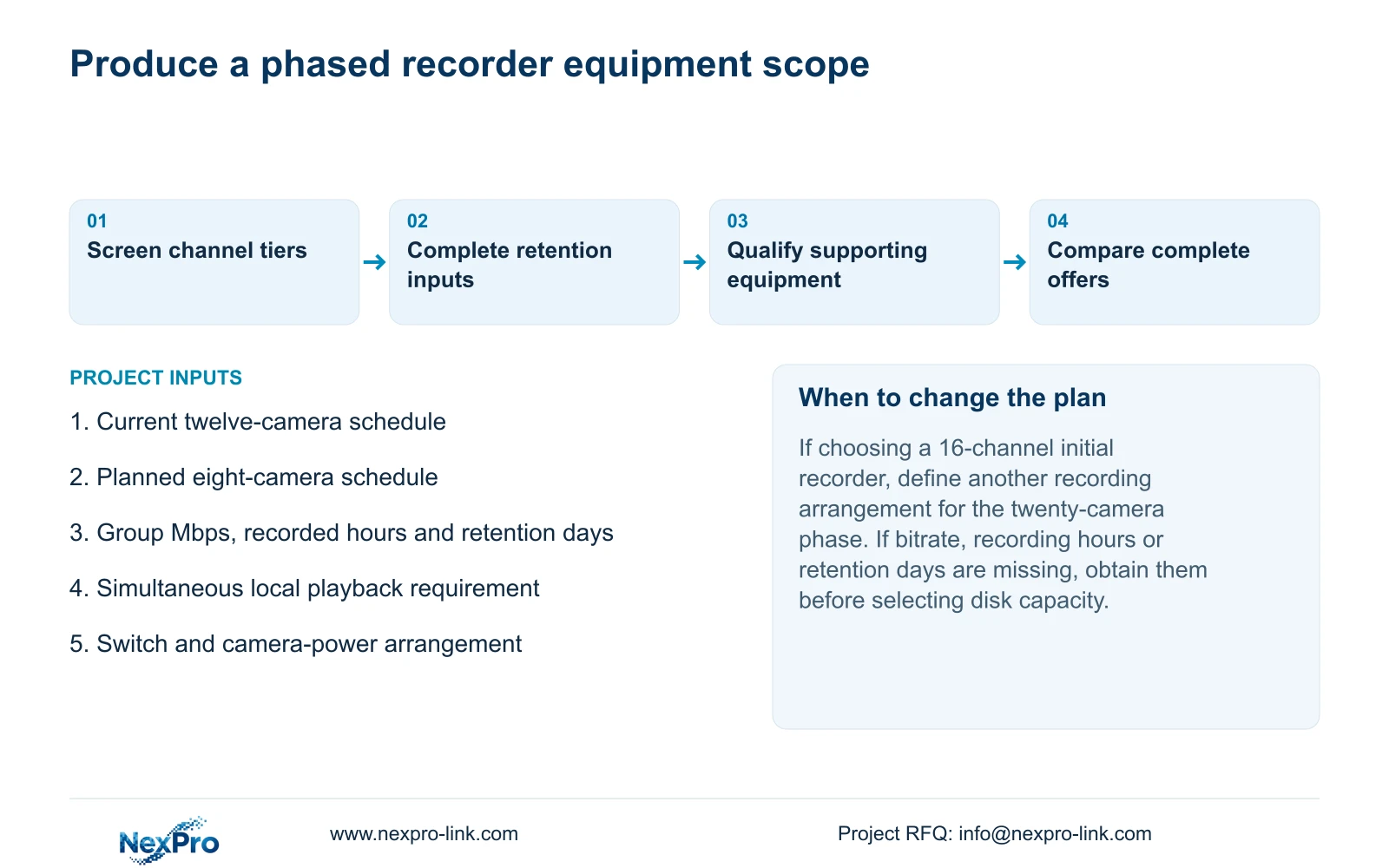
For each camera group, collect average video bitrate in Mbps, recorded hours per day and retention days. Account separately for audio, storage overhead and reserved space. This warehouse source supplies camera counts but no bitrate, daily hours or retention target, so it cannot produce a completed storage figure without additional inputs.
The supplied decimal formula is video TB = 0.00045 × Σ(channels × Mbps × recorded hours/day × days). The coefficient follows from Mbps × 1,000,000 bits/second × 3,600 seconds/hour ÷ 8 bits/byte ÷ 1,000,000,000,000 bytes/TB = 0.00045 TB per Mbps-hour.
For this scenario, let b₁ and b₂ be the groups' average Mbps, h₁ and h₂ their recorded hours/day, and d₁ and d₂ their retention days. Current video volume is 0.00045 × 12 × b₁ × h₁ × d₁ = 0.0054 × b₁ × h₁ × d₁ TB. Added volume is 0.00045 × 8 × b₂ × h₂ × d₂ = 0.0036 × b₂ × h₂ × d₂ TB. Add those group results after the missing inputs are defined.
If r is the fraction of usable capacity reserved, required usable capacity equals the accounted recording volume ÷ (1 - r). Adding r to the volume is a different calculation. Check the result against supported disks and actual usable capacity. Multiple disk positions do not establish RAID, redundancy or a particular retained duration.
Section 06
Include the external network and camera power
Section 3.3.1 shows a non-PoE arrangement with cameras and recorder connected through a switch, while cameras receive separate power. The recorder's ordinary LAN connection should not be specified as a PoE output.
For the additional storage area, identify the data path from each camera to the switch and recorder. Show camera power separately. If PoE is required, include a suitable external power-sourcing device or a recorder explicitly documented with the required PoE capability. Retain separate entries for the recorder supply, display and mouse.
Check the expansion against the switch arrangement and camera-power provision as well as recorder channels. No switch port count, power budget or camera demand is supplied for this scenario, so obtain those values before qualifying the network and power package.
Section 07
Compare the complete qualified alternatives
Normalize the current and future camera modes, retention objective, playback task, disks, network equipment, power provision, accessories, software and service boundary. Identify what each offer includes now and what must be added when the storage area opens.
A recorder-only offer and a complete equipment package are different scopes. Compare their differences before comparing actual quotations. If prices or inclusion details are missing, retain an unresolved scope row instead of calculating a saving. The useful decision is which qualified arrangement serves the agreed phases, not which label has the largest spare count.
Section 08
Apply the phased warehouse brief
Illustrative project scenario: A warehouse starts with twelve cameras and plans eight more after a storage area opens. A 32- or 36-channel recorder passes the combined channel-count screen, but remains conditional on stream acceptance, incoming bitrate, playback, storage and external equipment. A 16-channel initial arrangement requires a separately defined expansion plan. No delivered outcome or price advantage is implied.
| Situation | Required record | Decision boundary |
|---|---|---|
| Opening phase | Actual streams, modes, disks and power | Qualify the opening configuration |
| Later addition | Opening settings and planned growth | Recheck each changed resource |
| Final channel count fits | Other phase conditions still unresolved | Do not call both phases accepted |
Section 09
Is the 36-channel candidate automatically better?
No. It provides more nominal channel headroom in this scenario. Its other limits and complete scope still need to match the warehouse task.
Section 10
Can twenty cameras determine the disk requirement?
Camera count alone is insufficient. Supply each group's average bitrate, recorded hours and retention days, then account for audio, overhead and reserved capacity.
Section 11
Prepare the phased camera schedule
Send NexPro-Link the current and planned camera schedule, including recording inputs and the required simultaneous playback task, at info@nexpro-link.com.
Engineering references
These sources support the general planning principles. Always use the selected product's current datasheet and applicable project standards for final design.