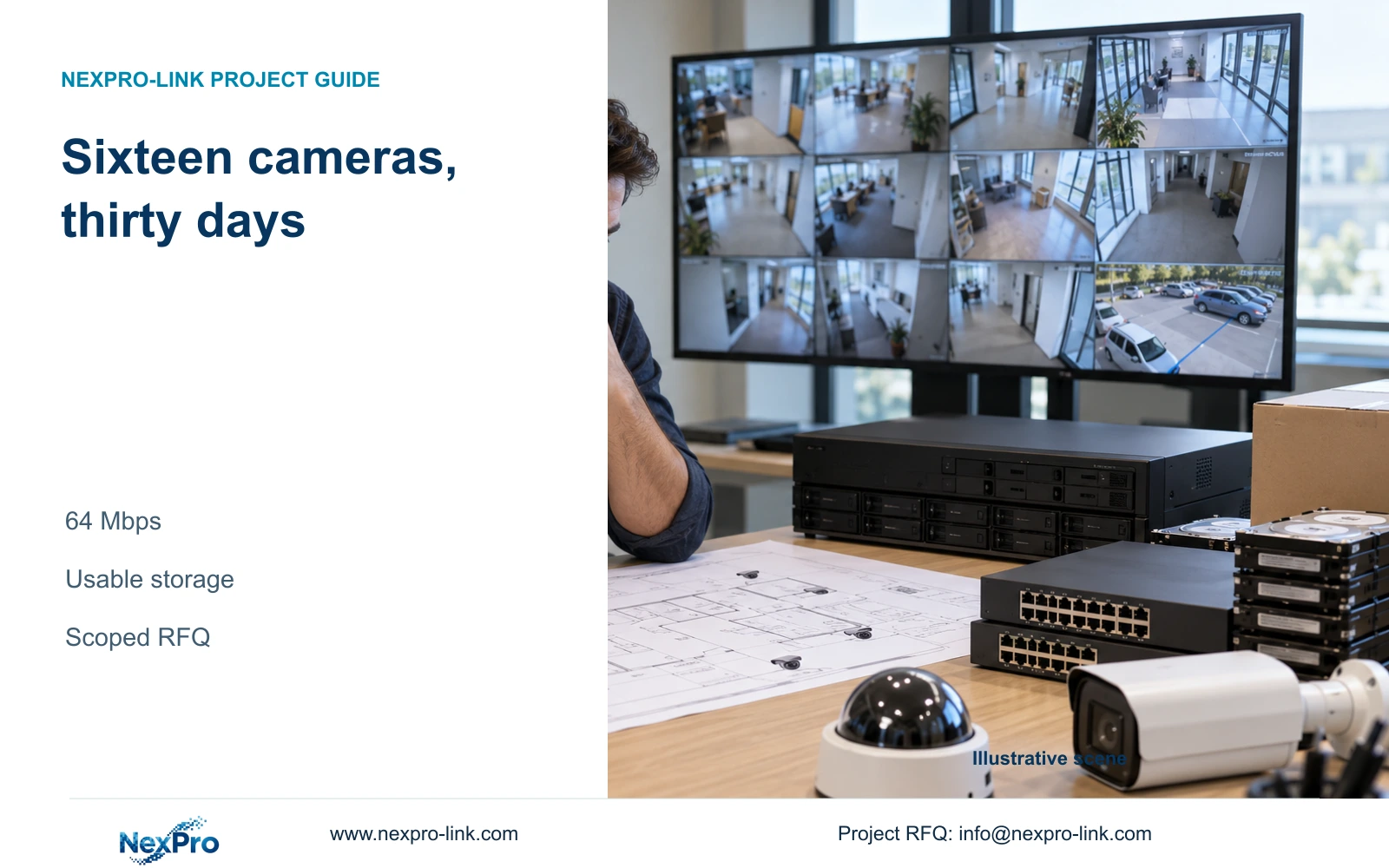
Sixteen continuous streams at an assumed average 4 Mbps need 20.736 decimal TB for thirty days. Turn that calculation into a usable-capacity requirement and a qualified equipment enquiry.
Section 01
Set the recording brief before choosing disks
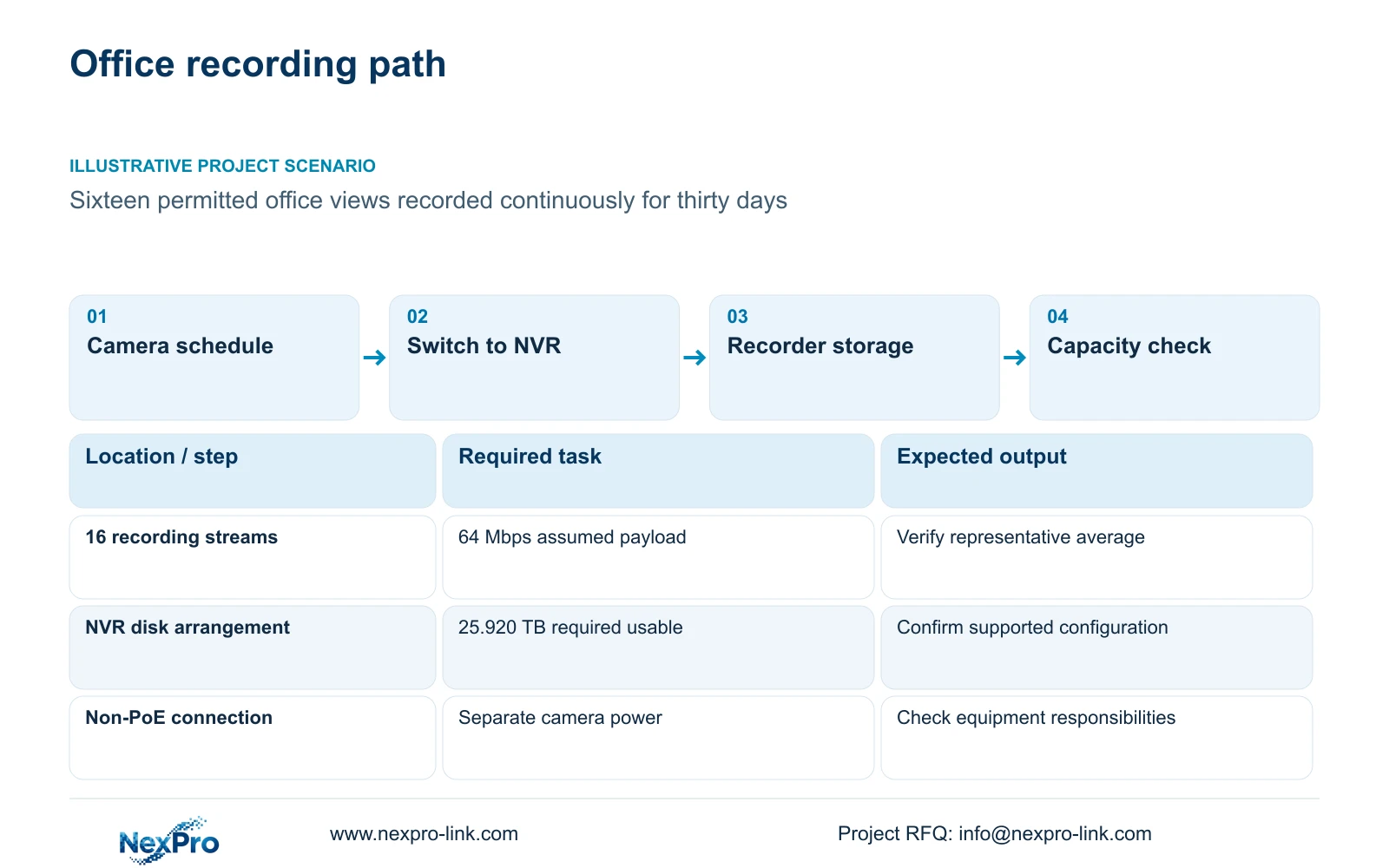
For sixteen cameras recorded continuously at an assumed average 4 Mbps each, thirty days produces 20.736 decimal TB of video. If video may occupy only 80% of usable storage, the corresponding requirement is 25.920 TB before separately accounting for audio, metadata and the actual storage arrangement. A sixteen-channel label alone cannot establish that capacity. Build a channel schedule, confirm the recorded stream and recording hours, then qualify the recorder's input, playback and supported disks. The enquiry should carry those requirements together so a supplier can identify a suitable configuration without silently changing the retention objective.
Start the schedule with the sixteen permitted views and the purpose of each recording. Attach each location to its intended recorder channel. Record its stream settings and continuous schedule alongside the location, so a supplier can see whether the channels share one assumption or require separate bitrate groups.
Section 02
Use representative bitrate evidence
The manual exposes CBR, VBR and bitrate fields, but a configuration entry does not establish the site's daily stored volume. Keep the assumed 4 Mbps visibly labelled until representative observations support it. Sample relevant lighting and motion conditions using the intended stream settings. An empty office screenshot should not become the basis for an occupied office's retention promise.
Use the representative average for recorded volume and an appropriate peak or configured limit for the network check. CBR and VBR describe control methods; neither label proves better reliability. If observations differ materially from the planning rate, revise the affected channel group before selecting disks. Preserve the accepted recording task when investigating the difference.
Section 03
Calculate thirty days and the longer-retention alternative
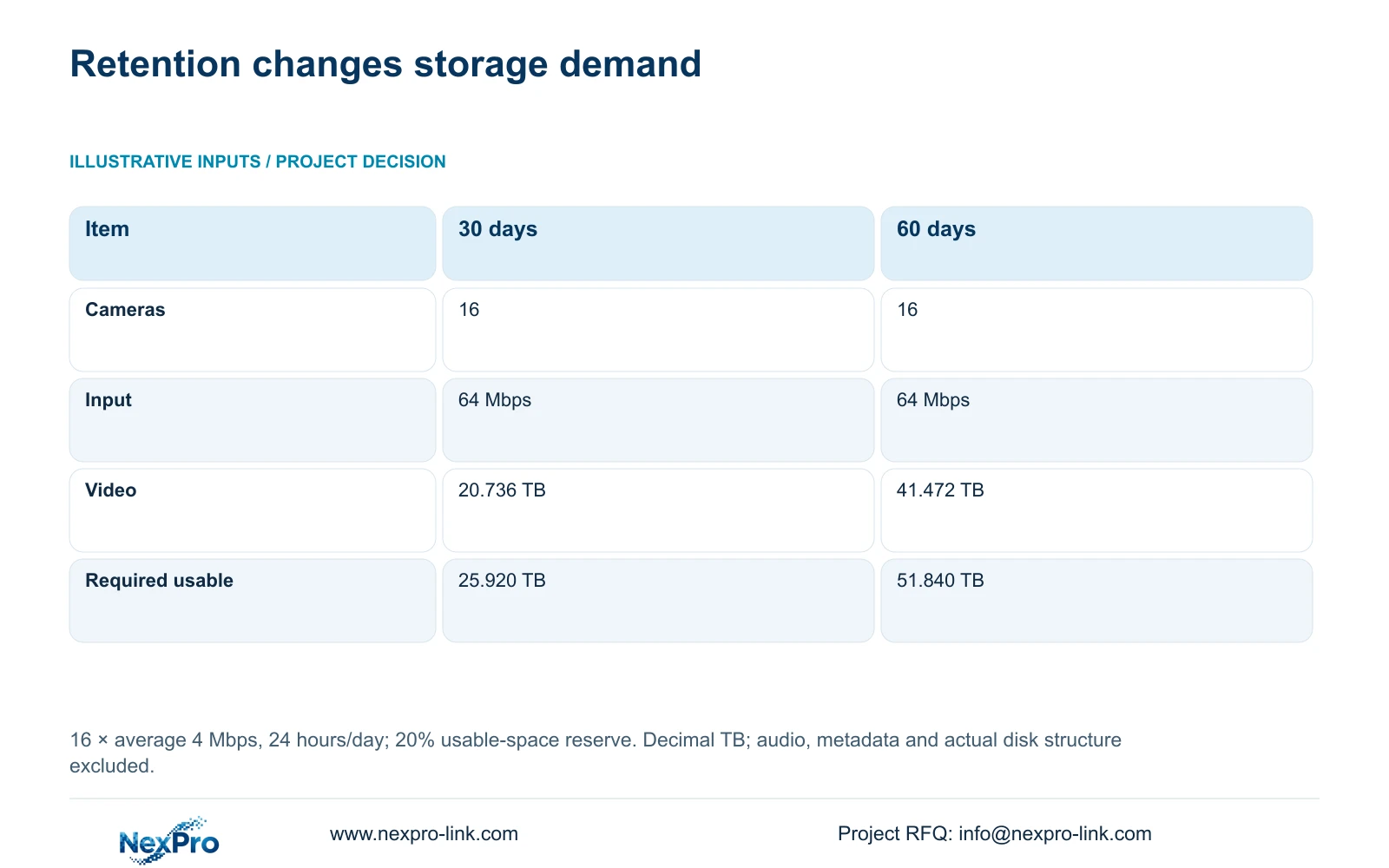
Option A uses 16 cameras × average 4 Mbps × 24 hours/day × 30 days. Option B keeps the same streams and daily hours but extends retention to 60 days. Both calculations use decimal TB and reserve 20% of usable space. Audio, metadata and the actual disk structure are excluded from this video-only example.
Aggregate video input = 16 × 4 Mbps = 64 Mbps. Video TB = 0.00045 × channels × average Mbps × hours/day × days. Therefore, Option A = 0.00045 × 16 × 4 × 24 × 30 = 20.736 TB. Option B = 0.00045 × 16 × 4 × 24 × 60 = 41.472 TB.
Required usable TB = video TB ÷ (1 − 0.20). Option A needs 20.736 ÷ 0.80 = 25.920 TB; Option B needs 41.472 ÷ 0.80 = 51.840 TB. Doubling retention doubles this example's recorded volume while leaving its recording input unchanged.
| Check | Option A | Option B |
|---|---|---|
| Camera count | 16 | 16 |
| Recording input | 64 Mbps | 64 Mbps |
| Retention | 30 days | 60 days |
| Video data | 20.736 decimal TB | 41.472 decimal TB |
| Required usable space | 25.920 TB | 51.840 TB |
Section 04
Qualify usable capacity and recorder limits
Leaving 20% of usable space free means dividing demand by 0.80. Multiplying demand by 1.20 applies a different allowance based on demand. Specify the intended policy in the enquiry, and keep raw disk capacity, usable capacity and the recording allocation in separate fields.
Check accepted camera modes, aggregate input, local playback, disk bays and supported per-disk capacity independently. The supplied public fields for NexPro-NVR4449-4K list 49 channels, 320 Mbps input and four SATA bays with a maximum 18 TB per disk. Those fields support a candidate review, but they do not establish the usable capacity of a selected disk arrangement or prove every required playback task.
If supported disks cannot provide the required usable capacity, investigate another qualified arrangement or recorder. Do not shorten the thirty-day brief to preserve the first hardware choice. A RAID-ready description without a defined level and configuration supplies no basis for a redundancy or usable-capacity calculation.
Section 05
Include camera power and the viewing equipment
The manual's non-PoE diagram connects cameras and recorder through a switch, with separate camera power. An ordinary recorder LAN socket should not appear as a PoE output in the office drawing. If the cameras require PoE, identify suitable external power-sourcing equipment or qualify a recorder explicitly specified for PoE.
List the switch, camera power arrangement, recorder power, display and mouse as separate equipment responsibilities. Identify retained items so the quotation does not duplicate them. Network connectivity and camera power need their own checks even when the recorder passes the channel and storage review.
| Observation | Meaning | Next action |
|---|---|---|
| 4 Mbps remains an assumption | Retention is provisional | Confirm representative recording rates |
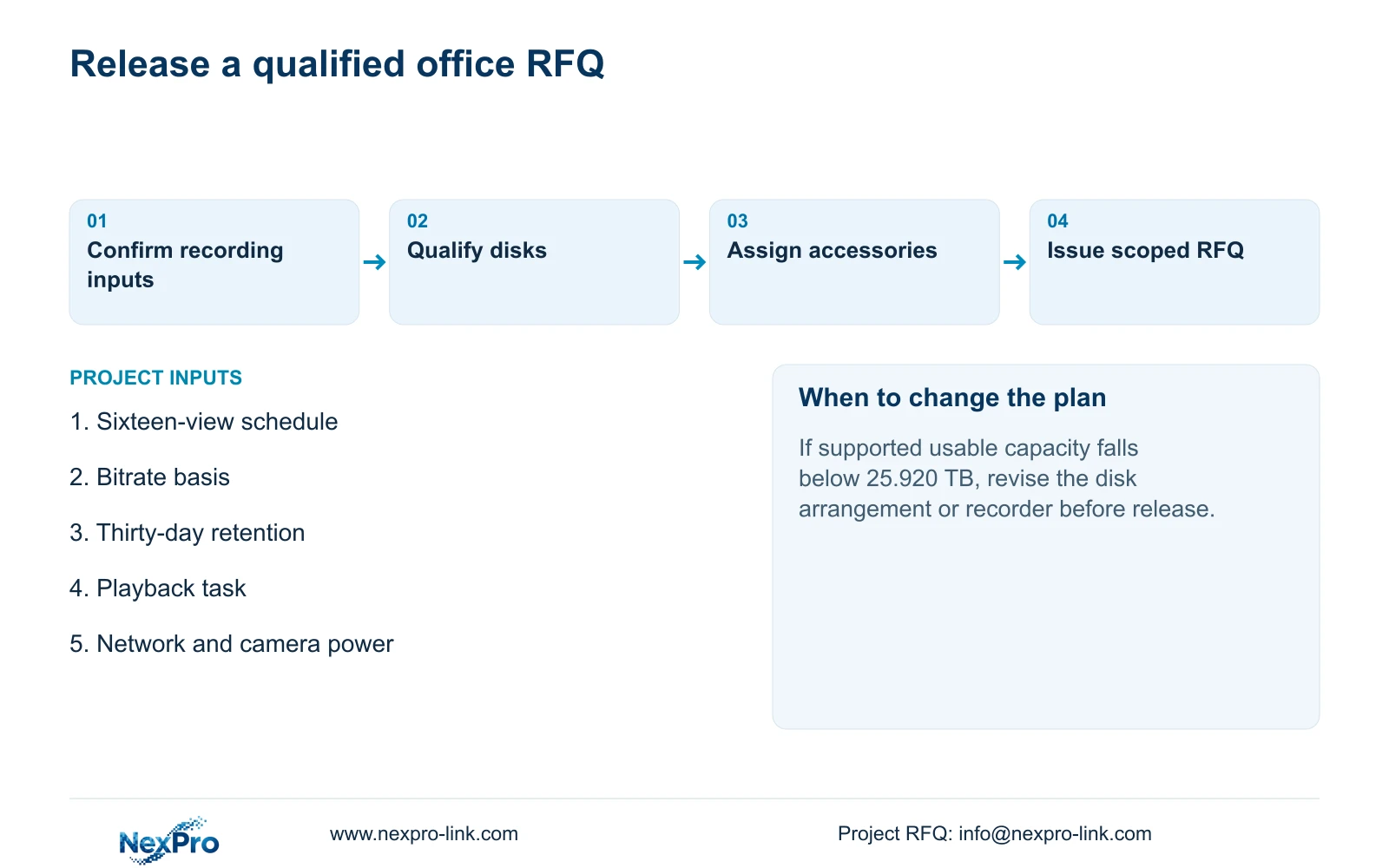
| Usable space falls below the requirement | The disk arrangement does not meet the brief | Revise supported disks or recorder |
| Recorder LAN is non-PoE | Camera power is a separate dependency | Include appropriate camera power equipment |
Section 06
Turn the office requirement into an enquiry
Illustrative project scenario: An office owner needs sixteen permitted views recorded continuously for thirty days. The engineer uses the stated 4 Mbps assumption to establish the video budget, then qualifies storage and input against the proposed configuration. The cost manager separates supplied equipment from retained network and display items.
The resulting RFQ contains the camera schedule, recording assumptions, retention requirement, simultaneous viewing and playback task, proposed disk arrangement and delivery destination. Mark unresolved bitrate observations or usable-capacity details explicitly. NexPro-Link's BOQ and tender support provides an appropriate entry point for discussing that bounded equipment package.
Source scope: This guide uses the supplied private NVR4.0 user manual CH_V2.4.doc, whose body identifies V2.2, sections 4.4.5, 4.3.3.3, 5.1, 5.2 and 3.3.1. Sections take priority over page numbers. Its TS models have no established mapping to NexPro-Link commercial SKUs.
Section 07
Can sixteen cameras determine the disk count?
No. Disk selection also needs average recording bitrate, daily hours, retention and the supported usable-capacity arrangement. The same sixteen streams require different capacity when retention changes.
Section 08
Can Seetong PC storage satisfy the recorder budget?
PC local recording and recorder disk recording are different storage objects. Count PC storage only within a separately defined recording task; do not substitute it for the NVR's required usable capacity.
Section 09
Submit the recording schedule
Send the sixteen-view schedule with its bitrate basis and thirty-day recording requirement to info@nexpro-link.com for a scoped configuration discussion.
Engineering references
These sources support the general planning principles. Always use the selected product's current datasheet and applicable project standards for final design.