A thirty-two-camera package must pass separate channel, input, storage and playback checks. Use one recording baseline to expose differences before comparing supplier offers.
Section 01
Qualify each resource against the same camera brief
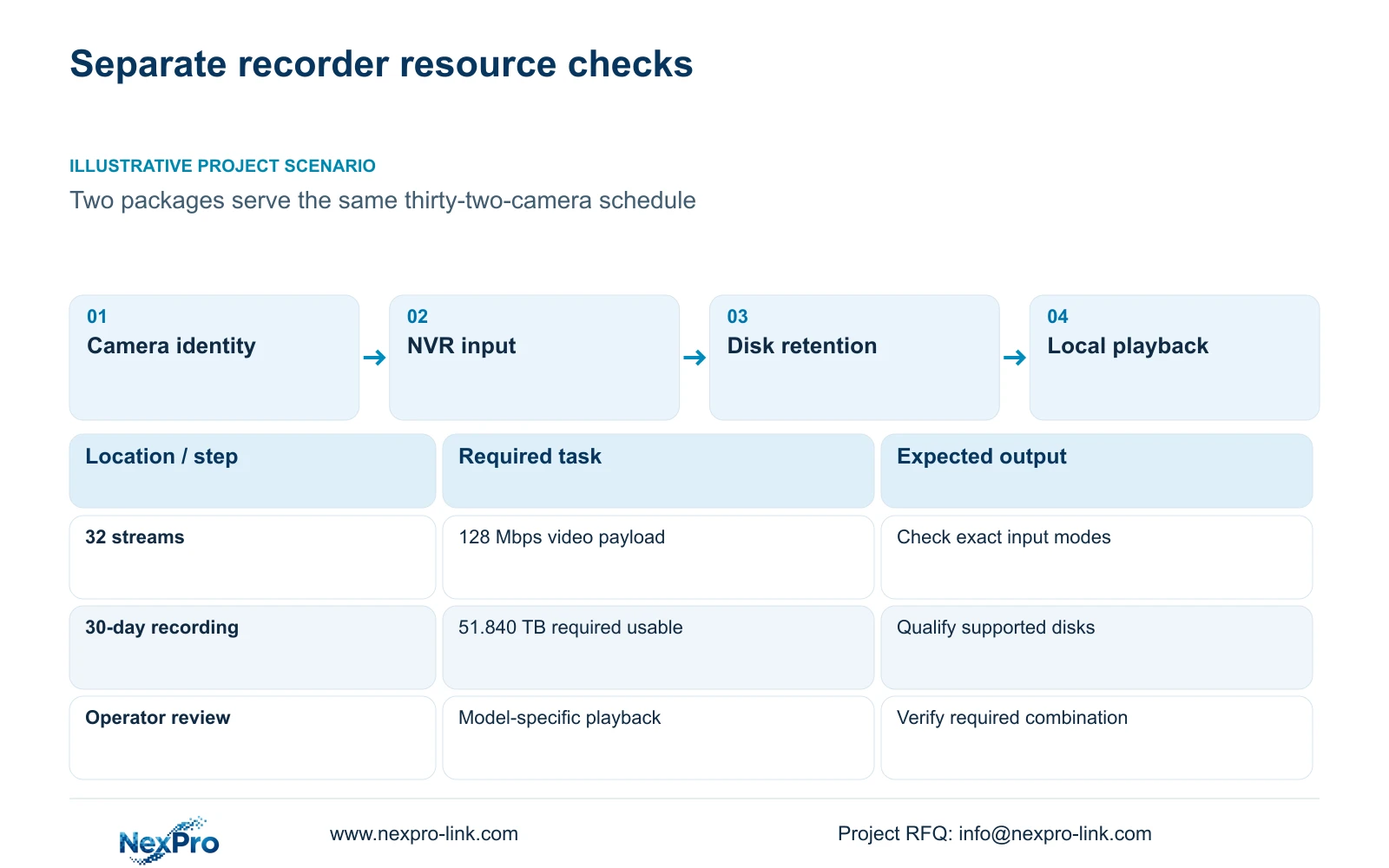
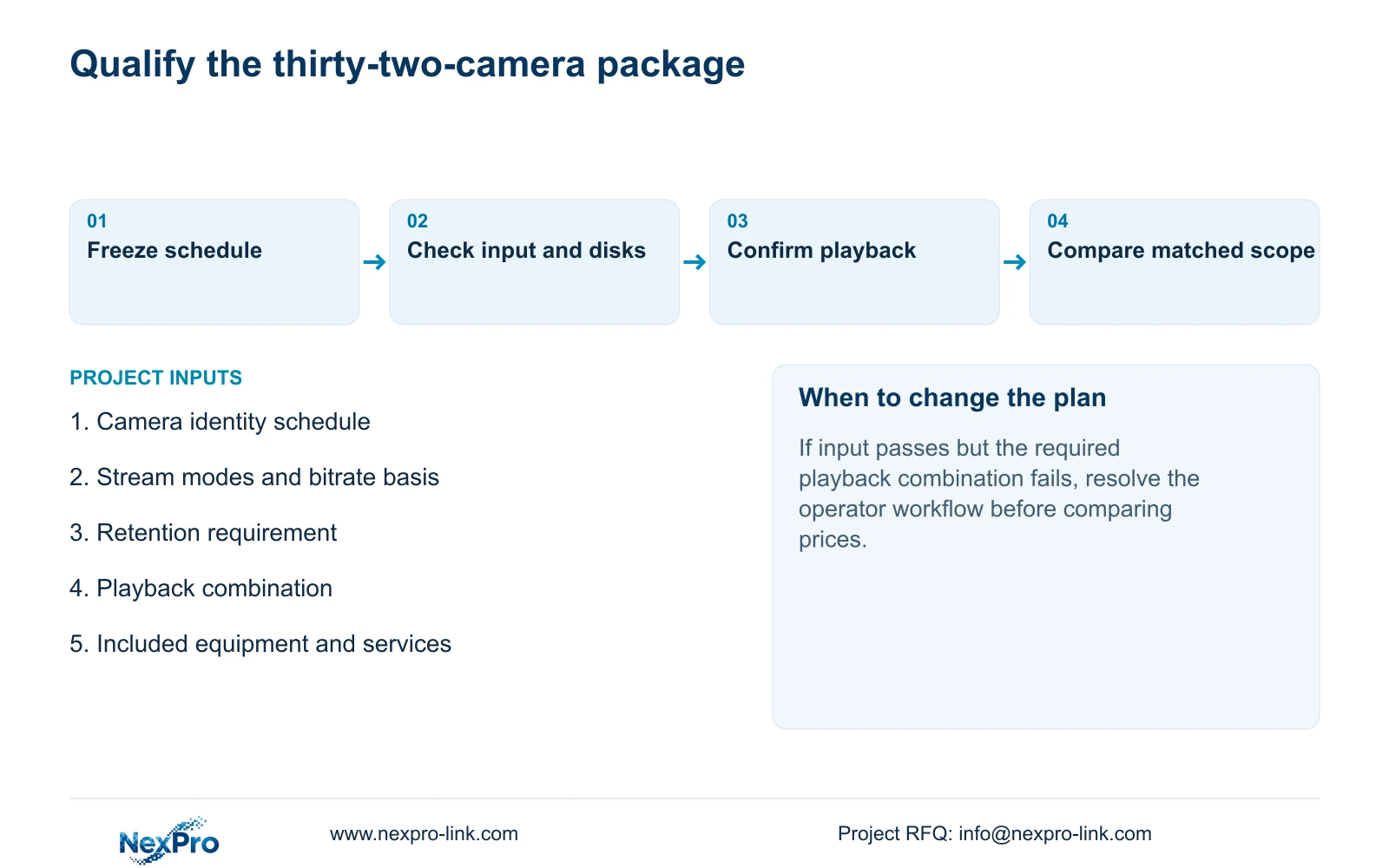
Thirty-two available recording channels do not establish sufficient input bandwidth, retained storage or simultaneous playback. For the supplied example, thirty-two continuous streams averaging 4 Mbps produce 128 Mbps of video input and 41.472 decimal TB over thirty days. Reserving 20% of usable space raises the video-only usable-capacity requirement to 51.840 TB. These checks address different resources, so passing one cannot compensate for failing another. Freeze the camera identities and recording modes first, calculate input and retention separately, then specify what the operator must review together. Compare quotations only after both packages address that same operating brief.
Keep drawing location, physical camera identity, IP address, NVR channel and displayed name in separate schedule fields. The recorder's channel-name and camera OSD controls support labels, but the project record maintains the mapping. Renaming a view and replacing its camera are different changes.
Section 02
Freeze identities and the recording-rate basis
Before comparing packages, check that both schedules contain the same thirty-two locations and intended recording tasks. Resolve missing or duplicated entries before calculating totals. After a replacement or channel reorder, update the mapping and verify the recorded location rather than relying on its familiar position in a live-view grid.
Use explicit stream bitrate assumptions instead of deriving traffic directly from pixel count. The 4 Mbps average here is a planning input, not a tested specification for every camera. The manual provides CBR and VBR fields, while the traffic view describes actual interface activity. Record lighting, motion and stream settings when gathering representative samples.
Use average recorded rates for retention and suitable peaks or limits for network evaluation. If a supplier proposes different encoding settings, retain them as a separate qualified alternative until their recording output satisfies the accepted observation task. A lower bitrate alone does not establish equivalent footage.
Section 03
Check input acceptance before expansion headroom
Aggregate input = 32 × 4 Mbps = 128 Mbps. Compare that video payload with the exact recorder's accepted channel modes and incoming bandwidth. Interface observations may also contain protocol overhead or other activity, so label the measurement boundary before comparing it with the arithmetic.
The supplied public fields for NexPro-NVR4449-4K list 49 channels and 320 Mbps input. They can support a candidate screen for this workload, but passing the channel and payload screens does not qualify disks, playback or future additions. Any proposed expansion requires its own modes and bitrate inputs.
Record each constraint and its evidence separately. If the required mode is unsupported, spare nominal bandwidth cannot resolve it. If input capacity is insufficient, extra disk bays cannot resolve it. Hold the affected configuration for revision while preserving the agreed recording task.
Section 04
Calculate thirty-day and sixty-day storage
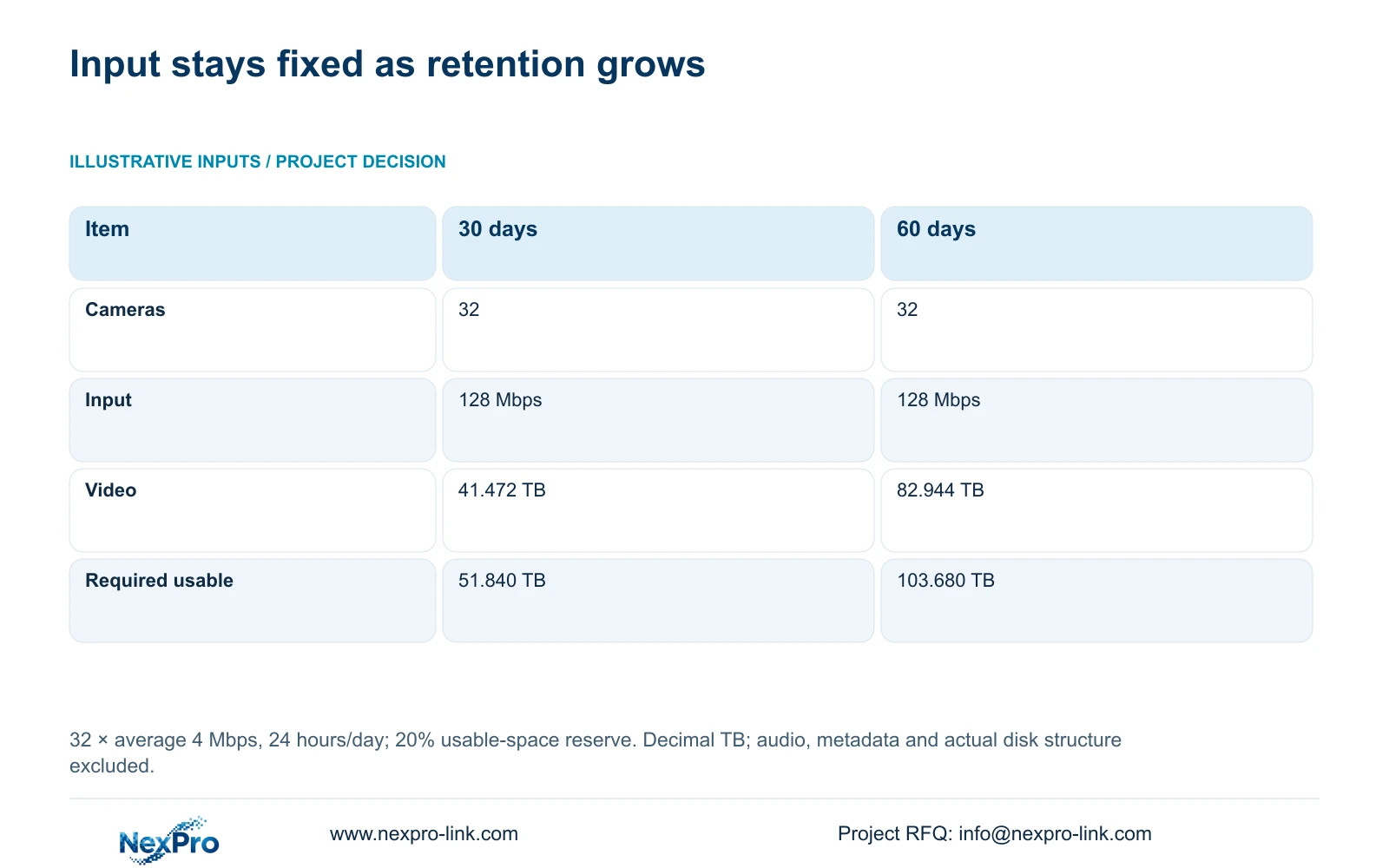
Option A assumes 32 cameras × average 4 Mbps × 24 hours/day × 30 days. Option B retains those streams and hours for 60 days. Video TB = 0.00045 × channels × average Mbps × hours/day × days.
Option A = 0.00045 × 32 × 4 × 24 × 30 = 41.472 decimal TB. Option B = 0.00045 × 32 × 4 × 24 × 60 = 82.944 decimal TB. Required usable TB = video TB ÷ (1 − 0.20), giving 41.472 ÷ 0.80 = 51.840 TB and 82.944 ÷ 0.80 = 103.680 TB.
The input stays at 128 Mbps while storage demand doubles. These figures exclude audio, metadata and the actual disk structure. Obtain a supported disk configuration with a stated usable result; raw disk totals cannot complete this check. The reserve policy is illustrative, and multiplying demand by 1.20 would apply a different allowance.
| Item | Option A | Option B |
|---|---|---|
| Camera count | 32 | 32 |
| Video input | 128 Mbps | 128 Mbps |
| Retention | 30 days | 60 days |
| Video volume | 41.472 decimal TB | 82.944 decimal TB |
| Required usable space | 51.840 TB | 103.680 TB |
Section 05
Specify the operator's playback combination
Ask which recorded views the duty operator must play simultaneously and at what recorded modes. Keep camera enrollment, incoming bandwidth, preview decoding, local playback and monitor output as separate requirements. A monitor output label cannot establish the number of recorded streams the recorder can decode together.
In section 5.2, TS8232C4 has alternative local-playback combinations of 1×4K OR 4×2MP OR 2×5MP. These modes cannot be added together. They illustrate how model-specific playback limits affect selection, and they must not be transferred to a NexPro-Link commercial SKU.
If the proposed combination does not meet the operator's task, seek a supported configuration or revise the review workflow with the owner. Do not assume that accepting thirty-two cameras means playing thirty-two full-resolution recordings simultaneously.
| Finding | Decision | Required follow-up |
|---|---|---|
| Channels pass, usable storage fails | Package remains unqualified | Revise supported disks or recorder |
| Input passes, playback task fails | Operator workflow remains unresolved | Confirm a supported playback combination |
| Supplier changes recording modes | Offers use different baselines | Reconcile accepted footage requirements |
Section 06
Compare qualified equipment packages
Illustrative project scenario: A contractor compares two 32-camera packages that use different disk and playback assumptions. The contractor first attaches the same camera schedule to both offers, then requests usable storage and the operator's playback combination. A package with shorter retention or reduced review capability remains a different offer until the owner accepts that change.
Normalize disks, accessories, software and the service boundary before comparing actual quotations. Identify retained equipment and separately included site work. NexPro-Link's BOQ and tender support can serve the resulting model and scope discussion; a recorder-only price does not represent an installed-system price.
Source scope: The supplied private NVR4.0 user manual CH_V2.4.doc has V2.2 in its body. Relevant sections are 4.3.1, 4.4.4, 4.12.6, 4.4.5, 4.3.3.3, 5.1 and 5.2. Section references take priority. Its TS model limits are separate from commercial model specifications.
Section 07
Can camera resolution determine the input total?
No. Supply the stream settings and a defined bitrate basis. Resolution identifies part of the required mode, while bitrate supplies the traffic input for this calculation.
Section 08
Does a larger channel tier solve a retention shortfall?
Only if its supported storage arrangement supplies the required usable capacity and its other constraints pass. A larger channel count alone does not establish a storage remedy.
Section 09
Submit the common comparison brief
Send the frozen thirty-two-camera schedule and required simultaneous playback task to info@nexpro-link.com for a configuration comparison.
Engineering references
These sources support the general planning principles. Always use the selected product's current datasheet and applicable project standards for final design.