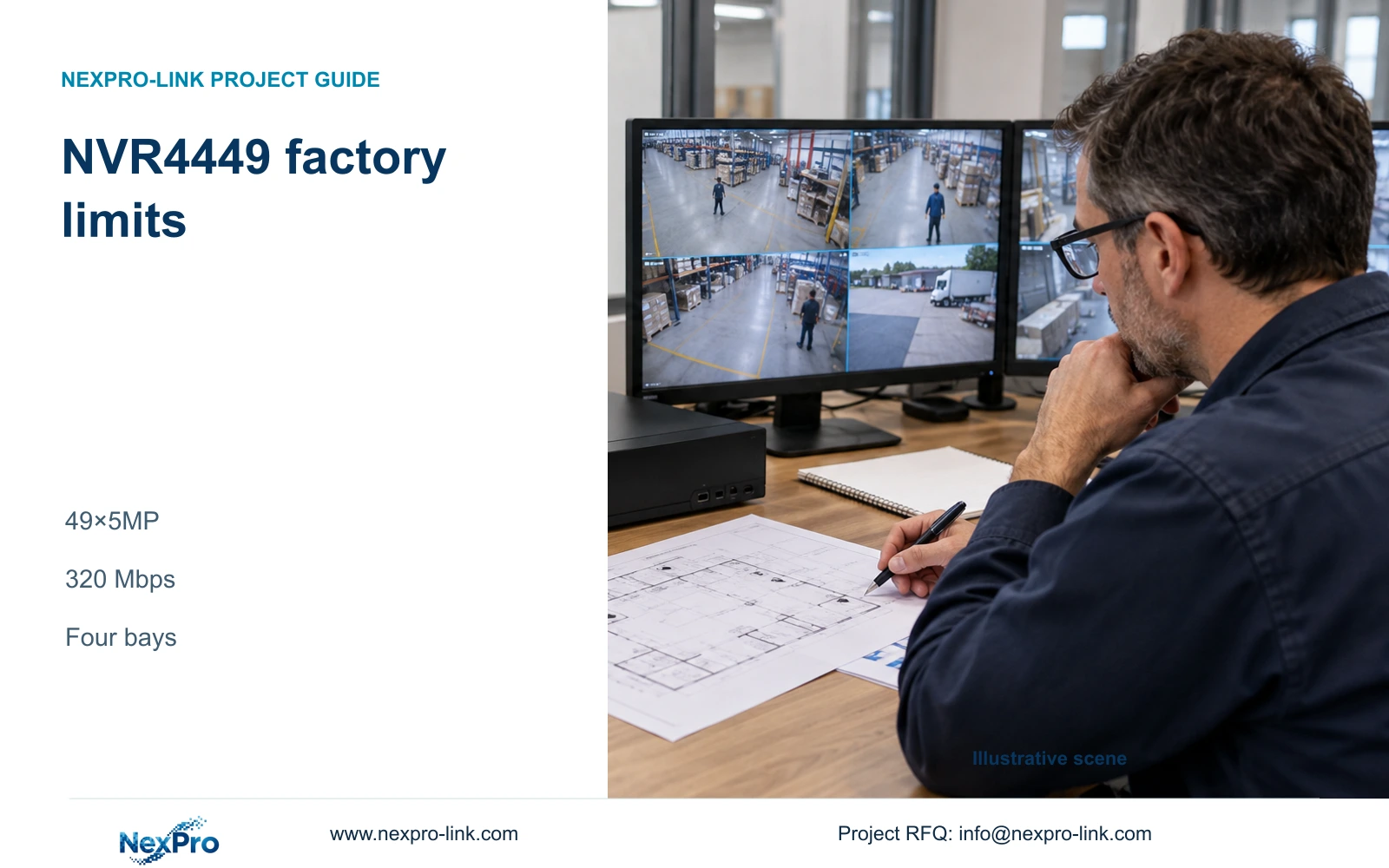
The NexPro-NVR4449-4K needs a mode-specific factory schedule. Its channel count, input rating and four disk bays answer different procurement questions.
Section 01
Read the channel and resolution combinations separately
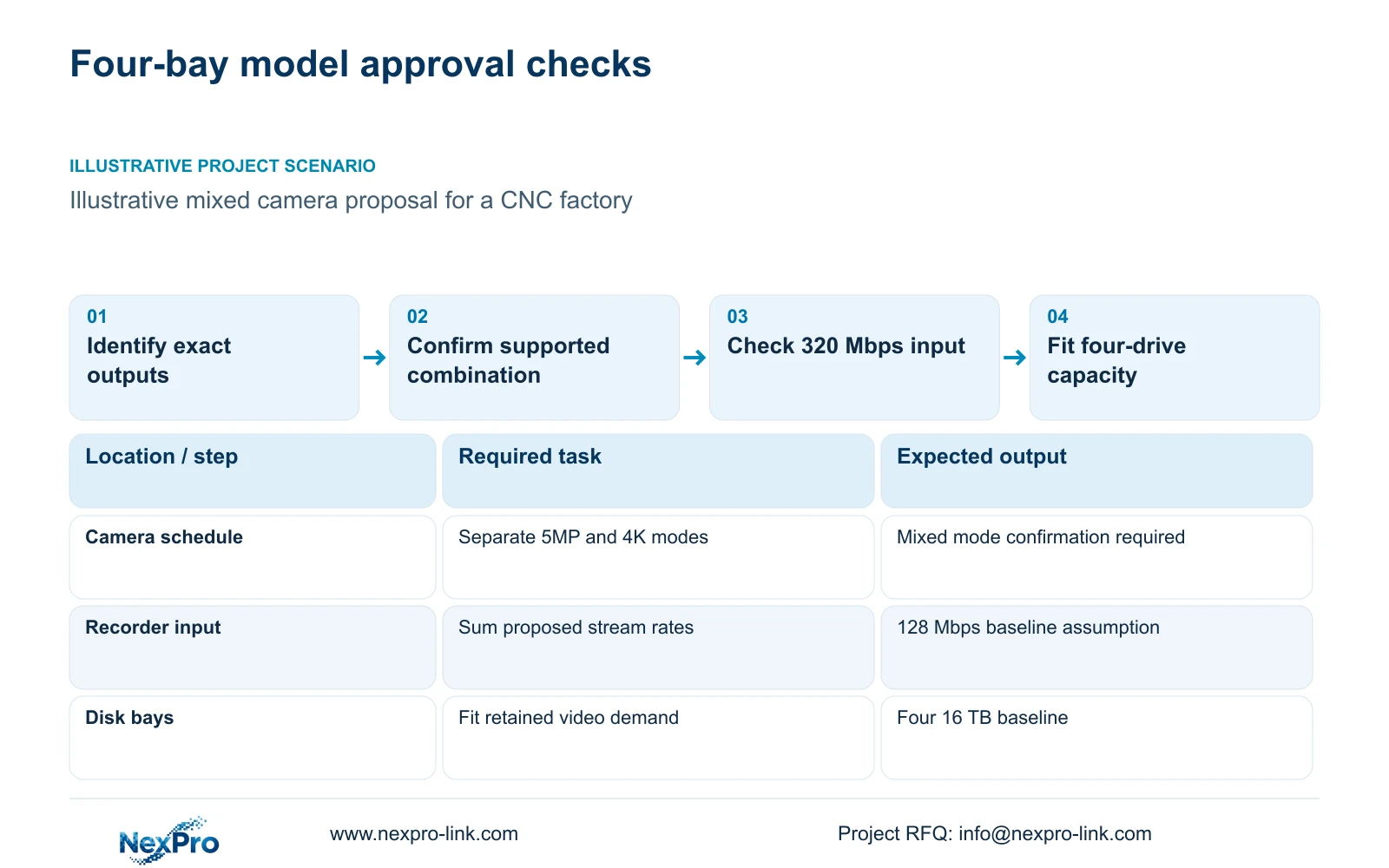
Use the NexPro-NVR4449-4K against its documented channel and resolution combinations, 320 Mbps input rating and four SATA bays. The published summary distinguishes 49×5MP from 9×4K. It does not establish 49 simultaneous 8MP streams, a mixed-resolution formula or a specific RAID mode. Those questions need exact configuration and firmware support before order approval.
Illustrative project scenario: An engineer wants to use the four-bay recorder for a mixed camera schedule in a new CNC factory. CASE01 supplies a 32-camera ordinary-security baseline, assumed within supported 5MP-class modes. A few proposed higher-resolution views are a planning change, with quantities and accepted output settings still unresolved. No mixed-mode capacity result is assumed here.
Start by recording the output actually requested from each camera, including resolution, frame rate, codec and stream setting. The supplied 5MP family lists 2880×1620 output; preserve that field. A camera family's marketing label cannot replace the stream identity the recorder must accept, and a 4K product name cannot approve an unlisted combination.
Section 02
Check the proposed input without converting headroom into channels
For the illustrative 32-camera baseline, average input = 32×4 Mbps = 128 Mbps. This compares with the quoted model rating of 320 Mbps input. Keep 128 Mbps labelled as assumed demand and 320 Mbps as the catalogue reference. The numerical difference does not authorise additional cameras at any resolution.
For a mixed schedule, calculate input as the sum of each camera's proposed stream rate. Identify the rates used for average retention and those used for configured or observed peak input. Motion, lighting and image settings can change actual traffic, so obtain representative observations from the intended scenes rather than treating one quiet sample as the permanent design load.
Check the network route and operator workload independently. Dual Gigabit LAN is a published interface field, but it does not establish an unrestricted combined input allowance, automatic failover or a particular segmentation arrangement. Document which interface carries each service and confirm the supported configuration before relying on it in a factory network drawing.
Section 03
Treat four disk bays as a capacity boundary
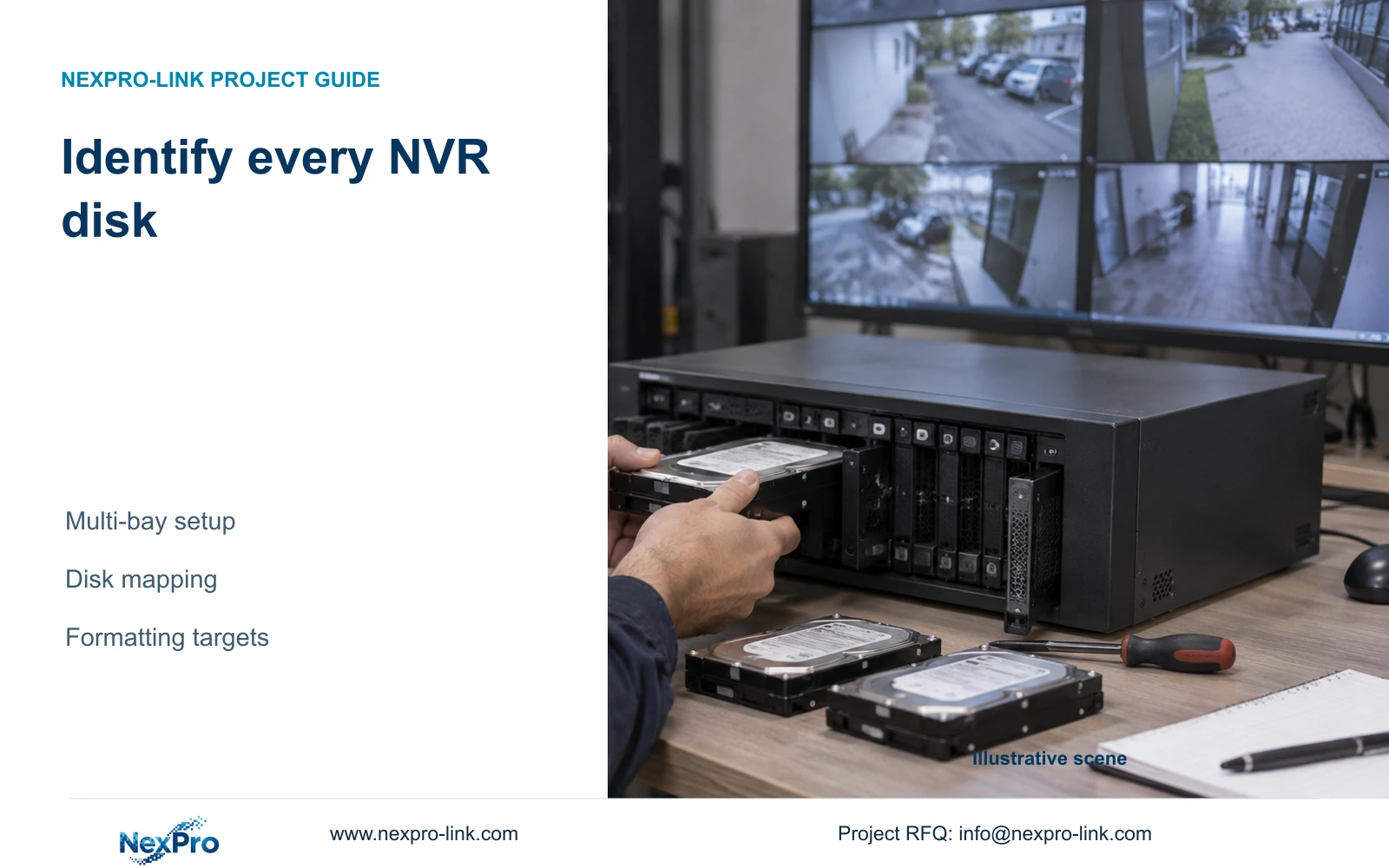
The recorder lists four SATA bays with up to 18 TB per drive. That defines a catalogue raw-capacity boundary of four compatible drives, not a promise about every disk model or usable storage arrangement. CASE01 uses four 16 TB surveillance drives, totalling 64 TB raw, rather than assuming the maximum drive size is always necessary.
Its illustrative usable estimate is 64×0.95 = 60.8 TB. Reserving 20% of that usable space leaves a video budget of 60.8×0.8 = 48.64 TB. Compare the video data with this budget directly. If comparing required usable capacity instead, use the 60.8 TB figure and do not subtract reserve a second time.
Four installed drives do not prove parity protection, hot-spare operation or recording continuity after a disk failure. Write those as separate requirements if the owner needs them. A supported resilience design may change available capacity and procurement scope; it cannot be added to this arithmetic merely by renaming the disk arrangement.
Section 04
Show exactly where the longer retention option fails
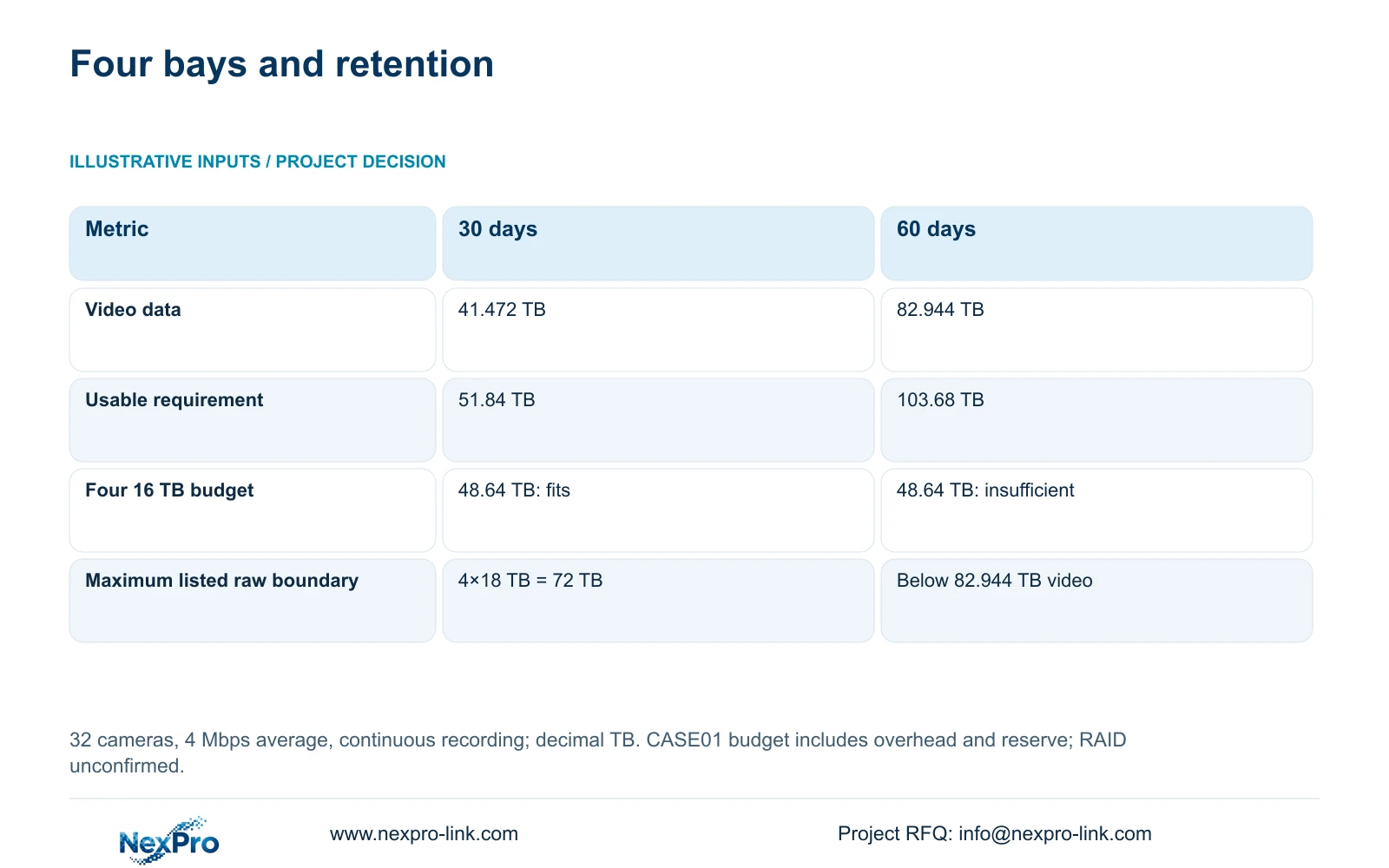
For continuous recording at 24 hours/day, use video_TB = n × Mbps × 10^6 × 86400 × days / 8 / 10^12. With n = 32 and average Mbps = 4, the results are 41.472 TB at 30 days and 82.944 TB at 60 days. Required usable_TB = video_TB / 0.8 gives 51.84 and 103.68 TB.
The four 16 TB drives in CASE01 provide a 48.64 TB video budget, so the 30-day baseline fits this planning model. The 60-day requirement does not. Even a catalogue boundary of four 18 TB drives totals only 72 TB raw, which is below 82.944 TB of video before any formatting factor or free-space allowance.
The decisive constraint for the longer option is disk capacity, despite unchanged camera count and assumed 128 Mbps input. Audio and extra metadata are excluded, and the 95% factor is a planning assumption. Before committing to retention, replace the average rates and verify the compatible drive and firmware arrangement.
| Check | 30 days | 60 days |
|---|---|---|
| Camera schedule | 32 at 4 Mbps | 32 at 4 Mbps |
| Daily recording | 24 hours | 24 hours |
| Video data | 41.472 TB | 82.944 TB |
| Required usable space | 51.84 TB | 103.68 TB |
| Four 16 TB video budget | 48.64 TB: fits | 48.64 TB: insufficient |
| Four 18 TB raw boundary | 72 TB raw | Below video demand |
Section 05
Approve the baseline and hold unresolved mixed modes
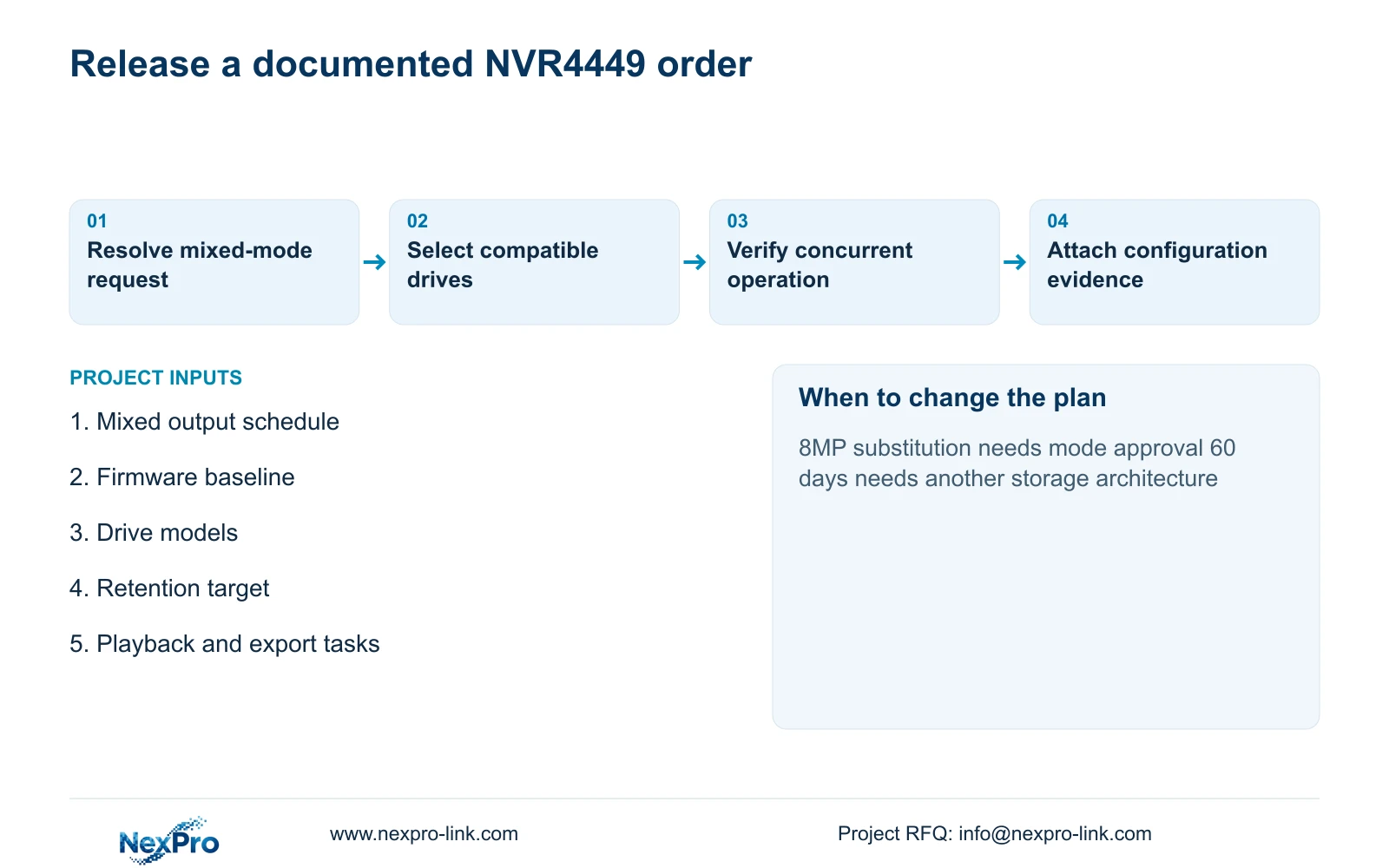
The practical recommendation is to retain the NexPro-NVR4449-4K as a candidate for the stated 32-camera, 30-day, supported 5MP-class baseline. Confirm disk compatibility and required operator functions before release. Keep proposed 8MP substitutions pending until a supplier response establishes the exact mixed recording combination on the intended firmware.
For 60 days at the same assumptions, move the comparison to a larger storage chassis or another documented architecture. The NexPro-NVR8864-4K offers an eight-bay reference, but its 64×5MP and 16×4K summaries still require mode-specific checking. Storage expansion does not resolve an unconfirmed mixed-resolution schedule.
Demonstrate capture while the agreed live viewing, playback and export tasks run. A recorder that accepts all inputs may still need a separate client or display arrangement for the operator workload. Compare alternatives on the same tests and disk allowance, retaining any required integration rather than trading it away to improve a headline equipment price.
Section 06
Keep model, firmware and disk evidence attached to the order
Create a model-specific approval sheet linking camera IDs to recorder modes, incoming rates and storage calculations. List the exact recorder identity, firmware baseline, compatible drives and tested operator tasks. Mark the engineer's unresolved mixed-mode questions prominently, so a quotation revision cannot appear complete while leaving the central compatibility decision unanswered.
NexPro-Link can use its BOQ and tender support scope to coordinate model matching, technical documentation and deviations. For this recorder, request a capacity comparison that separates supplied hardware, retained clients, optional display equipment and local commissioning work. The supplier's configuration evidence and the integrator's site acceptance record serve different purposes.
Include change triggers in the approved schedule: camera output changes, longer retention, higher bitrate and additional concurrent users. Recheck only the affected constraints, but keep the complete record coherent. Replacing the model name while retaining the old four-bay arithmetic would leave the purchase order technically ambiguous even if the new chassis has more space.
Section 07
Buyer questions
Can we calculate a mixed 5MP and 8MP limit from the two summary modes? No supported conversion formula is supplied. Submit the exact mixed schedule and request a documented response for the intended firmware rather than interpolating between 49×5MP and 9×4K.
Does buying 18 TB drives remove the 60-day shortfall? No, under the stated inputs. Four 18 TB drives total 72 TB raw, while 60 days already requires 82.944 TB of video. Usable-space allowances would reduce the available recording budget further.
What should happen if RAID is a mandatory tender requirement? Treat it as an unresolved compliance item for this reference. Require documentation of the supported storage architecture or select a documented alternative, then recalculate usable capacity and quote the changed scope.
Section 08
Confirm the four-bay recorder configuration
Send the exact mixed camera output schedule, retention target, proposed drive models, and concurrent playback/export requirements to info@nexpro-link.com to discuss NexPro-NVR4449-4K configuration evidence and alternatives.
Engineering references
These sources support the general planning principles. Always use the selected product's current datasheet and applicable project standards for final design.