Convert a documented prior packing or support issue into a specific requirement for the next order. Identify the affected role and evidence of closure, without turning one incident into a supplier-wide performance claim.
Section 01
Renew approval against the next project's actual scope
Convert a documented prior packing or support issue into a specific requirement for the next order. Identify the affected role and evidence of closure, without turning one incident into a supplier-wide performance claim. Recheck applicability at the new site. A lessons register should change a controllable deliverable, not merely repeat an unverified endorsement.
Use NexPro-Link as a repeat factory project supplier by carrying forward verified equipment roles, document formats and OEM baselines, then checking their applicability to the next site. The project manager should issue a revision-controlled scope schedule identifying what remains approved, what needs confirmation and what falls outside the previous approval. A successful camera order does not establish approval for every related equipment category or installation condition.
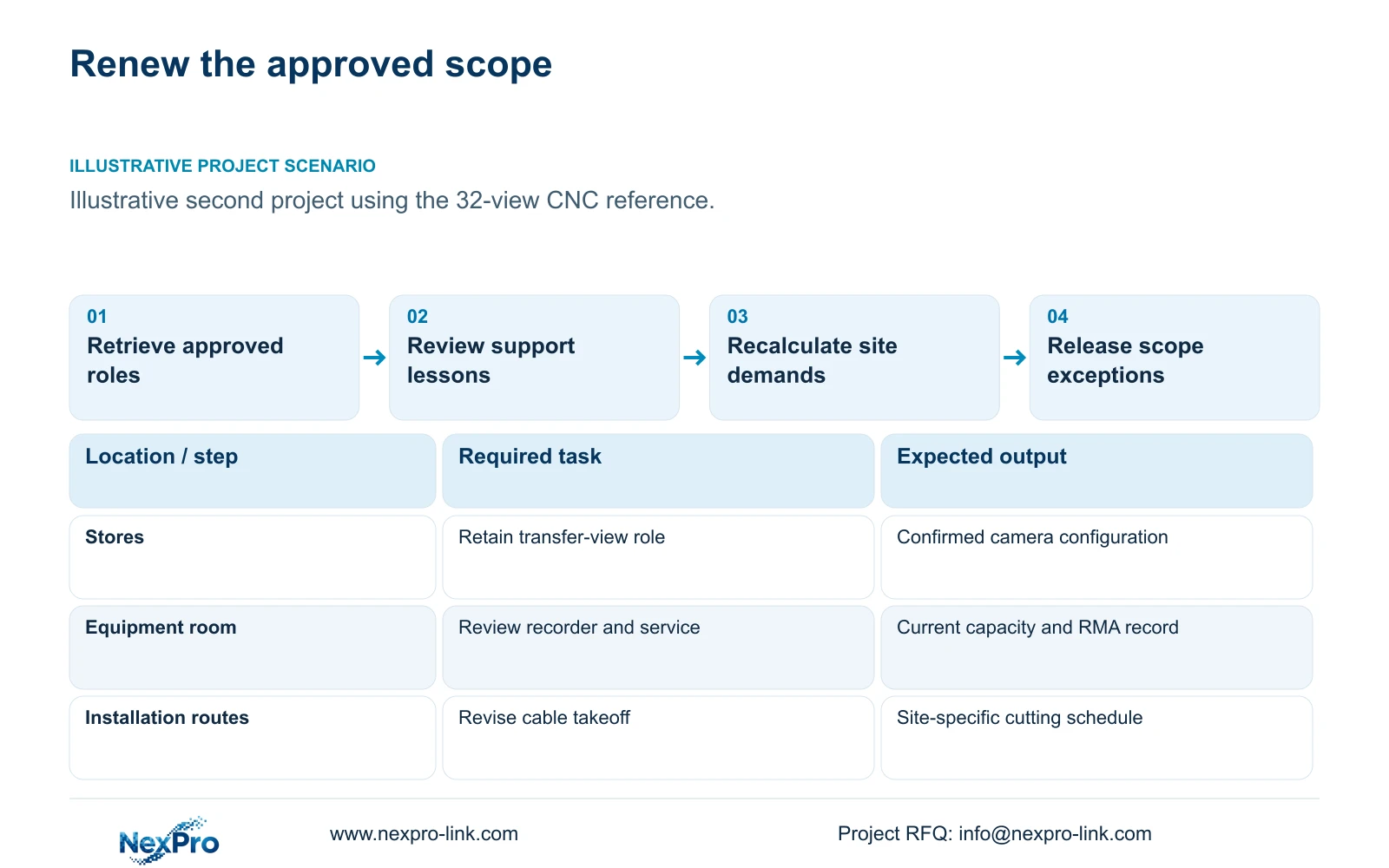
Illustrative project scenario: An integrator plans another industrial project after completing a first package. For planning, assume the next project uses the CASE01 reference: 32 ordinary security views covering gates, stores, permitted machine-hall transfers, common routes, dispatch and equipment-room approaches. These are hypothetical procurement inputs, not evidence of a completed NexPro-Link customer installation.
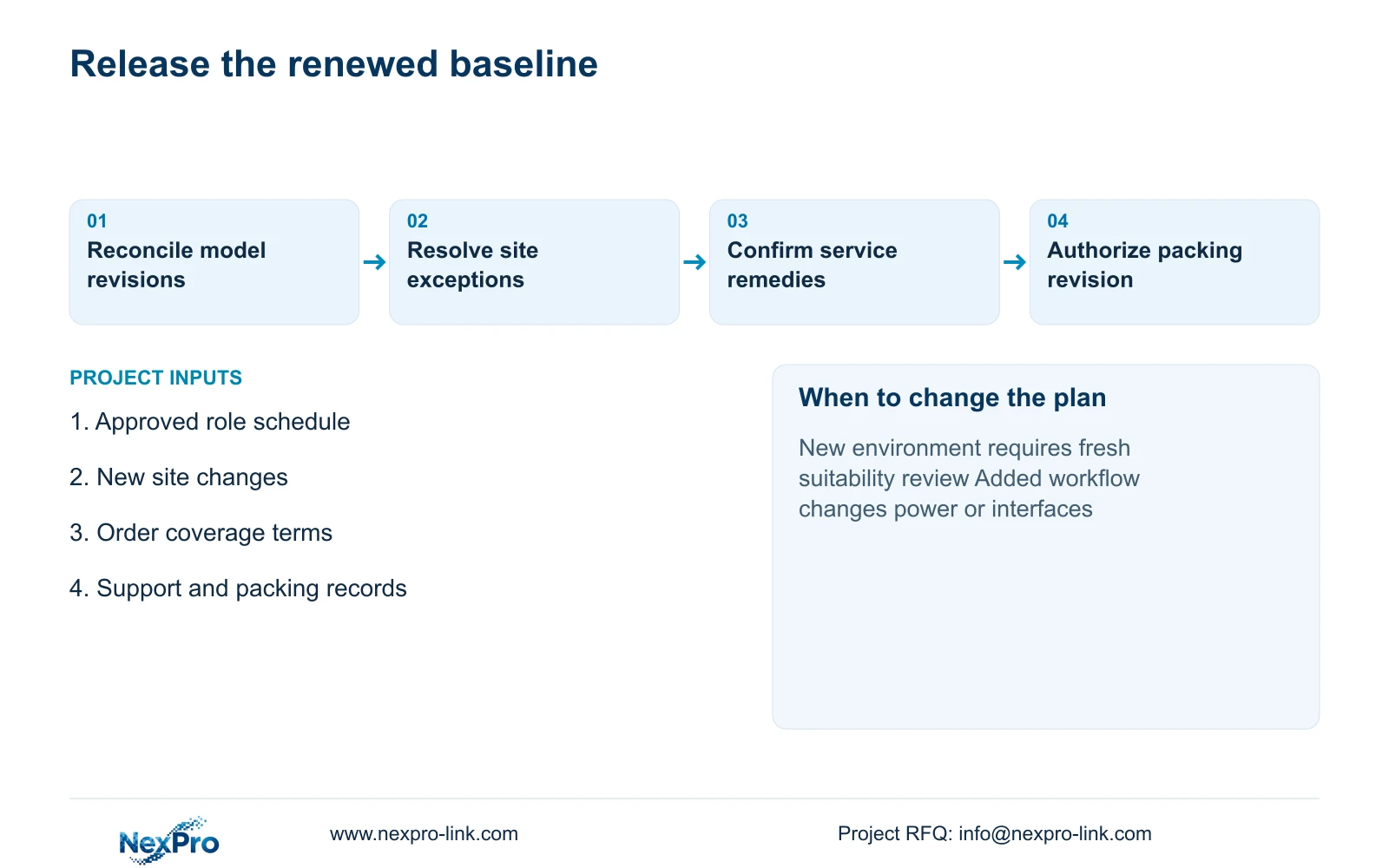
Retrieve the previous model schedule, accepted deviations, firmware identity, packing revision and applicable order terms. Compare each item with the new observation task and interruption impact. A camera previously accepted for an indoor transfer route can remain a candidate for that role; moving it to an exposed or specialist location requires a fresh suitability decision. Record approval by role and configuration so purchasing cannot mistake a familiar supplier name for unrestricted technical acceptance.
Section 02
Convert support and packing experience into controlled revisions
Review the first package's support records for changes that can prevent repeat work. Separate an incorrect accessory, an unclear location label and an unresolved operating issue because each requires a different correction. For example, if installers could not match cartons to the camera schedule, revise the project-tag convention and packing list. Changing the camera model would leave the identification problem unresolved.
Keep the technical identity visible alongside buyer branding. An approved laser logo or custom box can be reused through its artwork revision, surface location and sample approval, while model and serial records remain traceable. NexPro-Link's OEM scope includes labels, manuals, barcodes and packaging options. Hardware branding does not establish permission to rename third-party software, and artwork approval should not authorize an unnoticed hardware substitution.
Carry the service route into the repeat-order file as well. Identify who gathers fault evidence, authorizes returns, arranges local replacement and handles freight. Preserve the old order's coverage for its own equipment, then agree the new order separately. A practical improvement might be a clearer fault-report form or an approved spare allocation; neither should be presented as a warranty extension unless the written terms provide one.
Section 03
Recalculate the site inputs behind familiar equipment
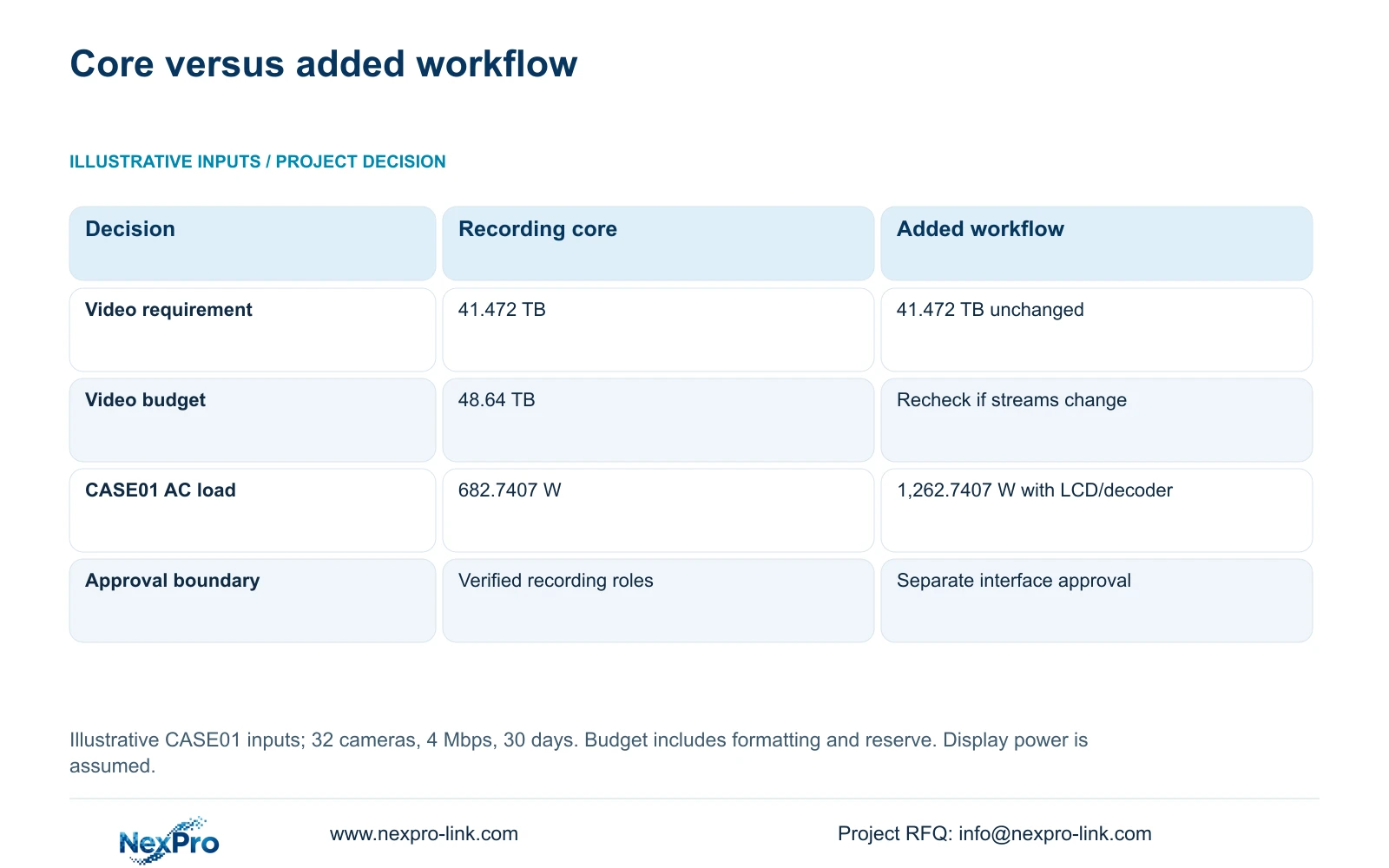
A repeated model schedule still needs new recording and infrastructure checks. In CASE01, 32 cameras at an illustrative average 4 Mbps, continuously recording for 30 days, produce video_TB = 32 × 4 × 10^6 × 86400 × 30 / 8 / 10^12 = 41.472 TB. Four 16 TB disks provide 64 TB raw; the planning recording budget is 64 × 0.95 × 0.80 = 48.64 TB. Compare 41.472 TB directly with that budget because formatting and the 20% reserve are already included.
The NexPro-NVR4449-4K reference has 49 catalogue channels, 320 Mbps input and four SATA bays supporting up to 18 TB per drive. The case's 128 Mbps aggregate input is only one selection check. Its streams are assumed to fit supported 5MP-class recording modes; channel count does not prove an all-8MP configuration, simultaneous decoding capacity or RAID. The engineer should confirm the actual streams and playback task before retaining this recorder.
Reopen cabling and power where the layout changes. CASE01 assumes 1,872 m of continuous CAT6 cuts and a feasible seven-reel plan using 305 m reels. Those quantities cannot follow the equipment family to a different building without a route takeoff. Assign the engineer the revised calculations, the local installer the route and electrical confirmation, and procurement the resulting quantity changes. This keeps supplier standardization from concealing site-specific shortages.
Section 04
Separate the repeat recording core from added workflows
Use a complete recording package as Option A, then identify any additional management or integration as Option B. Hold the owner's observation and retention outcome constant. Assign each line to supplied, retained, installer-provided or optional, with one named owner for each interface. The following comparison turns that method into choices for the illustrative next project.
The decisive difference is the dependency introduced by an added workflow. A central management server requires an agreed software function, supported interface, access owner and protected-power allowance. It cannot be treated as a free extension of the previous camera approval. Conversely, a local installer can provide the approved cabling without forcing it into the supplier's equipment quotation, provided its termination and testing responsibilities are explicit.
Keep optional shared displays separate from the recording core. CASE01's recording-first load is an assumed 682.7407 W; adding four LCD panels and a decoder raises it to 1,262.7407 W while retaining the original operator equipment. This uses 120 W per panel and 100 W for decoding as teaching assumptions, not published measured draw. It illustrates why a display addition reopens the power schedule even when cameras and retention remain unchanged.
| Decision | Option A: recording core | Option B: added workflow |
|---|---|---|
| Recording outcome | 32 agreed views; 30-day planning target | Same views and retention target |
| Hardware identity | Exact models, firmware and project tags | Same baseline plus approved interface identities |
| Network and power | Required recording nodes allocated | Added servers or interfaces separately counted |
| Software and access | Authorized viewing, retrieval and export | Defined additional workflow with an access owner |
| Procurement responsibility | Supplier equipment; installer cabling and mains | Added integration scope and named interface owner |
Section 05
Retain the baseline only where support remains workable
Prefer the verified equipment family when it still meets the new role and can be maintained under an agreed service arrangement. This preserves usable configuration records and familiar installation preparation. Change the recommendation when the owner requires a different platform, a specialist environment, an unsupported workflow or a recovery arrangement the proposed package cannot meet. Record the specific exception rather than reopening every accepted item.
Check coverage by line item before the purchase order. The supplied NexPro-Link warranty reference states a 24-month baseline from receipt for eligible main equipment, while the rack UPS page also uses a 1–2-year product term. Preserve that distinction and obtain the applicable written terms. Disks, batteries, consumables, local labour and freight require separate treatment; a combined equipment package should not obscure their different remedies.
For a recorder fault, define how the installer preserves available footage, identifies the unit and gathers symptoms before a return is authorized. For a camera fault, relate spare availability to the affected view's interruption impact. Procurement should compare other supplier proposals against the same operating task and service boundary. Without matched quotations or trials, the repeat relationship provides a coordination basis, not evidence of lower cost or better performance.
Section 06
Release a repeat-order file with explicit exceptions
Prepare one release file containing the current role schedule, technical and OEM revisions, site-specific quantities and service responsibilities. Reference the previous baseline without replacing the new project's records with old attachments. Mark unchanged items as carried forward, changed items with their reason, and unresolved items with an owner and required decision. An unanswered field should remain visible rather than being interpreted as included or zero cost.
NexPro-Link's BOQ and tender-support scope provides a route for model matching, technical documents, deviations and quotation coordination. Use that support to reconcile the equipment list with the approved scope. The buyer retains final approval, and local installation remains allocated to the appointed project team. The release should also identify which revisions invalidate packing instructions or require a new sample.
For subsequent orders, preserve the released file as the reference for replacement matching and support. If firmware, accessories or artwork change, issue a revision before shipment preparation. The useful output is an order-specific standard configuration with a workable warranty/RMA route, allowing the next project to reuse genuine lessons without inheriting assumptions that no longer apply.
Section 07
Buyer questions
Can a discontinued approved model be replaced without a new review? Treat the replacement as a controlled substitution. Compare its required view, recording mode, power, mounting and software workflow with the approved role, then record any differences. Matching resolution or housing appearance alone is insufficient.
Should repeat projects use the same spare pool? A shared pool is useful only where replacement compatibility and access arrangements are established. Record which configurations each spare can serve and who can release it. Site-specific accessories or branding may require separate allocations.
Does a later factory opening restart the warranty period? Do not assume it does. Check the applicable order's start-date provision and request written clarification where commissioning is delayed. Receipt-based equipment coverage and any separately agreed local service period should remain distinguishable.
Section 08
Refresh your approved repeat-order scope
Send your approved equipment-role schedule, proposed site changes, applicable order terms and interruption/service responsibilities to info@nexpro-link.com for a repeat-package scope review.
Engineering references
These sources support the general planning principles. Always use the selected product's current datasheet and applicable project standards for final design.