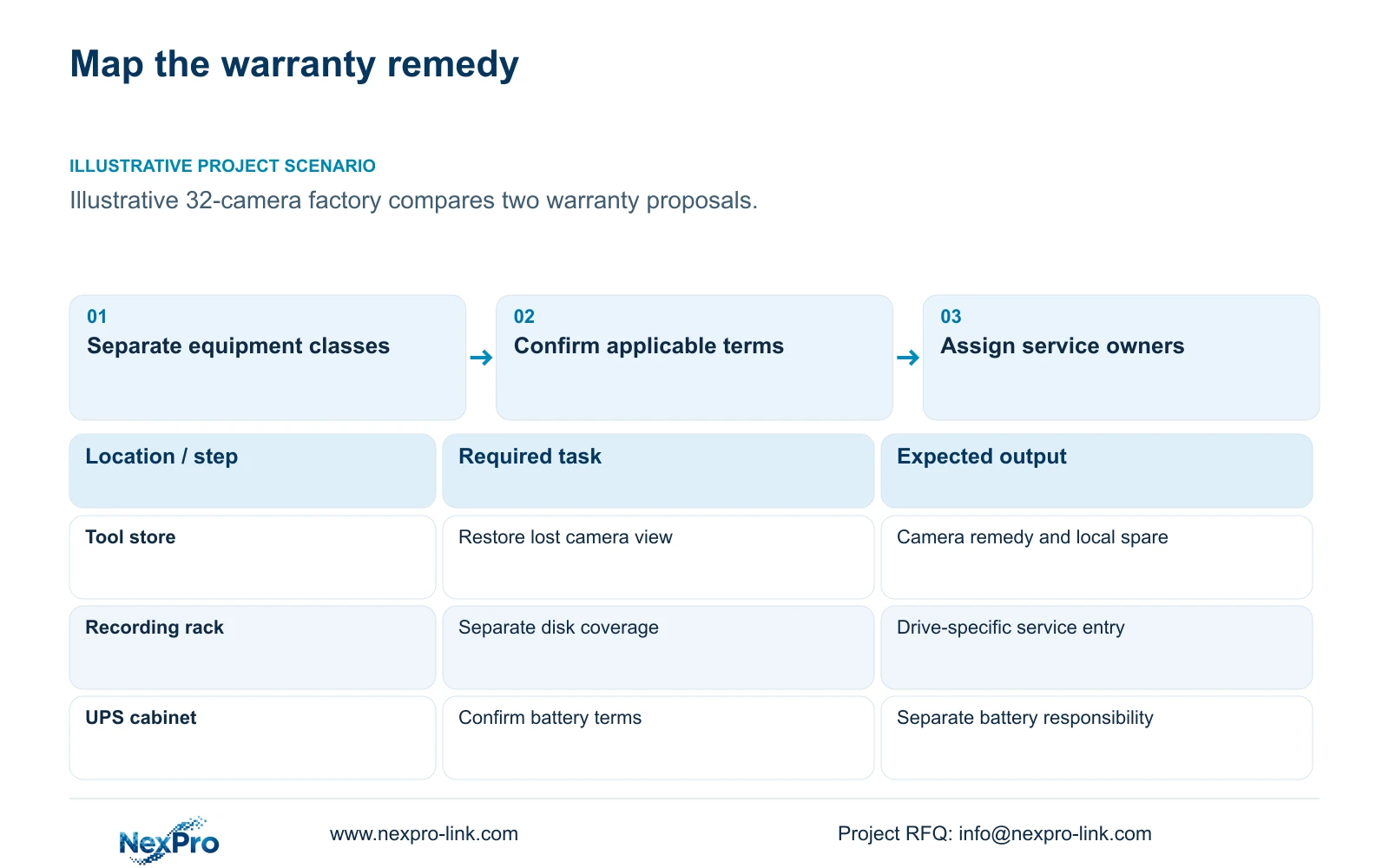
For one failed-device example, assign authorization, removal, replacement supply, freight and reinstallation to their actual contractual owners. Mark unknown charges as clarification items, not zero.
Section 01
Compare coverage for each equipment class
For one failed-device example, assign authorization, removal, replacement supply, freight and reinstallation to their actual contractual owners. Mark unknown charges as clarification items, not zero. Compare the completed remedy route across offers. This worksheet makes coverage executable without converting a warranty entitlement into an unsupported onsite restoration promise.
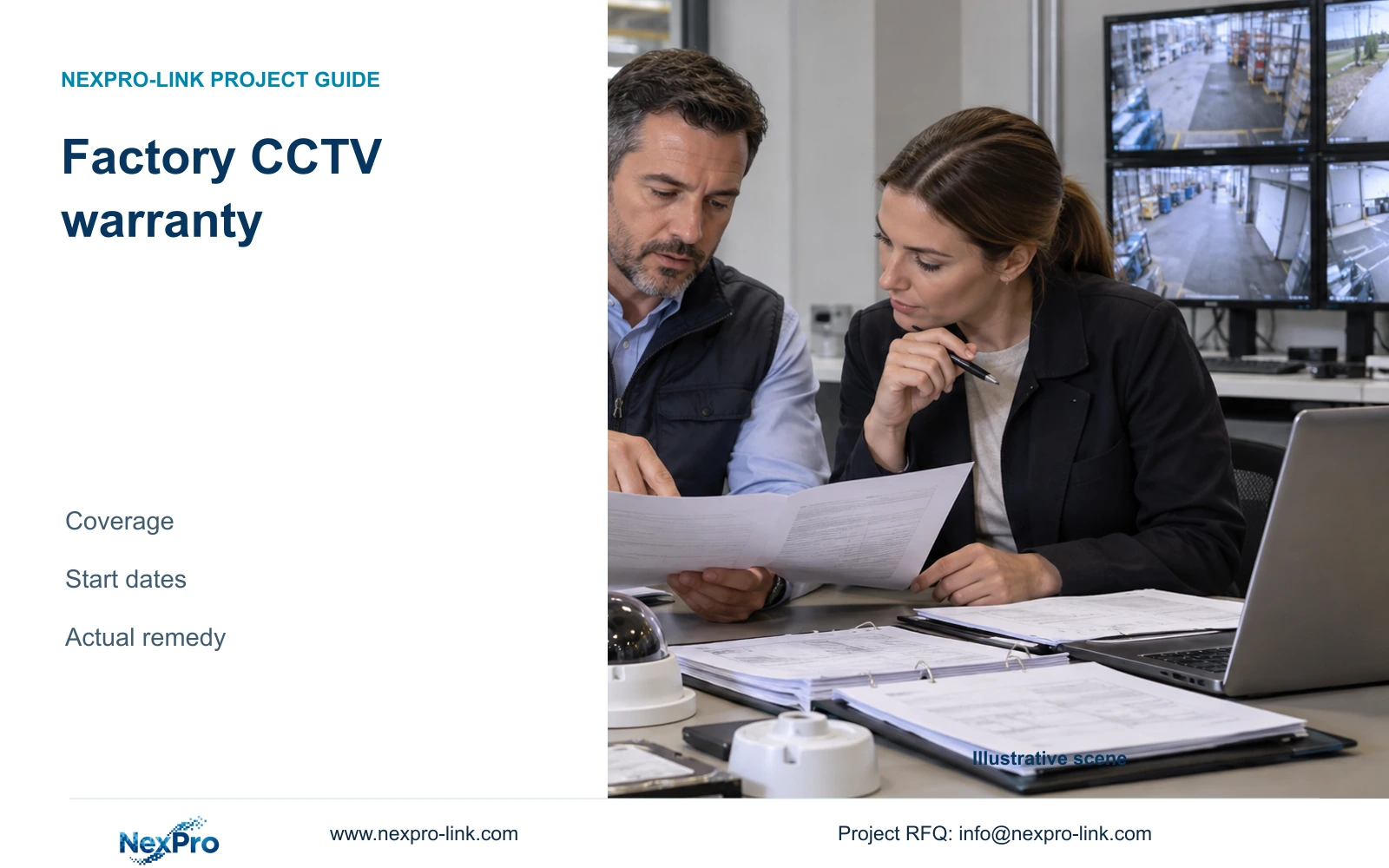
Compare factory CCTV warranties by covered equipment, start date and available remedy before comparing headline years. A camera repair entitlement does not establish coverage for the recorder's disks, UPS batteries, cable installation or the technician who removes a failed unit. The project manager needs a line-item service schedule that explains what happens when each part of the recording chain fails.
Illustrative project scenario: The plant compares warranty years across two complete project proposals. Use the supplied 32-camera CNC reference as the equipment context: ordinary security cameras, one recorder, four disks, four access switches and a local UPS. Assume the owner wants to review authorised material transfers and access. These are planning conditions, not a completed installation or a record of failures.
Create separate entries for main equipment, storage drives, batteries, consumables and site services. Attach the exact model or purchased item to each entry. NexPro-Link's supplied warranty policy gives eligible main equipment a 24-month baseline from receipt. Its rack UPS source also contains a 1–2-year product term, so the UPS requires explicit order clarification rather than automatic assignment of the general period.
Section 02
Resolve conflicting terms before issuing the order
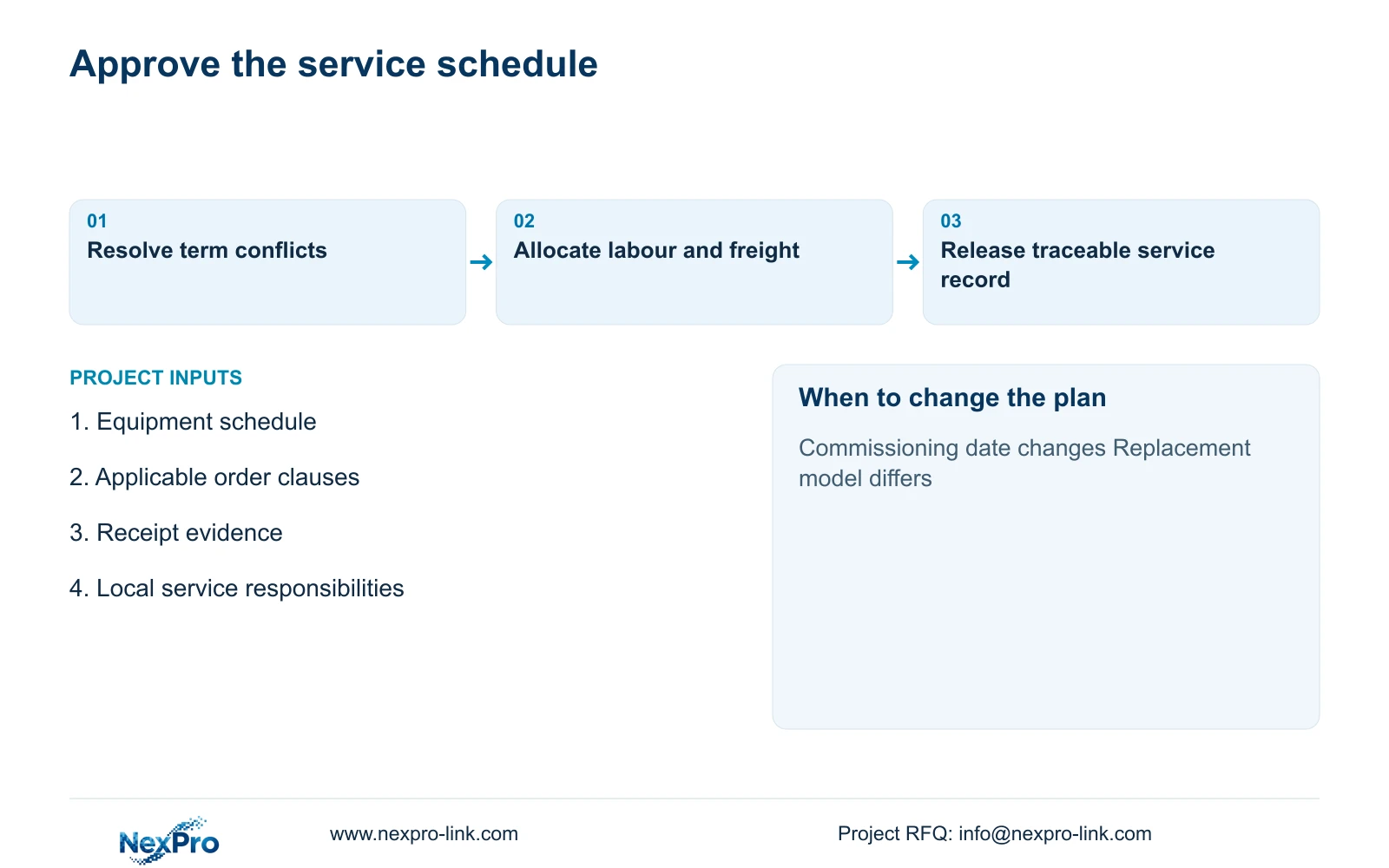
Use the accepted quotation, purchase order and applicable product policy together as the project record. Copy the relevant terms into the equipment schedule with their document revision. If the quotation and policy differ, ask the supplier to confirm which arrangement applies to the specific line item. Leaving both documents in a folder does not resolve the conflict.
Capture the covered fault scope, start trigger, duration, claim evidence and proposed remedy. Also establish who decides whether repair or replacement is appropriate and what approval precedes a return. A statement such as 'warranty included' leaves these decisions open. The quantity surveyor should treat unconfirmed service costs as unresolved amounts, never as zero.
Historical project-specific five-year statements need their own supporting order records. They should neither be copied into a new factory proposal nor discarded solely because a general page describes a shorter baseline. NexPro-Link's BOQ and tender support scope can help organise model matching and deviations; the buyer still approves the final commercial arrangement.
Section 03
Follow one failed device through the remedy
Test the proposed service route with a concrete example: a camera overlooking the tool-store handover stops recording. The operator reports the channel and time, the local integrator checks the relevant link and power conditions, and the supplier reviews the authorised fault evidence. Only then does the agreed repair or replacement process begin. Assign a named party to each handoff.
Ask who supplies safe access equipment, removes the camera, protects the exposed connection, packs the unit and pays outbound and return freight. Determine whether a temporary spare is included, separately purchased or unavailable. A replacement dispatched from overseas can still leave a critical view unavailable while transport and local installation are arranged.
Keep equipment remedy and service continuity as separate purchasing decisions. If the owner cannot tolerate the expected interruption, quote a compatible local spare or a local support arrangement. This adds inventory or service scope without changing the hardware warranty itself. Confirm how a repaired or substituted unit will be checked against the original view and recording task.
Section 04
Calculate the term remaining at commissioning
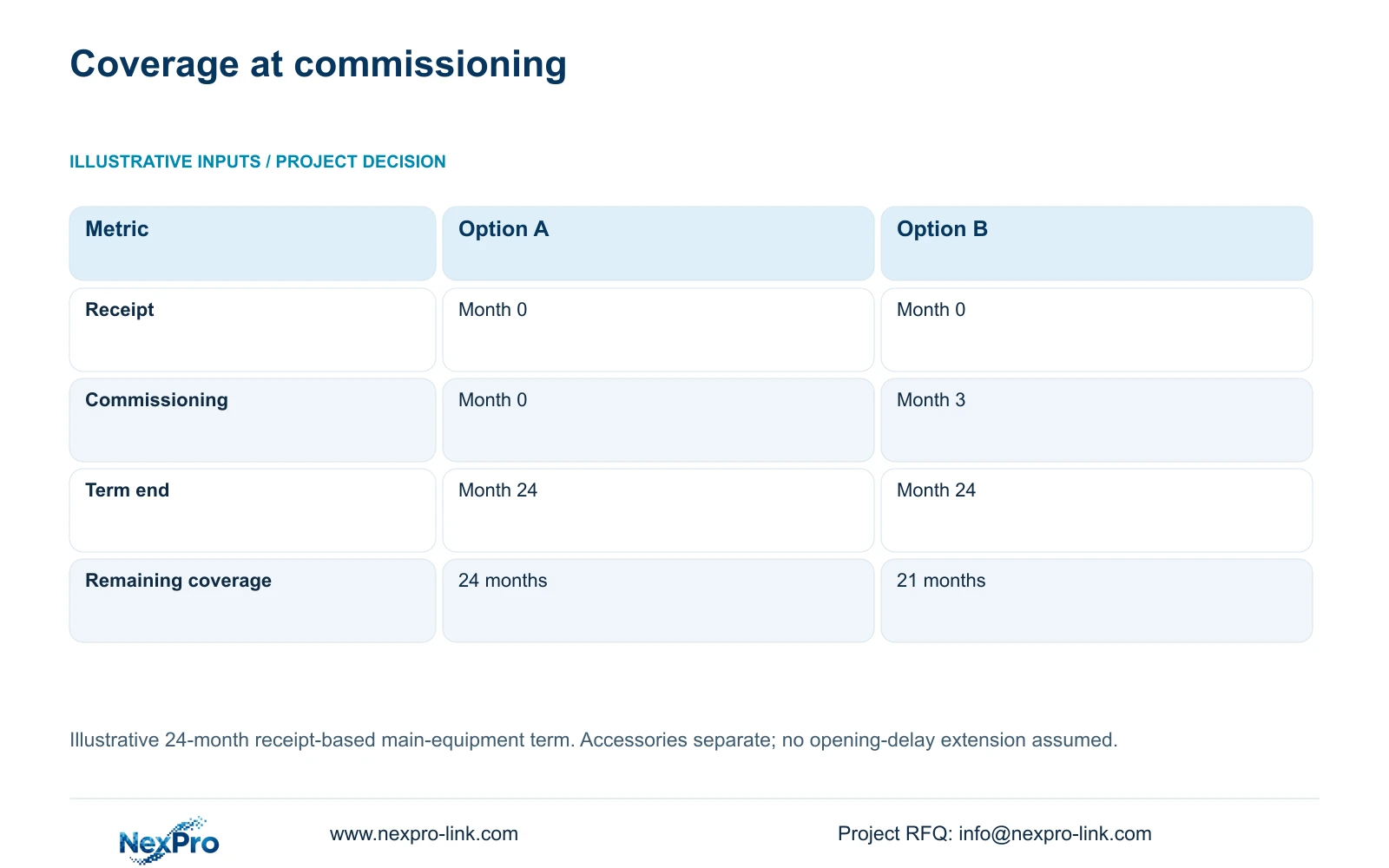
The illustrative timeline assumes receipt at month 0 and a 24-month eligible-main-equipment term beginning at receipt. Option A commissions at month 0; Option B commissions at month 3. The formula is remaining_term_at_commissioning = term_months − elapsed_months. For Option B, 24 − 3 = 21 months. Accessories remain outside this main-equipment calculation.
The decisive difference is the remaining covered operating period, not the stated expiry. Both examples end at month 24, but delayed commissioning leaves three fewer months after commissioning. Opening the plant does not automatically restart a receipt-based clock. An agreed alternative trigger or extension must be recorded separately and applied only to the equipment it covers.
Put receipt evidence beside the commissioning record so future support staff can reconstruct the timeline. For phased deliveries, calculate each batch from its applicable trigger instead of using the final site's opening date for everything. The table demonstrates the method; actual calendar dates and order terms determine the project's remaining period.
| Metric | Option A | Option B |
|---|---|---|
| Receipt | Month 0 | Month 0 |
| Commissioning | Month 0 | Month 3 |
| Main-equipment term end | Month 24 | Month 24 |
| Remaining at commissioning | 24 months | 21 months |
| Opening-delay extension | Not established | Not established |
Section 05
Choose terms that match the interruption impact
Prefer the proposal with a complete, acceptable service route for the required task. For an ordinary route camera with another useful view nearby, a return-to-supplier remedy may be workable. For the sole view of a controlled release point, the owner may need a locally held spare and an installer available to restore recording. Establish the interruption tolerance before judging the offers.
Compare NexPro-Link, Hikvision, Dahua or other packages on the same equipment and local-service boundary. A longer stated period may cover fewer items or omit freight; a shorter period may be paired with separately priced local support. Without matched quotations, neither arrangement can be declared cheaper. Show the differences as explicit inclusions, exclusions and optional services.
Change the preferred arrangement when access restrictions, delivery geography or specialist equipment make the proposed remedy impractical. The 32-camera reference contains ordinary security positions only. If a real project adds specialist cameras, preserve their environmental and approval requirements in the return and replacement route rather than treating an ordinary spare as equivalent.
Section 06
Make the warranty schedule usable after handover
Release a service schedule that links project tags, serial numbers, purchased models, receipt evidence and applicable terms. Give the owner a support contact route and identify the local party responsible for diagnosis and removal. Keep the original equipment identity when a unit is repaired, and add the replacement identity when it is exchanged.
For repeat orders, retain the approved technical configuration alongside the commercial terms. A later camera with a similar name may require different mounting or firmware checks, while a new battery or disk can have a different coverage scope. The purchasing team should request a deviation record whenever the proposed replacement differs from the approved item.
NexPro-Link can discuss the equipment list, technical documents and project packing needed to support this traceability. Local installation and onsite service must be separately assigned. Before approval, require every unresolved coverage or freight entry to have an owner and a resolution date so the handover pack contains an actionable route rather than a collection of brochures.
Section 07
Buyer questions
Should we buy a spare while the equipment is under warranty? Consider a spare when the accepted interruption is shorter than the practical diagnosis, return and installation process. Warranty eligibility and the need for local continuity are separate decisions.
Can all items on one invoice share the camera warranty? Only if the accepted terms explicitly provide that coverage. Obtain separate confirmation for disks, batteries, accessories and services even when they are purchased in one package.
What if an older project document promises a longer period? Identify the order and equipment to which it applies, then reconcile it with the supplier. Do not transfer an older project-specific promise to a new purchase without written agreement.
Section 08
Request a line-item warranty comparison
Send your equipment schedule, proposed warranty clauses, expected receipt and commissioning dates, and local labour/freight responsibilities to info@nexpro-link.com for a factory CCTV supply-scope discussion.
Engineering references
These sources support the general planning principles. Always use the selected product's current datasheet and applicable project standards for final design.