Reserve a complete operating scope before tender. Separate confirmed quantities, provisional allowances and optional upgrades so camera prices do not hide missing work.
Section 01
Set the operating scope of the estimate
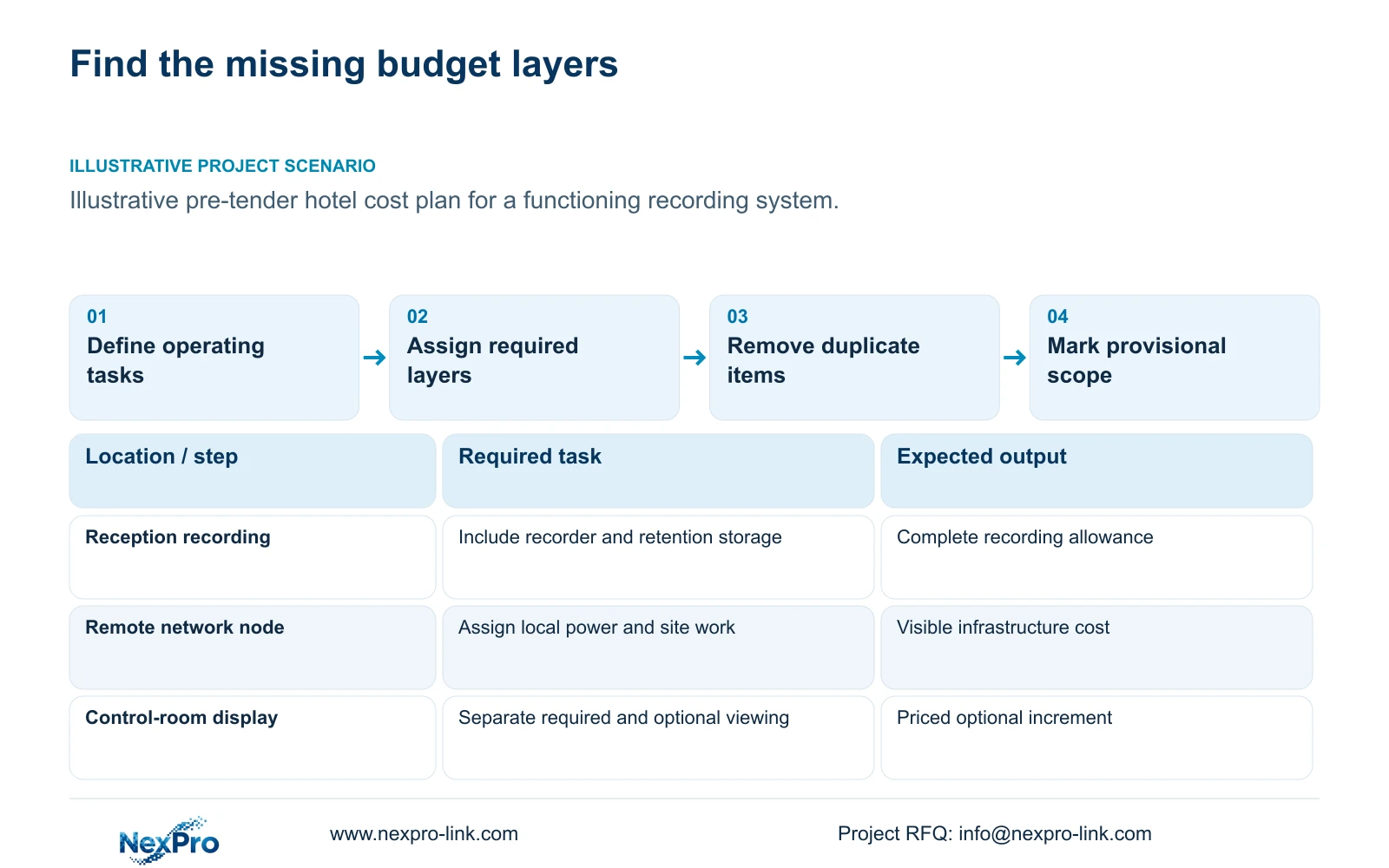
Reserve the complete capture-to-retrieval chain before tender, including the power and installation work needed to operate it. Keep optional display upgrades separate unless the operator requires them. Replace provisional amounts when quantities and quotations become available; do not conceal unresolved work inside a percentage added to camera prices.
State what the estimate covers and who delivers it. Equipment supply, local installation and later operating services can have different commercial boundaries. Identify the delivery destination and the required outage behaviour early, because both affect scope beyond the front-end devices.
Classify each line as a confirmed quantity, a provisional quantity or a defined risk allowance. The owner can then distinguish a design gap from a priced item. A budget based on room count alone leaves public-zone coverage and cable routes unresolved. Record the plan revision and operating assumptions that support the estimate so later changes have a traceable baseline.
| Required task | Given information | Decision still needed |
|---|---|---|
| Retrieve an incident | Public views identified | Retention, stream settings and storage scope |
| Record during an outage | Backup function requested | Protected nodes, target time and local power scope |
Section 03
Separate allowances from quotations
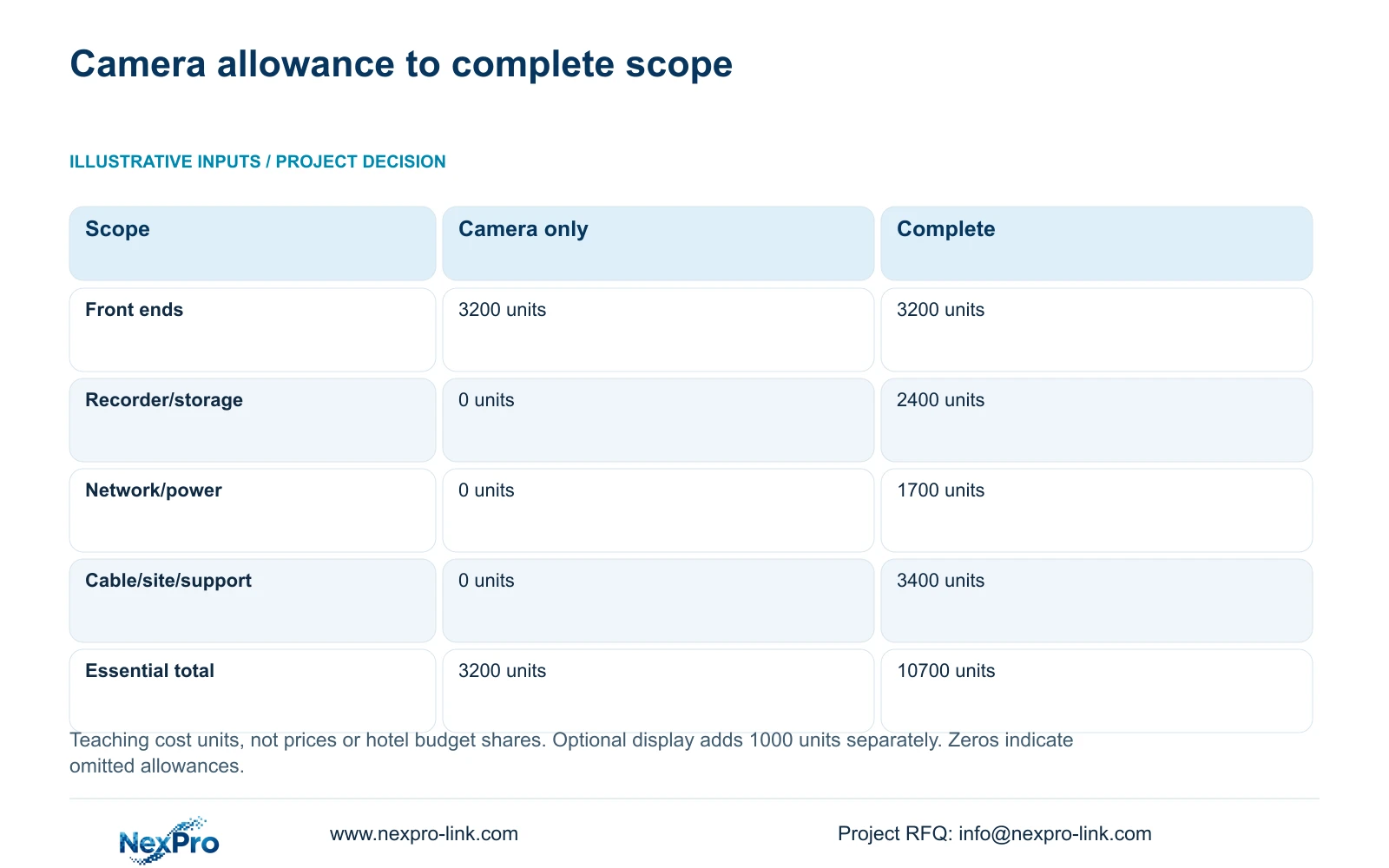
The following comparison uses teaching cost units, with no currency or market-price claim. Its inputs are front ends 3200, recorder and storage 2400, networking 800, power 900, cabling 1600, and installation/support 1800. An optional display allowance of 1000 remains outside the essential total.
Essential evaluated allowance equals the sum of required scope rows. Networking and power combine to 1700; cabling and site/support work combine to 3400. The complete teaching allowance is therefore 10700 units. The zeros in the camera-only column identify omitted allowances, not free equipment or services.
Use this structure to request comparable quotations. For each provisional row, retain its quantity assumption, inclusion boundary and source date. A supplier response should replace the relevant estimate without turning unchanged allowances into quoted amounts. The 10700-unit result does not establish typical hotel budget proportions and is independent of CASE01's engineering quantities.
| Metric / condition | Camera-only allowance | Complete allowance |
|---|---|---|
| Front ends | 3200 | 3200 |
| Recorder and storage | 0 | 2400 |
| Network and protected power | 0 | 1700 |
| Cabling and site/support work | 0 | 3400 |
| Essential total | 3200 | 10700 |
| Optional display | Not included | +1000 separately |
Section 04
Model one design change
Adding the illustrative optional display allowance changes the evaluated teaching total from 10700 to 11700 units while retaining the essential recording scope. This is a defined addition. It should not appear as an unexplained increase in camera cost or be funded by deleting required storage.
For a change involving camera quantities or specifications, keep a separate quantity bridge and rate bridge. Apply the original rate to the quantity difference, then apply the rate difference to the revised quantity. Show shared-resource changes separately so the same specification effect is not counted twice.
Before pricing extra points, check whether they cross recorder-channel, storage, switch-power or UPS-capacity limits. A small quantity change can require a larger shared component. Compare genuine reuse and cancellation opportunities, including any remaining site work. Artwork or hardware changes may also affect preparation and delivery, so a cost-only approval can leave the programme unresolved.
Section 05
Compare whole-package totals
Normalize equipment, installation, software and delivery inclusions before ranking totals. Keep recurring support and operating charges separate from the initial purchase. Where an exclusion lacks a value, leave it unresolved and obtain an input; treating it as zero makes an incomplete offer appear cheaper.
Evaluate optional improvements against a retained outcome. The display allowance is useful only if it serves an agreed observation task and includes the interfaces needed to operate it. A different recorder arrangement may affect storage or maintenance access, so its commercial comparison should retain the approved retention and retrieval requirement.
Where two qualified offers trade initial price against annual charges, state the evaluation period and calculate the crossover from their actual figures. Do not infer failure rates or service savings from a brand name. RICS New Rules of Measurement distinguishes cost-planning, detailed-measurement and maintenance uses; the teaching table here is an original illustration, not a RICS contract template.
| Retained outcome | Extra scope | Worth including when | Counter-condition |
|---|---|---|---|
| Incident retrieval | Larger operator display | An agreed viewing task needs it | Existing monitor meets that task |
| Continued recording | Additional protected node | The required path uses that node | It serves only deferred optional equipment |
Section 06
Prepare a cost-plan handoff
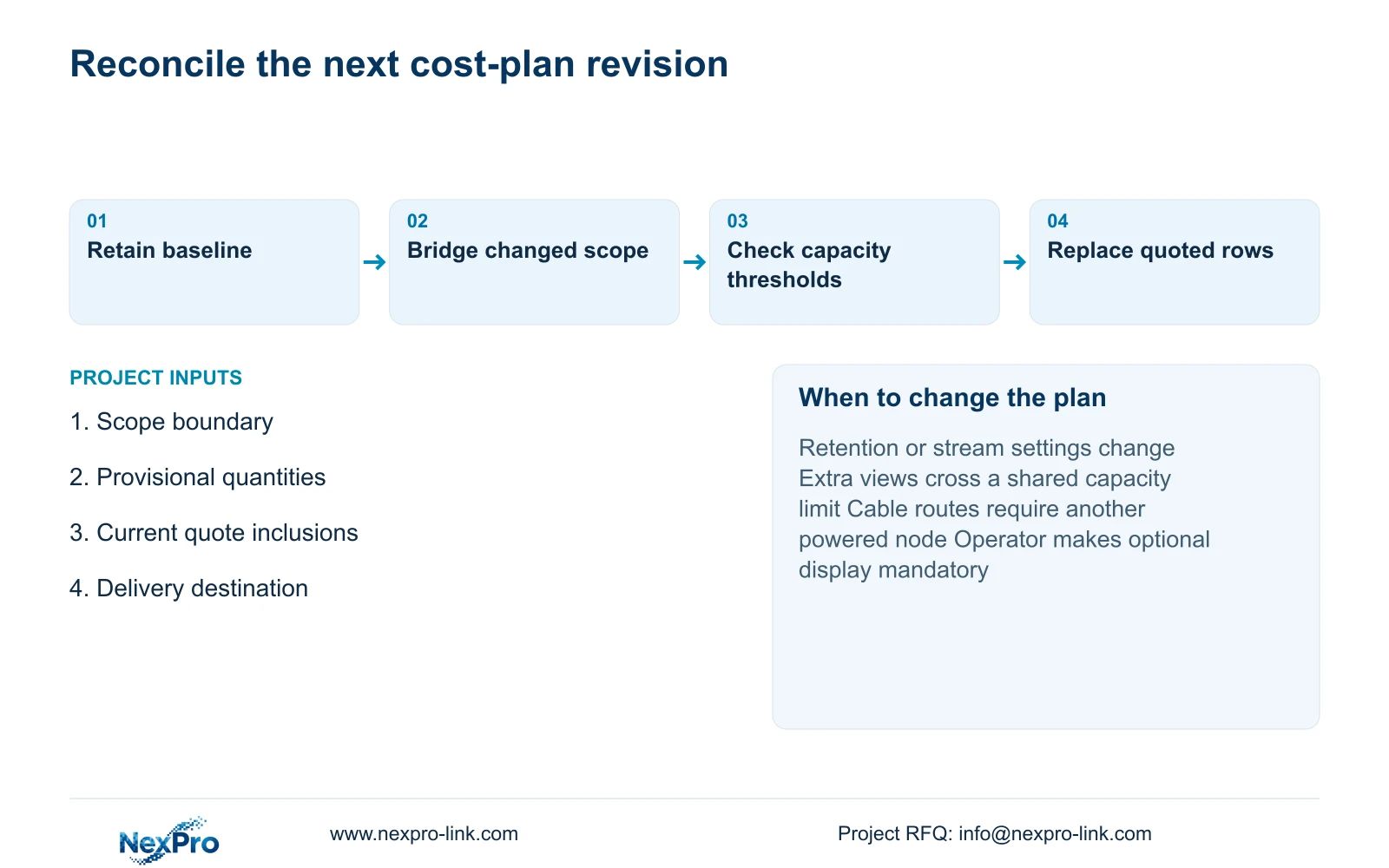
Issue one cost-plan revision that identifies the essential baseline, optional items and unresolved inputs. Each line should state its quantity basis and inclusion boundary. The handoff should allow an engineer to check function and a cost manager to reconcile price without translating an unexplained package total.
Choose the economical complete proposal after the required operating outcomes are satisfied. Reopen that selection if the operator adds a mandatory platform, retention changes, a route introduces a remote powered node, or a scope-matched quotation changes the evaluated total. Separate commercial uncertainties from technical shortfalls so the owner can approve the appropriate decision.
For a first budget response, send the scope table, provisional Camera Schedule and current inclusions or quotation references to info@nexpro-link.com, together with the destination. NexPro-Link's BOQ and hotel project support can discuss model matching and coordinated supply. Keep local installation, taxes and subsequent services visible wherever they fall outside the proposed equipment package.
Section 07
Buyer questions
Can a provisional budget be requested without final construction drawings? Yes, using available public-area plans and stated operating priorities. Mark quantities and routes as provisional and identify which decisions will replace them. An early budget response should preserve those assumptions.
Is a percentage contingency enough for missing cable and cabinet scope? Use separate allowances for identifiable missing work. A risk allowance can remain for uncertainty, but it should not hide known components or prevent their quantities from being reconciled later.
What evidence explains a revised package total? Provide the previous baseline, revised quantities, changed specifications and separately priced shared resources. Identify reuse and cancellation credits only where they are available, with any delivery effect recorded alongside the cost.
Engineering references
These sources support the general planning principles. Always use the selected product's current datasheet and applicable project standards for final design.