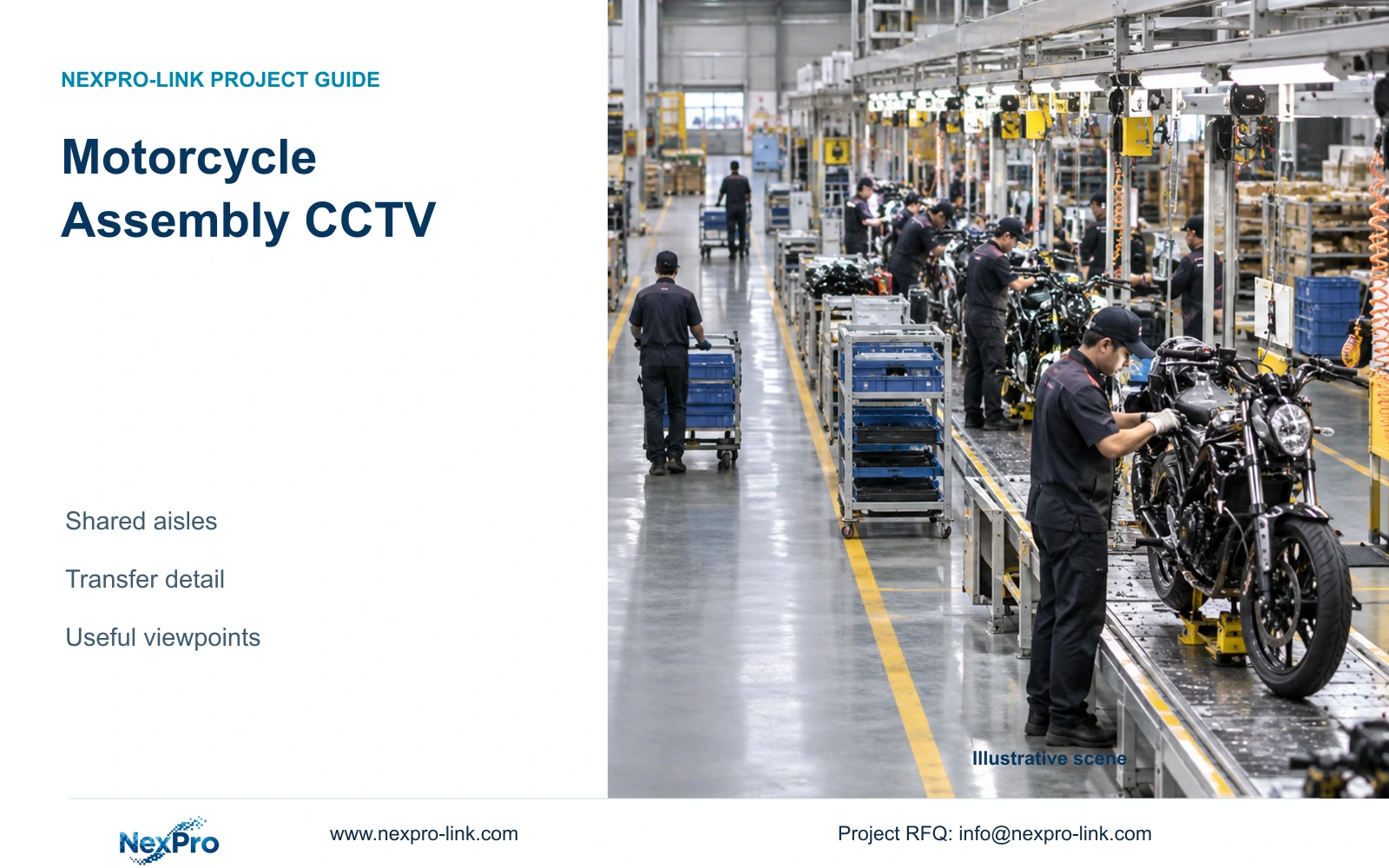
Plan motorcycle assembly CCTV around common material routes and distinct handover tasks, avoiding duplicate viewpoints that add resources without useful evidence.
Section 01
Separate shared movement from line-specific handovers
Motorcycle assembly factory CCTV should use common route coverage for shared movement and dedicated transfer views only where a distinct task requires them. Several cameras aimed from effectively identical positions may add storage and installation work without revealing additional evidence. Start by separating the corridor task from each line's handover task.
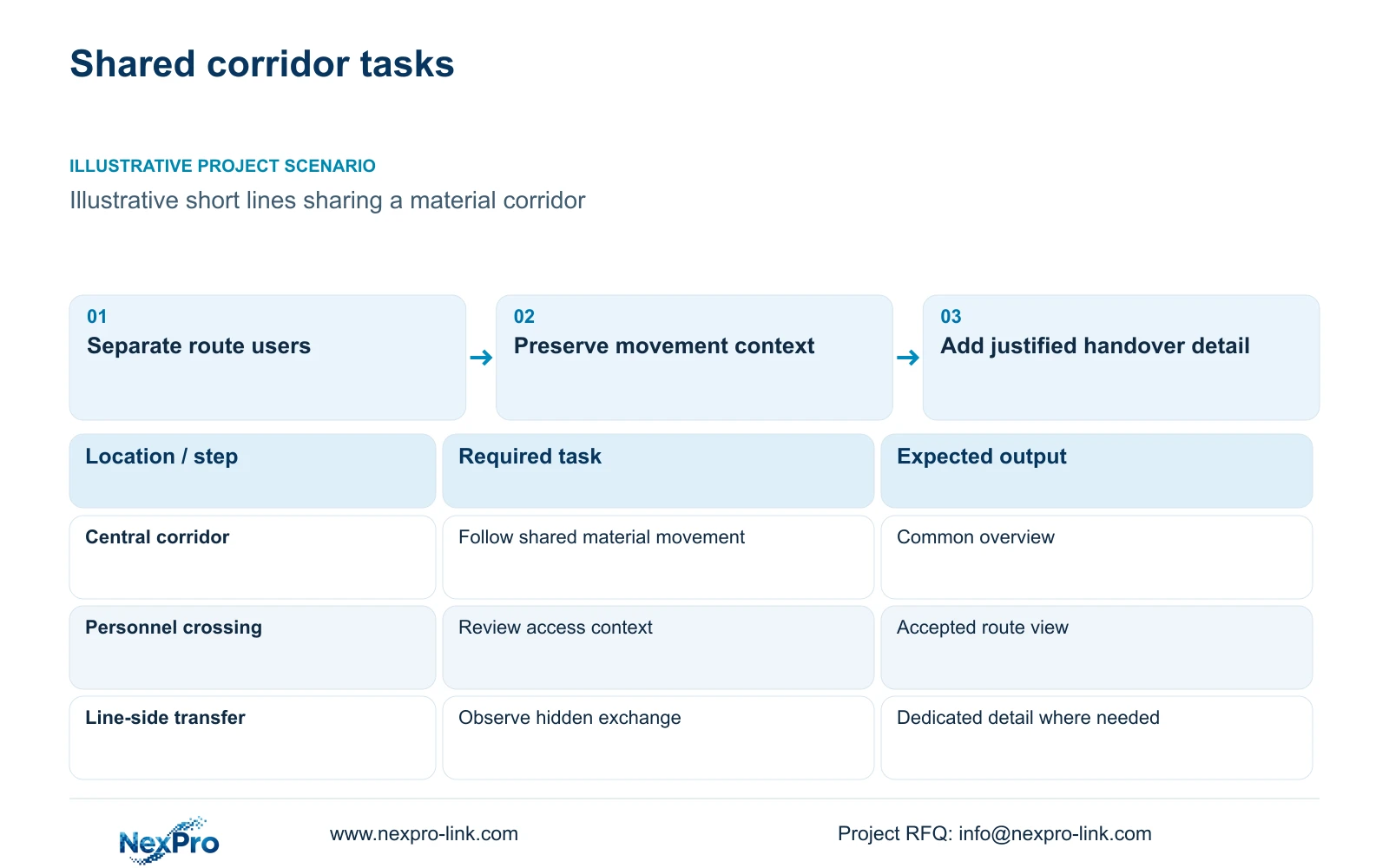
Illustrative project scenario: Several short assembly lines share one central material corridor. Assume trolleys deliver components to line-side points while personnel use designated crossing routes. The exact line count, corridor dimensions and camera quantities remain project inputs; the following method does not assign them from floor area.
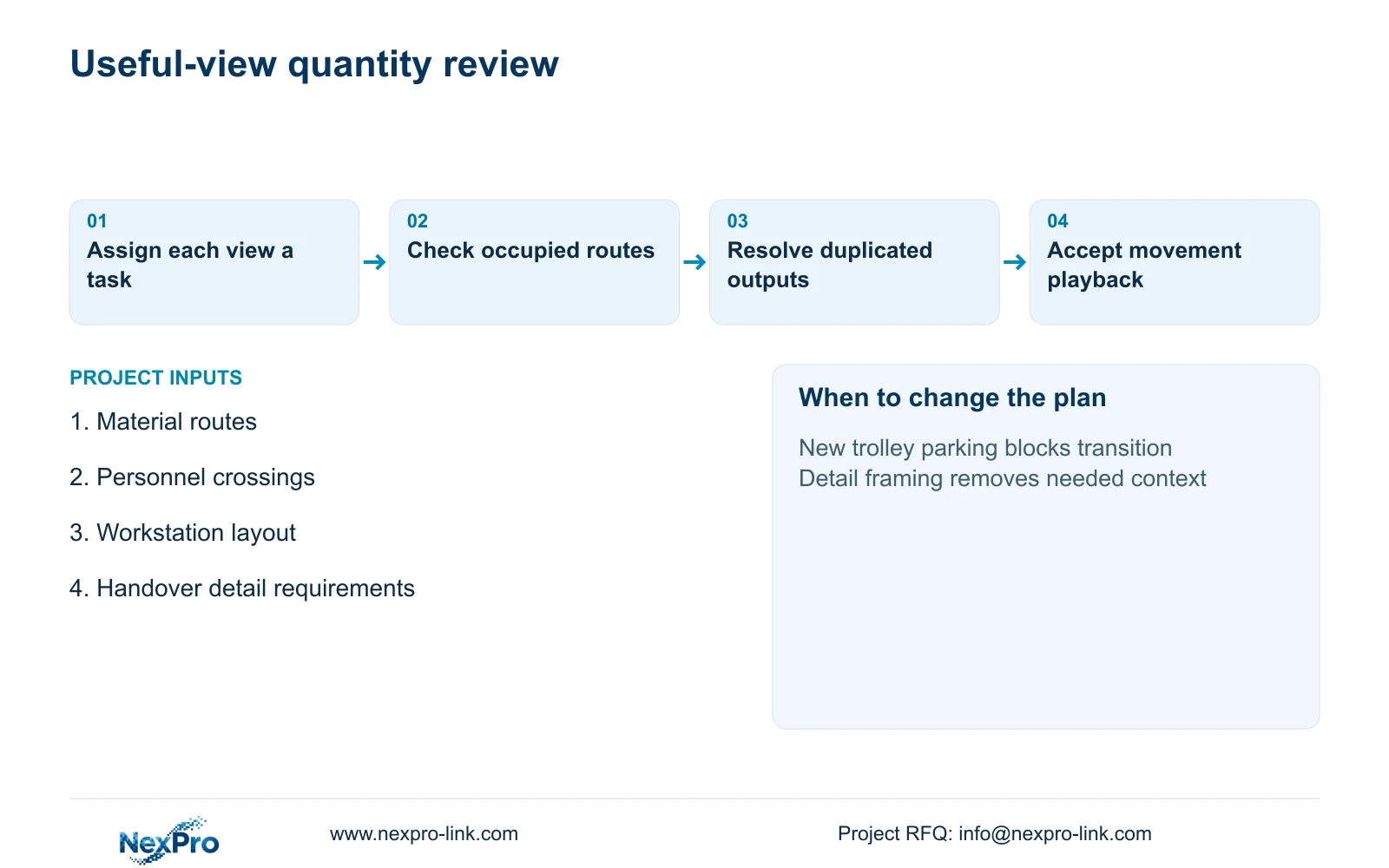
Mark material entry, line-side release, completed-unit movement and personnel crossings on the drawing. For each, state whether the owner needs movement context, access review or closer transfer detail. CCTV provides recorded context and should not be treated as a collision-avoidance system, machine inspection device or safety interlock. This task map gives the engineer a reason for each proposed view before camera quantities are priced.
Section 02
Preserve corridor context during normal traffic
Design shared-passage views for occupied operation. Place representative trolleys, racks and workstations in their normal positions and review where a person or load disappears from view. The useful baseline follows movement between meaningful route points, rather than showing every bench from a distant corner.
Use another angle when a repeated obstruction hides a required transition. Do not duplicate an obstructed view merely to increase the camera count. Where continuous route context is required, avoid relying on a camera that must be redirected or tightly reframed for a different task. Any accepted gaps should be identified on the view schedule.
Check shift lighting, doorway contrast and movement in recorded footage. A motorized lens can assist framing, but it cannot restore space outside the selected field or see through parked loads. Keep sightline reviews separate from cabling access: a convenient cable position may be unsuitable for the task, while a good viewpoint may need additional mounting or route work.
Section 03
Require a distinct output from every additional camera
Create a coverage register with the proposed location, required task, existing view and reason for addition. Useful reasons include revealing a transfer hidden from the overview or retaining route context while another camera supplies detail. A repeated model or line name is not, by itself, evidence that another identical viewpoint is needed.
For suitable ordinary locations, the NexPro-DM2812M55-5MP-DIC-AI source lists its Dome family, 2880×1620 output, 25fps and a 2.8–12mm motorized lens. Keep those exact source fields in the submission. Do not infer PTZ movement or an impact rating from the housing name. Choose the mounting form and framing according to the actual route and access conditions.
The owner should approve the observation task, the engineer the viewpoint and the contractor the feasible mounting and route. Record supplied, retained and optional items separately. Include production-system interfaces in another list so an ordinary handover view does not acquire responsibility for automatic production traceability. This makes the final quantity review a task decision rather than an arbitrary reduction exercise.
Section 04
Keep the coverage lost by a tighter view visible
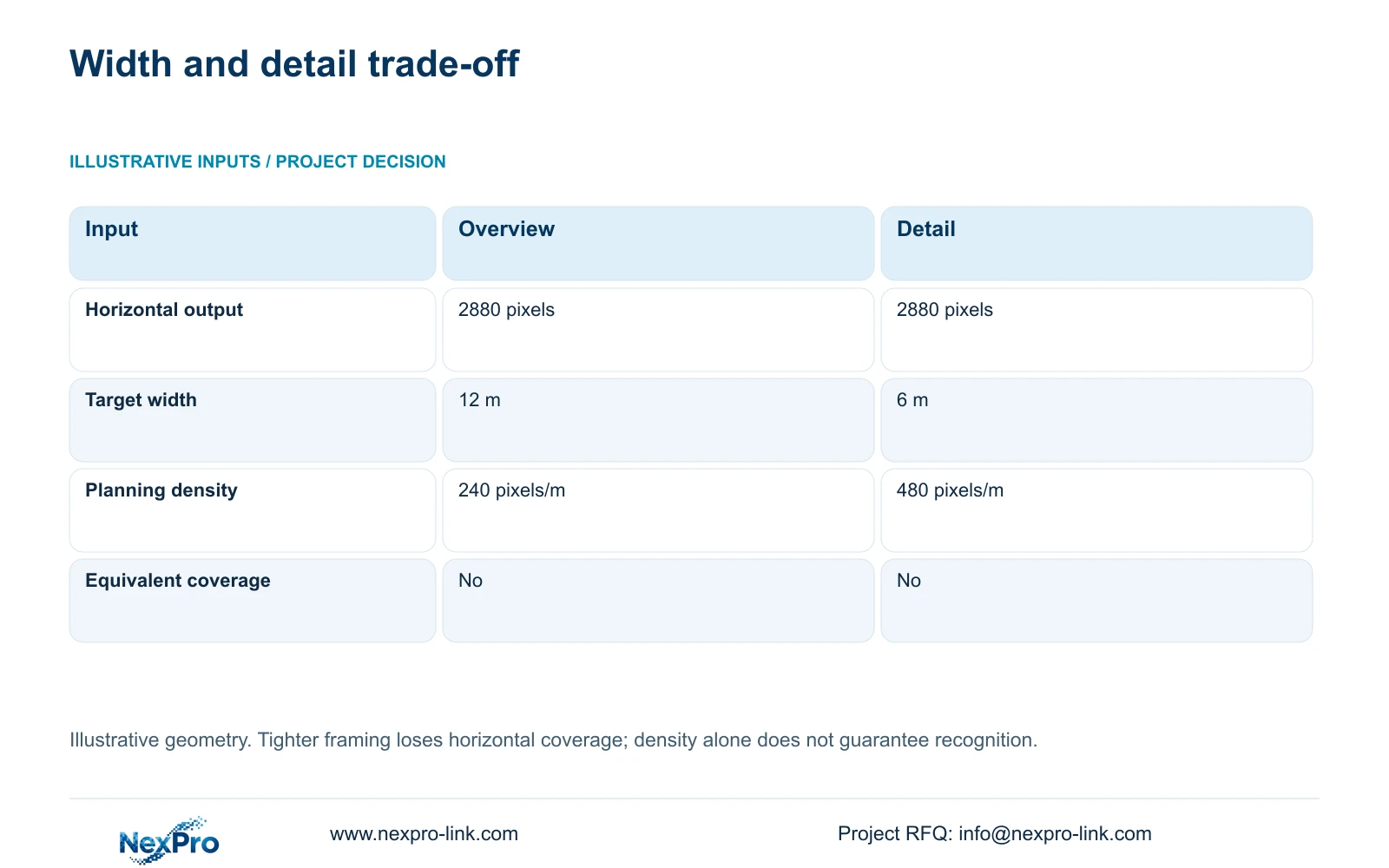
The illustrative comparison uses one assumed horizontal output of 2880 pixels. Option A covers 12 m at the target plane and Option B covers 6 m. Planning pixels per metre = horizontal_output_pixels / target_width_m. Therefore 2880 / 12 = 240 pixels per metre, while 2880 / 6 = 480 pixels per metre.
Narrowing the target width doubles the planning density but removes half the horizontal coverage at that plane. The options are not equivalent area coverage. A dedicated six-metre transfer view cannot automatically replace a twelve-metre overview when the owner still needs wider movement context.
Treat both widths as example geometry, not guaranteed lens fields of view. Establish the actual width from mounting distance, lens selection and camera orientation, then trial the recorded image. Density alone does not guarantee recognition or usable quality; light, movement, compression and obstruction remain relevant. No universal acceptance threshold is assigned here. Use the calculation to expose the trade-off before approving a tighter frame.
| Planning input | Overview | Dedicated detail |
|---|---|---|
| Horizontal output | 2880 pixels | 2880 pixels |
| Target-plane width | 12 m | 6 m |
| Planning density | 240 pixels/m | 480 pixels/m |
| Equivalent area coverage | No | No |
Section 05
Compare useful coverage with its complete resource cost
Recommend shared corridor overviews plus selective handover detail, subject to occupied-layout acceptance. Retain separate views when they provide necessary context or different obstruction angles. Remove an apparent duplicate only after confirming that its accepted task remains covered; a lower camera count is not useful if it creates an unexplained transition.
The supplied CASE01 illustrates the supporting scope behind a camera schedule. Its 32 cameras at an assumed average 4 Mbps require 128 Mbps recording payload and 41.472 TB for 30 days. These figures are not a motorcycle-plant prescription. They show why a quantity change also requires a revised bitrate, storage, PoE and cable schedule.
NexPro-NVR4449-4K lists 49 channels and 320 Mbps input, but supported recording modes and playback needs require separate confirmation. Count complete switch AC demand once when it includes PoE devices, and identify which power nodes need backup. Keep a normal search display if it serves the operator task. Additional screens or an LCD wall should answer a defined concurrent-view requirement rather than compensate for poorly chosen cameras.
Section 06
Hand over the accepted corridor and transfer map
Issue a view schedule that distinguishes common-route coverage from line-specific detail. Attach the accepted frame, mounting position, task ID, recorder channel and relevant drawing revision. Keep optional additions visible, with the condition that would release them, rather than burying provisional quantities inside a fixed equipment total.
NexPro-Link's BOQ and tender support can help match the accepted tasks to models and supporting equipment. Project labels and packing can separate corridor kits from transfer-point kits, while technical submittals preserve output modes and configuration assumptions. The agreed local installer remains responsible for route construction, mounting and site alignment.
Before acceptance, demonstrate a material movement from corridor entry through a selected line handover and locate it in playback. Confirm that a detail view has not displaced the required overview, and check retrieval under the actual operator permissions. Record any changed workstation or storage arrangement that invalidates a sightline. The handover map should let maintenance staff review later changes without guessing why each camera was installed.
Section 07
Buyer questions
Can one overview serve several assembly lines? Yes when the shared-route task is visible and accepted for all relevant movements. Separate detail views may still be needed where a line-side exchange is hidden or requires a different framing.
Should overlapping views be removed as duplicates? Check their outputs first. Overlap may preserve a transition or offer a different obstruction angle. Remove a view only when its required task remains covered, not simply because two images include the same aisle.
What should trigger a camera-plan review after opening? Review moved workstations, new trolley parking, changed material routes and altered lighting. Identify the affected view task, then adjust framing or placement and update its recording and installation records.
Section 08
Review shared-aisle coverage before ordering
Send your material and personnel route plan, line-side handover locations, occupied workstation layout, and required overview/detail tasks to info@nexpro-link.com for a task-led camera and supporting-equipment schedule.
Engineering references
These sources support the general planning principles. Always use the selected product's current datasheet and applicable project standards for final design.