
Before you choose between a modular and a fixed online UPS, write down what has to be powered and when. Separate the load you are already committed to from the load that might arrive later, and attach a date to each.
Section 01
Build the load plan before choosing the architecture
Before you choose between a modular and a fixed online UPS, write down what has to be powered and when. Separate the load you are already committed to from the load that might arrive later, and attach a date to each step. A phased load table does that, and it lets you compare modular and fixed options against the same expansion milestones instead of one optimistic forecast. Used well, the same table becomes the brief for a defined equipment proposal.
An MSP rarely reaches its final protected load on opening day. Record the expected IT load, network load and shared support load at each expansion phase, then give every phase a date range and confidence level. This keeps an optimistic sales forecast from becoming a hidden electrical assumption.
The load plan should also state what can be moved, consolidated or retired. A modular UPS is useful when the expansion steps are real and service access is planned. A fixed system can still be the cleaner choice when the load is stable and the operating team values a simpler parts structure.
| Planning field | Fixed system question | Modular system question |
|---|---|---|
| Initial load | Is low utilization acceptable? | How many modules are installed now? |
| Growth step | When is replacement or parallel capacity needed? | When are modules and battery strings added? |
| Service state | What is unavailable during maintenance? | Can a module be isolated without losing the objective? |
| Final boundary | What is the practical expansion limit? | What cabinet, bypass and distribution limits remain? |
Section 02
Calculate available capacity in the required state
Nameplate capacity is only the starting point. Compare normal capacity, capacity with one module unavailable and capacity during the planned maintenance arrangement. The load must remain within the limit defined for the state the business expects to survive.
Keep UPS output, battery energy, bypass capacity and downstream distribution as separate checks. Adding another power module cannot correct an undersized bypass, feeder or battery plan.
- State the capacity unit and power factor used in the comparison.
- Calculate the surviving state before applying the operating ceiling.
- Confirm the cabinet and bypass limits for the final phase.
Section 03
Compare initial utilization with the real growth schedule
A large fixed UPS may start at light load, while a modular system can start with fewer active modules. The comparison should use the selected configuration's efficiency and operating limits at the expected phase loads, not a single headline value.
Expansion work still needs a procurement lead time, approved method and suitable service window. Modularity reduces some replacement pressure, but it does not remove project planning or the need to keep compatible modules available.
Section 04
Price maintenance exposure and five years of change
Compare the initial hardware, bypass, battery, installation, commissioning, expansion labor and expected service events on the same scope. Mark which future costs are quoted and which remain estimates. This prevents a low first price from masking expensive capacity steps.
The operational review should describe how the MSP protects customers during a failed module, a bypass event and battery work. Capacity arithmetic supports that review, but it is not a facility resilience certification.
Section 05
Work through the surviving-capacity example
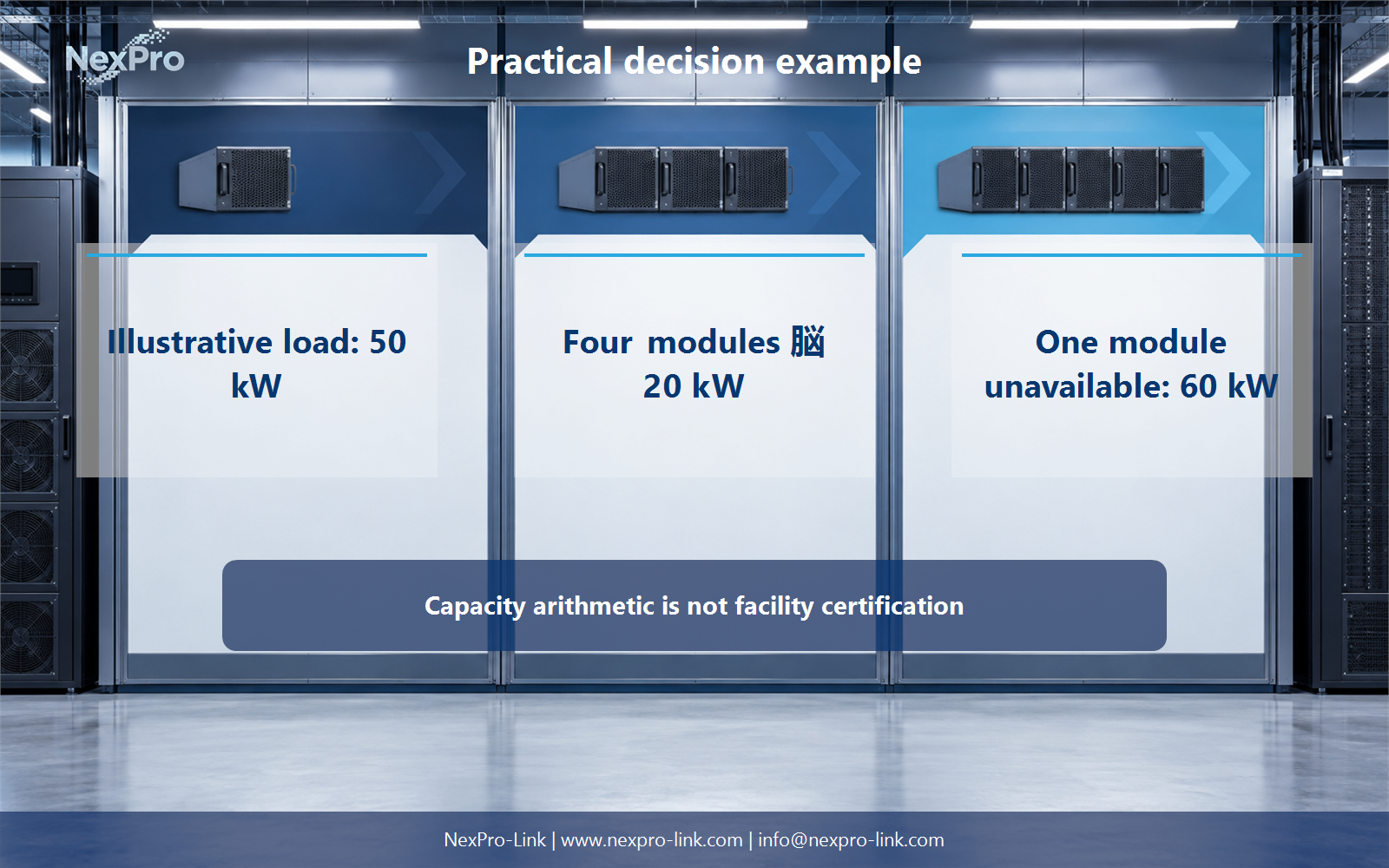
Assume four 20 kW modules support a 50 kW illustrative load. With one module unavailable, the surviving capacity is 60 kW, so the load uses 83.33 percent of that capacity. If the project requires no more than 80 percent utilization in the surviving state, it needs at least 62.5 kW of surviving capacity.
Use the result to test architecture and expansion timing. It does not prove runtime, selective coordination, cooling resilience or a facility certification. Those questions remain separate project checks.
Share the committed growth phases, redundancy objective, frame limits and service constraints so initial capacity and later expansion are quoted separately.
Engineering references
These sources support the general planning principles. Always use the selected product's current datasheet and applicable project standards for final design.