Share physical infrastructure only where each operator's recording, access and maintenance boundary remains enforceable, including during faults and tenant changes.
Section 01
Assign public-zone tasks to operating entities
Share switches, backbone routes or management resources only where the proposed system preserves each operator's approved access, recording allocation and maintenance responsibility. Use separate recording or network resources when the platform cannot enforce those boundaries or when one operator's change would interrupt another's essential service. Physical sharing alone does not justify common administrator access.
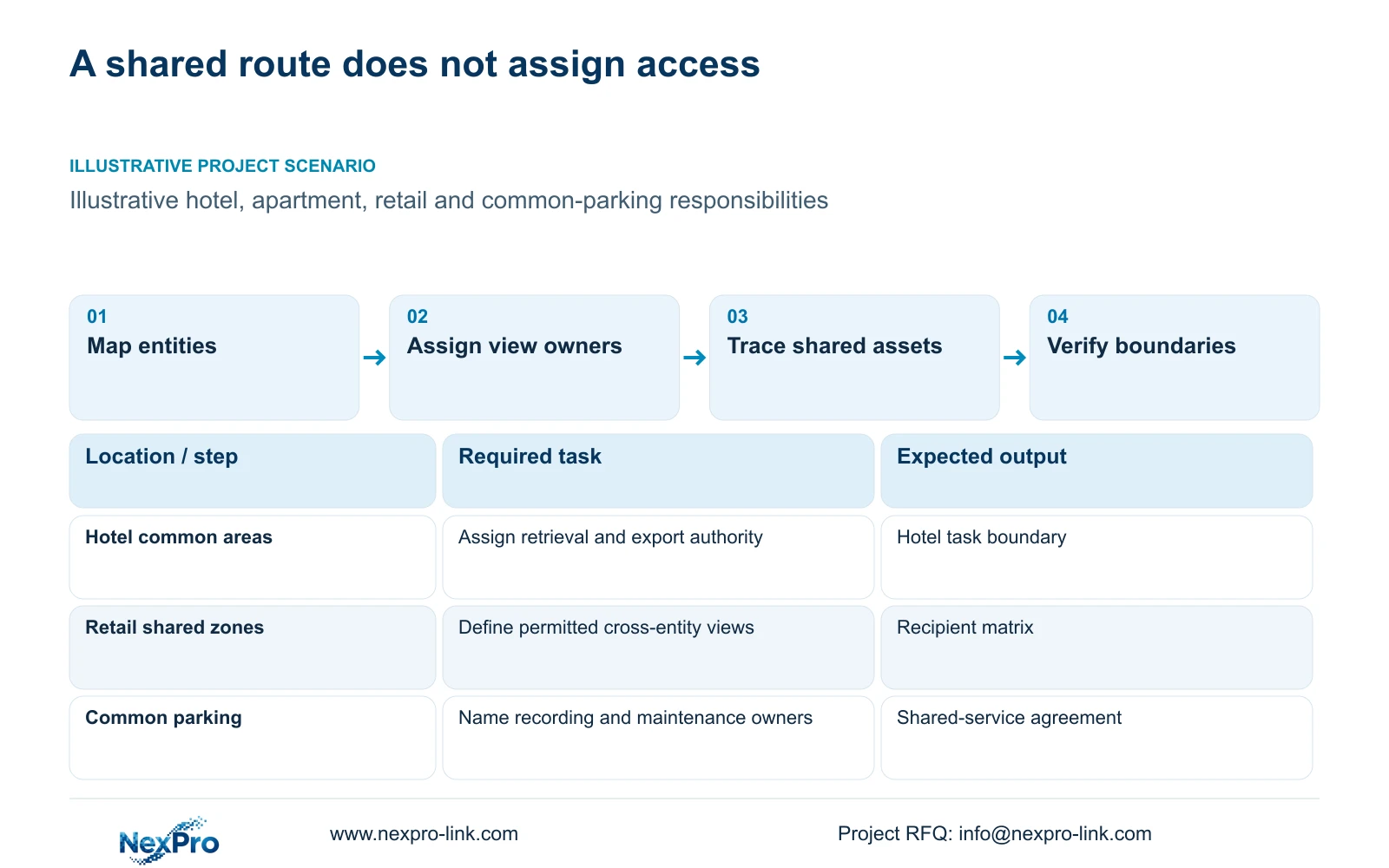
The illustrative CASE08 groups 80 views equally across hotel common areas, serviced-apartment common areas, retail shared zones and common parking/service areas. Its 220-room background is unrelated to that count. Give every view a responsible entity and a purpose. A shared entrance may require several authorized recipients, while its recording and export responsibility still needs a named owner.
Build the zone schedule before choosing a central platform. Record who requests a view, who authorizes its use and who handles an incident. Public-route coverage should exclude unnecessary private-space capture. The UK ICO guidance supports purpose and access considerations within its own jurisdiction and is marked as under revision; it does not supply a worldwide hotel rule.
| Required task | Illustrative scope | Decision still needed |
|---|---|---|
| Hotel incident retrieval | 20 hotel common-area views | Hotel viewing and export authority |
| Shared parking observation | 20 parking/service views | Recording owner and permitted recipients |
Section 02
Separate shared assets from shared permissions
Treat the backbone, access switches, recorders, storage and clients as separate resource decisions. A common cable route can carry distinct services. A shared recorder introduces additional questions about retention, operator permissions and maintenance windows. One coordinated order can still contain independently owned equipment and separately accepted subsystems.
Define the boundary at each interface. Record which entity's streams cross a shared link, who can change its configuration and which services lose access when it is unavailable. Logical separation requires supported equipment and a verified configuration; a labelled topology drawing cannot prove enforcement.
Shared assets need a maintenance agreement covering authorized changes and restoration priority. Separate recorders can reduce the scope of a recorder maintenance event, but they may still depend on the same core switch or power source. Examine that residual dependency before describing an arrangement as independently operational.
| Resource | Shared arrangement | Separated arrangement |
|---|---|---|
| Backbone | Common route and maintenance dependency | Entity paths and interfaces defined |
| Recording | Supported permissions and allocations required | Recorder ownership visible |
| Viewing | Only approved cross-entity views | Entity-specific operator scope |
Section 03
Calculate recording by entity and traffic by path
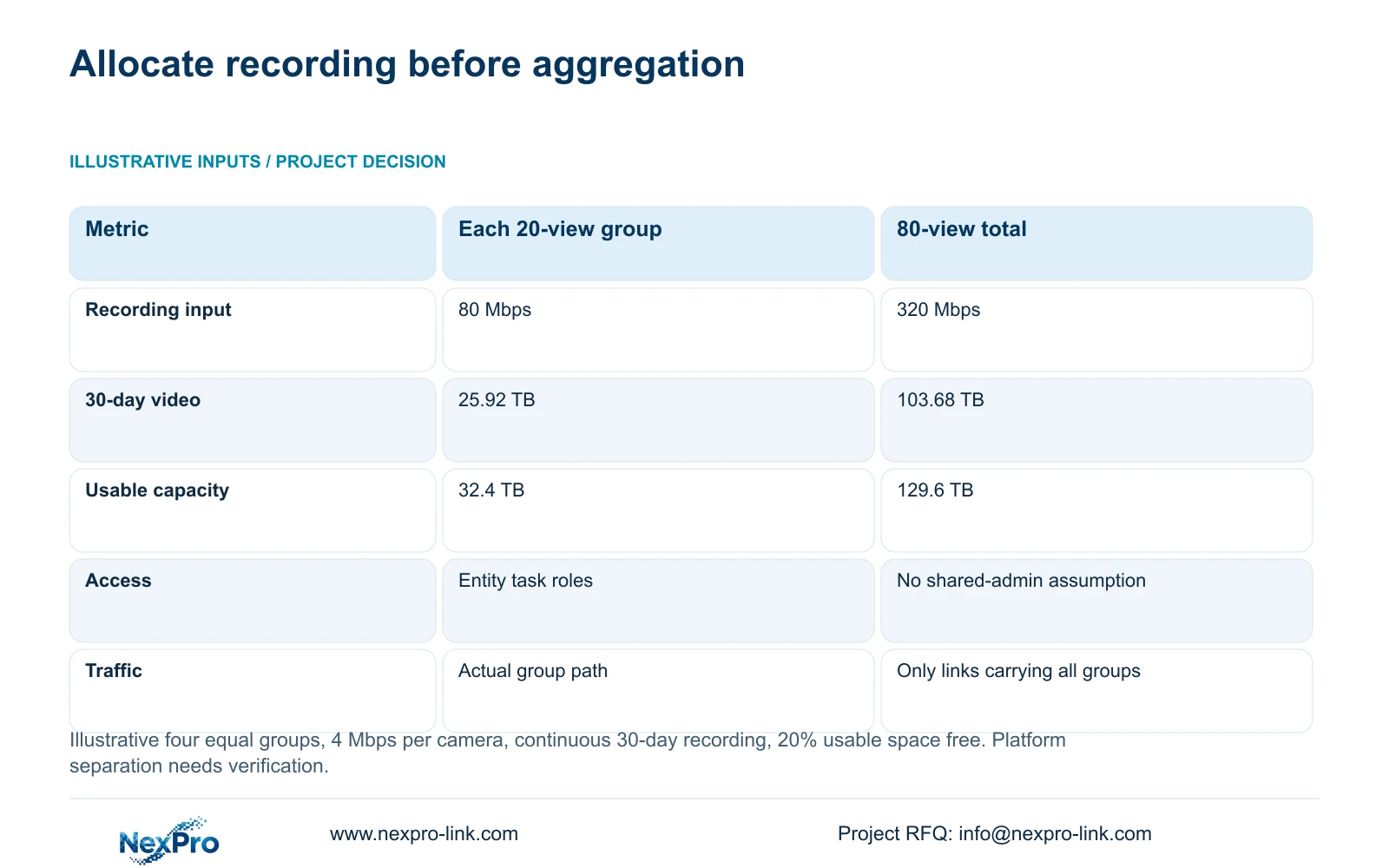
Assume 20 cameras per entity group at 4 Mbps each, recording continuously for 30 days. Each group contributes 80 Mbps, 25.92 TB video and 32.4 TB required usable capacity with 20% free. Aggregate demand is 320 Mbps, 103.68 TB video and 129.6 TB usable. Decimal video TB equals 0.0108 × cameras × Mbps × days; divide by 0.80 for reserve.
The independent topic comparison below holds the total recording outcome constant. Its optional extras do not change the storage requirement. CASE08 separately proposes four NexPro-NVR4449-4K units, each with four 10 TB drives. Total raw capacity is 160 TB; an assumed 95% formatting allowance leaves 152 TB, of which 121.6 TB is budgeted for video after reserve. No RAID loss is included.
Follow actual flows when sizing links. CASE08's five 16-camera access groups each carry 64 Mbps pure recording, or 70.4 Mbps with its illustrative 10% allowance. Only a path carrying all groups receives the full 320 Mbps recording sum. Viewing and export traffic add demand where they travel. Port speed, switch forwarding, NVR input and client decoding remain separate limits.
| Metric | Essential recording-first | Same core with extras |
|---|---|---|
| Recording input | 320 Mbps | 320 Mbps |
| 30-day video data | 103.68 TB | 103.68 TB |
| Required usable capacity | 129.6 TB | 129.6 TB |
| Protected path | Cameras, network and recording | Same plus selected extras |
| Display | Task-sized monitor/workstation | Optional wall; recording independent |
| Cost basis | Complete scope quotation | Documented incremental scope |
Section 04
Compare service boundaries during a fault
Compare centralized and partitioned recording under the same normal and interrupted states. Centralization can concentrate operator search and maintenance, provided the platform supports the necessary permissions and workflows. Partitioning makes ownership and recorder maintenance boundaries easier to describe, but adds equipment and may require several authorized search destinations.
CASE08's four-recorder arrangement is a teaching choice, not a requirement to buy one unit per legal entity. NexPro-NVR4449-4K publishes 49 channels, 320 Mbps input and four SATA positions with an 18 TB per-drive field. Its summary lists 49×5MP/9×4K; supported resolution combinations and RAID modes must be confirmed separately. Capacity arithmetic does not establish permission isolation.
Keep recording independent of the viewing wall. Likewise, protect each required access node, not only the central NVR. CASE08's assumed base total is 1,559.42 W across its equipment scope. That aggregate cannot be drawn as a single central supply for dispersed locations without an actual electrical design. Optional display load changes capacity and runtime requirements.
Section 05
Name access and maintenance owners separately
Assign viewing, retrieval, export and configuration tasks to supported roles. The building facilities team may maintain a shared node without authority to browse every operator's footage. Hotel security may receive selected parking views without authority to change another entity's recording policy. Test the actual device and client permissions against that matrix.
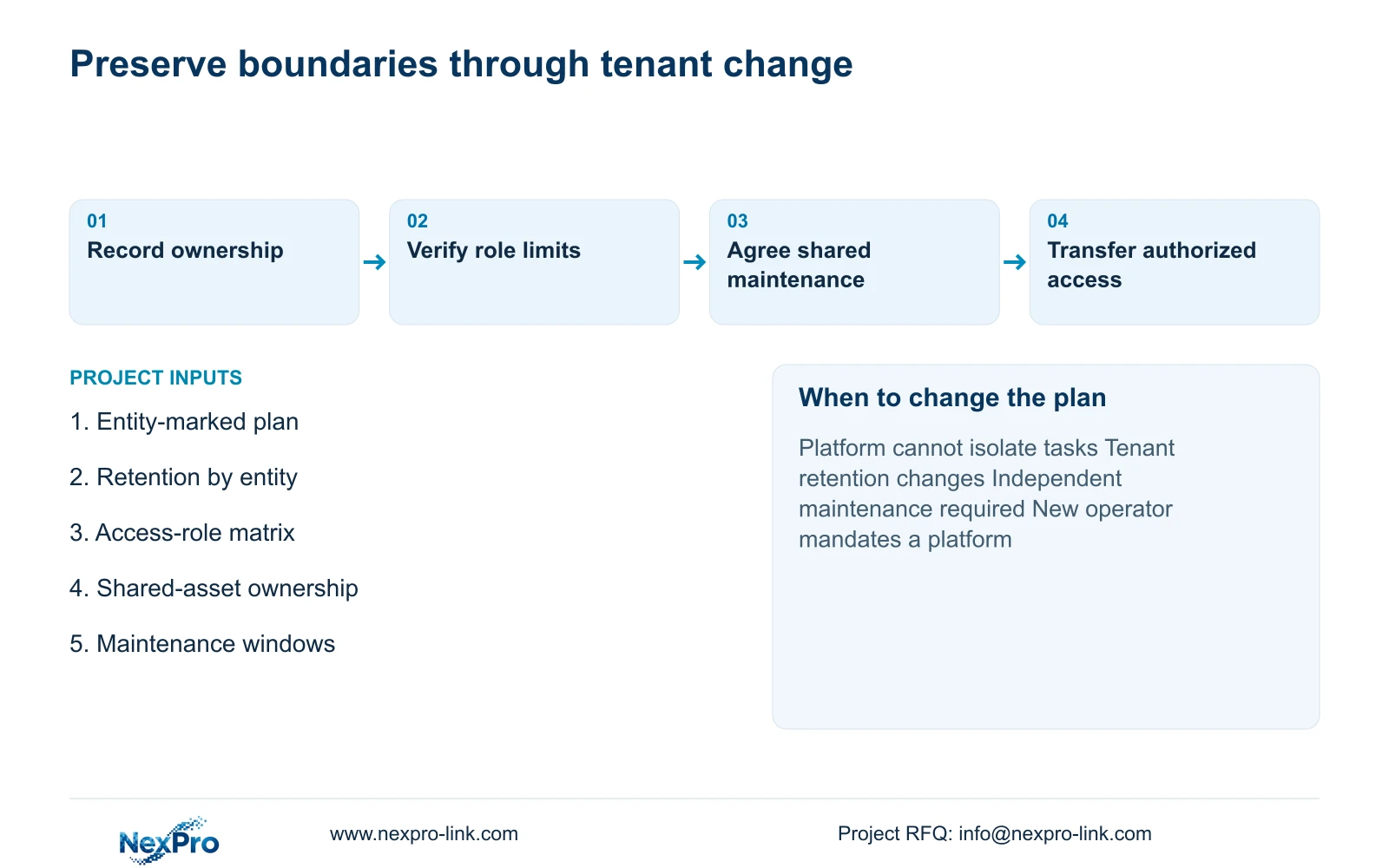
Remote support should use an approved limited task and a documented revocation path. Account ownership, device binding and network access are different layers. Avoid a permanent shared administrator account as the handover mechanism. Tenant departure requires an authorized transfer or removal process covering those layers.
State who reports a fault, who can access the cabinet and who restores the affected task. Include the maintenance window and cost owner for shared work. The supplied warranty record gives applicable main equipment a 24-month limited hardware baseline from receipt; accessory and order-specific terms remain separate. It does not establish included local labour or uninterrupted operation.
| Task | Authority to define | Capability to verify |
|---|---|---|
| Cross-entity viewing | Relevant operating owners | Approved views only |
| Shared-node maintenance | Asset and service owners | Change and restoration boundary |
| Tenant departure | Authorized account owner | Transfer and access removal |
Section 06
Specify an arrangement that tolerates operator change
Recommend shared physical infrastructure with entity-specific recording and access records where supported separation is demonstrable. Choose separate resources when a tenant change, independent retention policy or maintenance requirement cannot be accommodated safely within the shared arrangement. A mandatory operator platform may also change the management layer without changing every physical route.
Keep a dated baseline for camera identities, resource allocation and quoted responsibilities. A revised tenancy can change quantities, bitrate, storage or interfaces. Show those effects separately, including any capacity threshold that requires a larger node. An allocation spreadsheet does not authorize the project change.
Send the entity-marked public-zone plan, stream and retention schedules, access-role requirements and shared-asset maintenance boundary to info@nexpro-link.com. NexPro-Link can discuss BOQ/model matching and coordinated supply with a distinction between CCTV manufacture, supporting-category procurement and local delivery responsibilities. Actual platform separation and site acceptance remain project-specific tasks.
Section 07
Buyer questions
Can shared purchasing still produce separate equipment ownership? Yes. Identify the purchasing party, asset owner, recording owner and service responsibility by line item. A combined shipment does not establish common account ownership or unrestricted footage access.
Does a separate recorder remove all shared failure exposure? No. Trace its access switches, backbone and power. Separation at recording level leaves any common network or electrical dependencies in place.
What should change when a retail tenant leaves? Review authorized recipients, account and binding ownership, retention responsibility and equipment transfer. Recalculate resources only where the new tasks or stream settings change; do not erase unrelated operator boundaries.
Engineering references
These sources support the general planning principles. Always use the selected product's current datasheet and applicable project standards for final design.