Mixed 5MP and 8MP cameras need a group-by-group recording calculation. Compare assumed bitrates, preserve each view's evidence task, and qualify the recorder independently of storage.
Section 01
Assign image tasks before assigning stream budgets
Calculate mixed 5MP and 8MP factory storage from each group's recording bitrate, hours and retention period. Resolution alone does not establish a fixed daily data amount. The supplied comparison changes assumed input from 192 to 144 Mbps and 30-day video from 62.208 to 46.656 TB, provided the lower-rate overview group still captures the evidence the owner needs.
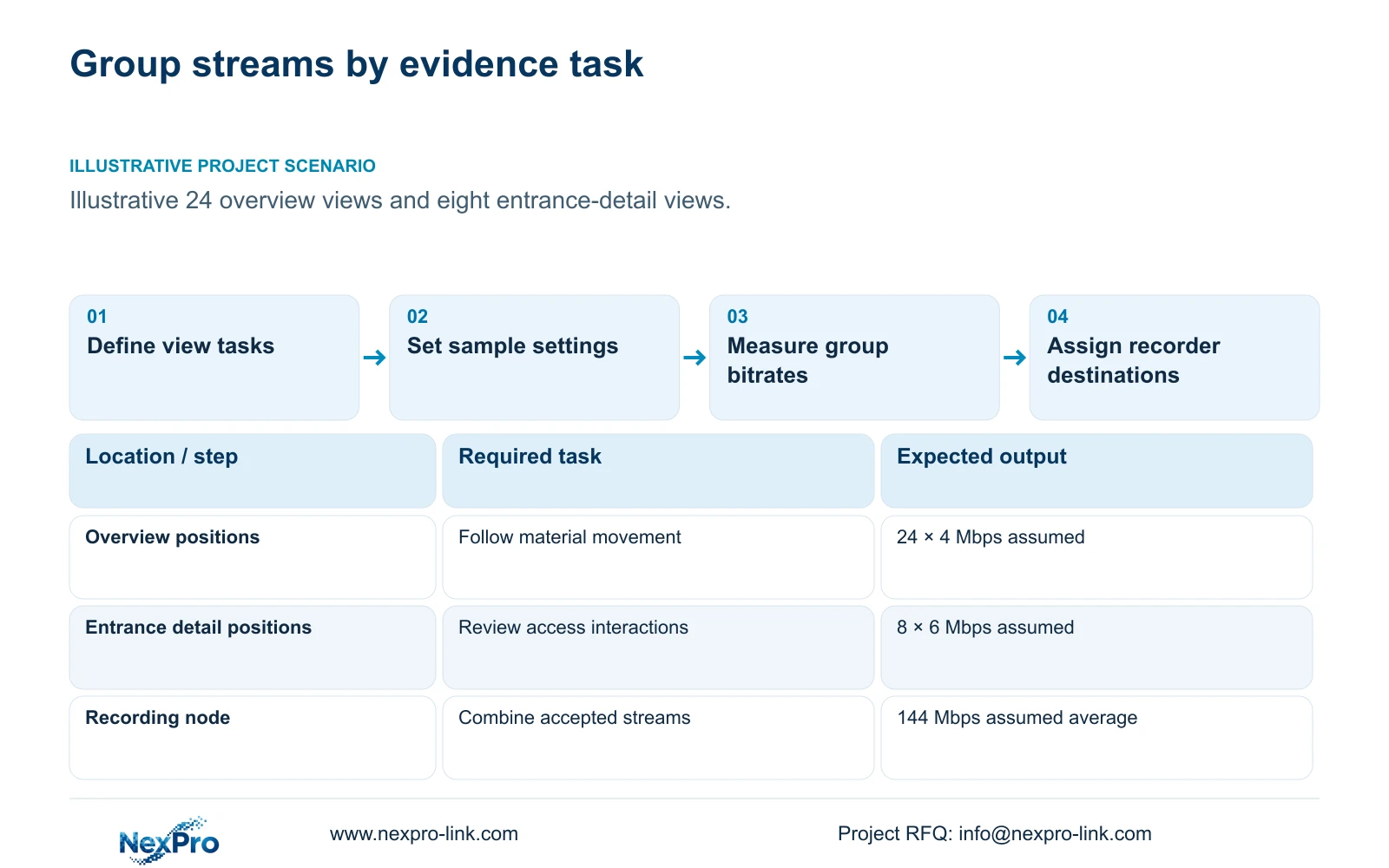
Illustrative project scenario: The proposal mixes ordinary overview cameras and higher-detail entrance views. Keep the supplied CNC reference's 32 ordinary security positions, then assume 24 overview views use 5MP-family candidates and eight detail views use 8MP candidates. The locations of the eight detail views require owner approval; this is a proposed modification to the reference, not its original all-5MP-class recorder assumption.
Give each group a concrete acceptance task, such as following a material transfer or reviewing an entrance interaction. Record the view width, target location and lighting conditions with that task. A higher-resolution label cannot compensate for a blocked sightline or an unsuitable lens position, and bitrate should not be lowered until the resulting recording is judged usable.
Section 02
Keep model output fields separate from assumed bitrates
The supplied NexPro-BL2812M55-5MP-DIC-AI specification lists the 5MP family with a 2880×1620 main output and 25fps. The NexPro-BL2812M88-8MP-DIC-AI lists 3840×2160 at 25fps. Both provide a stated 2.8–12 mm motorized lens range. Preserve these exact source fields in the submittal rather than replacing the listed 5MP output with another resolution.
For the calculation, use 4 Mbps for each of the 24 overview cameras and 6 Mbps for each of the eight detail cameras. Those are teaching inputs, not published fixed bitrates for the models. Option A assumes 6 Mbps for all 32 cameras. Both options retain continuous recording for 30 days, so the comparison isolates the effect of the assigned stream rates.
When samples are available, record representative movement, loading activity and night lighting at the proposed settings. Retain the codec, resolution, frame rate and image settings with the measurements. For variable bitrate, use a representative average for storage and a separate busy-period observation or declared limit for network and recorder checks.
Section 03
Sum each group's demand before sizing storage
Use input_Mbps = sum(camera_count × average_Mbps). The overview group contributes 24 × 4 = 96 Mbps, and the detail group contributes 8 × 6 = 48 Mbps. Their combined assumed average is 144 Mbps. Keeping the groups visible makes a later entrance upgrade traceable instead of forcing a new assumption across every camera.
For continuous recording, video_TB = 0.0108 × input_Mbps × days. The overview group generates 31.104 TB over 30 days; the detail group generates 15.552 TB. Their sum is 46.656 TB. Divide by 0.8 to obtain the 58.32 TB usable-capacity target when 20% of usable storage must remain free.
Calculate independently for every recorder if the groups are split across nodes. A global total cannot establish that each local disk layout fits. Keep exports, audio and additional metadata separate until their demand is defined. Adding these items should change the recorded assumptions, not disappear inside an unexplained contingency.
Section 04
Compare stream allocation at the same retention period
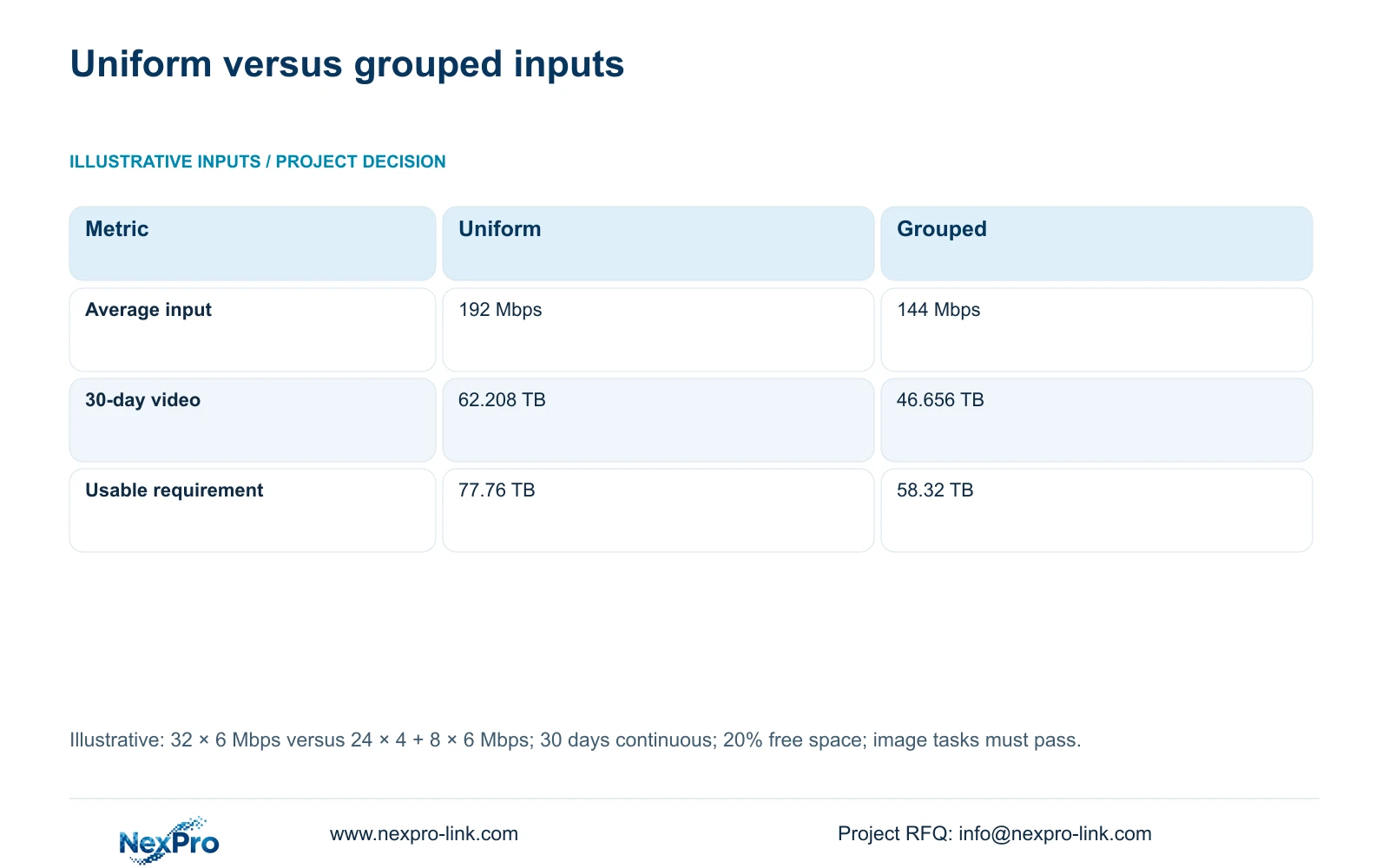
The uniform assumption produces 32 × 6 = 192 Mbps and 62.208 TB over 30 days. The grouped assumption produces 144 Mbps and 46.656 TB. The decisive change is the 24-camera group's assigned average bitrate; the eight detail cameras remain at 6 Mbps in both options.
The difference is 48 Mbps of assumed average input and 15.552 TB of video. It does not prove that one codec or supplier provides equivalent quality at a lower rate. Approve the grouped option only after evaluating the overview recordings against their defined task. If those recordings fail, increase the affected group's input and recalculate.
The usable-capacity targets make the procurement consequence clearer than raw video alone. Under CASE01's 95% usable-capacity assumption, four 16 TB disks provide 60.8 TB usable. That exceeds the grouped target of 58.32 TB but falls below the uniform target of 77.76 TB. Capacity fit still does not establish mixed-resolution recorder support.
| Metric | Option A: uniform | Option B: grouped |
|---|---|---|
| Camera stream allocation | 32 × 6 Mbps | 24 × 4 + 8 × 6 Mbps |
| Total average input | 192 Mbps | 144 Mbps |
| 30-day video | 62.208 TB | 46.656 TB |
| Required usable capacity | 77.76 TB | 58.32 TB |
Section 05
Qualify mixed-resolution recording separately from capacity
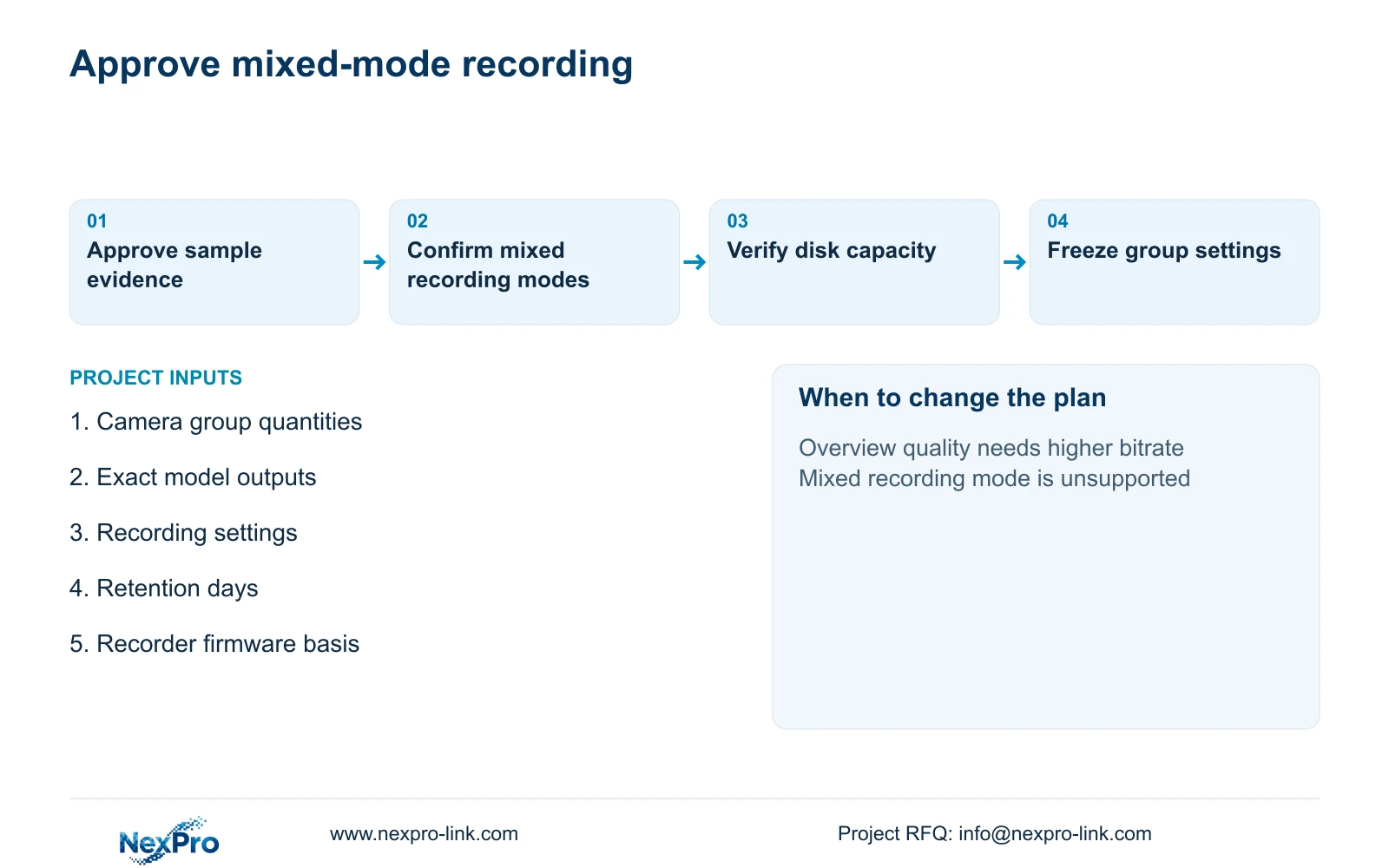
The NexPro-NVR4449-4K has a published 320 Mbps input rating and four SATA bays up to 18 TB per drive. Its summary distinguishes 49 × 5MP from 9 × 4K. Although both example average inputs are below 320 Mbps, those fields do not confirm a simultaneous 24-camera 5MP plus eight-camera 8MP configuration at the proposed settings.
Request an exact mixed-mode statement for the selected firmware and demonstrate recording, playback and export using that combination. The original CASE01 assumption covers supported 5MP-class streams, so changing eight cameras to 8MP requires a new qualification. The eight-bay NexPro-NVR8864-4K offers more physical storage, but its 64 × 5MP and 16 × 4K summaries likewise do not establish every mixed configuration.
Recommend the grouped calculation as the design method, with the recorder choice conditional on verified modes and actual stream demand. If qualification fails, select another supported configuration or architecture while retaining the accepted view tasks. Do not downscale the entrance stream simply to preserve a recorder already entered in the quotation.
Section 06
Release camera and storage schedules as one revision
Attach the camera-group schedule to the storage calculation and technical submittal. Each row should identify model, output, recording settings, average input basis and recorder destination. The owner approves the evidence task, the engineer verifies resource demand and the supplier identifies model or firmware deviations before procurement.
Require a substitution notice when a camera, firmware or codec setting changes. Recheck only the affected group first, then update shared input and disk capacity. Preserve sample recordings associated with the accepted configuration so later batches can be compared against the same task without claiming that a successful live view verifies all recording functions.
NexPro-Link's BOQ and Tender Support scope can coordinate these model and document differences. The quotation should distinguish camera choices from disk quantities and recorder changes. Keep incident archive provision as a separate line if required. This produces a mixed-camera package whose capacity can be recalculated without losing the reason each camera group was selected.
Section 07
Buyer questions
Should every 8MP camera use 6 Mbps? No. The 6 Mbps figure is an illustrative input. The accepted scene task, recording settings and representative measurements determine the project figure; resolution does not prescribe one fixed rate.
Can we average all camera rates into one number? A weighted average can reproduce the overall total, but retain the group schedule underneath it. Otherwise a changed camera quantity or entrance setting can be hidden and the local recorder allocation becomes harder to verify.
Does a 320 Mbps input rating approve this mixed camera order? It is only one resource check. Obtain confirmation for the exact simultaneous resolution, frame-rate and codec combination, then verify playback and export separately.
Section 08
Qualify a mixed-camera recording package
Send your camera-group task schedule, proposed recording settings, retention target and recorder/disk layout to info@nexpro-link.com. NexPro-Link can discuss a grouped storage calculation and the mixed-mode confirmations needed before ordering.
Engineering references
These sources support the general planning principles. Always use the selected product's current datasheet and applicable project standards for final design.