Compression can influence the size of a CCTV system’s disks and network, but savings depend on the scene and operating settings. Compare Seetong-compatible, Hikvision and Dahua configurations using the same required image task and recording period. Record the actual or explicitly assumed bitrate instead of repeating a generic percentage attached to a codec name.
Section 01
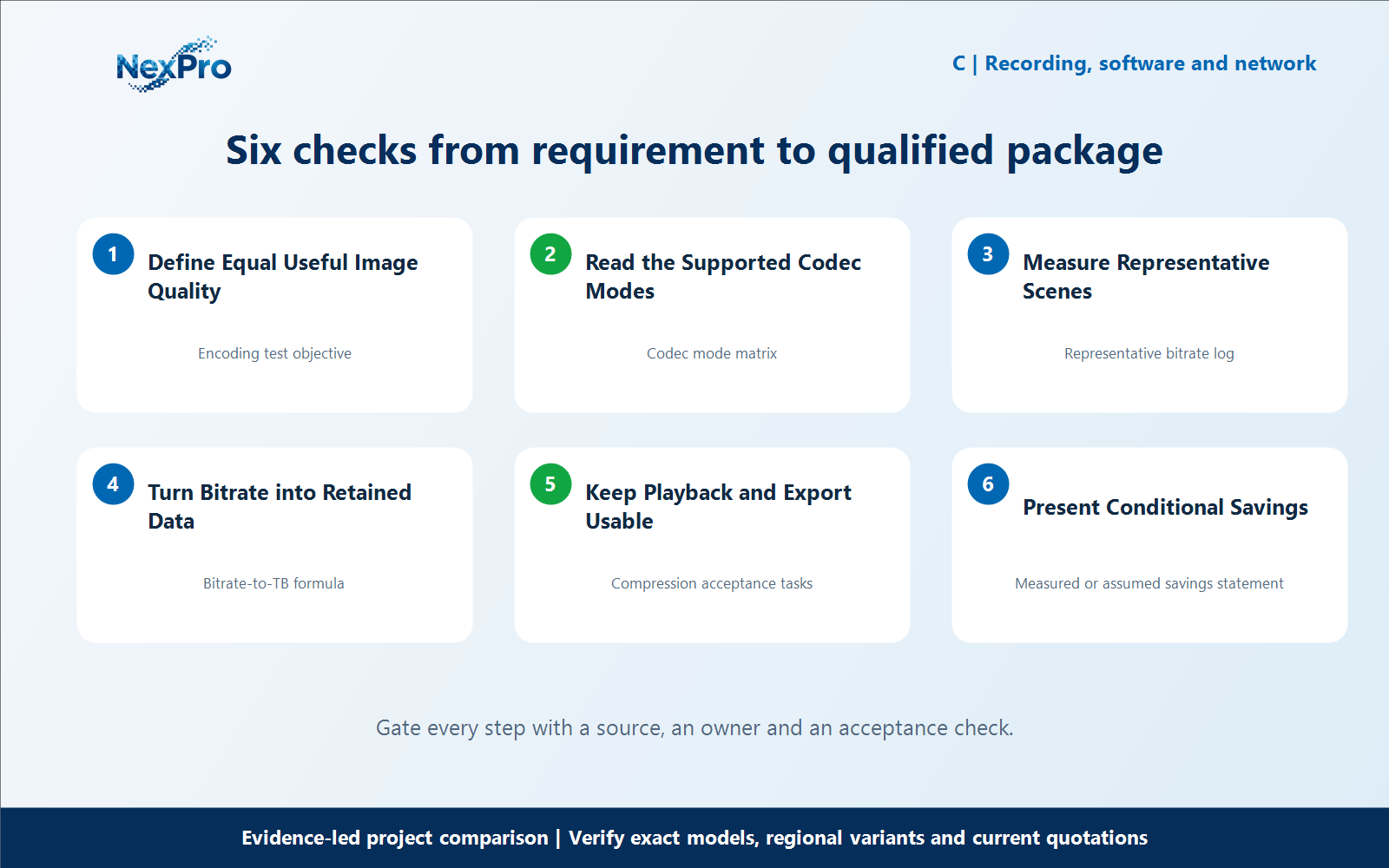
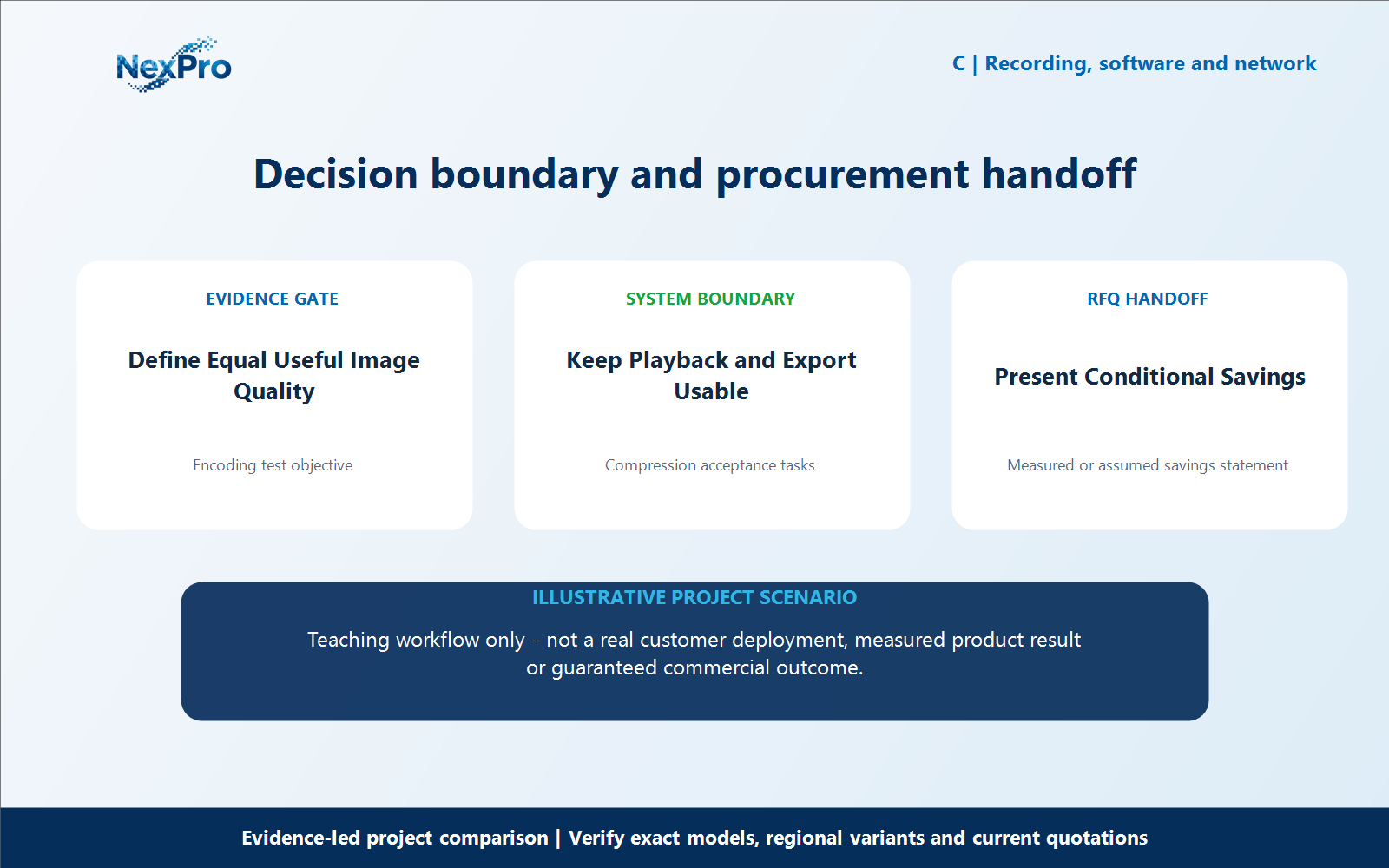
Define Equal Useful Image Quality
Compression can influence the size of a CCTV system’s disks and network, but savings depend on the scene and operating settings. Compare Seetong-compatible, Hikvision and Dahua configurations using the same required image task and recording period. Record the actual or explicitly assumed bitrate instead of repeating a generic percentage attached to a codec name. What should stay comparable in an encoding test? Keep the required target information, scene and recording purpose comparable. Simply assigning the same bitrate can show one type of comparison, but it does not prove equal usable detail. Inspect the recorded target and note any motion or compression artifacts that affect the task.
For define equal useful image quality, build a working record around Encoding test objective. For Seetong Hikvision Dahua H265 comparison, record the current project condition, candidate response, evidence source and unresolved boundary before comparing offers.
Review Encoding test objective separately from the downstream workflow. This prevents one attractive specification from deciding the complete Seetong Hikvision Dahua H265 comparison question without considering recording, installation, operation and support consequences.
Carry the Encoding test objective record into the RFQ, BOQ review or pilot checklist. For Seetong Hikvision Dahua H265 comparison, keep product capability, project assumptions and supplier responsibility beside the define equal useful image quality decision; site measurements, network policy, installation safety and acceptance remain project inputs unless the signed scope says otherwise.
- Record encoding test objective with a named source, owner or acceptance check; do not leave it as an unqualified brochure phrase.
Section 02
Read the Supported Codec Modes
Does the same smart-codec label mean identical behavior? No identical implementation should be assumed from a marketing suffix. Read the camera and recorder documentation for the selected modes and limitations. A feature may affect compatibility or other settings, so compare the working combination rather than attributing universal behavior to a brand or label.
For read the supported codec modes, build a working record around Codec mode matrix. For Seetong Hikvision Dahua H265 comparison, record the current project condition, candidate response, evidence source and unresolved boundary before comparing offers.
Review Codec mode matrix separately from the downstream workflow. This prevents one attractive specification from deciding the complete Seetong Hikvision Dahua H265 comparison question without considering recording, installation, operation and support consequences.
Carry the Codec mode matrix record into the RFQ, BOQ review or pilot checklist. For Seetong Hikvision Dahua H265 comparison, keep product capability, project assumptions and supplier responsibility beside the read the supported codec modes decision; site measurements, network policy, installation safety and acceptance remain project inputs unless the signed scope says otherwise.
- Record codec mode matrix with a named source, owner or acceptance check; do not leave it as an unqualified brochure phrase.
Section 03
Measure Representative Scenes
Why should quiet and busy periods both be sampled? Scene activity and lighting can affect the bitrate produced by a configured camera. A quiet short clip may not represent a full operating day. Observe representative periods, including the important movement and night conditions, and state the sampling limits when extrapolating a storage estimate.
For measure representative scenes, build a working record around Representative bitrate log. For Seetong Hikvision Dahua H265 comparison, record the current project condition, candidate response, evidence source and unresolved boundary before comparing offers.
Review Representative bitrate log separately from the downstream workflow. This prevents one attractive specification from deciding the complete Seetong Hikvision Dahua H265 comparison question without considering recording, installation, operation and support consequences.
Carry the Representative bitrate log record into the RFQ, BOQ review or pilot checklist. For Seetong Hikvision Dahua H265 comparison, keep product capability, project assumptions and supplier responsibility beside the measure representative scenes decision; site measurements, network policy, installation safety and acceptance remain project inputs unless the signed scope says otherwise.
- Record representative bitrate log with a named source, owner or acceptance check; do not leave it as an unqualified brochure phrase.
| Comparison factor | Object or condition | Evidence-led action | Do not infer |
|---|---|---|---|
| Input | Required target quality | Define test conditions | Not just codec name |
| Rate | Observed or assumed Mbps | Label sampling scope | No fixed brand percentage |
| Capacity | Decimal units and duration | Calculate recorded data | Separate usable allowance |
| Value | Retrievable useful footage | Compare qualified disk scope | Smallest file is not automatically best |
Section 04
Turn Bitrate into Retained Data
How is capacity compared once bitrate is known? Multiply the number of recording streams by their average data rate and recording duration, with consistent units. For continuous recording, one Mbps produces about 0.0108 decimal TB per day. Apply the selected retention period, then treat usable-capacity allowances separately from the recorded-data result.
For turn bitrate into retained data, build a working record around Bitrate-to-TB formula. For Seetong Hikvision Dahua H265 comparison, record the current project condition, candidate response, evidence source and unresolved boundary before comparing offers.
Review Bitrate-to-TB formula separately from the downstream workflow. This prevents one attractive specification from deciding the complete Seetong Hikvision Dahua H265 comparison question without considering recording, installation, operation and support consequences.
Carry the Bitrate-to-TB formula record into the RFQ, BOQ review or pilot checklist. For Seetong Hikvision Dahua H265 comparison, keep product capability, project assumptions and supplier responsibility beside the turn bitrate into retained data decision; site measurements, network policy, installation safety and acceptance remain project inputs unless the signed scope says otherwise.
- Record bitrate-to-tb formula with a named source, owner or acceptance check; do not leave it as an unqualified brochure phrase.
Section 05
Keep Playback and Export Usable
Can the smallest file size be the wrong outcome? Yes, when it removes detail needed for the target task or makes required playback and export unsupported. Include retrieval and evidence-viewing tasks in the trial. Disk savings are useful only if the resulting recordings still serve the project’s purpose.
For keep playback and export usable, build a working record around Compression acceptance tasks. For Seetong Hikvision Dahua H265 comparison, record the current project condition, candidate response, evidence source and unresolved boundary before comparing offers.
Review Compression acceptance tasks separately from the downstream workflow. This prevents one attractive specification from deciding the complete Seetong Hikvision Dahua H265 comparison question without considering recording, installation, operation and support consequences.
Carry the Compression acceptance tasks record into the RFQ, BOQ review or pilot checklist. For Seetong Hikvision Dahua H265 comparison, keep product capability, project assumptions and supplier responsibility beside the keep playback and export usable decision; site measurements, network policy, installation safety and acceptance remain project inputs unless the signed scope says otherwise.
- Record compression acceptance tasks with a named source, owner or acceptance check; do not leave it as an unqualified brochure phrase.
Section 06
Present Conditional Savings
How should the Seetong value case be stated? Show the resulting capacity and system scope for the qualified configuration and compare actual quotations. State the settings and scene assumptions behind any saving. Without a matched test, describe a planning method rather than claim that Seetong, Hikvision or Dahua always uses less storage.
For present conditional savings, build a working record around Measured or assumed savings statement. For Seetong Hikvision Dahua H265 comparison, record the current project condition, candidate response, evidence source and unresolved boundary before comparing offers.
Review Measured or assumed savings statement separately from the downstream workflow. This prevents one attractive specification from deciding the complete Seetong Hikvision Dahua H265 comparison question without considering recording, installation, operation and support consequences.
Carry the Measured or assumed savings statement record into the RFQ, BOQ review or pilot checklist. For Seetong Hikvision Dahua H265 comparison, keep product capability, project assumptions and supplier responsibility beside the present conditional savings decision; site measurements, network policy, installation safety and acceptance remain project inputs unless the signed scope says otherwise.
What should the buyer include in an RFQ for Seetong Hikvision Dahua H265 comparison? Provide the camera schedule, required workflows, candidate equipment lists, mandatory brand or integration constraints, and the evidence still needed for present conditional savings. Keep access credentials out of the inquiry. For Seetong Hikvision Dahua H265 comparison, this defines the next comparison; it does not promise identical performance, fixed savings or automatic approval.
- Record measured or assumed savings statement with a named source, owner or acceptance check; do not leave it as an unqualified brochure phrase.
Engineering references
These sources support the general planning principles. Always use the selected product's current datasheet and applicable project standards for final design.