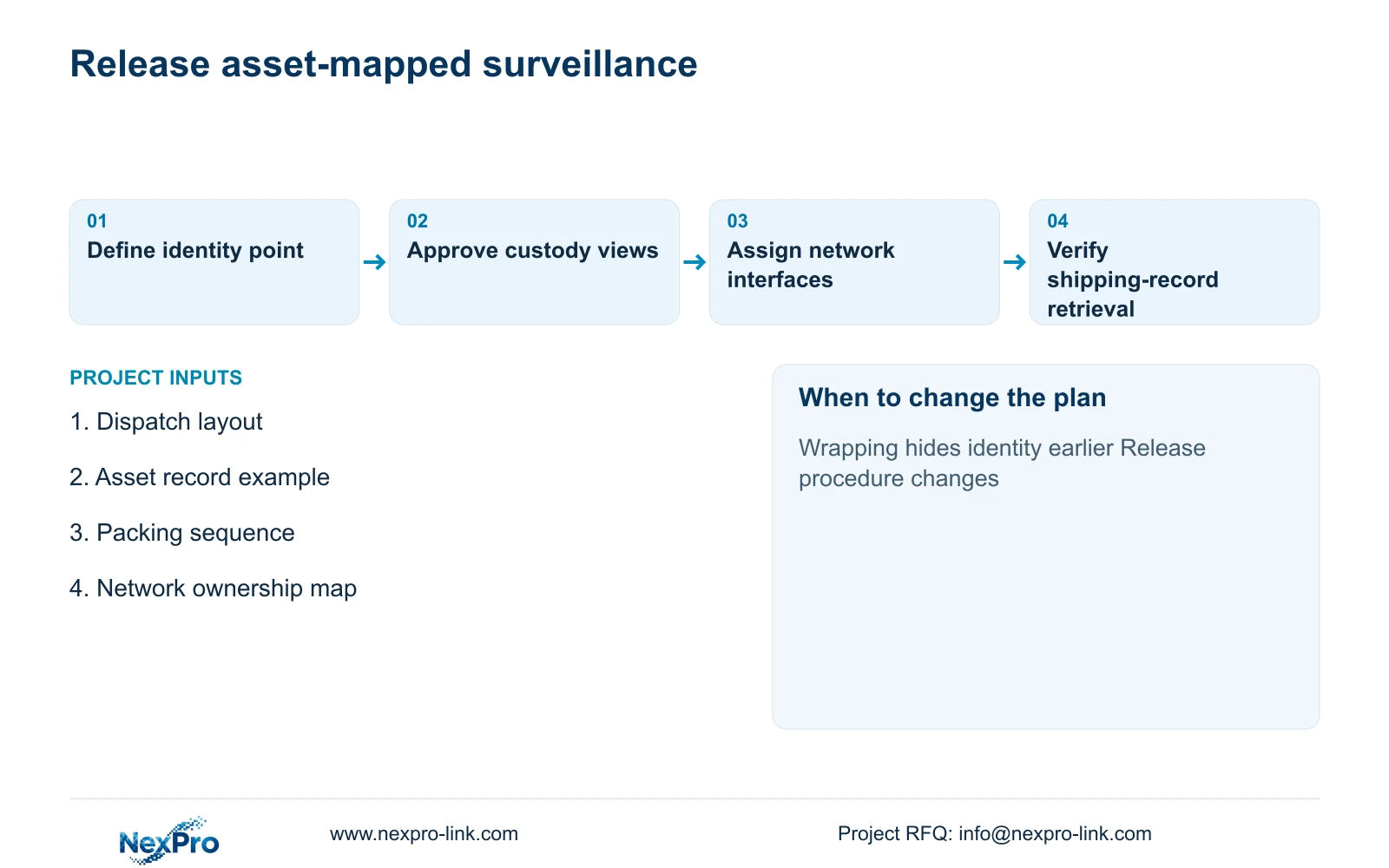
Before packing closes the identity point, pair the dispatch reference with the approved asset and test-record references. If rework or repacking changes that association, update the business record and retrieve the affected handover separately.
Section 01
Record custody changes at stores and dispatch
Before packing closes the identity point, pair the dispatch reference with the approved asset and test-record references. If rework or repacking changes that association, update the business record and retrieve the affected handover separately. Do not infer test approval from a cabinet's route through the workshop or reuse an earlier shipping reference without reconciliation.
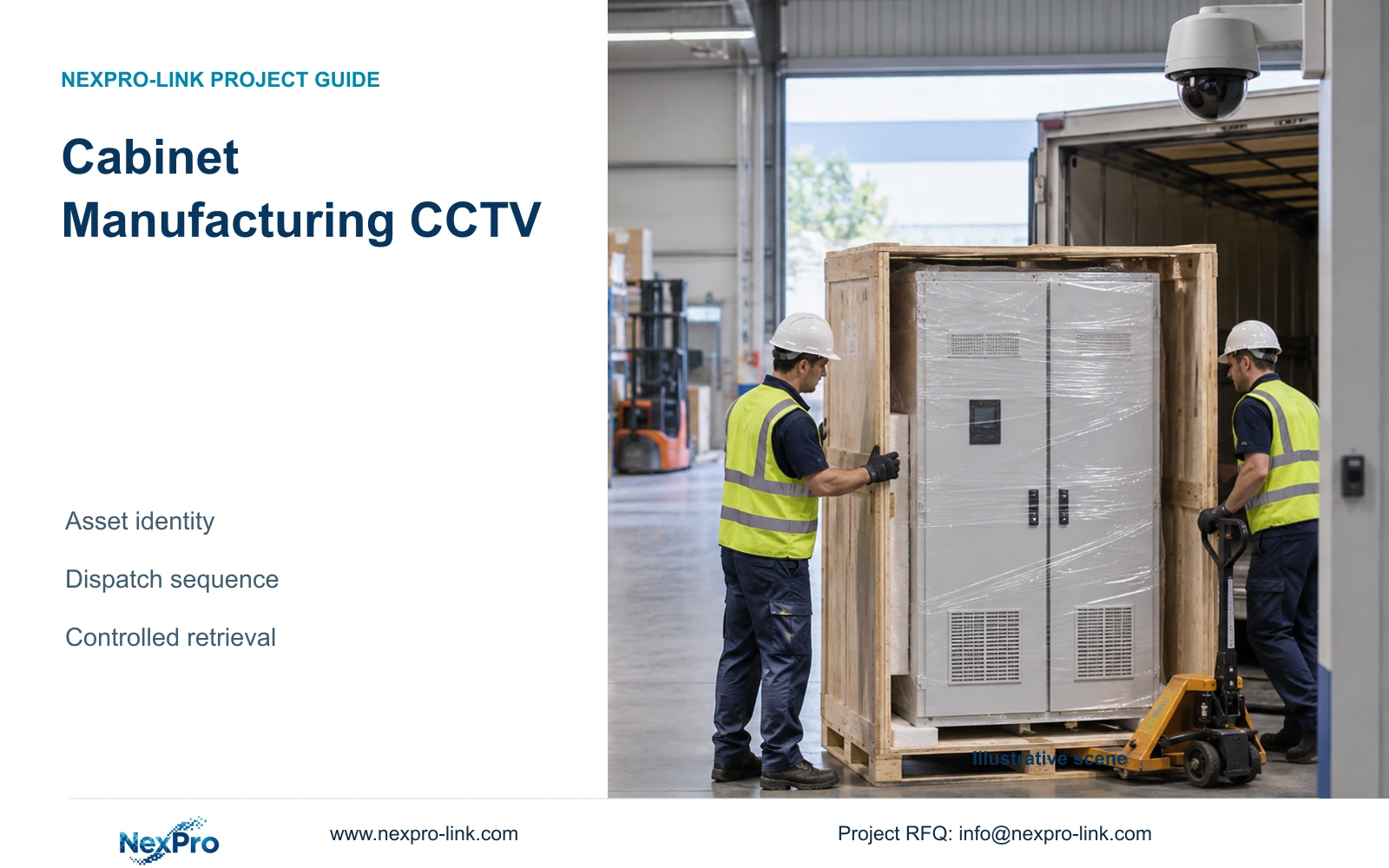
For inverter and electrical cabinet manufacturing, link the asset record and video time while recording stores access, packing and release. The asset system should provide the unit identity; CCTV should explain the visible custody sequence. Electrical compliance and test completion remain with their approved records, even when footage shows a cabinet leaving a test area.
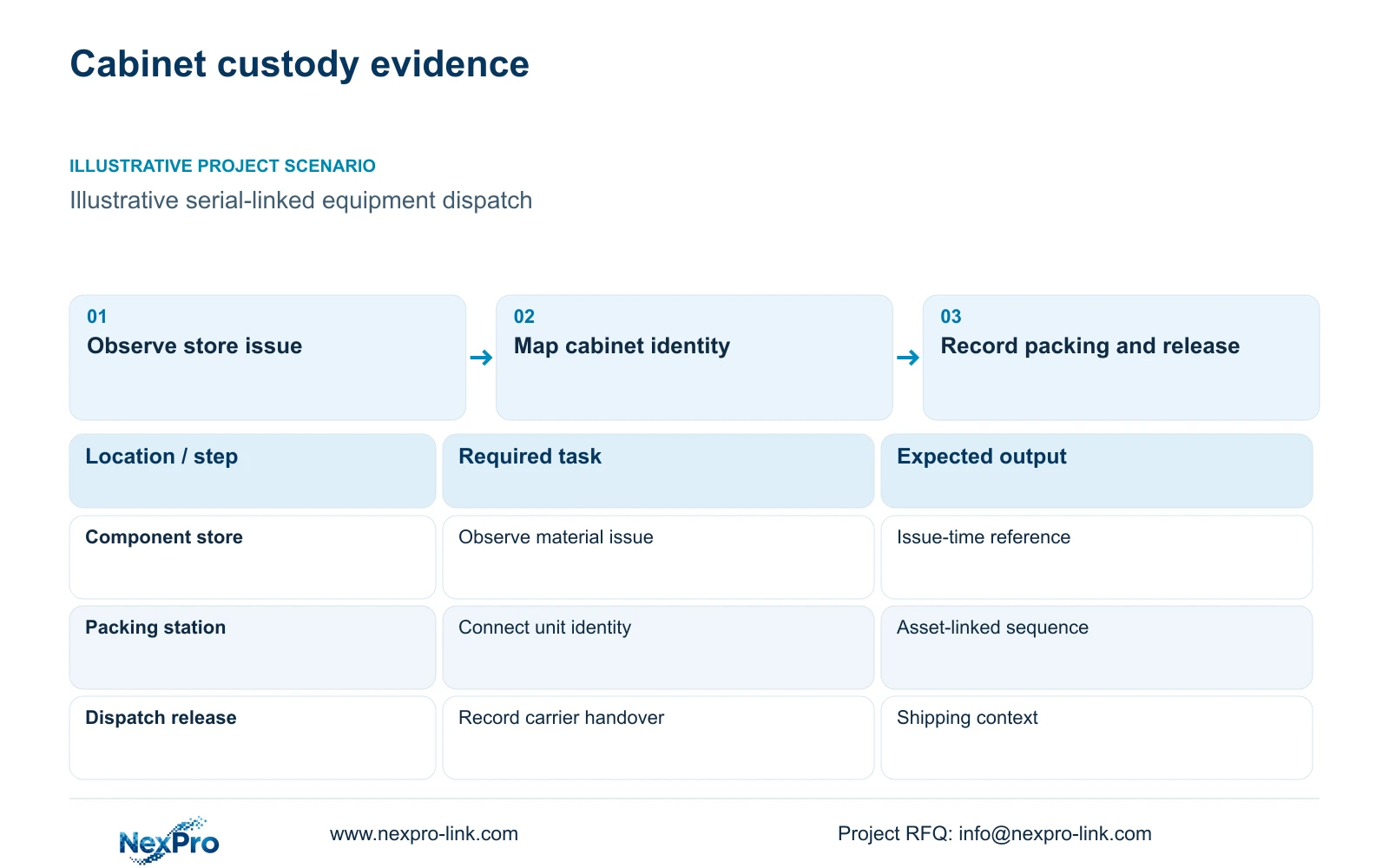
Illustrative project scenario: The plant manufactures high-value equipment and wants serial-linked shipping evidence. Assume components leave a controlled store, completed cabinets pass through packing, and dispatch staff release them to a carrier. These are planning assumptions. The useful camera tasks are to show material issue, cabinet handover and shipping movement without claiming that every concealed component or test action is visible.
Start the schedule at the points where responsibility changes. For the component store, define the issue counter or doorway that must be observed. For dispatch, identify the release position and the business record that names the cabinet. A wide warehouse view may show activity but still fail to connect a particular unit with the shipping reference.
Section 02
Choose an identity point that remains visible
Ask the production and dispatch teams when a cabinet's identifier is exposed and when protective wrapping hides it. A dependable identity point may be a recorded scan at the packing station, with its timestamp used to locate the camera sequence. Specify direct visual label reading only where the scene, lighting and stationary presentation can be demonstrated to support it.
Large cabinets can hide the operator's hands or block the receiving position. Place an overview to explain the route and a detail view where the handover itself requires closer observation. Check both with representative cabinet sizes and trolley orientations. A camera mounted for empty-floor visibility can lose the required action once the actual equipment occupies the station.
NexPro-BL2812M55-5MP-DIC-AI lists a 5MP-family output including 2880x1620 at 25fps and a 2.8-12mm motorized lens. It is an ordinary-area candidate for a defined view, not a guaranteed serial reader. The source supplies no fixed recognition distance. Keep that uncertainty out of the promised acceptance scope until a representative recorded trial resolves it.
Section 03
Protect the recording path and limit business-system access
Draw camera access, local recording and authorised viewing as distinct paths. The production or asset system can provide a record for manual lookup without a direct camera connection to its network. Where integration is required, identify the permitted data exchange and responsible system owners. NIST SP 800-82 Rev.3 provides an OT-security reference for considering operational constraints and separation; it does not qualify a particular camera installation.
CASE05 illustrates three independent 32-camera nodes in a solar-module campus. Each node receives an assumed 128Mbps locally, while the campus total is 384Mbps. That arrangement is useful when discussing separate stores and dispatch buildings, but the total must not be assigned to every backbone interface. Count the streams and review traffic that actually use each link.
Protect local switches and recorders through their actual electrical circuits if recording must continue during an outage. Keep production test supplies outside that security schedule. Fibre can connect buildings while power remains local. Record which operator services depend on the backbone and which local recording duties continue without it, then test those states during commissioning.
Section 04
Use the shipping reference to narrow a complete export
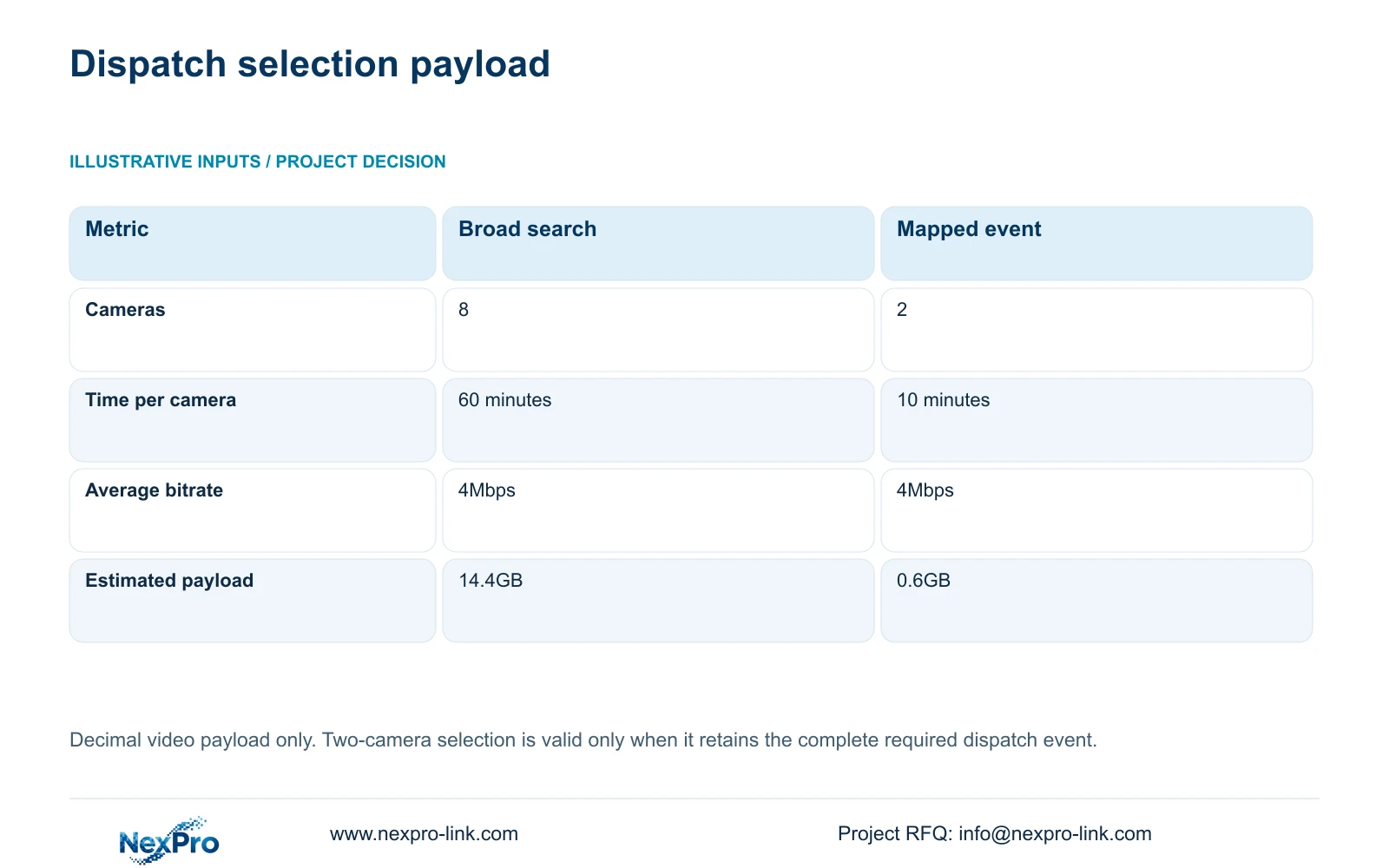
The illustrative broad request selects eight cameras for 60 minutes each at an average 4Mbps. A targeted request selects two relevant cameras for 10 minutes each at 4Mbps. Decimal payload is calculated as GB = cameras × Mbps × seconds / 8 / 1000. The results are 8 × 4 × 3600 / 8 / 1000 = 14.4GB and 2 × 4 × 600 / 8 / 1000 = 0.6GB.
The targeted choice is justified when the asset record identifies the correct packing and release views and their complete event window. It is not justified merely because it produces less data. If a cabinet is repacked, returned to holding or loaded later, extend the selection to include those actions. Preserve the relationship between the unit reference and each included clip.
The decisive difference is bounded event selection, not a lower-quality recording mode. These are average video payload estimates and do not guarantee export speed, reviewer time or legal evidence status. Keep the authorised request, selected camera IDs, start and end times and export recipient together so another reviewer can understand the material's scope.
| Metric | Broad search | Mapped dispatch event |
|---|---|---|
| Selected cameras | 8 | 2 |
| Minutes per camera | 60 | 10 |
| Average bitrate | 4Mbps | 4Mbps |
| Estimated payload | 14.4GB | 0.6GB |
| Selection basis | Uncertain route or timing | Approved asset-to-view mapping |
Section 05
Recommend mapped handover views with retained test records
Use a stable asset-to-camera mapping as the baseline, with overview and detail views only where the task needs them. Retain the quality system's test result and release authority. The owner receives shipping context; the engineer receives clear view and interface requirements; the quantity surveyor receives separately priced equipment, configuration and integration work.
Change the baseline if unit identity is unavailable at the proposed view, if several packing routes make manual mapping unreliable, or if the owner requires an existing enterprise platform. A higher-output camera may help a demonstrated detail task, but it cannot reveal identifiers underneath wrapping. A change to the identity process or camera position may be needed instead.
Compare NexPro-Link and other proposals with the same cabinet movement sequence, retention and authorised review workflow. Include mounts, network access, export preparation and local commissioning. An integration feature or local service included in one bid must remain visible in the comparison. No matched quotations or image tests are supplied here to support an overall price or performance winner.
Section 06
Make the equipment schedule follow the asset workflow
The project schedule should identify store, packing and release camera IDs, recorder assignments and business-record references. Separate new cameras from retained networks and asset systems. Mark automatic integration and continuous multi-view displays as options unless required. Assign an owner to each interface, including the timestamp source and the approved export destination.
NexPro-Link's BOQ support scope can help align model references, submittals and quotation deviations. For this application, project preparation should preserve location labels through equipment packing and configuration records. A branded carton or camera label should carry the correct project identity without replacing the technical model or firmware information needed for maintenance.
Accept the system with a redacted shipping record and a representative cabinet sequence. Demonstrate recorded packing, release and retrieval under the approved account permissions. Recheck the mapping after packing stations move or release procedures change. Handover documents should state that the CCTV package supplies operational evidence and excludes electrical testing, compliance certification and production safety duties.
Section 07
Buyer questions
Must the camera read the serial number directly? No. A dependable asset scan or shipping record can supply identity and timestamp. Direct visual reading is an additional acceptance task that needs a representative scene test.
What should a bid include if automatic linkage is proposed? Specify the exchanged fields, supported software versions, responsible interface owners and a demonstration from asset record to recorded clip. Keep configuration and ongoing support scope identifiable.
Can footage show that a cabinet passed electrical testing? Movement through a test area does not prove the result. Refer to the approved test record, then use footage only for the associated handling or custody context.
Section 08
Scope serial-linked dispatch evidence
Send the stores-to-dispatch layout, a redacted asset or shipping record, the packing and release sequence, and network ownership boundaries to info@nexpro-link.com for an equipment-scope discussion.
Engineering references
These sources support the general planning principles. Always use the selected product's current datasheet and applicable project standards for final design.