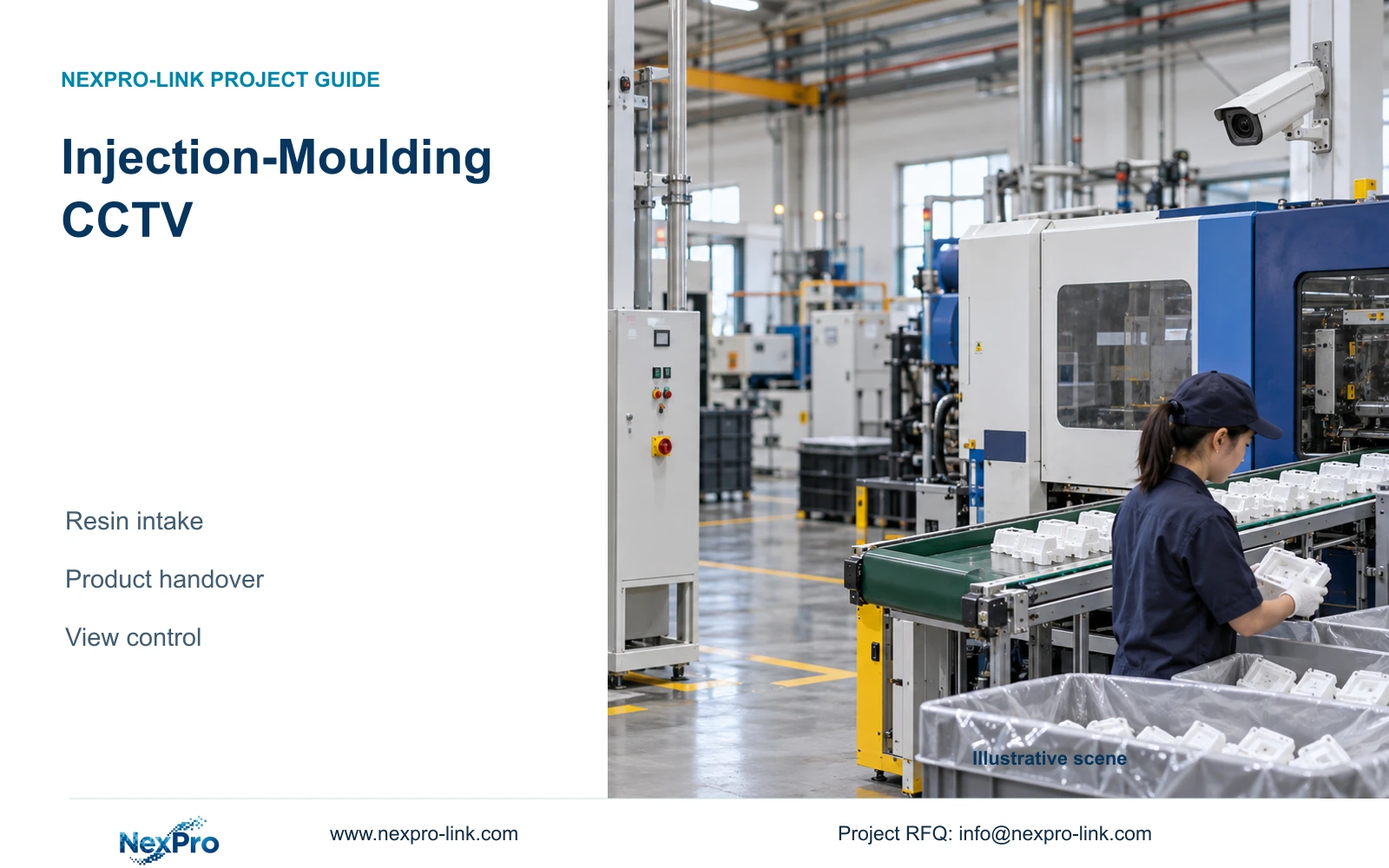
Define injection-moulding CCTV around resin intake, authorised machine access and product collection, with separate decisions for detail, process boundaries and changing layouts.
Section 01
Put the camera at the authorised transfer
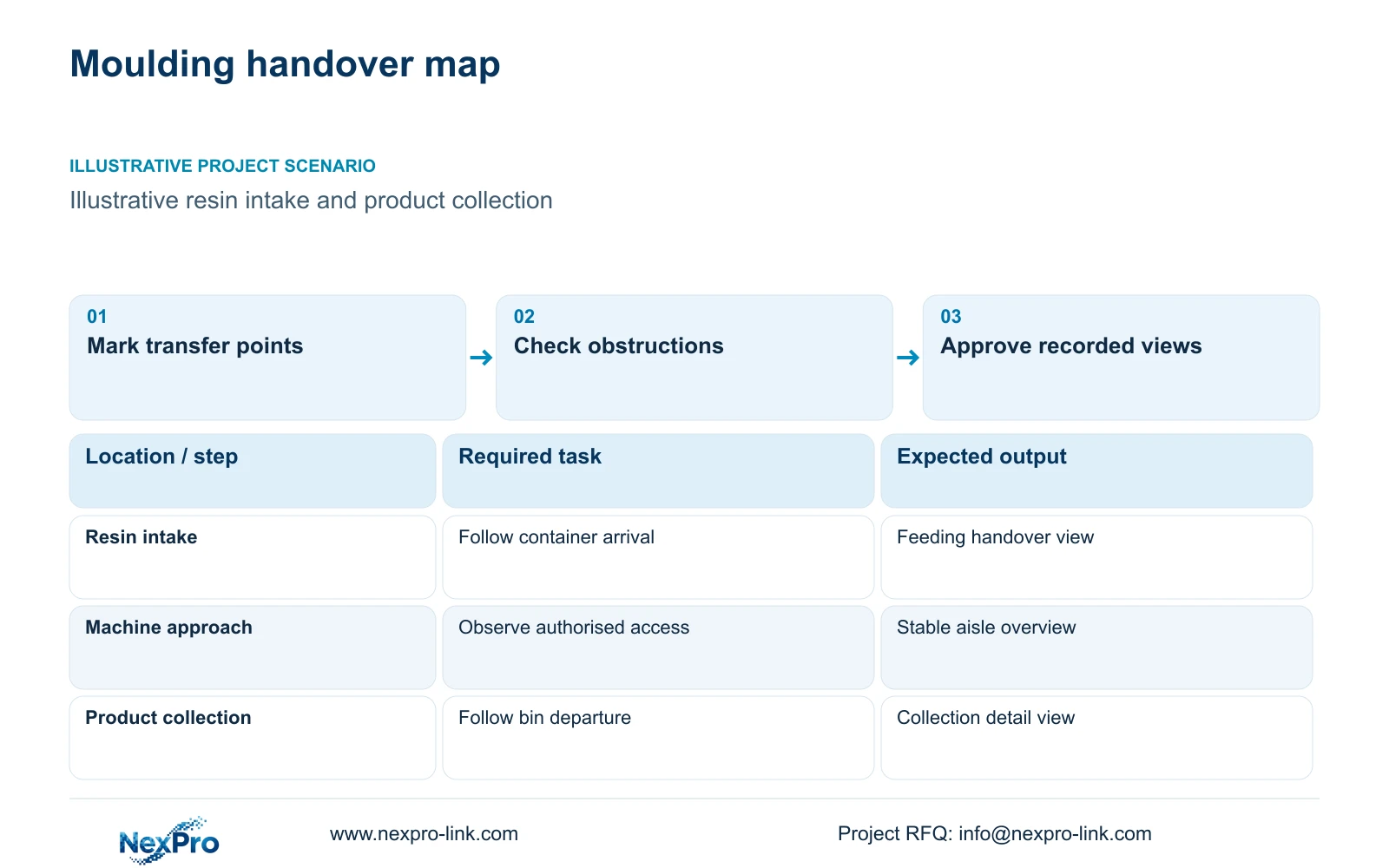
Injection moulding factory CCTV should record resin intake, authorised machine approaches and finished-product handover from positions clear of heat, moving equipment and maintenance routes. Start by identifying where custody changes and what the reviewer must see: the arriving container, the person handling it, the receiving point and the departure. These observations define a security view. They do not establish correct resin selection, mould protection or machine guarding.
Illustrative project scenario: An injection-moulding shop wants handling evidence at resin intake and product collection. Assume material arrives in labelled containers and finished parts leave in collection bins. These are planning assumptions, not details of a completed project. The project manager marks each transfer location on a drawing and asks production staff to demonstrate the movement with normal equipment present. A view approved with an empty aisle may lose the receiving point when a trolley, collection bin or operator enters the scene.
Section 02
Keep production decisions outside the surveillance scope
Write the acceptance requirement as an observable event, such as following a container from the authorised aisle to the feeding position. Avoid requirements that imply the camera confirms polymer grade, detects mould damage or prevents access to moving machinery. If production needs those functions, retain a separate specialist work package with its own acceptance criteria and responsible supplier. The security schedule should identify the interface without claiming the ordinary camera performs the specialist task.
Obtain transfer speeds, heat exposure at the proposed mounting point, dust information and any relevant solvent-area boundaries. Include downstream packing or printing routes only where they form part of the handover being reviewed. A dusty feeding location may need a different mounting position and cleaning access; a classified or otherwise unsuitable position requires specialist assessment. The responsible local designers must verify applicable installation requirements. A general enclosure rating cannot resolve every environmental input, and missing exposure information should remain an open selection item.
Section 03
Make the handover map survive mould changes
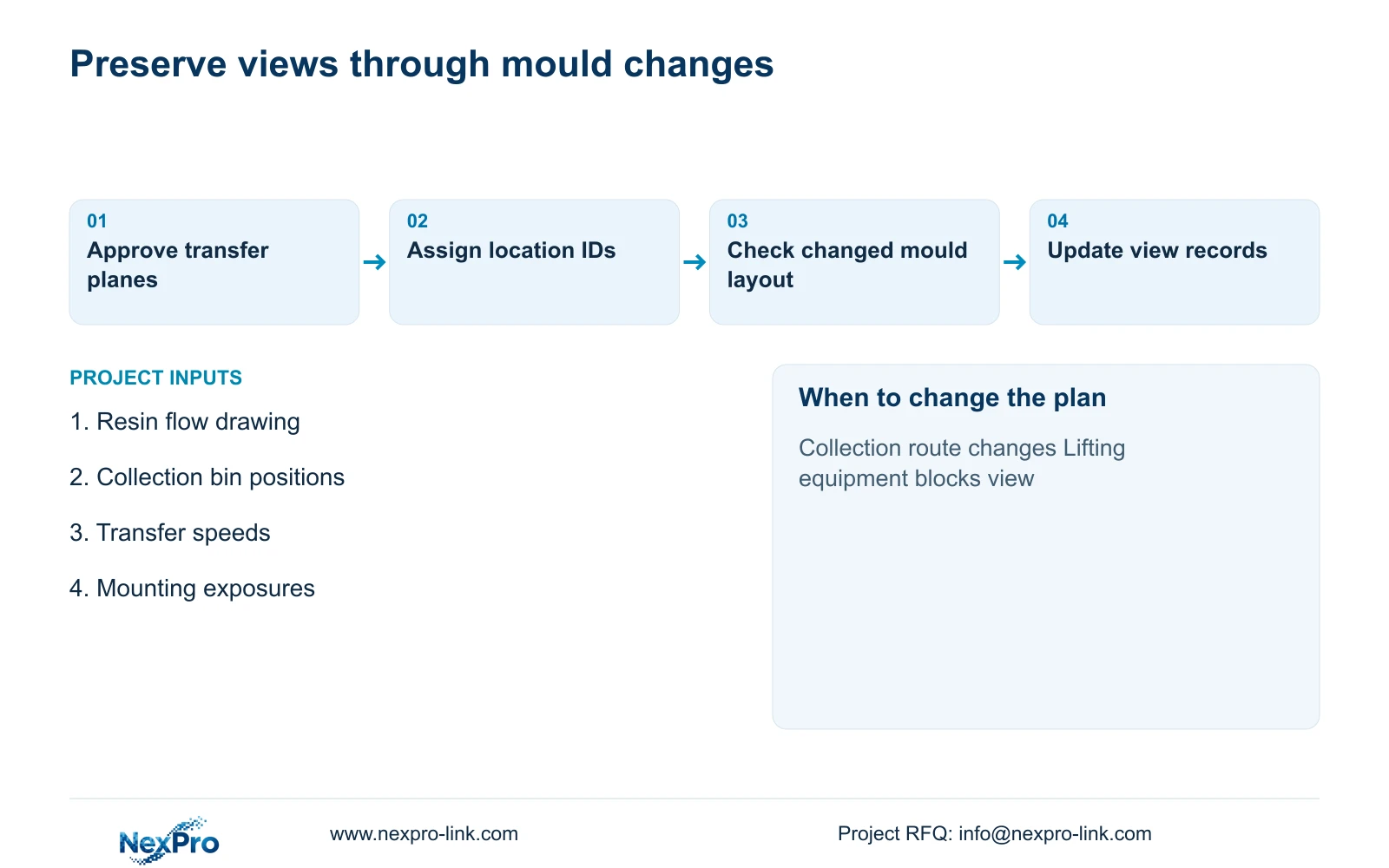
Anchor the security handover map to stable aisle entrances and transfer points where possible. For each view, record the target plane, mounting position, expected obstructions and the production arrangements under which it was approved. When mould changes alter collection bins, lifting equipment or operator access, the production representative should flag affected views before the revised arrangement becomes routine. The installer then checks alignment and submits replacement acceptance images.
The NexPro-BL2812M55-5MP-DIC-AI is a relevant ordinary-area candidate with a listed 2880×1620 output, 25fps@5MP and a 2.8–12mm motorized lens. Those fields support discussion of framing, but they do not guarantee a particular target width from an unspecified mounting distance. Assign the supplied camera and configuration record to the equipment supplier, mounting and final alignment to the local installer, and layout-change notification to the owner. Separately list specialist positions rather than allowing them to disappear into the ordinary-camera quantity.
Section 04
Choose detail width without losing movement context
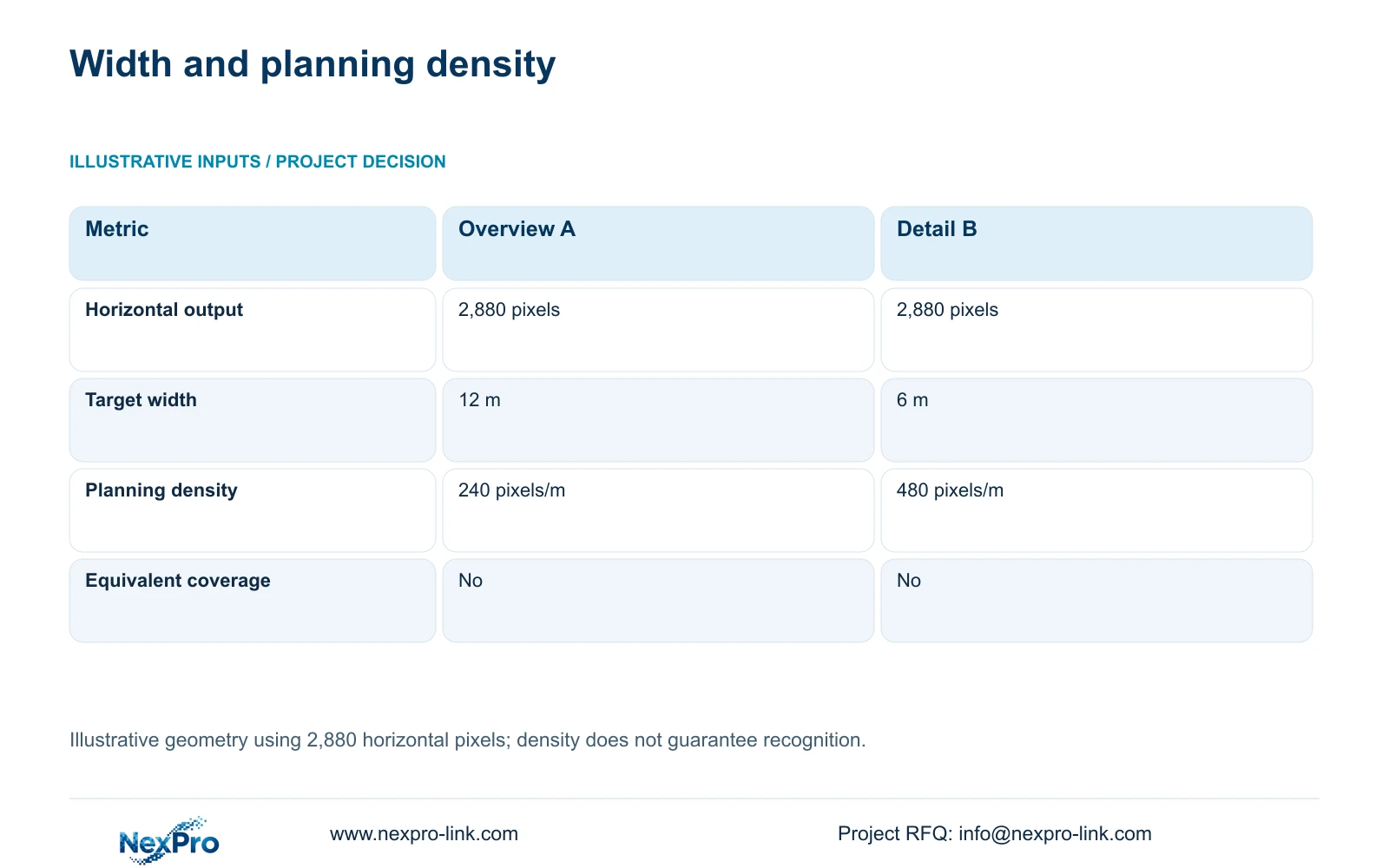
The illustrative comparison uses one assumed horizontal output of 2,880 pixels. Option A covers 12 m at the target plane; Option B covers 6 m. The formula is planning_pixels_per_metre = horizontal_output_pixels / target_width_m. Therefore, 2,880 / 12 = 240 pixels/m and 2,880 / 6 = 480 pixels/m. These widths are example geometry, not guaranteed fields of view for a lens setting.
The decisive difference is the lost horizontal coverage. A tighter view may make the receiving point easier to examine while excluding the route by which a bin arrived. If both tasks matter, retain an overview and price the detail view separately. Pixel density alone does not guarantee recognition: viewing angle, exposure, motion, lighting, compression and obstruction still affect the recorded result. Neither option establishes mould-protection capability, and no universal image-acceptance threshold is assigned to these calculated densities.
| Metric | Option A: overview | Option B: detail |
|---|---|---|
| Horizontal output | 2,880 pixels | 2,880 pixels |
| Target width | 12 m | 6 m |
| Planning density | 240 pixels/m | 480 pixels/m |
| Equivalent coverage | No | No |
Section 05
Protect the recording path before adding display scope
Recommend stable overview positions with dedicated detail only at transfers that fail the agreed image task. Reconsider that arrangement when collection routes move, obstructions become persistent or environmental conditions exclude the proposed mount. Compare alternative suppliers using the same transfer sequence, recording hours, retention and installation boundary. A cheaper camera-only offer cannot be compared directly with a package that includes storage, protected switching and site alignment.
CASE01 provides a separate illustrative system baseline, not an injection-moulding installation: 32 ordinary-area cameras at an assumed 4 Mbps each produce 128 Mbps of recorder input. Its 30-day video quantity is 41.472 TB, against a 48.64 TB recording budget from four 16 TB disks after the stated formatting and free-space factors. This shows why adding detail cameras must trigger a capacity review. The NexPro-NVR4449-4K has a published 320 Mbps input reference and four SATA bays; its channel count does not establish simultaneous decoding or RAID. A retrieval monitor can remain the display basis unless operators need continuous multi-view supervision.
Section 06
Issue a supply schedule that preserves each view
The RFQ schedule should carry location IDs from the drawing into camera labels, recorder channel names and packing lists. Include the accepted transfer task, provisional stream settings and mounting accessories against each position. NexPro-Link's BOQ and tender-support scope can support model matching, technical documents and quotation coordination. Project-labelled or OEM packaging can follow the same location structure without changing the underlying image or installation requirement.
Keep cable routes and power dependencies visible alongside the camera schedule. A relocated detail camera may need a revised continuous cable length, termination method and switch port. The PoE budget needs the selected camera's actual maximum demand, which the supplied camera source does not establish. UPS sizing should include the complete switch AC input without counting its powered cameras twice. The final handover should contain representative resin-feeding and product-collection recordings, the approved view map and an unresolved-items list for specialist or site-dependent positions.
Section 07
Buyer questions
Can one camera follow a transfer and read its container label? Possibly, but approve both tasks on recorded footage with the actual container position and movement. If the label requires a narrower view that loses the arrival route, use a separate detail position.
Should every mould change require new equipment? No. First check whether the accepted transfer plane and sightline have changed. Realignment may suffice; additional equipment is justified when the revised movement cannot be captured from the existing position.
What should remain provisional in an early quotation? Mounting geometry, actual maximum camera demand, representative bitrate and unresolved environmental suitability should remain explicit assumptions until the project team supplies or verifies them.
Section 08
Define your moulding-shop handover views
Send your resin-to-product flow drawing, transfer speeds and container positions, mounting-area exposure information, and required recording period to info@nexpro-link.com for a scoped equipment and handover-map discussion.
Engineering references
These sources support the general planning principles. Always use the selected product's current datasheet and applicable project standards for final design.