For a proposed accessory or operating-mode addition, obtain its effect on the endpoint's documented power interface and maximum demand. Recheck the supplying port and total allocation before enabling it.
Section 01
Compare power at the correct reference point
For a proposed accessory or operating-mode addition, obtain its effect on the endpoint's documented power interface and maximum demand. Recheck the supplying port and total allocation before enabling it. Keep undocumented heaters or illuminators outside the approved budget. A formerly working pairing does not qualify every later device function.
Select IEEE PoE types for industrial CCTV by matching the exact endpoint power interface, type, class and supported delivery conditions to the supplying port. Then check the switch's total PSE budget. Camera-side demand, individual-port capability and chassis wattage answer different questions; a large number in one column cannot establish the other two.
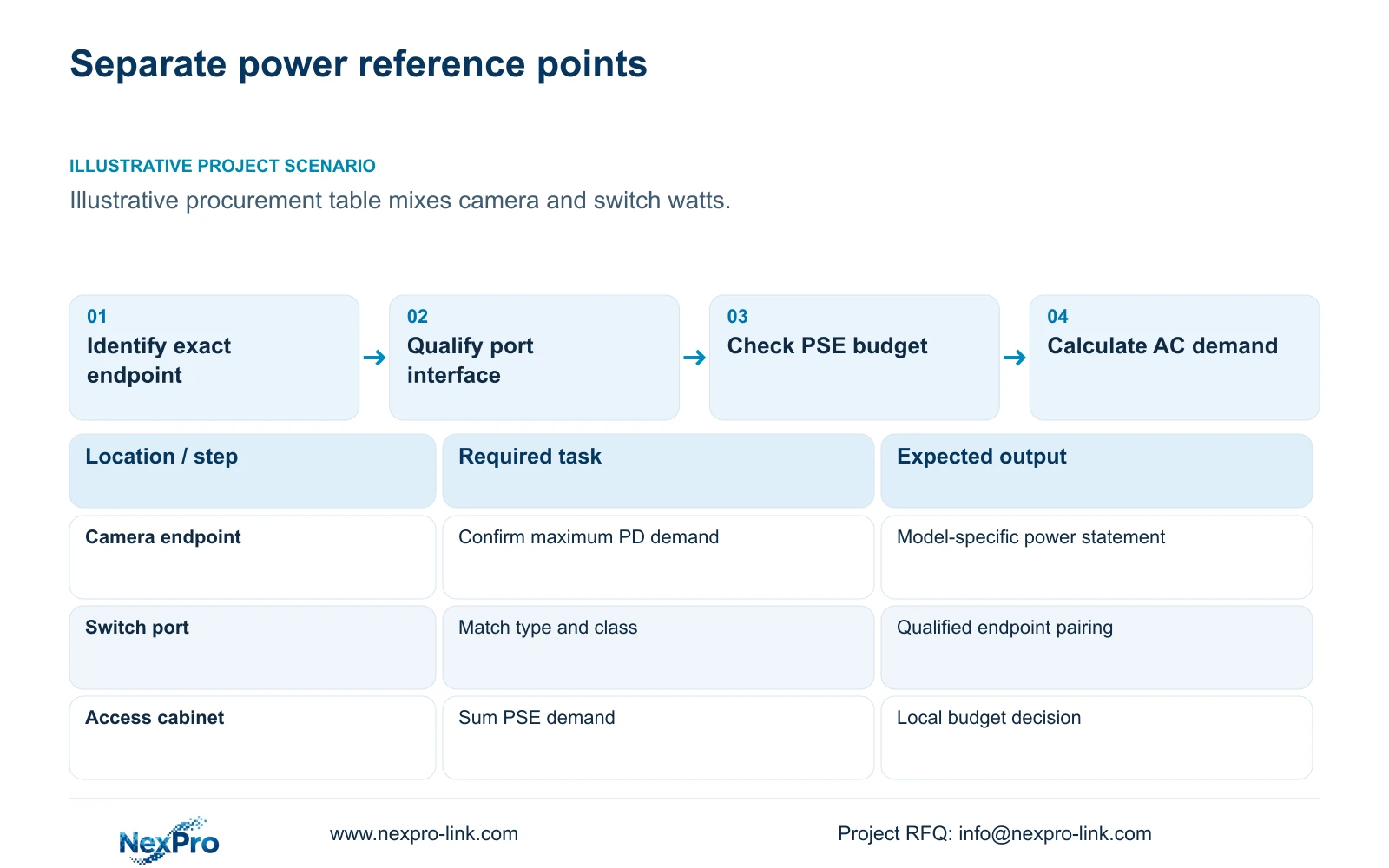
Illustrative project scenario: The procurement table compares camera demand directly with the largest advertised switch number. Use the supplied 32-camera CNC reference to correct that table, reviewing four groups of eight ordinary security cameras. Assume 12 W maximum PD demand per camera for the calculation, while leaving the actual interface requirements and maximum power confirmation open.
Begin by labelling every wattage field as PD demand, PSE output, total PSE budget or AC input. Keep manufacturer ratings separate from design assumptions. This simple revision prevents a buyer from accepting an apparently generous switch while overlooking a port that cannot support the selected endpoint's required power arrangement.
Section 02
Obtain an endpoint-to-port compatibility statement
For each camera model, request the manufacturer's stated PoE interface and the conditions attached to its maximum demand. Record the switch model, proposed port and supported power type alongside it. Terms such as PoE or high power in a quotation are insufficient when they omit the exact endpoint and port pairing.
The supplied BL2812M series specification establishes PoE for NexPro-BL2812M55-5MP-DIC-AI. It also lists the 5MP family output as 2880×1620 and a 2.8–12 mm motorized lens. Those imaging fields help identify the intended unit, but they do not establish its maximum watts or a specific PoE type and class. Keep these missing fields in the compliance request instead of converting the illustrative 12 W into a product specification.
Microchip's DS00002992A explains the following upper-level PSE/PD power reference points. The lower device-end allowance accounts for the delivery boundary; it is not the camera's measured consumption. Ethernet Alliance also distinguishes IEEE-based products from proprietary implementations marketed as PoE. Confirm the exact type, assigned class and supported pairing rather than approving equipment from a PoE++ label alone. Optional extended-power operation is outside this comparison.
| IEEE family and type | PSE output reference | PD available power reference |
|---|---|---|
| 802.3af / Type 1 | 15.4 W | 12.95 W |
| 802.3at / Type 2 | 30 W | 25.5 W |
| 802.3bt / Type 3 | 60 W | 51 W |
| 802.3bt / Type 4 | 90 W | 71.3 W |
Section 03
Qualify the operating functions that drive demand
Approve the power pairing for the functions the project will actually use. Ask whether the maximum demand statement covers enabled illumination, audio and any other supported functions relevant to the exact model. A sample running with a simplified daytime configuration cannot settle a requirement for a different operating state.
Treat proposed higher-power equipment as a separate endpoint group. Do not assume that a port serving an ordinary fixed security camera will also serve a future specialist device. Obtain the replacement model's power interface, supply arrangement and environmental scope before reserving a port or quoting an injector.
For the engineer, the output is a camera-to-port schedule with confirmed, assumed and unresolved fields clearly distinguished. The supplier supplies compatibility evidence and exact model identity; the installer verifies the physical connection. The owner decides whether optional functions belong in the accepted operating scope, avoiding a later change that invalidates the original power selection.
Section 04
Check the chassis budget after matching the ports
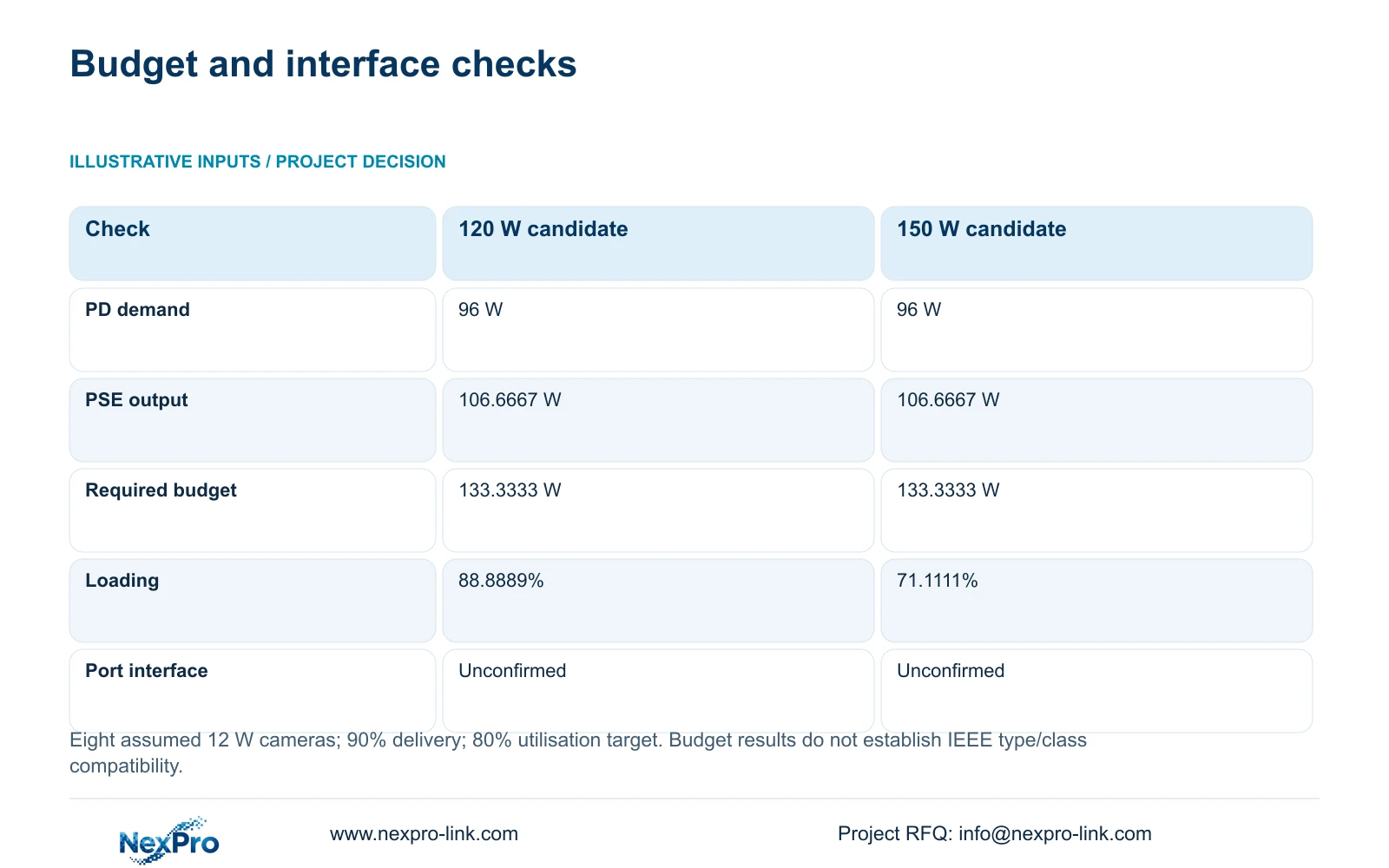
The teaching calculation for one group is PD_W = 8 × 12 = 96 W. With 90% assumed cable delivery, PSE_W = 96 / 0.90 = 106.6667 W. Under the selected 80% maximum utilisation target, required_budget_W = 106.6667 / 0.80 = 133.3333 W. These values establish a budget comparison, not a compatible IEEE interface.
The 120 W candidate operates at 88.8889% of its stated budget under these assumptions, while the 150 W candidate operates at 71.1111%. Prefer the latter budget basis for this group because it meets the target. Both candidates still require endpoint-to-port qualification; passing the table cannot resolve an unspecified type or class. Replace the estimated demand with the offered switch's supported allocation method before final approval, especially when power is reserved by class rather than actual consumption.
The associated AC estimate is switch_AC_W = (PSE_W + 15) / 0.90 = 135.1852 W. Switch electronics of 15 W and AC conversion efficiency of 90% are assumed. Keep this input-supply calculation outside the PSE comparison so the UPS schedule does not confuse output budget with wall-plug demand.
| Check | 120 W candidate | 150 W candidate |
|---|---|---|
| Assumed PD demand | 96 W | 96 W |
| Required PSE output | 106.6667 W | 106.6667 W |
| Budget loading | 88.8889% | 71.1111% |
| 80% target | Not met | Met |
| Endpoint type/class support | Requires confirmation | Requires confirmation |
| Assumed AC input | 135.1852 W | 135.1852 W |
Section 05
Reject substitutions that leave the interface unresolved
Recommend an offer only when it satisfies both the port pairing and the group budget. A switch with a greater chassis allowance but unresolved endpoint support should remain a conditional offer. Conversely, a documented compatible port does not justify accepting a total budget below the approved design requirement.
Compare alternatives from NexPro-Link, Hikvision, Dahua or another supplier against identical enabled functions, cable arrangement and expansion scope. Preserve any mandatory integration or specialist protection requirement. A lower equipment price is not comparable if the alternative silently removes a required function or transfers an injector and local power supply to the installer.
Maintain a separate permitted traffic matrix for recording, viewing and administration. ONVIF Profiles concerns device and client interoperability with exact firmware applicability; it does not prove the power interface. NIST SP 800-82 Rev.3 supplies the OT-security context for controlled network boundaries. Neither a video connection nor a VLAN assignment closes the PoE qualification question.
Section 06
Carry qualified pairings into preparation and handover
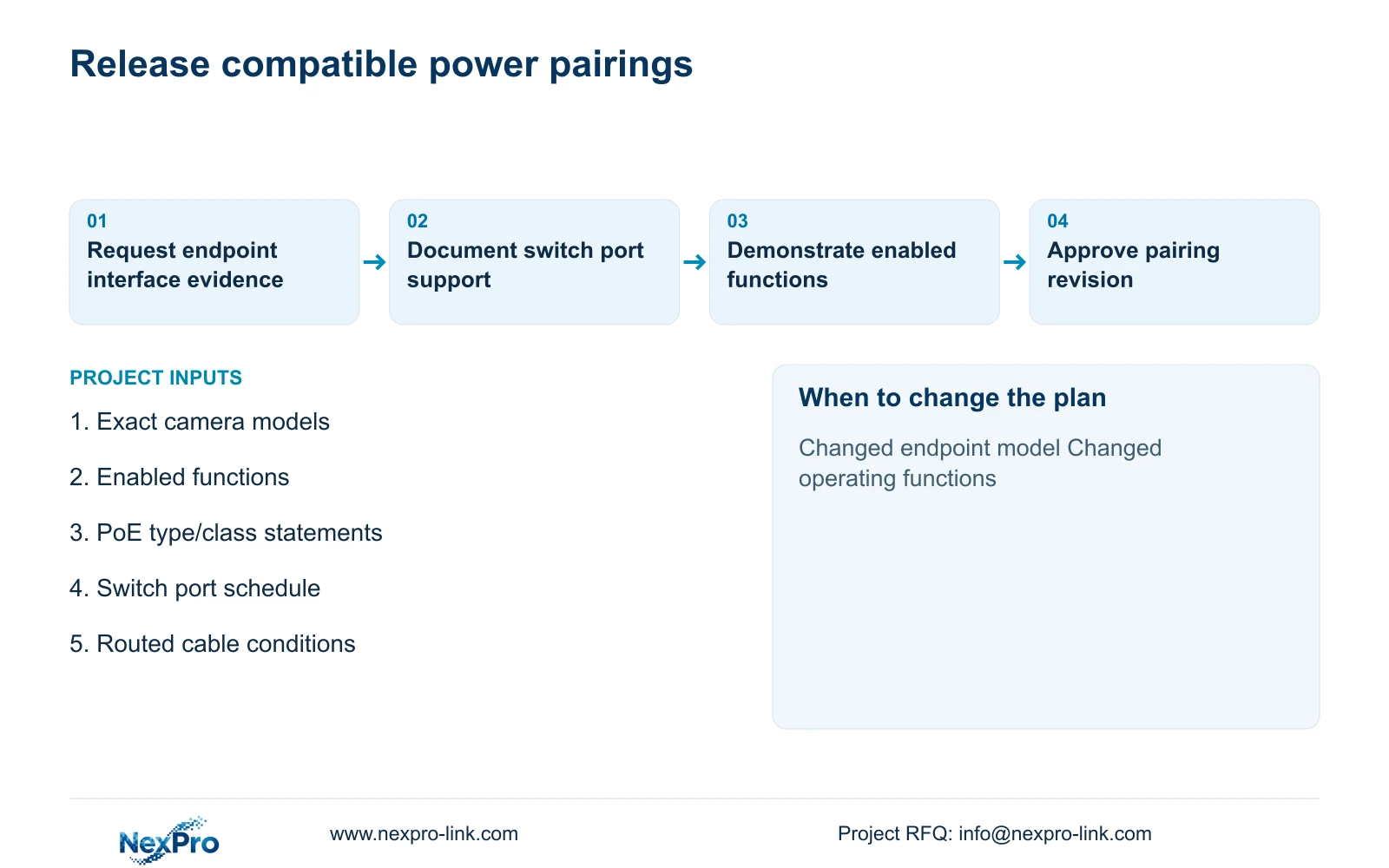
Use the approved pairing sheet as the basis for sample preparation. Record camera and switch identities, proposed ports and the operating functions demonstrated. Check restart and operation under the accepted configuration, then reconcile observations with manufacturer documentation. Do not treat a single successful startup as evidence for every cable route or optional device.
NexPro-Link's BOQ and Tender Support scope can coordinate exact model matching and documented deviations. For this article, the required supply output is a clear list of approved pairings and unresolved inputs, followed by a cabinet budget schedule. Cabinet labels and grouped packing should retain those identities when equipment reaches the installer.
Reopen qualification when the endpoint model, supply interface, cable path or enabled functions change. Record the affected port and group instead of replacing all equipment automatically. Site installation and final acceptance should verify the actual arrangement, while the quotation distinguishes supplied switches, optional injectors and locally provided electrical work.
Section 07
Buyer questions
Can ONVIF compatibility confirm PoE compatibility? No. ONVIF device and client profiles address supported video-system functions. Obtain a separate power-interface statement for the exact camera and supplying port.
Should every factory camera receive a higher-power port? Only where the selected endpoint or approved expansion requires it. Uniform higher-power ports may simplify procurement, but their value should be assessed against documented requirements and quotations.
Can we approve the budget while awaiting the camera's maximum watts? You can issue a provisional calculation using clearly marked assumptions. Keep final switch approval conditional on confirmed power and interface data, with a defined revision point.
Section 08
Qualify the proposed PoE pairings
Email the exact camera models and enabled functions, stated PoE type/class data, proposed switch port schedule and routed cable conditions to info@nexpro-link.com for model-matching and deviation review.
Engineering references
These sources support the general planning principles. Always use the selected product's current datasheet and applicable project standards for final design.
- User BL2812M series product specification
- NexPro-Link BOQ & Tender Support
- ONVIF Profiles
- NIST SP 800-82 Rev.3 final
- Microchip — Next-Generation PoE, DS00002992A, tables 2–4: power reference points and assigned classes
- Ethernet Alliance — IEEE types and proprietary PoE distinctions; no certification claimed for this camera