Total metres provide only a lower bound for reel purchasing. A continuous-cut plan shows whether the stock can actually supply every required factory camera link.
Section 01
Count complete links before committing to reels
Determine factory CAT6 reel quantity from a feasible allocation of complete continuous cuts. For ten required 85 m links supplied on 305 m reels, four reels are needed. The total-only estimate gives three, but those reels can supply only nine complete links. Order against the cut schedule and list deliberate spare stock separately.
Illustrative project scenario: Several long camera runs fit within the assumed channel design but consume reels inefficiently. The quantity surveyor receives ten 85 m continuous cuts, each already including its endpoint allowances. Assume every run uses the same approved cable construction and no splicing is permitted. The issue is how the required lengths fit into reels, rather than whether the camera count has been added correctly.
Give each cut a camera ID and destination cabinet. Confirm that the engineer has checked its installed link boundary before treating it as ready for procurement. A purchasing plan can demonstrate that material fits into reels, but it cannot approve a route or substitute for installation testing.
Section 02
Assign every cut to a specific reel
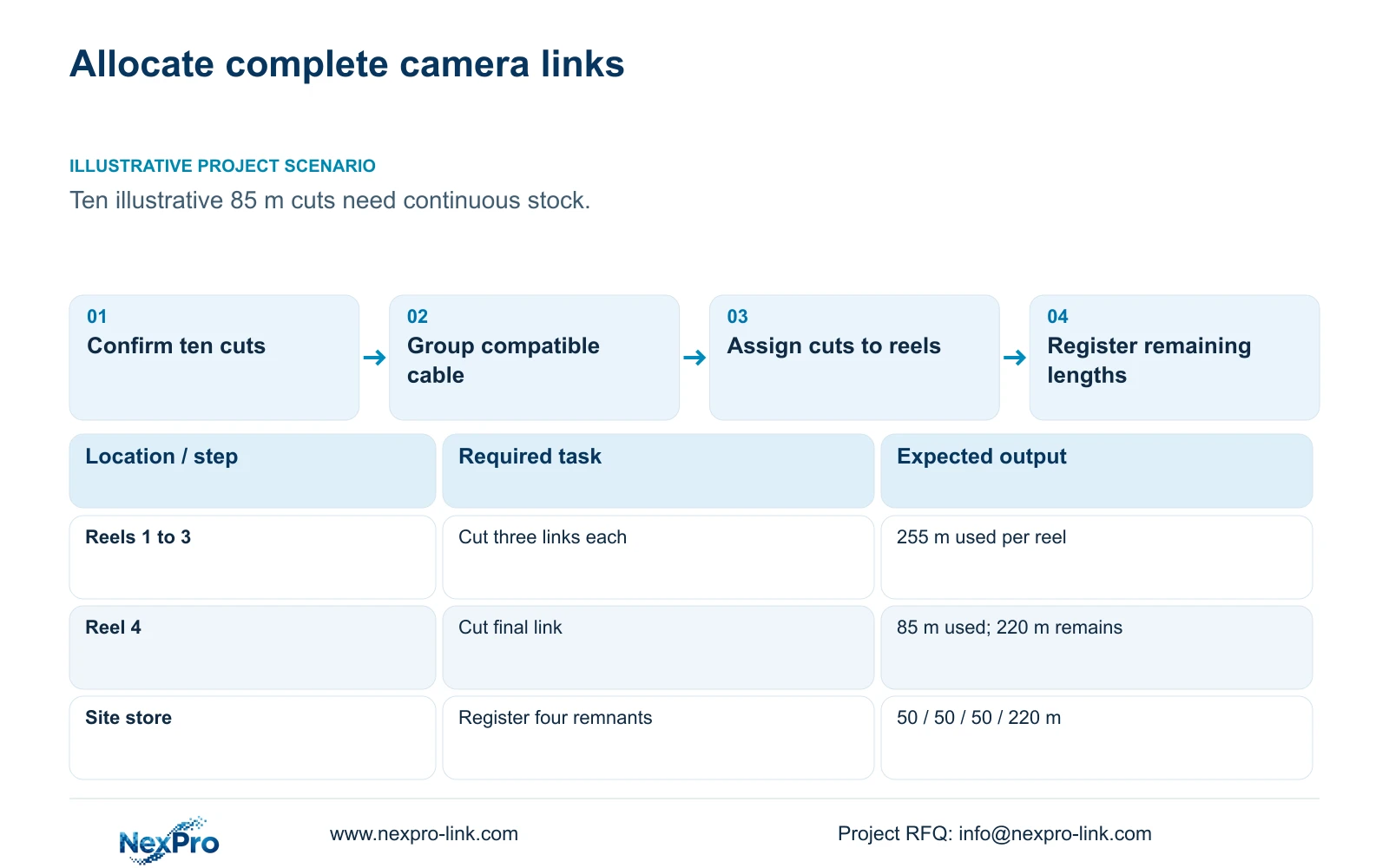
For equal-length cuts, first calculate how many fit on one reel. Here max_cuts_per_reel = floor(305 / 85) = 3. Four cuts would require 340 m. A feasible assignment places links 1 to 3 on reel 1, links 4 to 6 on reel 2, links 7 to 9 on reel 3 and link 10 on reel 4.
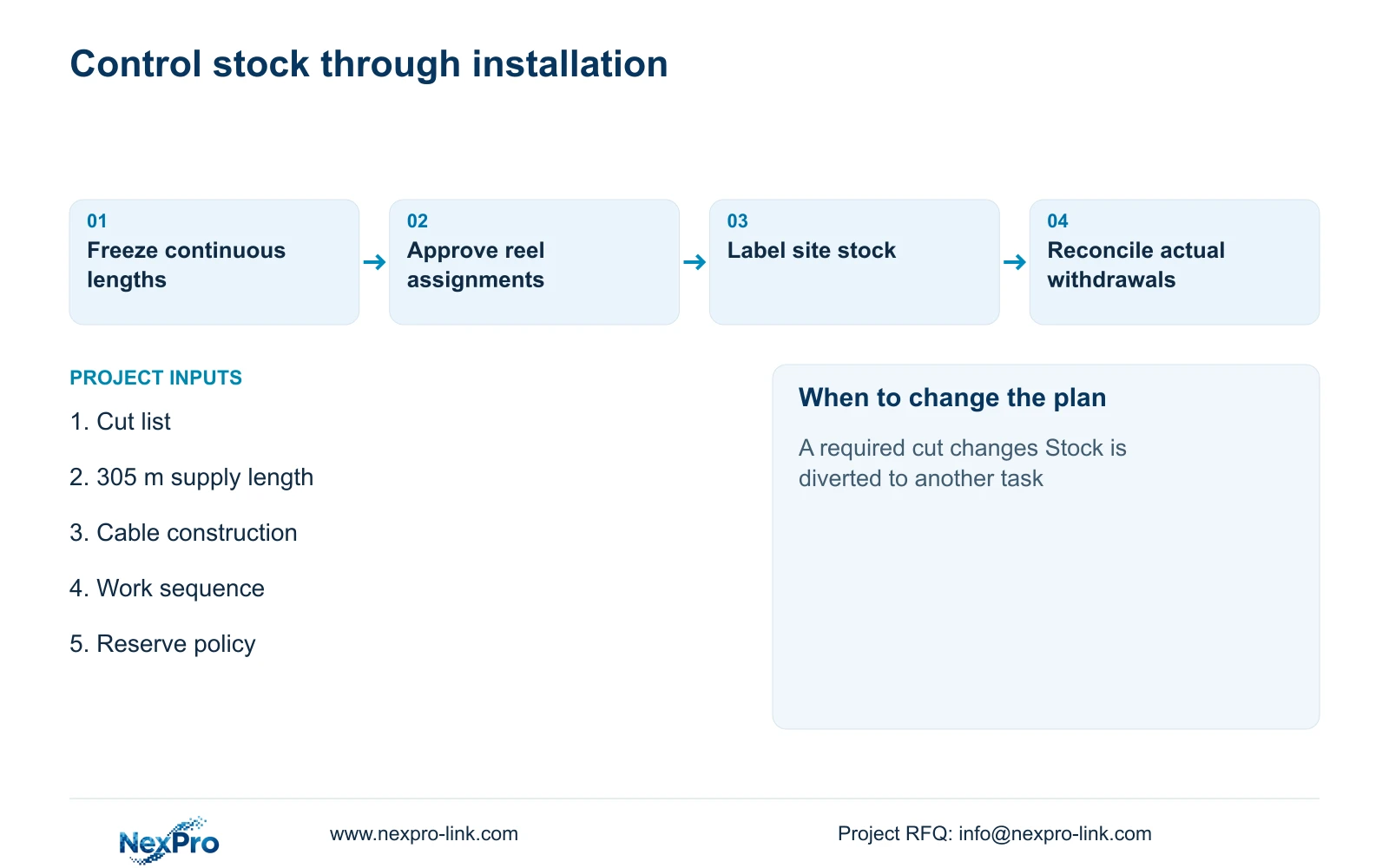
Each of the first three reels uses 255 m and leaves 50 m. The fourth uses 85 m and leaves 220 m. Put those assignments in the installation issue sheet so the crew does not consume the longest remaining piece on an unlisted short task. Label the reel and record actual withdrawals as work proceeds.
Mixed lengths need individual allocation rather than this equal-cut shortcut. One practical method sorts cuts from longest to shortest, then places each in the first compatible reel with sufficient remaining length. Check every resulting sum against 305 m. Such a feasible method does not automatically prove the globally smallest reel count, particularly when cable constructions or work phases must remain separate.
Section 03
Identify what the remaining cable can actually serve
Four reels provide 4 × 305 = 1,220 m of stock. After the required 850 m is cut, 370 m remains: three pieces of 50 m and one of 220 m. That is the material balance of this allocation. It is not a separate spare allowance, and the three 50 m pieces cannot supply another 85 m link individually.
A remnant may serve a later shorter run if its construction, condition and verified remaining length fit that task. Keep a remnant register with reel or batch identity and storage location. Do not price every remainder as recoverable value or assume arbitrary pieces can be joined into a permanent camera link.
If the owner wants replacement stock for one complete 85 m run, identify which continuous piece is to be held for that purpose and how its availability will be protected. If reserve must be an unopened reel, specify that as an additional purchasing line. The reserve policy should describe a usable outcome rather than a percentage whose purpose nobody can explain.
Section 04
Expose the missing link in the total-only estimate
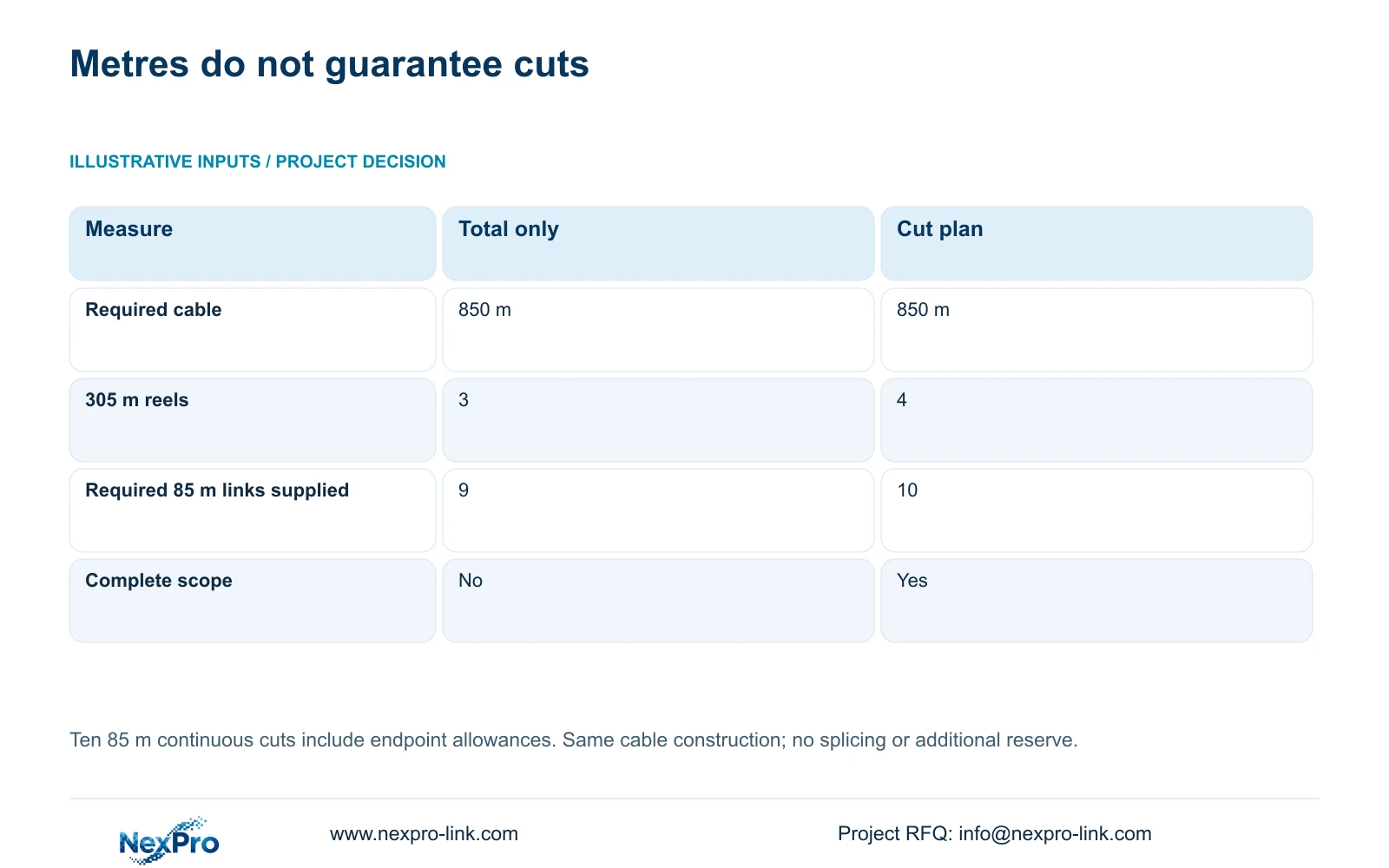
The illustrative formulas are total = 10 × 85 = 850 m; total_only = ceil(850 / 305) = 3 reels; max_cuts_per_reel = floor(305 / 85) = 3; feasible_reels = ceil(10 / 3) = 4. The total-only result is a lower bound because it treats available metres as freely interchangeable.
The decisive difference is one unavailable complete link. Three reels contain 915 m in aggregate, which exceeds 850 m, yet the required ten cuts do not fit. The table therefore compares delivery of the same ten-link task, rather than comparing two different cable requirements. Additional reserve and patch cords are excluded.
CASE01 demonstrates a different distribution: 32 continuous cuts of 41 to 76 m total 1,872 m. Its supplied allocation uses seven 305 m reels, matching the rounded total-length lower bound. The listed used lengths are 304, 284, 305, 300, 270, 286 and 123 m. Both examples require a cut check, even when the lower bound happens to be achievable.
| Measure | Total-only estimate | Feasible allocation |
|---|---|---|
| Required installed cable | 850 m | 850 m |
| Purchased reels | 3 × 305 m | 4 × 305 m |
| Required 85 m links supplied | 9 of 10 | 10 of 10 |
| Meets required cut schedule | No | Yes |
Section 05
Compare usable stock and installation sequence
For the ten-link example, select four reels with the stated allocation. Accept a smaller order only if a revised route schedule, a different verified supply length or suitable existing continuous stock demonstrates that all ten approved cuts can be delivered. A claim that total metres are sufficient does not meet that requirement.
Installation sequence can change how material is allocated. If different crews need simultaneous access to stock, assign reels by work package and identify any transfer of remnants between crews. The quantity surveyor should compare the resulting material and handling scope with a pooled cutting arrangement. Avoid declaring a saving until both plans serve the same approved links.
Also separate cable constructions before optimizing quantities. Indoor, exposed outdoor and other specified runs may require different products. Fluke's typical 90 m permanent-link and 100 m complete-channel distinction remains relevant to the approved route boundary, but a length within that reference does not establish environmental suitability. Shortening a cut to fit a reel requires engineering approval, not a storekeeper's decision.
Section 06
Make the purchasing line traceable to the cut plan
Issue the BOQ with cable type, supply length, reel quantity, required cuts and reserve treatment. Include a reel assignment sheet and state whether the contractor may substitute longer supply lengths. The substitution review should check that every continuous link still fits and that packaging, handling and site access remain practical.
NexPro-Link's SP5648 is a Cat6 48-port patch panel, and DT968MX is a Cat6 tool-less module. These Structured Cabling references can support the termination schedule, but neither identifies a 305 m bulk cable product. CASE01's 64 modules assume two module-ended terminations for each of 32 links; a direct-plug arrangement changes that count and the testing method.
NexPro-Link can discuss BOQ coordination, relevant component matching and project packing around the accepted schedule. Local installation, reel control and test records should remain explicit contractor deliverables. Before shipment or site issue, reconcile the approved drawing revision with the cut list so a late camera move does not leave the crew working from an obsolete allocation.
Section 07
Buyer questions
Can existing cable remnants reduce the order? Yes, when each proposed remnant is a verified continuous length of the required construction and condition. Allocate it to a named cut before reducing new reel quantity.
Must every project carry an unopened spare reel? That is a project reserve choice. Define the replacement or change work the reserve must support, then decide whether controlled remnants or unopened stock meet that objective.
What if the crew cuts a link longer than scheduled? Record the actual withdrawal and rerun the remaining allocation. Do not rely on the original material balance once an unplanned cut has consumed stock assigned to another link.
Section 08
Check the reel quantity before ordering
Send your continuous cut list, specified reel lengths, cable construction groups and reserve policy to info@nexpro-link.com to discuss a traceable material and termination schedule.
Engineering references
These sources support the general planning principles. Always use the selected product's current datasheet and applicable project standards for final design.